Trust In God’s Timing (Exodus 2:15-25)

Moses fled from Pharaoh and went to live in Midian, where he sat down by a well. Now a priest of Midian had seven daughters, and they came to draw water and fill the troughs to water their father’s flock. Some shepherds came along and drove them away, but Moses got up and came to their rescue and watered their flock.

When the girls returned to Reuel their father, he asked them, “Why have you returned so early today?”

They answered, “An Egyptian rescued us from the shepherds. He even drew water for us and watered the flock.”

“And where is he?” Reuel asked his daughters. “Why did you leave him? Invite him to have something to eat.”

Moses agreed to stay with the man, who gave his daughter Zipporah to Moses in marriage. Zipporah gave birth to a son, and Moses named him Gershom, saying, “I have become a foreigner in a foreign land.”

During that long period, the king of Egypt died. The Israelites groaned in their slavery and cried out, and their cry for help because of their slavery went up to God. God heard their groaning and he remembered his covenant with Abraham, with Isaac and with Jacob. So God looked on the Israelites and was concerned about them. (New International Version)

Faith is active, not static; it’s a dynamic experience of growth, not a possession that sits on your desk to admire. The experience of faith is much like a muscle that needs exercise and growth in order to be strengthened. 

Moses needed to learn and grow in faith, just as much or more than the rest of us. He didn’t always get it right. Wanting to show solidarity with his own people, and to help them by doing what he could, Moses killed an Egyptian overseer who was abusing a Hebrew slave.

Even though Moses tried to hide what he did, the word got out. And having grown up in the royal court of Pharaoh, he knew it was only a matter of time before he was found out. So, he left, at forty years old, knowing nobody outside of Egypt that he might connect with.

For the next forty years, Moses was in Midian, having received the hospitality he needed to survive. He married, settled down, and lived a very different life than the one he once had in Egypt. I doubt he forgot about his people in slavery. But I am pretty sure Moses doubted himself and saw no connection between himself and being able to do anything about his people’s awful situation.

Little did he know what was coming in his future.

“God is too good to be unkind. Too wise to be mistaken; and when you cannot trace his hand you can trust his heart.”

Charles Haddon Spurgeon

The fact that Moses was eighty years old before he became the human agent of God’s deliverance, after a forty year stint in the backside of the desert as a shepherd, tells us that it took him awhile to mature. Even though Moses may have had a sense that the Israelites needed freedom from slavery, and acted on that sense by killing a ruthless Egyptian, his sense of timing was not good.

There is a time for everything, said the writer of Ecclesiastes. Wisdom, the ability to apply faith in concrete situations, is often in the timing of things. To know when to speak and when to listen, when to act and when to wait, is an important facet of faith. 

The ancient Israelites were slaves in Egypt for centuries. Moses knew they were suffering, and he acted impetuously. But it was not yet time. The groans of the people, however, did not go unnoticed. Eventually, the Jewish cry came up to God, and God heard them. The Lord remembered his covenant with them. 

But why did God not act sooner, or use Moses earlier? Why did the Hebrew people have to suffer for so long? That, my friend, is information that is only privy within the mind of God. The Lord has the big picture of what is happening in the universe; and I don’t.

The perspective of time surely looks much different when you can stand above it and see the past, present, and future all in one look.

For us, if we are to develop in faith and gain a wise sense of timing, we will need to rely on God. Trusting in ourselves, our own efforts, and our own perceived timing of how things ought to proceed will usually not end well. 

We may, much like Moses, find ourselves taking a “time out” from God in obscurity, until we learn to wait on the Lord’s deliverance.

Moving into the New Testament, in the fullness of time, Paul said to the Galatians, Jesus came, born of a woman, born under law, to redeem those under the law. (Galatians 4:4-5)

Faith is trusting in what God is doing, even though it might seem like the Lord is painfully slow in acting when circumstances are difficult. Yet, God sees; and God delivers. 

The Lord accomplishes deliverance according to divine timing – not ours. So, don’t be impetuous and cockeye about what needs to be accomplished, and when it needs to be done. Instead, do your best to keep up your spiritual growth, develop a good sense of timing, and rely upon the wisdom gained while you’re living in the backside of the desert.

Redeeming God, you control all things, including the clock. Give me wisdom so that my sense of timing might reflect your will and your way. Help me to persevere through suffering, and to trust in your goodness and grace, through Jesus Christ my Lord, in the strength of the Holy Spirit. Amen.


Spiritual Growth (1 Peter 2:1-3)

Therefore, rid yourselves of all malice and all deceit, hypocrisy, envy, and slander of every kind. Like newborn babies, crave pure spiritual milk, so that by it you may grow up in your salvation, now that you have tasted that the Lord is good. (New International Version)

Spiritual growth is of vital importance.

God made humanity in the divine image and likeness – which means we were created as spiritual persons. We must therefore recognize that the area of our greatest value, potential, fruitfulness, and life fulfillment will be in the realm of the spiritual. 

If we deny our spirituality, whether in thought or in practice, we will inevitably become confused and set ourselves up for failure. That’s because our basic nature is one of being spiritual persons. Our spiritual growth is important; and God has made the provision for us to experience this growth.

For spiritual growth to occur, we will need to do away with everything that prevents that growth from happening. All evil and wickedness, hypocrisy and envy, slander and gossip, must be jettisoned as inconsistent with our spiritual selves and our new birth as believers in Jesus.

Just as babies need milk for growth, Christians need to ingest the apostolic teaching given to them as indispensable to their growth toward salvation. In the words of the psalmist, Christians have found the Lord Jesus as good to the taste.

Taste and see how good the Lord is!
    The one who takes refuge in him is truly happy! (Psalm 34:8, CEB)

Spiritual growth is both a necessity and a command; it’s neither optional nor something to work on if we have some discretionary time. God has made every provision for our spiritual growth; the Lord has not left us alone.

You, therefore, beloved, since you are forewarned, beware that you are not carried away with the error of the lawless and lose your own stability. But grow in the grace and knowledge of our Lord and Savior Jesus Christ. To him be the glory both now and to the day of eternity. Amen. (2 Peter 3:17-18, NRSV)

Grace refers to all the privileges of being a redeemed person. Knowledge denotes all the benefits of God’s revelation to us. This is our sustenance in order to spiritually grow as Christians.

And we are to crave it with the same kind of intensity that a newly born baby will seek for food. As babies, my girls were barracudas when it came to feeding time. They went at breast-feeding with so much gusto that my poor wife was often left in downright pain afterwards. 

That same kind of desire for feeding must be present with us as believers in Christ’s church. When we obey the command of the Apostle Peter and make it a priority in our life, we will grow.

One of the problems with spiritual growth is that there is a disease-like force operating in our lives – a destructive tendency toward lethargy and passivity toward spiritual things. 

It’s ironic that people who confess Jesus as Lord can be so attentive about trivial things, and yet, at the same time, be so unconcerned about giving focus to feeding on the Word of God. We cannot go on living like this and expect to be successful in the Christian life.

To grow spiritually requires speaking the truth in love, instead of using our words for tearing-down others. Loving exhortation and encouragement causes us to grow up into the people Christ wants us to be. (Ephesians 4:15)

We are to have an aggressive application of the truth, in both speech and action, that impacts our daily faith walk with Jesus. The way we grow spiritually, both personally and corporately, is through practicing the truth of Holy Scripture. Our priorities, goals, and values need to reflect a solid commitment to fulfill scriptural truth in daily life. Have we:

  • Come before God and confessed the things we have done and left undone when it comes to God’s revealed will?
  • Humbled ourselves before one another in the church and asked for prayer?
  • Read the Bible on the subject of spiritual growth and followed its teachings so we can know the joy and love God has for us?
  • Been lethargic and passive about our spiritual selves?

The Holy Spirit has been gifted to us for our spiritual growth so that we might be brought into close fellowship with the Lord Jesus. 

By obeying the Scripture in this area of practicing biblical truth, we will begin to experience spiritual growth and the joy of the Lord. 

However, if we allow ourselves to remain lethargic and apathetic concerning spirituality, we will never become our true selves. We must choose to make a biblical response both to God and to one another when it comes to our personal and collective growth as spiritual persons. 

This is not a matter of personal willpower because spiritual growth is much more than our own effort. We must face our spiritual condition and seek both God’s help and the help of God’s community of the redeemed, the church. 

Only then will spiritual growth become a reality.

Good and blessed God, we keep asking that we may be filled with the knowledge of God’s will in all spiritual wisdom and understanding, so that we may live worthy lives, fully pleasing to you, as we bear fruit in every good work and grow in the grace and knowledge of the Lord Jesus. 

May you make us strong with all the strength that comes from your glorious power, so that we may have endurance and patience, joyfully giving thanks to you who has enabled us to share in the inheritance of the saints in the light, through Christ our Savior, in the power of the Holy Spirit. Amen.

A Laughable Faith (Genesis 18:1-14)

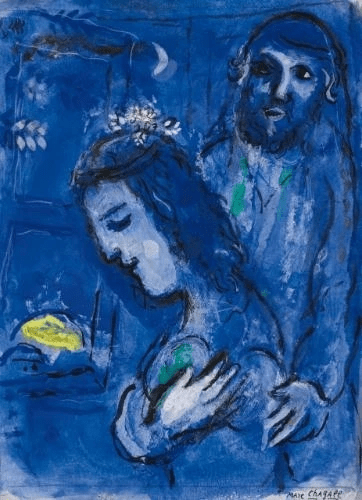
Abraham and Sarah, by Marc Chagall, 1956

One hot summer afternoon while Abraham was sitting by the entrance to his tent near the sacred trees of Mamre, the Lord appeared to him. Abraham looked up and saw three men standing nearby. He quickly ran to meet them, bowed with his face to the ground, and said, “Please come to my home where I can serve you. I’ll have some water brought, so you can wash your feet, then you can rest under a tree. Let me get you some food to give you strength before you leave. I would be honored to serve you.”

“Thank you very much,” they answered. “We accept your offer.”

Abraham went quickly to his tent and said to Sarah, “Hurry! Get a large sack of flour and make some bread.” After saying this, he rushed off to his herd of cattle and picked out one of the best calves, which his servant quickly prepared. He then served his guests some yogurt and milk together with the meat.

While they were eating, he stood near them under the tree, and they asked, “Where’s your wife Sarah?”

“She is right there in the tent,” Abraham answered.

One of the guests was the Lord, and he said, “I’ll come back about this time next year, and when I do, Sarah will already have a son.”

Sarah was behind Abraham, listening at the entrance to the tent. Abraham and Sarah were very old, and Sarah was well past the age for having children. So she laughed and said to herself, “Now that I am worn out and my husband is old, will I really know such happiness?”

The Lord asked Abraham, “Why did Sarah laugh? Does she doubt that she can have a child in her old age? I am the Lord! There is nothing too difficult for me. I’ll come back next year at the time I promised, and Sarah will already have a son.” (Contemporary English Version)

You never know what a day will bring.

Abraham and Sarah woke up one morning and went about their daily routines. But when they went to bed that night, their lives were turned upside-down. After all, God has a way of shaking up our lives, in a good way.

There’s nothing quite like an unsolicited promise. It seems the old couple, Abraham and Sarah, had come to grips with their childlessness. But the Lord was about to upset the status quo, in a good way.

“To one who has faith, no explanation is necessary. To one without faith, no explanation is possible.”

St. Thomas Aquinas

A divine promise was made. The only thing Abraham and Sarah needed to do was believe – and, well, do what a couple needs to do to conceive a child. I don’t know many couples who are sexually active at 100 years old. It certainly would take an act of faith to believe that you could become impregnated and give birth to a baby at that age.

True belief results in decisive action. Abraham and Sarah believed and God’s promise was activated in their lives, not only changing the couples’ life, but also transforming history. The experience taught them to keep their heads up and continue looking ahead for the fulfillment of all God’s good promises.

By faith Abraham obeyed when he was called to go out to a place that he was going to receive as an inheritance. He went out without knowing where he was going.

By faith he lived in the land he had been promised as a stranger. He lived in tents along with Isaac and Jacob, who were coheirs of the same promise. He was looking forward to a city that has foundations, whose architect and builder is God.

By faith even Sarah received the ability to have a child, though she herself was barren and past the age for having children, because she believed that the one who promised was faithful. So descendants were born from one man (and he was as good as dead). They were as many as the number of the stars in the sky and as countless as the grains of sand on the seashore. (Hebrews 11:8-12, CEB)

Sometimes faith seems laughable. Belief in God, or at least in God’s promise, might appear by some to be about as possible or relevant as getting a hamburger named after you at Burger King. But faith, nonetheless, is very real and very needed.

Without faith, there’s no hope, and no basis for love. Belief is the foundation from which we construct a life. Faith imagines and actualizes a new reality, even when that reality seems improbable, impossible, and far-fetched.

In the New Testament Gospels, there were people who believed Jesus could heal their paralyzed friend. They envisioned a different reality than the one their friend was experiencing.

Some people brought to him a paralyzed man on a mat. Seeing their faith, Jesus said to the paralyzed man, “Be encouraged, my child! Your sins are forgiven”…. Then Jesus turned to the paralyzed man and said, “Stand up, pick up your mat, and go home!” And the man jumped up and went home! (Matthew 9:2, 6b-7, NRSV)

The size of the faith is not the issue – it is in whom that faith is placed. The littlest of faith in Jesus can have massive results, whereas the biggest of faith in someone who cannot get you to the other side gets no results.  Small information put into action through placing complete trust in Jesus makes all the difference.

“I [Jesus] assure you that if you have faith the size of a mustard seed, you could say to this mountain, ‘Go from here to there,’ and it will go. There will be nothing that you can’t do.” (Matthew 17:20, CEV)

God is ready to open a new future to us. And, indeed, it will be a good, just, and right future beyond what we ourselves can even ask or imagine. We just need a bit of faith to see the impossible become possible.

You never know what a day will bring. Maybe today you’ll experience a faith so laughable that it will change your life forever.

O heavenly Father, in whom we live and move and have our being: We humbly pray you to guide and govern us by the Holy Spirit, so that in all the cares and occupations of our life we may not forget you, but may remember that we are ever walking in your sight, and so, trust in your grace and goodness, through Jesus Christ our Lord. Amen.

A Mountain of Good News (Isaiah 25:6-9)

On this mountain the Lord of hosts will make for all peoples
    a feast of rich food, a feast of well-aged wines,
    of rich food filled with marrow, of well-aged wines strained clear.
And he will destroy on this mountain
    the shroud that is cast over all peoples,
    the covering that is spread over all nations;
    he will swallow up death forever.
Then the Lord God will wipe away the tears from all faces,
    and the disgrace of his people he will take away from all the earth,
    for the Lord has spoken.
It will be said on that day,
    “See, this is our God; we have waited for him, so that he might save us.
    This is the Lord for whom we have waited;
    let us be glad and rejoice in his salvation.” (New Revised Standard Version)

Mountains are a prominent and symbolic part of Holy Scripture.

Abraham sojourned to a mountain where he exhibited the pinnacle of faith in radical obedience to God’s command to sacrifice his son Isaac. (Genesis 22:1-19)

The Law was given to Moses on a mountain. (Exodus 19:1-20:17)

Elijah traveled 40 days and nights to meet God on a mountain. (1 Kings 19:11-18)

Jesus preached the most famous sermon ever on a mountain. (Matthew 5-7)

Because of such references, we routinely refer to extraordinary events as “mountaintop experiences.”

Your steadfast love, O Lord, extends to the heavens,
    your faithfulness to the clouds.
Your righteousness is like the mighty mountains;
    your judgments are like the great deep;
    you save humans and animals alike, O Lord. (Psalm 36:5-6, NRSV)

The mountain is a contrast and antithesis to the valley of death below. It signifies God’s power and reign over all earthly rulers. On the mountain we enjoy a great feast of the soul, not to mention an actual meal full of celebration. After all, food and celebration always go together in God’s kingdom.

Whenever healing and/or emancipation happen, it’s time for a celebration. To celebrate significant events, and ritualize them so we remember them, is wise and much needed.

For the Christian, Jesus is the fulfillment of all God’s good promises. In Christ, we have deliverance from guilt, shame, death, and hell. Because Jesus Christ is risen from death and has conquered the grave, our salvation is assured and made possible. And so, along with the prophet Isaiah, we proclaim the good news of peace through the crucifixion and resurrection of Christ.

How beautiful upon the mountains
    are the feet of the messenger who announces peace,
who brings good news,
    who announces salvation,
    who says to Zion, “Your God reigns.” (Isaiah 52:7, NRSV)

Celebration of the good news keeps any sort of spiritual amnesia at bay; and when future difficulties arise, because of our joy in salvation, we are able to recall the mighty acts of God and embrace hope for the future.

If we consistently practice celebration, the redemption experienced in the past is constantly fresh, like a sumptuous meal before us in an endless buffet of goodness. We can eat anytime we want.

Banquets are rightly associated with hospitality, generosity, and fellowship. Meals in the ancient Near East culture were much more than utilitarian; eating together was (and, frankly, still is in most parts of the world) a deeply spiritual event which communicates acceptance, encouragement, and love to one another.

God is the ultimate host. He throws the best parties. God ensures that there is plenty of food, fellowship, and fun. God’s joy knows no bounds. In the middle of a world beset with sadness, loss, and grief, God’s boundless generosity swallows up people’s disgrace and mourning.

At God’s Table, no one cries alone; everyone is comforted; nobody walks away hungry; and, every person is waited upon, no matter who they are or where they have come from. Indeed, there is always room at the Table.

Through Christ’s resurrection, death has been swallowed up in victory. (1 Corinthians 15:54)

Death no longer has any power to control, humiliate, or shame us into submission. Death’s threats are empty.

The Grim Reaper’s teeth have been pulled and his scythe has been broken. He is the party-pooper who is barred from entry.

There is life and abundance for all who ascend the mountain and feast with God at his Table. The invitation has gone out. The Table is spread. We need only to come.

In the joy of your Son, Jesus Christ, through his mighty resurrection and in expectation of his coming again, we offer ourselves to you, Almighty God, as holy and living sacrifices. Together with all your people everywhere and in every age, we proclaim the mystery of the faith:

Christ has died!

Christ is risen!

Christ will come again!

Send your Holy Spirit upon us, we pray, that the bread which we break and the cup which we bless may be to us a sacred communion, a holy celebration of Christ’s body, blood, and victory over death. We declare:

God has spoken!

God has acted!

God has provided!

May you gather all into your hospitable and abundant kingdom; through Jesus Christ, your Son, our Lord, who lives and reigns with you and the Holy Spirit, One benevolent God, now and forever. Amen.