Leave and Go (Genesis 8:13-19)

In the six-hundred-first year of Noah’s life, on the first day of the first month, the flood had dried up. Noah opened the hatch of the ship and saw dry ground. By the twenty-seventh day of the second month, the Earth was completely dry.

God spoke to Noah: “Leave the ship, you and your wife and your sons and your sons’ wives. And take all the animals with you, the whole menagerie of birds and mammals and crawling creatures, all that swarming extravagance of life, so they can reproduce and flourish on the Earth.”

Noah disembarked with his sons and wife and his sons’ wives. Then all the animals, crawling creatures, birds—every creature on the face of the Earth—left the ship family by family. (The Message)

The ancient story of Noah recounts a devastating universal flood—a story that began with problems akin to those in our present contemporary world. (Genesis 6:5-7:24)

Violence, in the days of Noah, had become so common and widespread, that the very heart of God was pained.

The Lord saw how evil humans had become on the earth. All day long their deepest thoughts were nothing but evil. The Lord was sorry that he had made humans on the earth, and he was heartbroken. (Genesis 6:5-6, GW)

So, God decided to bring judgment, and laid plans to rid the earth of humanity. To start over, God instructed Noah to build an ark to preserve his family and a few of every animal species.

And then, it rained, day and night, for weeks on end. The flood destroyed everything. Yet, God remembered Noah and all the animals, and the waters eventually receded. Noah sent out a raven, and then a dove, to see if they could find land.

Finally, the day came when they could step out of the ark, and the Lord told Noah to step off the big ark of a ship, set the animals free, and start repopulating the Earth.

There are, indeed, a lot of ethical questions that bubble up for us as readers about the entire flood narrative. Why kill everyone, including children too young to know better, and animals who apparently weren’t the problem to begin with? And, if things are so bad, why spare anyone or anything? After all, people started the violence, and they don’t seem very changed after the flood. What’s up with that?

Yet, honestly, just asking those questions puts us on some supposed high ground of morality – something we cannot claim – as if we know better than God.

Perhaps we humans still do not yet have a collective sense of our depravity, that is, of our awful potential for acts of violence (both physical and psychological) as well as our penchant for saying and doing nothing in the face of such evil. We keep offloading the issue onto God, as if the Lord is the problem.

Keep in mind, that by God’s grace, the Lord promised to never again destroy the Earth, as in the days of Noah, and still preserved a remnant of humanity. Yet sadly, that hasn’t stopped us humans from keeping up our violent and destructive ways. Throughout the whole of human history, we seem to have to keep learning the same lesson over and over again: that our actions (and in-actions) have far-reaching consequences for both us and all the rest of creation.

The violence humans do to one another and the violence we do to the natural world come from the same place in the human heart. A good and wise God created us good. And although we are capable of great evil, as the flood story says, and as we know every day, God means for us to be transformed.

God promised not to destroy the world. Now it’s our turn to promise the same.

How can we keep such a promise? I believe we can do it by being obedient to leave the ship and step off the ark. In other words, it’s important that we leave where we presently are, and go where God calls us.

Realizing a better world, a changed life, and a blessed Earth involves our movement to leave something behind, and go to a place we’ve not been before.

The Lord said to Abraham:

Leave your country, your family, and your relatives and go to the land that I will show you.” (Genesis 12:1, CEV)

God said to Moses:

“I have heard the cry of the people of Israel. I have seen how the Egyptians are oppressing them. Now, go! I am sending you to Pharaoh so that you can bring my people Israel out of Egypt.” (Exodus 3:9-10, GW)

And, as a result of Moses obeying God, Pharaoh (eventually) said to the Israelites:

“Get out, you and your Israelites! Leave my country; go and worship the Lord, as you asked.” (Exodus 12:31, GNT)

Later, God clarified the instructions for heading to the Promised Land:

“Leave this place, you and the people you brought out of Egypt, and go to the land that I promised to give to Abraham, Isaac, and Jacob and to their descendants.” (Exodus 33:1, GNT)

Jesus instructed:

“So, what if you are offering your gift at the altar and remember that someone has something against you? Leave your gift there and go make peace with that person. Then come and offer your gift.” (Matthew 5:23-24, ERV)

Jesus said to his disciples:

“All authority in heaven and on earth has been given to me. Therefore go and make disciples of all nations, baptizing them in the name of the Father and of the Son and of the Holy Spirit, and teaching them to obey everything I have commanded you. And surely I am with you always, to the very end of the age.” (Matthew 28:18-20, NIV)

Why does God repeatedly tell us to leave and go? Because we tend to hunker down in our entrenched ways of bigotry and idolatry, which are the fodder for human violence, and refuse to see other people created in the image and likeness of God.

Leaving and going opens us to the possibility of connection, and thus, love. And love is the heat source which melts the polar ice cap of hate and violence.

Almighty Father, who gave your only Son to die for our sins and to rise for our justification: Give me grace to leave malice and wickedness behind, so that I may go and serve you in truth and holiness, through Jesus Christ, your Son, my Lord, who lives and reigns with you and the Holy Spirit, one God, now and forever. Amen.

Listen To Lady Wisdom (Proverbs 3:13-18)

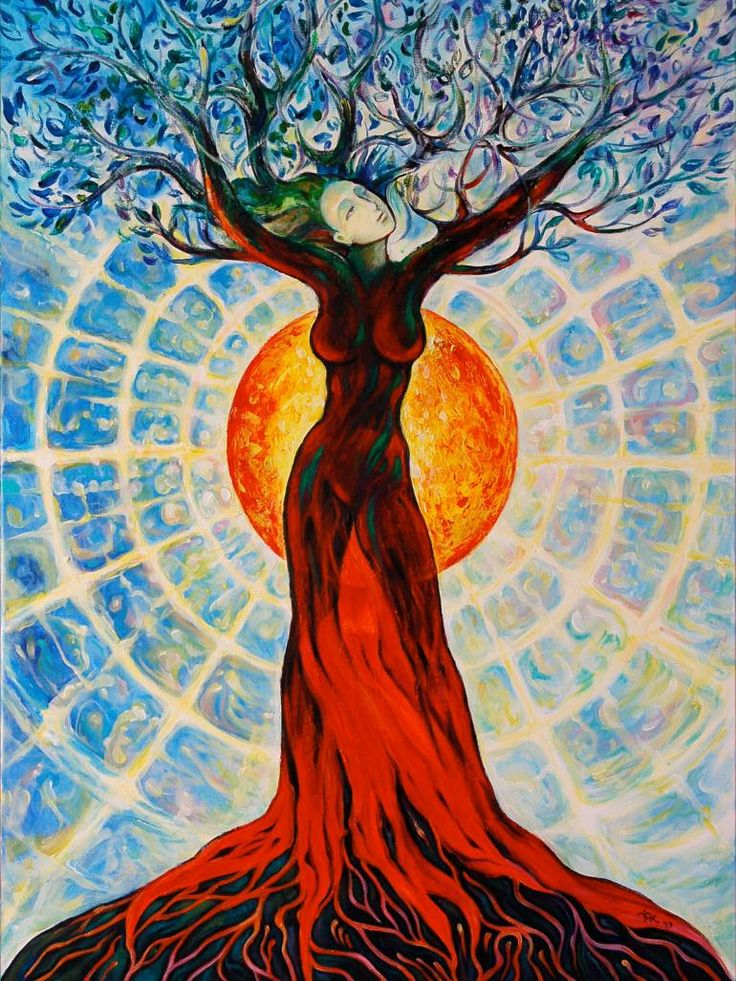
Tree of Life, by Margarita Kriebitzsch, 2013

You’re blessed when you meet Lady Wisdom,
    when you make friends with Madame Insight.
She’s worth far more than money in the bank;
    her friendship is better than a big salary.
Her value exceeds all the trappings of wealth;
    nothing you could wish for holds a candle to her.
With one hand she gives long life,
    with the other she confers recognition.
Her manner is beautiful,
    her life wonderfully complete.
She’s the very Tree of Life to those who embrace her.
    Hold her tight—and be blessed! (The Message)

I like it that the author chose to personify wisdom as a woman. Maybe that’s because I have a wife and three daughters. Perhaps it has something to do with the fact that they, along with most of the women in my life, seem to have an almost mysterious quality of insight and understanding which transcends my very cerebral and logical approaches to life.

What I’m trying to say is that wisdom isn’t measured with a one-dimensional test of a person’s mental reasoning powers, but also requires emotional intelligence, social intelligence, interpersonal and relational intelligence, and spiritual intelligence, just to name a few.

And Lady Wisdom has it all. She’s the perfect combination of all the intelligent factors which make for a complete, fulfilling, and good life.

Everyone desires a good life. Nobody wakes up in the morning, sits on the edge of the bed, and thinks to themselves, “I really hope to have a bad day today!” A person might get up on the wrong side of the bed and grump their way through the first hours of the day, but no one makes a conscious decision to deliberately have a disappointing life. 

Indeed, we all want a good life. Students go to school hoping to have a good experience. Marriages begin with the hope of having a good life together. New employees start with the wish that there will be satisfaction in doing a job well done. Parents dream of their kids growing up to have a good life. 

We want the kind of life that brings contentment, joy, and happiness. So, how does it come?

A good life comes through embracing Lady Wisdom. And she has always been there, as the very Tree of Life:

“I was there when God set the heavens in place,
    when he marked out the horizon on the face of the deep,
when he established the clouds above
    and fixed securely the fountains of the deep,
when he gave the sea its boundary
    so the waters would not overstep his command,
and when he marked out the foundations of the earth.
    Then I was constantly at his side.” (Proverbs 8:27-30, NIV)

A good life has a basic respect and honor for God at the heart of it. Lady Wisdom understands this, first hand. She knows we are prone to being afraid. So, she assures us that the pursuit of true wisdom is worth it. With Lady Wisdom at our side, we have calm and confidence; we know when to take risks and when to be patient.

Most of all, our insecurities and anxieties begin to melt away as we connect with the image of God within us. Trust bubbles up from the depths of our soul, and we are no longer afraid of the unknown and what may happen to us.

The fear of the Lord is the beginning of wisdom, and knowledge of the Holy One is understanding.

Proverbs 9:10, NIV

The fear of the Lord means to honor and obey God, to be loyal and submissive. We know there is a good God from which our own good lives derive.

In a state of trust, of calm and confidence, we are able to listen and hear Lady Wisdom’s sage instruction. So, if you want to live a good life – and not just survive but thrive – then we must adopt a posture of listening.

The prerequisite to any semblance of a good life is to have a teachable spirit, to give focused attention to Wisdom. A fool is a fool, first and foremost, because he does not listen. Instead, he is negative, complains, and spews advice based in partial information.

But the person who hugs Lady Wisdom and does not let go, has learned to be attentive to the voice of God.

Continual fear of people is a death-dealing practice. But the person who fears God by listening to wise counsel discovers a life-giving practice that will serve them well for a lifetime. 

The teachable spirit bends the ear to hear good advice. Such a wise spirit inclines toward acquiring knowledge and learning the skillset needed to live a spiritually abundant life.

For the Christian, therefore, we cannot learn if do not read. The Bible is a book. If the Bible was a car, I would tell us all to learn to be mechanics; if it were a fish or a deer, I would tell us all to learn the best ways to hunt and fish; or if it was a store, I would encourage us to learn about being good shoppers and consumers. 

Yet, the Bible is a book. So, we must read it, memorize it, meditate on it, and learn from it. Becoming familiar with the contents of Holy Scripture, and immersing ourselves in it’s wisdom, will mold us in the ways of humility and form us spiritually for a lifetime of peace, love, and joy. 

Maybe you aren’t a tree hugger. But I encourage you to become one. Embracing Lady Wisdom is the surest way to avoiding unnecessary problems and finding purpose in life. Indeed, because she is good, we become good.

Today, God of Wisdom, let me experience your good and gracious heart. Draw me into your very being, into the core of your love for me, others, and the world. Give me a glimpse of others from your good, right, and just perspective, in loving them, forgiving them, and delighting in the way they give glory to God through their very existence. Help me to discern out of that place of deep affection for humanity, that I, too, might be a useful conduit of your love in the world. Amen.

Make Wise Choices (Proverbs 3:5-12)

Trust in the Lord with all your heart. Never rely on what you think you know. Remember the Lord in everything you do, and he will show you the right way. 

Never let yourself think that you are wiser than you are; simply obey the Lord and refuse to do wrong. If you do, it will be like good medicine, healing your wounds and easing your pains. 

Honor the Lord by making him an offering from the best of all that your land produces. If you do, your barns will be filled with grain, and you will have too much wine to store it all.

My child, when the Lord corrects you, pay close attention and take it as a warning. The Lord corrects those he loves, as parents correct a child of whom they are proud. (Good News Translation)

“The choice to make good choices is the best choice you can choose. Fail to make that choice and on most choices you will lose.”

Ryan Lilly

The biblical book of Proverbs is a collection of short pithy statements based in experiential truth. That is, they are wisdom sayings.

Wisdom is a gradual accumulation of understanding, over time, with a combination of observation and practice.

The Teacher (the Collector of the proverbs) highlights the wisdom needed to navigate life. It’s a bit like learning the basic laws of the universe, such as respecting the force of gravity by not walking off the roof of your house.

Wisdom observes and pays attention; then applies the understanding gained to reality.

Failing to cultivate a wise life (foolishness) creates all kinds of problems.

Notice the realities we need to respect in our Old Testament lesson for today: God, God’s guidance, God’s honor, God’s discipline.

And then notice the verbs which tell us how to respond wisely: trust, remember, obey, honor, pay close attention. Submitting to reality, respecting others, and accepting situations as they are, and not as we want them to be, is evidence of a sage life.

In contrast to the sage response, foolish reactions are made up of pride, avarice, and hate.

Both wisdom and foolishness are evidenced by their outcomes.

The wise person, having been taught a respect for God and the ways of grace, will most likely have the experience of receiving guidance, health, abundance, and love. Conversely, the fool who ignores divine counsel will probably experience misplaced trust, health issues, short-sighted financial decisions, and cruddy attitudes.

“You can’t choose your potential, but you can choose to fulfill it.”

Theodore Roosevelt

All things being equal, the wise person who deliberately and carefully applies knowledge and understanding to life will have an abundant spirit full of satisfaction – whereas the fool who improvises everything will struggle to live in a small world of holistic poverty and want.

The gist of today’s verses is that one cannot live as an island. We all need to practice consultation and collaboration to achieve a good life. Instruction and correction are necessary to obtain the good life. To spurn both divine and human connections in favor of radical personal independence is plain old foolish; it leads to a lousy life.

In short, the fool incessantly airs opinions with useless sophistry to an empty room; and, the sage is an observant student to universal rhythms and has learned the timing of proper words and of silence.

I am going to state this all in a different way: Relying on God and others through making and keeping promises to one another is the basis of a solid community and a gratifying personal life. Relying merely on one’s self is a one-way road to spiritual pain and emotional damage, not to mention physical illness and financial scarcity.

Fools always think they know best. Sages always know better than that.

The collection of Proverbs we have in the biblical canon is a presentation, a dialectic, a contrast and a setting forth of two ways of approaching how to live in the world:

  • foolishness or wisdom
  • independence or interdependence
  • cognitive pride or mental humility
  • negligence of evidence-based research or consultation through books, literature, and reading
  • exploitation of resources or submission to the natural laws and rhythms of the land
  • holding-on with clenched fists or generosity with open hands
  • Grinch-like attitudes or God-like dispositions
  • incessant criticism or heartfelt tribute
  • blaming or recognizing other’s contributions
  • shame or vulnerability
  • bitterness or forgiveness
  • resistance to correction or acceptance of discipline
  • hate or love
  • judgment or grace

There is always a fork in the road. And standing at those intersections of life, we must choose whether to take the difficult path of wisdom, or amble down the broad highway of foolishness.

The two paths will lead to either life or death, joy or despair, hope or disappointment, faith or fear.

How will you choose? Which way will you go?

Choose wisely, my friend.

Almighty God, the fountain of all wisdom, you know our necessities before we ask and our ignorance in asking: Have compassion on our weakness, and mercifully give us those things which for our unworthiness we dare not, and for our blindness we cannot ask; through the worthiness of your Son Jesus Christ our Lord, who lives and reigns with you and the Holy Spirit, one God, now and forever. Amen.

Acceptance (Acts 7:17-40)

“As the time drew near for God to fulfill his promise to Abraham, the number of our people in Egypt had greatly increased. Then ‘a new king, to whom Joseph meant nothing, came to power in Egypt.’He dealt treacherously with our people and oppressed our ancestors by forcing them to throw out their newborn babies so that they would die.

“At that time Moses was born, and he was no ordinary child. For three months he was cared for by his family. When he was placed outside, Pharaoh’s daughter took him and brought him up as her own son. Moses was educated in all the wisdom of the Egyptians and was powerful in speech and action.

“When Moses was forty years old, he decided to visit his own people, the Israelites. He saw one of them being mistreated by an Egyptian, so he went to his defense and avenged him by killing the Egyptian. Moses thought that his own people would realize that God was using him to rescue them, but they did not. The next day Moses came upon two Israelites who were fighting. He tried to reconcile them by saying, ‘Men, you are brothers; why do you want to hurt each other?’

“But the man who was mistreating the other pushed Moses aside and said, ‘Who made you ruler and judge over us? Are you thinking of killing me as you killed the Egyptian yesterday?’ When Moses heard this, he fled to Midian, where he settled as a foreigner and had two sons.

Moses and the Burning Bush, by Marc Chagall

“After forty years had passed, an angel appeared to Moses in the flames of a burning bush in the desert near Mount Sinai. When he saw this, he was amazed at the sight. As he went over to get a closer look, he heard the Lord say: ‘I am the God of your fathers, the God of Abraham, Isaac and Jacob.’ Moses trembled with fear and did not dare to look.

“Then the Lord said to him, ‘Take off your sandals, for the place where you are standing is holy ground. I have indeed seen the oppression of my people in Egypt. I have heard their groaning and have come down to set them free. Now come, I will send you back to Egypt.’

“This is the same Moses they had rejected with the words, ‘Who made you ruler and judge?’ He was sent to be their ruler and deliverer by God himself, through the angel who appeared to him in the bush. He led them out of Egypt and performed wonders and signs in Egypt, at the Red Sea and for forty years in the wilderness.

“This is the Moses who told the Israelites, ‘God will raise up for you a prophet like me from your own people.’ He was in the assembly in the wilderness, with the angel who spoke to him on Mount Sinai, and with our ancestors; and he received living words to pass on to us.

“But our ancestors refused to obey him. Instead, they rejected him and in their hearts turned back to Egypt. They told Aaron, ‘Make us gods who will go before us. As for this fellow Moses who led us out of Egypt—we don’t know what has happened to him!’ (New International Version)

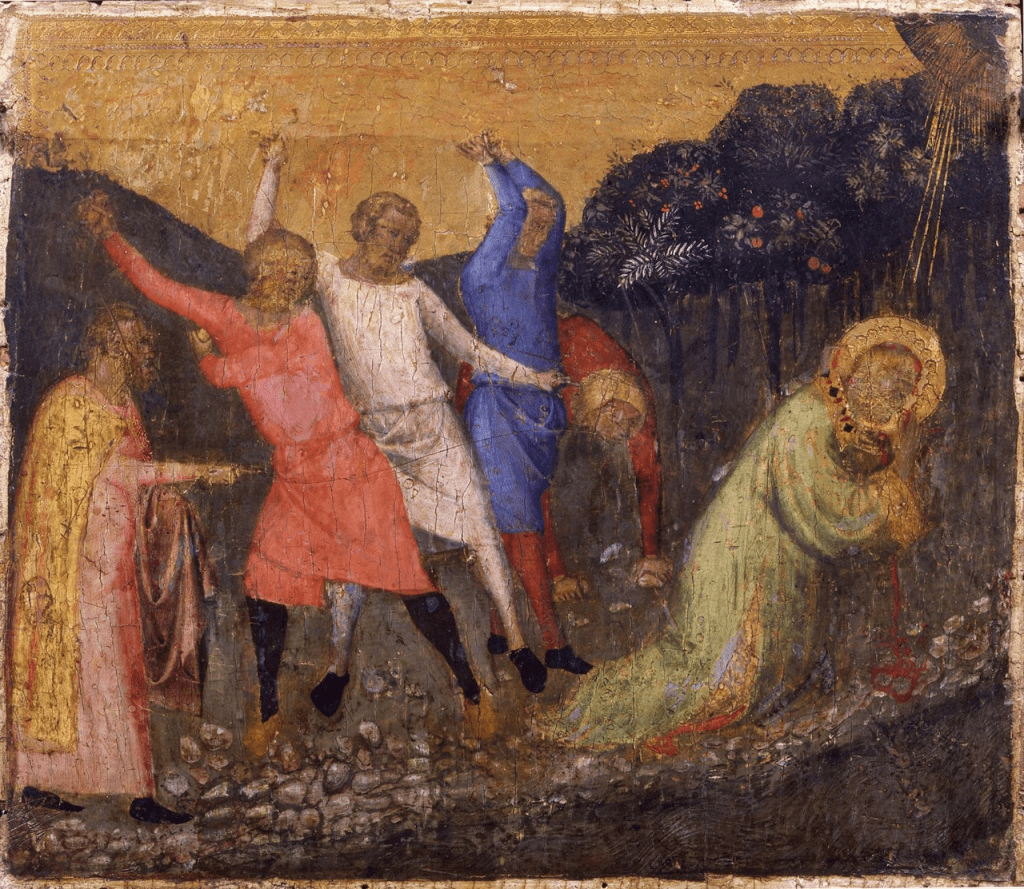
Martyrdom of St. Stephen, by Bernardo Daddi, 1345

We humans are a confusing paradox of sinner and saint. We are majestic people, created in the image and likeness of a good God.

And we are also profoundly fallen, touched by the power of sin in every area of our lives. Our hearts exist with both light and darkness, having the capacity for both incredible altruism as well as inexplicable evil.

So then, it will do no good to retreat into binary definitions of people as being either good or bad. No, we shine and shadow at the same time. The thing that really gets us into a terrible mess is when we ignore or deny our shadow selves. We then demonize the other while claiming purity for ourselves.

This is precisely what occurred with Stephen and a group of his fellow Jews who refused to acknowledge their shadow side. And it resulted in Stephen’s stoning and death. Whereas Stephen lifted and brought to light the unseemly aspects of their collective heritage, the people wanted nothing to do with it.

In our present day, the response might be something like, “Quit being so negative. We focus on the positive. Expel this recalcitrant troublemaker once and for all!”

Oy. Acceptance cuts two ways. We must accept both our blessings and our curses. And the acceptance of what is will not occur apart from a solid self-acceptance of who we are and how we are feeling in any given situation. On the practical level, it works something like the following story…

Several years ago, I went on a leadership retreat in the Canadian wilderness. We were so far out in the sticks that we needed special first aid training before leaving – because if someone got severely injured it would be hours before any medical attention could be received. There was no cell phone service, no towns, no anything except mile after square mile of wilderness. 

One day, it was very windy and several of us were on a lake canoeing to a destination. It was late May, which means the water was still ice cold in Canada. One of the canoes capsized and we had to act quickly and deliberately – which was no small feat in a stiff wind. More than fifteen minutes would result in hypothermia for the two people in the water.

I did not like being in that situation. In fact, I didn’t much like the Canadian wilderness. Too many black flies and giant mosquitoes for me. My shadow side was coming out. But here I was, and I had to accept the reality I was in. One of the lessons I learned in that moment was that acceptance can sit alongside other reactions and emotions.

For example, a person can be outraged by an injustice, as Stephen was, and accept that it is a reality. Acceptance does not mean complacency or giving up. We can accept something while at the same time trying to make it better.

I also needed to accept what was happening inside of me. I was cold and worried. Trying to push those feelings away would have only added to the stress of the situation. If I failed to accept what was true about myself, I would be less able to deal with the situation, and so, would compromise my ability to help two people at risk.

I needed to accept the whole circumstance, including myself. Accepting what is inside gave me more influence over the situation, not less. Self-acceptance became the key to acceptance of unwanted conditions, and more importantly, acceptance of one another as human beings.

In that moment of rescuing two people (which ultimately proved successful) I became aware of a part of myself – the part that gets afraid and irritated – and chose not to stuff it or deny its existence. I became the guy who talked to the panicked people in the water and kept them as calm as possible so that the others could get them out. I was able to do my part to help fearful people because I acknowledged and accepted my own fear.

Unlike my situation, however, Stephen’s experience ended in martyrdom. Just because we respond rightly is no guarantee that everything will work out for our benefit. Rather, we say and do the things we must say and do, while leaving the results to a sovereign Lord.

It is our responsibility to work on ourselves, not others. And acceptance is the path to get there, all of it, not just part of it.

Jesus, let your mighty calmness lift me above my fears and frustrations. By your deep patience, give me tranquility and stillness of soul in you. Make me in this, and in all things, more and more like you. Amen.