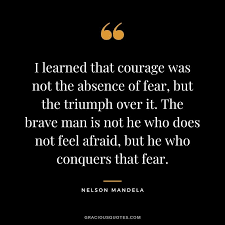
Be Brave, Not Afraid (Deuteronomy 31:1-13)

Then Moses went out and spoke these words to all Israel: “I am now a hundred and twenty years old and I am no longer able to lead you. The Lord has said to me, ‘You shall not cross the Jordan.’ The Lord your God himself will cross over ahead of you. He will destroy these nations before you, and you will take possession of their land. Joshua also will cross over ahead of you, as the Lord said. And the Lord will do to them what he did to Sihon and Og, the kings of the Amorites, whom he destroyed along with their land. The Lord will deliver them to you, and you must do to them all that I have commanded you. Be strong and courageous. Do not be afraid or terrified because of them, for the Lord your God goes with you; he will never leave you nor forsake you.”

Then Moses summoned Joshua and said to him in the presence of all Israel, “Be strong and courageous, for you must go with this people into the land that the Lord swore to their ancestors to give them, and you must divide it among them as their inheritance. The Lord himself goes before you and will be with you; he will never leave you nor forsake you. Do not be afraid; do not be discouraged.”

So Moses wrote down this law and gave it to the Levitical priests, who carried the ark of the covenant of the Lord, and to all the elders of Israel. Then Moses commanded them: “At the end of every seven years, in the year for canceling debts, during the Festival of Tabernacles, when all Israel comes to appear before the Lord your God at the place he will choose, you shall read this law before them in their hearing. Assemble the people—men, women and children, and the foreigners residing in your towns—so they can listen and learn to fear the Lord your God and follow carefully all the words of this law. Their children, who do not know this law, must hear it and learn to fear the Lord your God as long as you live in the land you are crossing the Jordan to possess.” (New International Version)

The Old Testament book of Deuteronomy is all about remembering and being reminded of what we already know. There’s really nothing new under the sun. So, our task as people is mostly to recall and bring to our minds and heart those things which we need to remember.

We humans have this tendency to remember the things we need to forget, and to forget the things we must remember. And what is to be continually remembered and recalled is that there is no basis to be afraid when God is with us and will fulfill divine promises.

For Christians, the resurrection of Christ from death has changed everything – especially when it comes to fear. In this Christian season of Eastertide, we discover and explore the vast implications of what it means to possess a new life. 

Because Christians serve a risen Savior, this newfound reality brings courage and confidence. Fear isn’t something we simply dismiss with willpower. Rather, fear begins to loosen and diminish whenever there is an awareness of God’s presence among us. Consider just a few of the many references to this in Holy Scripture, in addition to the statements in today’s Old Testament lesson:

Remember, I commanded you to be strong and brave. Don’t be afraid because the Lord your God will be with you wherever you go.” (Joshua 1:9, ERV)

 Don’t fear, because I am with you;
    don’t be afraid, for I am your God.
    I will strengthen you,
    I will surely help you;
    I will hold you
    with my righteous strong hand. (Isaiah 41:10, CEB)

Be happy with what you have because God has said, “I will never abandon you or leave you.” So we can confidently say,

“The Lord is my helper.
I will not be afraid.
What can mortals do to me?” (Hebrews 13:5-6, GW)

Believe it, or not, the Bible tells us 365 times to not be afraid. Maybe that’s not a coincidence that we can quote a verse every day of the year about our own fearfulness in the face of all life’s challenges.

When it comes to fear and bravery, God does not so much command us to be courageous, as he wants us to draw from the great reservoir of bravery within. That is, God has already created us strong, as creatures in the divine image. We just need to get in touch with what is already there. And, for the Christian, the reality of Easter awakens and calls forth that life.

We can act with boldness and overcome fear because Jesus is the pioneer of our salvation. Christ is the One who enables us to draw from the deep well of courage:

So then, since we have a great High Priest who has entered heaven, Jesus the Son of God, let us hold firmly to what we believe. This High Priest of ours understands our weaknesses, for he faced all the same testing we do, yet he did not sin. So, let us come boldly to the throne of our gracious God. There we will receive his mercy, and we will find grace to help us when we need it most. (Hebrews 4:14-16, NLT)

You and I can do this; we can do hard things. We really can face the fears in front of us. You can surmount the adversity you are in the middle of – not because of some words I say, but because Christ has risen from death. He’s alive, and his presence makes all the difference.

Ever-present God: Give me strength to live another day;
Let me not turn coward before its difficulties or prove recreant to its duties;
Let me not lose faith in other people;
Keep me sweet and sound of heart, in spite of ingratitude, treachery or meanness;
Help me to keep my heart clean and to live so honestly and fearlessly that no outward failure can dishearten me or take away the joy of conscious integrity;
Open wide the eyes of my soul that I may see good in all things;
Grant me this day some new vision of your truth;
Inspire me with the spirit of joy and gladness and make me the cup of strength to suffering souls; in the name of the strong Deliverer, our only Lord and Savior, Jesus Christ. Amen.

Living Into a New Story (Deuteronomy 5:22-33)

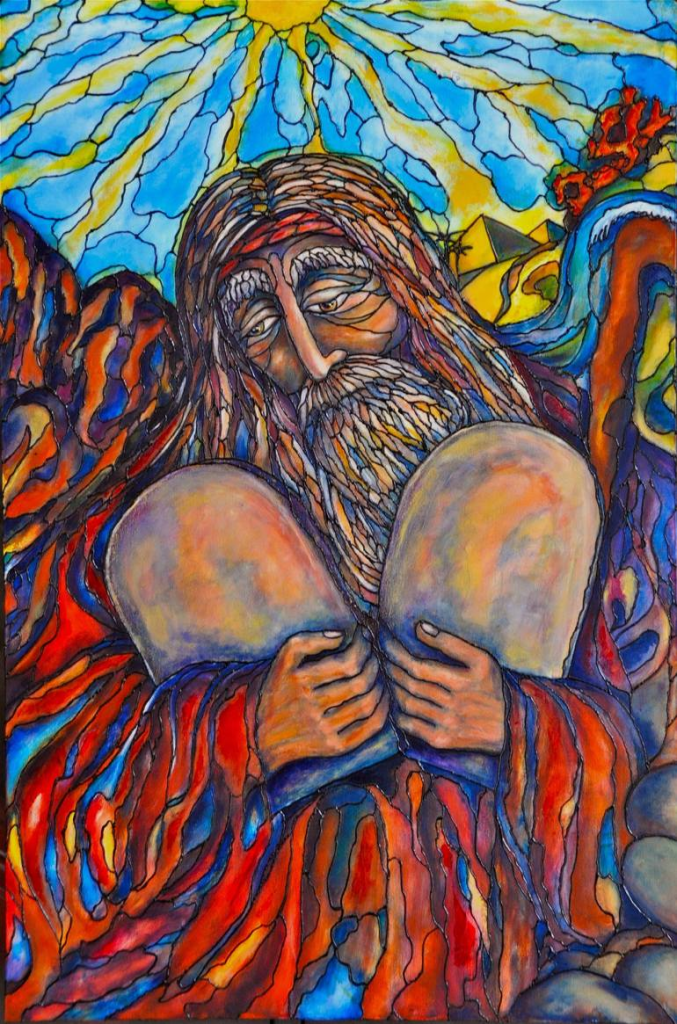
Moses, by Rae Chichilnitsky

“These are the commandments the Lord gave to all of you when you were gathered at the mountain. When he spoke with a mighty voice from the fire and from the thick clouds, he gave these commandments and no others. Then he wrote them on two stone tablets and gave them to me.

“When the whole mountain was on fire and you heard the voice from the darkness, your leaders and the chiefs of your tribes came to me and said, ‘The Lord our God showed us his greatness and his glory when we heard him speak from the fire! Today we have seen that it is possible for people to continue to live, even though God has spoken to them. But why should we risk death again? That terrible fire will destroy us. We are sure to die if we hear the Lord our God speak again. Has any human being ever lived after hearing the living God speak from a fire? Go back, Moses, and listen to everything that the Lord our God says. Then return and tell us what he said to you. We will listen and obey.’

“When the Lord heard this, he said to me, ‘I have heard what these people said, and they are right. If only they would always feel this way! If only they would always honor me and obey all my commands, so that everything would go well with them and their descendants forever. Go and tell them to return to their tents. But you, Moses, stay here with me, and I will give you all my laws and commands. Teach them to the people, so that they will obey them in the land that I am giving them.’

“People of Israel, be sure that you do everything that the Lord your God has commanded you. Do not disobey any of his laws. Obey them all, so that everything will go well with you and so that you will continue to live in the land that you are going to occupy. (Good News Translation)

The people were at the cusp of entering the Promised Land. They had experienced four hundred years of slavery; deliverance from Egyptian bondage; and forty years of wandering around the desert with no permanent home. Now, Moses gathers everyone together and restates God’s Law for a new generation about to realize God’s promise.

In today’s Old Testament lesson, Moses recalls his experience of receiving the two stone tablets, known to many as the Ten Commandments. Moses does this because he does not want this new generation of Israelites to be like their parents and grandparents – who experienced a failure of faith, resulting in their sojourn in the wilderness.

Obedience to God and all of God’s commands is central to a life of faith.

For that obedience to happen, all obstacles must be removed so that we can have an unhindered path in living the way we want to live. The Israelites were in slavery four hundred years. They needed a new story, which meant changing the old one. The people could participate with God by doing the following:

  1. Accept their wounded past of slavery. We cannot let something go and die without acknowledging it and having full acceptance that it happened.
  2. Don’t accept the limitations others put on us. The Israelites were slaves for so long that the Egyptians would have liked them to believe that’s all they could ever be. But the reality is that they are the people of God, meant for infinitely more than bondage.
  3. Trust the process of moving out of one story and into another. And it will take time. Forty years of wandering the desert helped the people wrap their minds and hearts around new possibilities.
  4. Take charge of your life by being a full participant in what the Lord is doing. Acting apart from God is pride. Failing to act is a lack of faith. But a divine/human participation knows what God does and what human responsibility is.
  5. Embrace all the emotions that go with what’s happening. Old ways often die hard. It didn’t take long after leaving Egypt for the people to long for the garlic and leeks of their former life. Holding and sitting with our feelings is an important piece of embracing a new story.
  6. Pay attention to constructing a soul which can serve you for a lifetime by taking initiative and action, reflecting on experiences, and living the insights gained.
  7. Discover new sources of growth and development for your new story and the next chapter of life. The same sources and resources which got you to this point may not be the same ones that will carry you on.

Moving through this liminal space enables us to obey God in new and fresh ways for the future. Obedience itself is not the hard thing; its ensuring a solid theological ground to stand on that is free of spiritual impediments that can hinder our faith.

Spiritual growth implies movement and change. This is necessary in order for the strengthening of faith. In allowing God’s commands and God’s sovereignty to have their way within us, we purposely engraft what’s needed for a lifetime of faith, hope, and love.

Glorious and sovereign God, give us your Spirit, so that we will be wise in how we live our lives. Help us to know you better through all of the experiences and learning we acquire in this life.

May our minds be opened to see your light, so that you will know the hope to which you have called us; and how rich are the wonderful blessings you promise us.

Grant us your strength so that we might remove every obstacle to faith. That spiritual power working in us is the same as the mighty strength which you used when raising Christ from death and exalting him above all things. Amen.

A (Needed) Perspective on the Christian Life (Acts 27:39-44)

Paul’s Shipwreck, by Ludolf Backhuysen (1630–1708)

When daylight came, they did not recognize the land, but they saw a bay with a sandy beach, where they decided to run the ship aground if they could. Cutting loose the anchors, they left them in the sea and at the same time untied the ropes that held the rudders. Then they hoisted the foresail to the wind and made for the beach. But the ship struck a sandbar and ran aground. The bow stuck fast and would not move, and the stern was broken to pieces by the pounding of the surf.

The soldiers planned to kill the prisoners to prevent any of them from swimming away and escaping. But the centurion wanted to spare Paul’s life and kept them from carrying out their plan. He ordered those who could swim to jump overboard first and get to land. The rest were to get there on planks or on other pieces of the ship. In this way everyone reached land safely. (New International Version)

Saul was an up and rising star among the Jewish Pharisees. He was committed to his religion to the point of approving the death of the first Christian martyr, Stephen. Saul saw followers of Jesus as an aberration to Judaism, and did whatever he could to stamp out the sect.

During one of his travels to do just that, he was confronted by a vision of Christ himself, who said to Saul, “Why do you persecute me?” (Acts 9:4-5) For days Saul was blind, mimicking his spiritual blindness. Both his physical and spiritual eyesight were restored when he came to faith in Christ and began following the words and ways of Jesus. His name changed from Saul to Paul the Apostle.

Paul’s conversion was a complete transformation of life. Yet, this in no way meant that the rest of his life was all rainbows and butterflies. Just the opposite. Saul the Persecutor ended up becoming Paul the Persecuted One.

With the same drive and desire that he once had to do away with Christians altogether, so now the Apostle Paul put all that energy into proclaiming the good news of grace and forgiveness in Jesus Christ his Savior and Lord. And, as one might expect, this put Paul in the crosshairs of his former partners, the Jewish Pharisaical leadership. They now despised Paul.

The Jewish religious authorities hated Paul so much that they made sure to stir up trouble for him everywhere he went, even when it was way out in the Gentile sticks of Galatia and the Gentile strongholds of Greece. And that is essentially why Paul landed in prison. He was portrayed as a rebel and a troublemaker, an enemy of the social order (even though Paul himself was actually a citizen of Rome).

As a Roman citizen, Paul invoked his right to appeal to Caesar. And so, he was put on a Roman prison ship, bound from Palestine to Italy. And that is where we pick up today’s New Testament lesson.

Paul had been through an awful lot of adversity, hardship, and persecution. His faith had become so robust that a terrible storm and a shipwreck could not at all wreck his commitment to Christ. In fact, it only strengthened it.

It’s not always easy to see, but Paul’s words to the Roman Christians are true, even for us today:

And we know that God causes everything to work together for the good of those who love God and are called according to his purpose for them.

The Apostle Paul (Romans 8:28, NLT)

This is an understanding of God, a deep theological perspective, which is informed by years of walking with Jesus in the crucible of suffering and difficulty. It discerns the Lord as caring and loving, even when it appears on the surface that God is mean and capricious.

Many Christians today tend to believe that the redemption which Christ secured is a mere life insurance policy for heaven. And, if it has anything to do with the here-and-now, it means we ought to have all our desires met for earthly peace and abundance. If that were true, both Jesus and Paul were miserable failures as godly people.

God, however, cares about our salvation, our wholeness and integrity as people on this earth. Yes, we have eternal life, yet that life has already begun, and we are to live into it now.

Christianity is a paradoxical faith. The way to gain your life is to lose it. The path to glory is through suffering.

This, my friends, means that we do not gain a good and blessed life by attempting to make everything in life go our way, without any difficulty. Instead, the good life comes by acknowledging the grit and grist of life. It is in the full acceptance of suffering, persecution, illness, death, and our own psychological infirmities that leads us into becoming who God wants us to be – and thus more open to what joy really is.

On the practical level, this means that our failures, our missed expectations, and our dashed hopes are very important pieces to our faith and it’s development. All of this is what awakens us to compassion – both for others and ourselves.

So then, Paul’s perspective on all the difficulties in his life is that they are significant spiritual incubators of faith for him. Paul accepted his sufferings and hardships – and more than that – he valued them for the ways they developed his faith in God and ability to minister to others.

As one old Rabbi once put it:

“There are many rooms in God’s castle. There is, however, one key that opens every room, and that key is a broken heart.”

Ba’al Shem Tov (1698-1760)

Sovereign God, let our love be genuine; help us to hate what is evil, and to hold on to what is good; and empower us to love one another with mutual affection. Strengthen our spirits so that we might serve our Lord Jesus. With you as our faith, we choose to rejoice in hope; be patient in affliction; and persevere in prayer, by means of your blessed Holy Spirit. Amen.

Let Me Tell You What God Has Done For Me (Psalm 66:8-20)

Praise our God, all peoples,
    let the sound of his praise be heard;
he has preserved our lives
    and kept our feet from slipping.
For you, God, tested us;
    you refined us like silver.
You brought us into prison
    and laid burdens on our backs.
You let people ride over our heads;
    we went through fire and water,
    but you brought us to a place of abundance.

I will come to your temple with burnt offerings
    and fulfill my vows to you—
vows my lips promised and my mouth spoke
    when I was in trouble.
I will sacrifice fat animals to you
    and an offering of rams;
    I will offer bulls and goats.

Come and hear, all you who fear God;
    let me tell you what he has done for me.
I cried out to him with my mouth;
    his praise was on my tongue.
If I had cherished sin in my heart,
    the Lord would not have listened;
but God has surely listened
    and has heard my prayer.
Praise be to God,
    who has not rejected my prayer
    or withheld his love from me! (New International Version)

“God made humans because God loves stories.”

Elie Wiesel

The Church’s Prayer Book

Those of us who utilize the Revised Common Lectionary Daily Readings are familiar with having a psalm each day. In addition, the same psalm is repeated three consecutive days, following the pattern of Thursday, Friday, and Saturday readings preparing for Sunday – and Monday, Tuesday, and Wednesday readings reflecting on Sunday. The Psalter has such a prominent place in the readings because it is viewed as the Church’s Prayer Book.

Within the book of Psalms, we have the full range of human experience and emotion. Much like athletes in weight training, putting in their reps (repetitions), so the Christian is to use the weighty Psalms with repeated use for spiritual growth and development. Prayer and praise, lament and celebration, are necessary equipment for the strengthening of faith and a healthy Christian life.

Psalms of Praise and Thanksgiving

Today’s psalm is a song of thanksgiving for the community of worshipers approaching the temple and offering their sacrifices to God. Together, as the people of God, they proclaim what God has done for them. Through hardship and difficulty, they have realized abundance and joy. Personal witness and testimony are given to the congregation for answered prayer so that all may rejoice together in God’s steadfast and unfailing love.

Expressing celebration is important. Without it, our spirits are famished and find it difficult to be patient and persevere. With celebration, our spiritual muscles flex with joy and are in shape for the trials and tribulations which lie ahead. Corporate affirmation and personal appreciation are meant to work together in a grand profession of faith in God’s good guidance and help.

“Come and listen and I will tell you what God did for me,” benefits both the individual and the group. If all we ever hear and experience is hardship, our faith muscle will be overused and give out. We need stories to celebrate. We need to hear testimonies of God’s enduring love.

So, what has God done for you? What celebrations do we have today? Are you willing to share your story?

Ritual Celebration

Celebrations are necessary because they highlight the things most important to us. And it is okay to make them regular rituals – which is why I care about attending to the Christian Year with it’s centrality of Jesus and the movements of Advent, Christmas, Epiphany, Lent, Easter(tide), Ascension, Pentecost, and “Ordinary” Time.

Ritual celebration is, of course, not unique to Christianity. Rituals are part of being human. At it’s heart, ritual is a form of celebration, of remembering to observe significant events, special seasons, and daily routines. Each ritual observance is a re-telling of meaningful stories for an individual, family, or group of people.

Observing ritual celebrations:

  • Re-enforces our values.
  • Gives us a sense of belonging.
  • Marks time for us in meaningful ways.
  • Forms daily habits in us.
  • Reminds of us of who we are and what our purpose in this world is.
  • Helps us express our emotions in a healthy way.
  • Adds new stories to our lives.
  • Connects us to our spiritual ancestors and bonds us to one another.
  • Builds close relationships and trust.
  • Heals us from traumatic events.

Not observing ritual celebrations:

  • Causes a lack of identity and purpose.
  • Creates loneliness and confusion.
  • Hollows out our lives and sucks our souls of joy.

Sharing stories, and paying attention to rituals, are a primary connection between the individual and the community, a place where our identities and our values are reinforced and transformed into a force for good in the world.

Both the smallest and biggest of celebrations are appropriate, along with everything in between. While writing at my desk, a majestic male red wing blackbird perched himself on the bush in front of the window. Being only a few feet from him, I could see his feathers in detail and his glorious preening for the benefit of the females.

You are wonderful, Lord,
    and you deserve all praise,
because you are much greater
    than anyone can understand.

Each generation will announce
to the next your wonderful
    and powerful deeds.
I will keep thinking about
your marvelous glory
    and your mighty miracles.
Everyone will talk about
    your fearsome deeds,
and I will tell all nations
    how great you are.
They will celebrate and sing
about your matchless mercy
    and your power to save. (Psalm 145:3-7, CEV)

On a much grander scale, today I gathered with a family at the bedside of their loved one to grieve his death, and to also remember and celebrate his life for the gift he had been to so many. Together we were able to say, “Let the whole world bless our God and loudly sing his praises.”

We pray. God answers. We rejoice. If we don’t rejoice in the company of others, then we eventually forget – which then makes the next hardship even harder.

The practice of telling our story is the means by which we come to understand our faith. Testimony not only declares what we believe, but is also the vehicle that shapes our belief. The psalmist issues an invitation for people to come and hear, and he will tell what God has done. The story, the psalmist’s testimony of faith, is a simple one, essentially saying: I prayed to God. God listened. God answered. Praise be to God! And I will now tell you about God.

Tell a Story

When the Bible speaks about God, it most often does so by telling a story of what God has done. The Bible, as a whole, follows the pattern of a story: creation, fall, redemption, and new creation.

Beginning in the Old Testament, we get stories of God’s creative activity, humanity’s fall into sin, and God’s response of covenant and promise. The Lord calls Abraham and Sarah and their ancestors to a special relationship with a special purpose to reclaim all the world to it’s intended design.

The story continues with the Exodus from Egypt, the giving of God’s divine commandments, the wandering in the wilderness, the conquest of the land, the monarchy and finally the exile.

The New Testament picks up the story, telling about Jesus as the fulfillment of the Old Testament promises and spelling out the meaning of his death and resurrection.

The book of Acts continues the grand story of redemption and of what God has done, climaxing in the life, death and resurrection of Jesus. The apostles further the story by spreading good news of great joy: in Jesus Christ, there is grace, forgiveness, purpose, faith, hope, and love for all people everywhere.

In all the storytelling, remember to celebrate the mighty acts of God and declare what the Lord has done for you.

Creator God, because of your abundant love, you chose to bring light and order into the formless void, to create a world of unsurpassed beauty; and you saw that it was good. We ask that you continue to recreate the world with that same attentive love, to bring light into today’s ever increasing chaos and darkness. Replenish our hearts so that we too can renew the face of the earth, through Christ our Lord. Amen.