Living with Purpose (Exodus 19:1-9a)

Moses, by Marc Chagall, 1956

On the first day of the third month after the Israelites left Egypt—on that very day—they came to the Desert of Sinai. After they set out from Rephidim, they entered the Desert of Sinai, and Israel camped there in the desert in front of the mountain.

Then Moses went up to God, and the Lord called to him from the mountain and said, “This is what you are to say to the descendants of Jacob and what you are to tell the people of Israel: ‘You yourselves have seen what I did to Egypt, and how I carried you on eagles’ wings and brought you to myself. Now if you obey me fully and keep my covenant, then out of all nations you will be my treasured possession. Although the whole earth is mine, you will be for me a kingdom of priests and a holy nation.’ These are the words you are to speak to the Israelites.”

So Moses went back and summoned the elders of the people and set before them all the words the Lord had commanded him to speak. The people all responded together, “We will do everything the Lord has said.” So Moses brought their answer back to the Lord.

The Lord said to Moses, “I am going to come to you in a dense cloud, so that the people will hear me speaking with you and will always put their trust in you.” (New International Version)

If I were to list every job I’ve ever had in my life, it would be a long list. I’m sure, at this point in my life, that I wouldn’t immediately recall some of them. Some workplaces were run well. Others, especially in the factories I worked, were characterized by inattention to working conditions and expected employees to be more like extensions of their machines than like people. And I typically never knew why we were doing what we were doing.

I’ve also been in many churches and pastored a wide array of congregations. Some of the churches were run well and were attentive to their mission and service to the world. Others left a lot to be desired. Without trying to be simplistic, today’s Old Testament lesson gives the clue to what makes the difference: a clear sense of purpose. 

God made it clear that Israel was given the mandate “to be a kingdom of priests and a holy nation.”

Although there was always a remnant of Israelites who held to this original purpose, we know the end of the story. Israel largely failed to fulfill their God-given reason for existence and did not follow through with their missionary goal. They ended up in exile, mostly because of straying from their intended purpose, which then also led to a lack of holiness.

When Christians, Churches, and faith communities of all kinds lose sight of why they exist, they degenerate into a bunch of finicky cats who want ever richer food and a lusher bed to sleep on. 

So, let’s be clear about the reason for our existence as an institutional Body of believers: We exist not to be catered to, but to be people who do the priestly work of interceding for others so that the nations might come to know the God of all the earth. 

“Intercessory prayer might be defined as loving our neighbor on our knees.”

Charles Bent

We exist for holiness, set apart to be the conduit between heaven and earth so that others might come to embrace the life that is truly life. 

Christianity recognizes that it was Christ who fulfilled the great promises of God as the ultimate Prophet, Priest, and King. Through his holy life, Christ became the priest who made the once for all sacrifice to end all sacrifices. He reigns over a moral kingdom which is a light to the nations. And the Church, as Christ’s Body, is to continue this purpose of kingdom ethics by letting the light of Jesus shine into the shadowy dark places of this world.

Wherever you find complaining, backbiting, gossip, and slander, there you will find a profound lack of purpose. Because without a “why,” people fill the vacuum with endless squabbling about petty affairs which amount to nothing, in the scope of eternity.

And wherever there is only talk of how others can meet personal needs and satisfy pet desires, in that place there is a lost mandate to be a priest bringing others to God. 

The gracious and priestly work of intercession is the purpose many are lacking. Believers everywhere must return to this holy and sacred vocation.

Jesus modeled for us the work of intercession when he prayed:

“Father, I want those you have given me to be with me where I am, and to see my glory, the glory you have given me because you loved me before the creation of the world. Righteous Father, though the world does not know you, I know you, and they know that you have sent me. I have made you known to them, and will continue to make you known in order that the love you have for me may be in them and that I myself may be in them.” (John 17:24-26, NIV)

The Lord has said what the divine purpose is. It is our task, therefore, to do everything God has spoken.

O sovereign and majestic God, you are holy. So, I choose to be holy in all I do. I intercede for those around me who either cannot or will not come to you on their own. Draw them to yourself so that they might experience the grace and mercy of Jesus Christ, through the power of the Holy Spirit. Amen.

A Prayer of Blessing (1 Kings 8:54-65)

Solomon, by Marc Chagall (1887-1985)

As soon as Solomon finished praying and making these requests to the Lord, he got up from before the Lord’s altar, where he had been kneeling with his hands spread out to heaven. He stood up and blessed the whole Israelite assembly in a loud voice: 

“May the Lord be blessed! He has given rest to his people Israel just as he promised. He hasn’t neglected any part of the good promise he made through his servant Moses. 

May the Lord our God be with us, just as he was with our ancestors.

May he never leave us or abandon us. 

May he draw our hearts to him to walk in all his ways and observe his commands, his laws, and his judgments that he gave our ancestors. 

And may these words of mine that I have cried out before the Lord remain near to the Lord our God day and night so that he may do right by his servant and his people Israel for each day’s need, and so that all the earth’s peoples may know that the Lord is God.

There is no other God! Now may you be committed to the Lord our God with all your heart by following his laws and observing his commands, just as you are doing right now.”

Then the king and all Israel with him sacrificed to the Lord. Solomon offered well-being sacrifices to the Lord: twenty-two thousand oxen and one hundred twenty thousand sheep when the king and all Israel dedicated the Lord’s temple. 

On that day the king made holy the middle of the courtyard in front of the Lord’s temple. He had to offer the entirely burned offerings, grain offerings, and the fat of well-being sacrifices there, because the bronze altar that was in the Lord’s presence was too small to contain the entirely burned offerings, the grain offerings, and the fat of the well-being sacrifices. 

At that time Solomon, together with all Israel, held a celebration. It was a large assembly from Lebo-hamath to the border of Egypt. They celebrated for seven days and then for another seven days in the presence of the Lord our God: fourteen days in all. (Common English Bible)

Prayer is arguably one of the most significant works a spiritual person could ever do.

Why do I say that?

Because we, as people (especially Americans!) tend to be focused on solutions, fixes, and getting things done. We work hard; and if it doesn’t work out, then we pray.

Yet prayer is a needed activity from the get-go. Prayer is to be infused from the beginning to the end. Prayer is to be our very breath.

Relying solely on our strength, smarts, and stamina – on self – may yield some results; but the human touch cannot provide like the divine touch. Trusting in all else, besides God, shall eventually fail.

Now this I know:
    The Lord gives victory to his anointed.
He answers him from his heavenly sanctuary
    with the victorious power of his right hand.
Some trust in chariots and some in horses,
    but we trust in the name of the Lord our God.
They are brought to their knees and fall,
    but we rise up and stand firm. (Psalm 20:6-8, NIV)

King Solomon prayed. He prayed before building a temple to the Lord. He prayed during construction. He offered prayers after its erection and provided prayers of dedication to it.

And, in today’s Old Testament lesson, Solomon was faithful to pray and bless the people who participated in the building, as well as all the people who would worship at the temple.

Biblical prayers are solid theological models for us in our own prayers. They give us some needed form and function, directing us in how to pray and what the content of those prayers ought to be.

So, I offer this prayer of blessing for you, based in Solomon’s to the people:

Blessed be the Lord our God, who has given peace to people, just as he said he’d do. Since we have been justified through faith, we have peace with God through our Lord Jesus Christ. Not a one of all those good and wonderful promises that God spoke has failed.

May the God and Father of our Lord Jesus Christ, our very own God, continue to be with us just as he was with all of our spiritual ancestors.

May God never give up and walk out on us.

May God keep us Christo-centric, revolving our entire lives around him, devoted to him, following the life path he has cleared, being attentive to the words and ways of Jesus, walking at the pace and the rhythms he laid down for us to follow and observe.

May these words that I pray in the presence of God be always before the divine throne, day and night, so that the Lord will do what is right, just, and fair for us and for all people everywhere.

May mercy and justice reign day after day after day. Then all the people on earth will know God is the true God; there is no other God.

And may your lives be totally obedient to God, following the path of righteousness the Lord has cleared, alert and attentive to avoid the path of temptation, through Jesus Christ our Lord, in the strength of the Holy Spirit. Amen.

Get Rid of Grumbling (Numbers 16:41-50)

Grumbling broke out the next day in the community of Israel, grumbling against Moses and Aaron: “You have killed God’s people!”

But it so happened that when the community got together against Moses and Aaron, they looked over at the Tent of Meeting and there was the Cloud—the Glory of God for all to see.

Moses and Aaron stood at the front of the Tent of Meeting. God spoke to Moses: “Back away from this congregation so that I can do away with them this very minute.”

They threw themselves face down on the ground.

Moses said to Aaron, “Take your censer and fill it with incense, along with fire from the Altar. Get to the congregation as fast as you can: make atonement for them. Anger is pouring out from God—the plague has started!”

Aaron grabbed the censer, as directed by Moses, and ran into the midst of the congregation. The plague had already begun. He put burning incense into the censer and atoned for the people. He stood there between the living and the dead and stopped the plague.

Fourteen thousand seven hundred people died from the plague, not counting those who died in the affair of Korah. Aaron then went back to join Moses at the entrance to the Tent of Meeting. The plague was stopped. (The Message)

grum-bled, grum-bling, grum-ble:

  • to murmur or mutter in discontent; complain sullenly
  • an expression of discontent; complaint; unhappy murmur; growl.

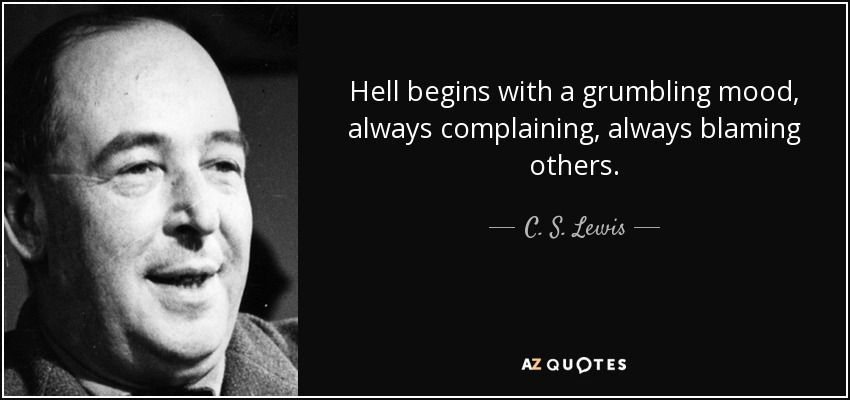
Out of all the bad things in this old world, grumbling and murmuring aren’t typically at the top of our list of heinous sins. Yet, they’re bad. The reason grumbling needs squelching is because complaining is like a gateway drug – start using it and it will surely lead to worse things, unless stopped.

A surefire way to divide a community of people is by grumbling and complaining. This was the deliberate tool of Korah – a Levite who was angling for more power and authority amongst the Israelites in their sojourn in the desert. His stirring up rebellion through constant complaints was a high-handed sin, meant to undercut Moses as the leader.

The revolt he incited resulted in a dramatic intervention of God in causing the earth to open up and swallow Korah and the rebels. The Lord has a zero tolerance policy toward satanic plans of upending godly leadership and replacing it with a lust for power.

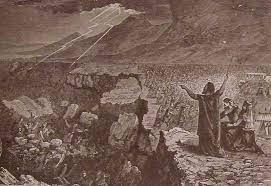
The Punishment of Korah, Holman Illustrated Bible, 1890

Unfortunately, this was not the end of the story. Aftershocks of grumbling erupted around the community. And it was dealt with by God with the same sort of wrath that Korah experienced. A plague broke out and many more died.

So, why all the death? This was far more than a bunch of malcontents who were griping about how things were going. It was an assault against the Lord – in the same way Lucifer once brought rebellion to heaven. In both cases, swift action was taken.

Please keep in mind that we need a nuanced understanding of complaining, grumbling, and arguing. A great deal of complaining is an expression of grief, of pushing back against the hurt. There’s also the grumbling that comes because everybody else is doing it. But then there is the sort of grumbling that is intended to topple God as the authority and place oneself in that position. That’s the nasty sort which will get one in a heap of trouble.

I once had a parishioner, several years back, who continually complained about me. More than that, he seemed to be always trying to get others to join him in his constant grumbling. I certainly tried to be as meek as Moses. Whether that happened, or not, I’m not sure.

It got bad enough that one Sunday, the grumbler invited me to come outside after church and settle things “like men,” which meant with fisticuffs. Oy.

About a month later, the man was standing in his driveway, then fell straight over. He was dead before he even hit the pavement. I’ll leave it to you for an interpretation. I’ll also say that, obviously, the grumbling and rebellion stopped.

The people’s grumbling and revolt against Moses was tantamount to rebelling against God.

Grumbling is not okay. Whenever folks dig in and complain in order to overturn something or someone which the Lord has established, their plans for destruction get turned in on themselves. In other words, what happens to themselves is what they were planning all along for another.

The New Testament author of Hebrews picked up this tone of grumbling from the ancient Israelites, and offered a warning to his own contemporary audience:

“Today, if you hear his voice,
    do not harden your hearts
as you did in the rebellion,
    during the time of testing in the wilderness,
where your ancestors tested and tried me,
    though for forty years they saw what I did.
That is why I was angry with that generation;
    I said, ‘Their hearts are always going astray,
    and they have not known my ways.’
So I declared on oath in my anger,
    ‘They shall never enter my rest.’ ”

See to it, brothers and sisters, that none of you has a sinful, unbelieving heart that turns away from the living God. (Hebrews 3:8-12, NIV)

The author also provided some simple yet profound exhortation for keeping grumbling and murmuring at bay:

But encourage one another daily, as long as it is called “Today,” so that none of you may be hardened by sin’s deceitfulness. (Hebrews 3:13, NIV)

Encouragement is the daily practice which prevents a hard heart and soul rot – the very things which lead a person to begin complaining and rebelling.

If there is no encouragement, complaints will take root. And if complaints take root, bitterness begins to grow. And if bitterness begins to grow, it will feed itself on grudge-bearing. And if grudge-bearing persists, it will have very unpleasant results.

See to it that no one falls short of the grace of God and that no bitter root grows up to cause trouble and defile many. (Hebrews 12:15, NIV)

So, let us cultivate the fruit of the Spirit, and put aside the shameful deeds of darkness. Let us look for ways to encourage one another, rather than tearing down each other. Let us:

Fix our eyes on Jesus, the pioneer and perfecter of faith. For the joy set before him he endured the cross, scorning its shame, and sat down at the right hand of the throne of God. Consider him who endured such opposition from sinners, so that you will not grow weary and lose heart. (Hebrews 12:2-3, NIV)

Holy God, you work in us to will and to act in order to fulfill your good purpose. Help us to do everything without grumbling or arguing, so that we may become blameless and pure, without fault in a warped and crooked generation, through Jesus Christ our Lord, in the power of the Holy Spirit. Amen.
Slow Down (2 Kings 2:1-12)

Not long before the Lord took Elijah up into heaven in a strong wind, Elijah and Elisha were leaving Gilgal. Elijah said to Elisha, “The Lord wants me to go to Bethel, but you must stay here.”

Elisha replied, “I swear by the living Lord and by your own life that I will stay with you no matter what!” And he went with Elijah to Bethel.

A group of prophets who lived there asked Elisha, “Do you know that today the Lord is going to take away your master?”

“Yes, I do,” Elisha answered. “But don’t remind me of it.”

Elijah then said, “Elisha, now the Lord wants me to go to Jericho, but you must stay here.”

Elisha replied, “I swear by the living Lord and by your own life, that I will stay with you no matter what!” And he went with Elijah to Jericho.

A group of prophets who lived there asked Elisha, “Do you know that today the Lord is going to take away your master?”

“Yes, I do,” Elisha answered. “But don’t remind me of it.”

Elijah then said to Elisha, “Now the Lord wants me to go to the Jordan River, but you must stay here.”

Elisha replied, “I swear by the living Lord and by your own life that I will never leave you!” So the two of them walked on together.

Fifty prophets followed Elijah and Elisha from Jericho, then stood at a distance and watched as the two men walked toward the river. When they got there, Elijah took off his coat, then he rolled it up and struck the water with it. At once a path opened up through the river, and the two of them walked across on dry ground.

After they had reached the other side, Elijah said, “Elisha, the Lord will soon take me away. What can I do for you before that happens?”

Elisha answered, “Please give me twice as much of your power as you give the other prophets, so I can be the one who takes your place as their leader.”

“It won’t be easy,” Elijah answered. “It can happen only if you see me as I am being taken away.”

Elijah and Elisha were walking along and talking, when suddenly there appeared between them a flaming chariot pulled by fiery horses. At once, a strong wind took Elijah up into heaven. Elisha saw this and shouted, “Israel’s cavalry and chariots have taken my master away!” After Elijah had gone, Elisha tore his clothes in sorrow. (Contemporary English Version)

“For fast-acting relief from stress, try slowing down.”

Lily Tomlin

In placing today’s Old Testament lesson of Elijah ascending to heaven in a whirlwind next to yesterday’s New Testament lesson of Christ’s ascension, the Revised Common Lectionary wants us to consider the relationship between the two.

What goes up, must come down. Two people ascending to heaven will eventually descend back to the earth.

But why all this elapsed time? If there’s something left yet to be done, why not just do it then? Or right now?

Ah, but there’s the issue. In asking such questions, I (we) betray our modern Western mindset of being governed by the god of speed.

The archenemy of faster is to be slow. And, believe me, slow is seen as a sin by most Westerners. For example, because I have a bum back, I tend to walk slow. More than once, I’ve walked from the parking lot into a store and had cars honk at me, and even some drivers swear and flip the bird at me – just for not hurrying along and making them wait a precious few seconds.

Or take the case of the stereotypical boss who is ready to pounce on an employee who shows up a minute late for work (of which I’ve observed a hundred times over my career). I’m sure you have your own examples.

In God’s kingdom, the slow will inherit the earth – not the speedy ones. That’s because God, at least from a human perspective, is slow. Yet, that’s more of a subjective matter and an issue of perspective. Christ ascended to heaven two thousand years ago. And still no Jesus, no Second Coming. What’s “up” with that? Because many people aren’t “down” with it.

But do not forget this one thing, dear friends: With the Lord a day is like a thousand years, and a thousand years are like a day. The Lord is not slow in keeping his promise, as some understand slowness. Instead he is patient with you, not wanting anyone to perish, but everyone to come to repentance. (2 Peter 3:8-9, NIV)

Far from being a sin, slowness is actually a virtue. Spiritual maturity can only result with the element of time – lots of it. There’s no quick way to becoming whole and integrated. Bible Cliff’s Notes aren’t going to get you very far. Most things cannot be rushed – especially when it comes to our words. Running our mouths never ends well.

You must understand this, my beloved brothers and sisters: let everyone be quick to listen, slow to speak, slow to anger, for human anger does not produce God’s righteousness. (James 1:19-20, NRSV)

Elijah will come. So will Jesus. In the meantime, we need to embrace being an Elisha character who learns the unforced rhythms of grace and discerns the power in slowness.

We are to take time in learning from a trusted mentor… time in sitting with difficult emotions, like sorrow, and time in allowing God to be God so that untimely shenanigans like pulling up the wheat when trying to rid the field of weeds doesn’t happen.

People have a job to do while we wait – to bear witness of the things we have seen and heard. Power is given to those who await God’s gracious gift. Pentecost is just around the corner. Be patient.

Gracious and patient God, slow me down so that I may see you in this fast paced life. Give us all a listening heart and contemplative eyes, so that we might hear your voice may see you in our active world, through Christ our Lord. Amen.