Spiritual Support (Ezekiel 29:3-7)

Speak and say, The Lord God proclaims:

I’m against you, Pharaoh, Egypt’s king,
    great crocodile lurking
    in the Nile’s canals,
        who says, “The Nile is all mine;
        I made it for myself!”
I will set hooks in your jaws;
    I will make the fish from the Nile’s canals cling to your scales.
I will drag you out of the Nile’s canals,
    and also all the fish from the Nile’s canals
    clinging to your scales.
        I will fling you out into the desert,
        and also all the fish from the Nile’s canals.
You will fall on the open ground,
    and won’t be gathered or retrieved.

I’ve given you to the beasts of the earth
        and the birds in the sky for food.
Everyone living in Egypt will know that I am the Lord.

Because they were a flimsy crutch for the house of Israel—when they took you in hand, you would splinter and make their shoulders sore; when they leaned on you, you would break, bringing them to their knees. (Common English Bible)

“Relying on God has to begin all over again every day as if nothing yet had been done.”

C.S. Lewis

From where, and to whom, do we look to for support?

The Pharaoh of Egypt could open his mouth as wide as a crocodile, but he had no real strength – only talk and no bite – and talk is cheap, especially in the face of a sovereign God.

The Lord had little tolerance for Pharaoh’s bombast, so God decided to don the divine crocodile hunter hat and pull the old creature out of the Nile River.

The reeds that grow along the Nile in Egypt look something like bamboo. They appear as if they might make a decent staff or crutch, but the reeds are not good for that, and if used so, would shatter and put some significant splinters into your hand.

God was warning the Israelites against sizing up Egypt as a significant means of support, and then putting weight on them for help. The leadership of Jerusalem was trusting in Pharaoh and his Egyptian troops to rescue them from the Babylonian army.

But, as we know from history, the Babylonians soundly defeated the Egyptian soldiers. Pharaoh was no support, at all, and became a shattered crutch to Judah, just as God had warned.

We need to be careful about choosing our sources of support. There are a lot of unreliable means of help out there, that people turn to in life.

When going through tough times, we may believe that popularity and power, or alcohol and drugs, or wealth and position will help support us and get us through the hard situation. Yet, they all prove too weak and inadequate in the end.

God is able to carry a person through a crisis, so that we do not just survive it, but grow and thrive through it. We must continually be vigilant and wise to resist the temptation toward the shiny things in life which may draw us to depend upon unreliable things and people. We need God working through God’s people to help support us in a time of need.

Our help is in the name of the Lord,
    who made heaven and earth. (Psalm 124:8, NRSV)

One of the great Christian theologians of the twentieth century, the Protestant Swiss professor Karl Barth, believed that we are not fully human and fully supporting one another apart from:

  • mutual seeing and being seen
  • reciprocal speaking and listening
  • granting one another mutual assistance
  • doing everything with gratitude and gratefulness

Barth used the German term Mitmenschlichkeit (co-humanity) to communicate that we are human and supported with a trusted other person alongside us. In other words, human flourishing requires mutual giving and receiving. Only in relation to each other, including those in need, do we thrive as people.

Christianity is a dependence upon God and an inter-dependence on one another; it’s not an isolated independent venture. Adversity, hardship, and difficulty can become a symbiotic relationship between the care-seeker and the caregiver, within the foundation of Trinitarian love, expressed with grace and hope given by Jesus in the power of the Holy Spirit.

So, when we talk about spiritual support of another, it includes the following alliterated points:

  • Struggle. Enter another’s spiritual and emotional wrestling along with them, without succumbing to the impetus to change or fix, but to empathize, affirm, and validate emotions and experiences.
  • Share. Seek to be emotionally available and aware – to be present in another’s pain and wonderment, understanding that a person cannot go any deeper with me than I have gone with myself.
  • Story. Listen to the story that a person weaves about their own situation, background, family, support, religious milieu, as well as their personal spiritual and emotional world.
  • Salvation. Allow and give permission to the person to name and resolve their own struggle; because I am neither the Savior nor in the saving business, as if deliverance and freedom depended upon me.

“Do not let your hearts be troubled. Believe in God; believe also in me.”

Jesus to his disciples (John 14:1, NRSV)

Trust of another must be given carefully and wisely, not flippantly or thoughtlessly. And becoming a trusting person involves not only a willingness to do so, but also the presence to listen, the place to care, and the passion and commitment to do what is helpful, not hurtful.

Blessed God of support and strength, you have given me the shield of your salvation, and your right hand has supported me. Your divine help has gotten me through, and given me a wide place for my steps under me, so that my fee do not slip.

Gracious God, you have given me an example through the Lord Jesus that we must support the weak, remembering his words, “It is more blessed to give than to receive.” May it be so, in the strength given by the Holy Spirit, to your glory and honor. Amen.

A Life of Compassion (Matthew 9:35-10:23)

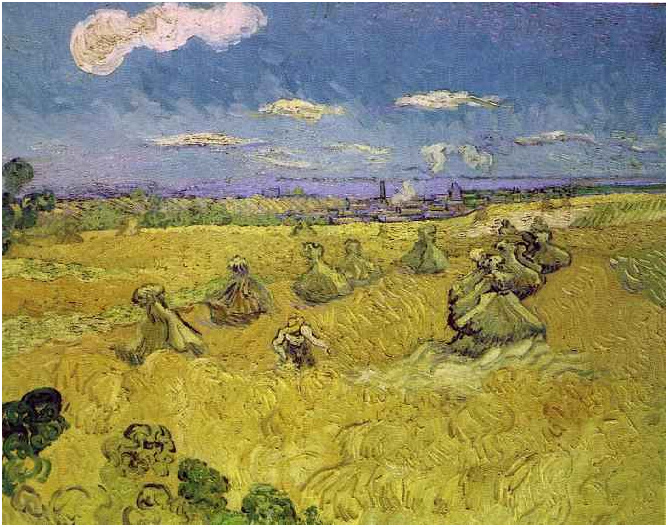
Wheat Stacks with Reaper, by Vincent Van Gogh, 1888

Jesus went through all the towns and villages, teaching in their synagogues, proclaiming the good news of the kingdom and healing every disease and sickness. When he saw the crowds, he had compassion on them, because they were harassed and helpless, like sheep without a shepherd. Then he said to his disciples, “The harvest is plentiful but the workers are few. Ask the Lord of the harvest, therefore, to send out workers into his harvest field.”

Jesus called his twelve disciples to him and gave them authority to drive out impure spirits and to heal every disease and sickness.

These are the names of the twelve apostles: first, Simon (who is called Peter) and his brother Andrew; James son of Zebedee, and his brother John; Philip and Bartholomew; Thomas and Matthew the tax collector; James son of Alphaeus, and Thaddaeus; Simon the Zealot and Judas Iscariot, who betrayed him.

These twelve Jesus sent out with the following instructions: “Do not go among the Gentiles or enter any town of the Samaritans. Go rather to the lost sheep of Israel. As you go, proclaim this message: ‘The kingdom of heaven has come near.’ Heal the sick, raise the dead, cleanse those who have leprosy, drive out demons. Freely you have received; freely give.

“Do not get any gold or silver or copper to take with you in your belts—no bag for the journey or extra shirt or sandals or a staff, for the worker is worth his keep. Whatever town or village you enter, search there for some worthy person and stay at their house until you leave. As you enter the home, give it your greeting. If the home is deserving, let your peace rest on it; if it is not, let your peace return to you. If anyone will not welcome you or listen to your words, leave that home or town and shake the dust off your feet. Truly I tell you, it will be more bearable for Sodom and Gomorrah on the day of judgment than for that town.

“I am sending you out like sheep among wolves. Therefore be as shrewd as snakes and as innocent as doves. Be on your guard; you will be handed over to the local councils and be flogged in the synagogues. On my account you will be brought before governors and kings as witnesses to them and to the Gentiles. But when they arrest you, do not worry about what to say or how to say it. At that time you will be given what to say, for it will not be you speaking, but the Spirit of your Father speaking through you.

“Brother will betray brother to death, and a father his child; children will rebel against their parents and have them put to death. You will be hated by everyone because of me, but the one who stands firm to the end will be saved. When you are persecuted in one place, flee to another. Truly I tell you, you will not finish going through the towns of Israel before the Son of Man comes. (New International Version)

Use your voice for kindness, your ears for compassion, your hands for charity, your mind for truth, and your heart for love.

We need compassion; humanity cannot survive without it.

Compassion is…

  • a concern for the well-being of others
  • the basis for altruism and the most virtuous motive one can possess
  • activated within the human heart when witnessing another person’s suffering
  • helping other people feel seen, heard, and known
  • the bridge that connects us with another in need
  • life

While on this earth, I believe Jesus was the very embodiment of compassion. To reflect on Christ’s compassion helps us to raise our own compassion quotient, and thus, avoid succumbing to the whims of indifference concerning human need.

Compassion responds to human need

In his earthly ministry of preaching, teaching, and healing, Jesus went through all the towns and villages. He neither waited for people to come to him nor wanted anyone to fall through the cracks. Doing this compassionate work, Jesus was moved by the depth of people’s needs.

The word for “compassion” in the Bible means “to be moved in the pit of your gut.” It is to be filled with pity and heartbroken over the unmet needs of people.

So, what moves and stirs compassion deep down in your gut?

Jesus went into towns and was broken-hearted over people who were harassed and helpless, locked into patterns of life that were harmful and damaging. 

Jesus came to this earth to seek and save people, offering forgiveness and a new life. Jesus willingly brought compassion – and his motivation for doing so was neither from duty nor guilt. Compassion is the proper motivation for all things.

Just as Jesus went out and ministered, then was moved by what he saw, so our compassion is aroused whenever we go out and enter people’s lives, seeing first-hand the depth of human need.

Compassion results in prayer

Christ saw the masses of people and told his disciples to ask God to send workers because the harvest is plentiful. Jesus knows there are large numbers of people waiting to hear good news. So, he said to pray earnestly and compassionately.

Compassion brings us to prayer and impels us to pray that workers be sent to people who are ripe for hearing good news. We must not listen to the hellish lie: That certain people don’t really want the good news of the kingdom of God; that my neighbor, or co-worker, or family member is not spiritual and doesn’t care about forgiveness or grace – that there is nothing within them to respond to compassion.

The devil does not want us to have merciful compassion for them, to be moved to intercede for them in prayer, nor to become a harvester in the field of people. Jesus said the harvest is plentiful; and it is through compassionate prayer that the work will be done.

Compassion sends us out

The call to prayer is central, but it’s not everything. As faith without works is dead, so prayer without mission is empty.

The people Jesus authorized for ministry were a collection of twelve motley disciples who thought differently about a great many things. Yet, the compassion of Jesus changes lives and brings people together from diverse backgrounds and viewpoints.

The disciples were told, in their initial mission as followers of Jesus, to go only to the house of Israel. Israel’s house needed to be put in order first before they could ever think of going to Gentiles. We begin by reaching out to people in our own backyard.

“You will be my witnesses in Jerusalem, and in all Judea and Samaria, and to the ends of the earth.” Jesus (Acts 1:8, NIV)

Jesus told the disciples to do exactly what he had been doing: preaching and healing, proclaiming the message that “the kingdom of God is near.” 

The kingdom is not only something in the future; the kingdom of God has already broken into the present time, and the evidence of it is the transformation of people’s lives now. The blessings and promises of kingdom life are presently available.

Jesus sent the disciples out and told them not to take anything with them. They were to leave all their baggage behind. The disciples were to be stripped of everything so that they had the ability to see people and their needs and be moved with compassion as Jesus was.

The kingdom of God was near to them, so they did not need to add anything for the mission. Jesus did not want his disciples assuming they already knew what people needed. Instead, they must be present to people and discover their needs without bias. As compassion is freely received, it is to be freely given.

Cultivating Compassion

Compassion is the appropriate response to human need. Yet, we do not always react with compassion. The following are a few approaches which prevent us from becoming compassionate, along with some ways of cultivating a compassionate life:

  1. A defeating and discouraging environment. Contempt, anger, hatred, and abuse drives out compassion. The environment around us makes a difference. If we find we must check our hearts at the door and avoid compassion to just make it, then we need a change of environment. Life is too short, and the world too compassion-starved, to maintain a situation that drags us down and hinders the kingdom of God within us.
  2. An unhealthy pace of life.  A person cannot have a compassionate heart if they are running too fast to see other people’s needs. When spare moments are used to try and figure out how to keep all the balls in the air and all the plates spinning, there’s no way to dole out compassion to others. So, slow down. No one comes to the end of life and wishes they had logged more hours of work at their job. Develop a plan on how to slow down enough to tune into the needs of others and have emotional energy for them.
  3. Excessive caregiving. Compassion fatigue is a real thing. Resentment can build toward the very people we care for because of constant giving without receiving. When the emotional gas tank is empty, it is possible to become cold-hearted. Yet, some keep going anyway – and ruin their engine. Caring for others must be meticulously balanced with caring for self. There is a time for everything, including rest and recuperation. Jesus regularly practiced the disciplines of solitude and silence. If he needed those restorative practices, so do we.
  4. Objectifying people. Whenever we put adjectives in front of people, compassion is lacking. Referring to “those” people, “lesbian” neighbors, “black” folks at work, my “obnoxious” relative, or, the “poor” family down the street, are all examples of objectifying people and putting them at a distance from ourselves. Your neighbors are your neighbors, your family is your family, and the people in your life are just people, period. Compassion arises as we look for what is common among us, not different. Compassion brings solidarity with others, not separation and division.

May you allow God the time to form a compassionate heart within through being with Jesus. May compassion toward others be the defining characteristic of your life.

The Plan Comes Together (Genesis 24:10-52)

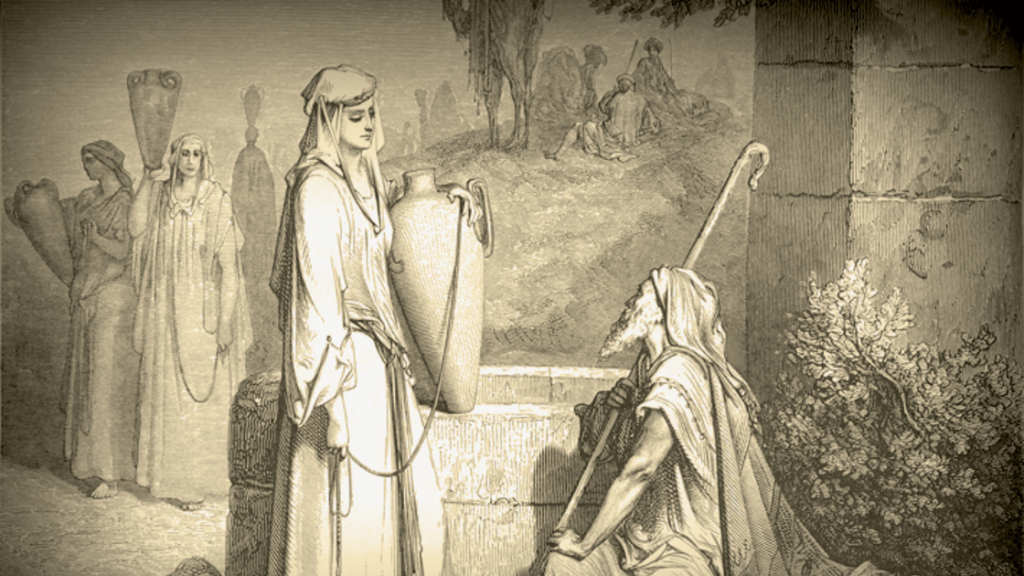
Rebekah and Abraham’s servant, an engraving by Gustave Dore (1832-1883)

Reading Holy Scripture is important. And the way we read it is significant. For the past several years, I have personally made it a practice to always read from the Bible out loud. There is something deeply powerful and impactful about the experience of reading aloud God’s Word.

I also try and read Scripture carefully and slowly. I deliberately make choices about my tone and inflexion, paying attention to which words are emphasized. I try to communicate as best I can the spirit and intent of the words.

I encourage you today to read aloud (and listen to) today’s Old Testament lesson. Take your time. Read it at your own pace. Notice which words you tend to accent, and what the Spirit may be saying to you in the reading…

Soon after that, the servant loaded ten of Abraham’s camels with valuable gifts. Then he set out for the city in northern Syria, where Abraham’s brother Nahor lived.

When he got there, he let the camels rest near the well outside the city. It was late afternoon, the time when the women came out for water. The servant prayed:

You, Lord, are the God my master Abraham worships. Please keep your promise to him and let me find a wife for Isaac today. The young women of the city will soon come to this well for water, and I’ll ask one of them for a drink. If she gives me a drink and then offers to get some water for my camels, I’ll know she is the one you have chosen and that you have kept your promise to my master.

While he was still praying, a beautiful unmarried young woman came by with a water jar on her shoulder. She was Rebekah, the daughter of Bethuel, the son of Abraham’s brother Nahor and his wife Milcah. Rebekah walked past Abraham’s servant, then went over to the well, and filled her water jar. When she started back, Abraham’s servant ran to her and said, “Please let me have a drink of water.”

“I’ll be glad to,” she answered. Then she quickly took the jar from her shoulder and held it while he drank. After he had finished, she said, “Now I’ll give your camels all the water they want.” She quickly poured out water for them, and she kept going back for more, until his camels had drunk all they wanted. Abraham’s servant did not say a word, but he watched everything Rebekah did, because he wanted to know for certain if this was the woman the Lord had chosen.

The servant had brought along an expensive gold ring and two large gold bracelets. When Rebekah had finished bringing the water, he gave her the ring for her nose and the bracelets for her arms. Then he said, “Please tell me who your father is. Does he have room in his house for me and my men to spend the night?”

She answered, “My father is Bethuel, the son of Nahor and Milcah. We have a place where you and your men can stay, and we also have enough straw and feed for your camels.”

Then the servant bowed his head and prayed, “I thank you, Lord God of my master Abraham! You have led me to his relatives and kept your promise to him.”

Rebekah ran straight home and told her family everything. Her brother Laban heard her tell what the servant had said, and he saw the ring and the bracelets she was wearing. So Laban ran out to Abraham’s servant, who was standing by his camels at the well. Then Laban said, “The Lord has brought you safely here. Come home with me. There’s no need for you to keep on standing outside. I have a room ready for you in our house, and there’s also a place for your camels.”

Abraham’s servant went home with Laban, where Laban’s servants unloaded his camels and gave them straw and feed. Then they brought water into the house, so Abraham’s servant and his men could wash their feet. After that, they brought in food. But the servant said, “Before I eat, I must tell you why I have come.”

“Go ahead and tell us,” Laban answered.

The servant explained:

I am Abraham’s servant. The Lord has been good to my master and has made him very rich. He has given him many sheep, goats, cattle, camels, and donkeys, as well as a lot of silver and gold, and many slaves. Sarah, my master’s wife, didn’t have any children until she was very old. Then she had a son, and my master has given him everything. I solemnly promised my master that I would do what he said. And he told me, “Don’t choose a wife for my son from the women in this land of Canaan. Instead, go back to the land where I was born and find a wife for my son from among my relatives.”

I asked my master, “What if the young woman refuses to come with me?”

My master answered, “I have always obeyed the Lord, and he will send his angel to help you find my son a wife from among my own relatives. But if they refuse to let her come back with you, then you are freed from your promise.”

When I came to the well today, I silently prayed, “You, Lord, are the God my master Abraham worships, so please lead me to a wife for his son while I am here at the well. When a young woman comes out to get water, I’ll ask her to give me a drink. If she gives me a drink and offers to get some water for my camels, I’ll know she is the one you have chosen.”

Even before I had finished praying, Rebekah came by with a water jar on her shoulder. When she had filled the jar, I asked her for a drink. She quickly lowered the jar from her shoulder and said, “Have a drink. Then I’ll get water for your camels.” So I drank, and after that she got some water for my camels. I asked her who her father was, and she answered, “My father is Bethuel the son of Nahor and Milcah.” At once I put the ring in her nose and the bracelets on her arms. Then I bowed my head and gave thanks to the God my master Abraham worships. The Lord had led me straight to my master’s relatives, and I had found a wife for his son.

Now please tell me if you are willing to do the right thing for my master. Will you treat him fairly, or do I have to look for another young woman?

Laban and Bethuel answered, “The Lord has done this. We have no choice in the matter. Take Rebekah with you; she can marry your master’s son, just as the Lord has said.” Abraham’s servant bowed down and thanked the Lord. (Contemporary English Version)

How was your experience in reading this story out loud? What did the Spirit bring to you through it? Will you share your experience with us?…

Go and Serve the Lord (Genesis 24:1-9)

Abraham was now a very old man. The Lord had made him rich, and he was successful in everything he did. One day, Abraham called in his most trusted servant and said to him, “Solemnly promise me in the name of the Lord, who rules heaven and earth, that you won’t choose a wife for my son Isaac from the people here in the land of Canaan. Instead, go back to the land where I was born and find a wife for him from among my relatives.”

But the servant asked, “What if the young woman I choose refuses to leave home and come here with me? Should I send Isaac there to look for a wife?”

“No!” Abraham answered. “Don’t ever do that, no matter what. The Lord who rules heaven brought me here from the land where I was born and promised that he would give this land to my descendants forever. When you go back there, the Lord will send his angel ahead of you to help you find a wife for my son. If the woman refuses to come along, you don’t have to keep this promise. But don’t ever take my son back there.” So the servant gave Abraham his word that he would do everything he had been told to do. (Contemporary English Version)

The Spirit of God operates through us, God’s people. Although the Lord could do everything without us, God chooses to use us as servants doing the divine will. All of life is really and ideally a divine/human cooperative of the Lord working in and through us to accomplish good and divine purposes.

The spotlight of today’s Old Testament lesson follows Abraham’s servant – which is a picture of the Holy Spirit’s work. God has given us the responsibility and privilege of being humble servants in the world. Much like Abraham’s faithful and trusted servant, we are to fulfill God’s expectations to leave and go do the Lord’s bidding.

We have both the duty and delight of giving ourselves to the task of going out and finding the person(s) for whom the Lord sends us to find.

Jesus once said to his disciples:

“If any of you wants to be my follower, you must give up your own way, take up your cross, and follow me. If you try to hang on to your life, you will lose it. But if you give up your life for my sake and for the sake of the Good News, you will save it.” (Mark 8:34-35, NLT) 

Blessing from God happens when we leave everything and follow Jesus. God is still holding out this promise of blessing that can be realized through leaving and going. As Abraham sent out his servant, the Lord sends out so that divine promises are realized and humanity is blessed. Consider some biblical examples:

  • In order to experience marital blessing, God said in the beginning that a man must “leave his mother and father and cleave to his wife.” (Genesis 2:24) 
  • The writer of Proverbs says that if we want to see blessing, to experience God’s presence and approval, you must “leave your simple ways.” (Proverbs 9:6) 
  • Jesus said that if you have relational problems and are getting ready to worship you must “leave your gift at the altar.” Then, “first go and be reconciled to your brother.” (Matthew 5:23-24)  
  • Christ stated that, as the Great Shepherd, he will leave the ninety-nine sheep to go after one lost one. (Luke 15:4) 
  • The Lord Jesus commissioned us to do the business of leaving: “Go, and make disciples of all nations.” (Matthew 28:19). 
  • Jesus also said, “If you want to be perfect, go, sell your possessions and give to the poor, and you will have treasure in heaven.”(Matthew 19:21) 
  • The invitation has gone out concerning God’s great banquet of blessing: “Go to the street corners and invite to the banquet anyone you find.” (Matthew 22:9)

Being sent, leaving and blessing, go together.

I “leave” you with some thoughts on stepping out of our friendly and familiar environment to know the blessing of God:

  1. Hang around with others who want the blessing of God. Spend time with those who are eager to do God’s will and be God’s servant. Light each other’s fire, and let the Holy Spirit kindle a fresh flame in your heart by being around passionate Christian people. Don’t be a lone ranger, but instead consult and collaborate with others.
  2. Walk across the room. God may not be calling all of us to leave this country and go to an unreached people-group, but he is calling us all to leave our seats and walk across the room to encourage another person in their faith; or across the street to strike up a spiritual conversation with a lost neighbor; or across town to a lonely or hurting elderly person; or down the street to hang out at the laundry mat to meet new people who need the good news of grace. And, by all means, we are to walk across the pages of Scripture to follow Jesus in obedience to the Holy Spirit’s promptings.
  3. Step out in faith, no matter who you are. We might all consider Mother Teresa, who died in 1997, to be a super-Christian. She once stated, “By blood, I am Albanian. By citizenship, an Indian. By faith, I am a Catholic nun. As to my calling, I belong to the world. As to my heart, I belong entirely to the Heart of Jesus. God still loves the world and He sends you and me to be His love and His compassion to the poor to quench His thirst for love and for souls.”  Yet, at the same time, Teresa struggled in her faith for most of her life and often felt like her own soul was desolate. She once confessed, “In my soul, I feel just the terrible pain of loss, of God not wanting me, of God not being God, of God not really existing.” Even in this, her dark night of the soul was still the salvation for thousands.
  4. Don’t talk it to death. There is always more research and information and counsel to obtain. At some point you need to act. We have no need to create a sub-committee to investigate the findings of that other committee in order to decide. Frederick Buechner said, “The place God calls you to is the place where your deep gladness and the world’s deep hunger meet.” Where does your passion and the world’s great need meet? Leave, and go there. 

We are servants, meant to fulfill the instructions of a God who is calling us and sending us to do good work in this world.

Lord Jesus Christ, you stretched out your arms of love on the hard wood of the cross that everyone might come within the reach of your saving embrace. Clothe us in your Spirit so that, reaching forth our hands in love, we may bring those who do not know you to the knowledge and love of you; for the honor of your Name. Amen.