Love for Others (Romans 13:8-14)

Let no debt remain outstanding, except the continuing debt to love one another, for whoever loves others has fulfilled the law. The commandments, “You shall not commit adultery,” “You shall not murder,” “You shall not steal,” “You shall not covet,” and whatever other command there may be, are summed up in this one command: “Love your neighbor as yourself.”Love does no harm to a neighbor. Therefore love is the fulfillment of the law.

And do this, understanding the present time: The hour has already come for you to wake up from your slumber, because our salvation is nearer now than when we first believed. The night is nearly over; the day is almost here. So let us put aside the deeds of darkness and put on the armor of light. Let us behave decently, as in the daytime, not in carousing and drunkenness, not in sexual immorality and debauchery, not in dissension and jealousy. Rather, clothe yourselves with the Lord Jesus Christ, and do not think about how to gratify the desires of the flesh. (New International Version)

The first eleven chapters of Paul’s letter to the Roman Church focuses on the nature of the gospel, that is, the good news of God’s unconditional love for us in Christ.  In order to love others, we must first grasp the truth that God loves you as if you were the only person on earth. 

The Father’s mercy and kindness reached to such a length as to send the Son to woo people in love back to God. It is through Christ’s life, death, resurrection, ascension and glorification that there is forgiveness of sins and new life for those who, by faith, trust in Jesus for deliverance.

This is what the Bible calls “grace.”  It is a steadfast committed love that seeks out others for no other reason than that they need help.  And this is both the foundation and the motivation for Christian love. It is always open season on love.

Whenever you see the phrase “one another” in the New Testament, it is talking about fellow Christians. And whenever there is the phrase “the other,” “others,” or “fellowman,” the Bible is talking about outsiders, that is, non-believers. 

Therefore, Paul’s vision for the church is that it should love all people, without exception.  So, we need to do away with any kind of notion of the church being like a country club that caters to members who pay their dues. Instead, let’s stick with biblical metaphors for Christians such as being light instead of dark; or wearing clean clothes instead of dirty clothes, meaning to live holy lives in order to exhibit a holy love toward outsiders.

We know we are supposed to love; this is not a new message. None of us will walk away saying, “Well, that was new! I’ll be! The Bible actually says I am supposed to love other people!” Yet, at the same time, we all know there is a lack of love in this old fallen world, and sometimes even in Christ’s church. 

When author John Shore did research for a book titled, I’m OK – You’re Not: The Message We’re Sending Non-Believers Toward Christianity, to his surprise the over-and-above response he got from those outside of the faith was, “Why do Christians hate us so much?”

Over the past several years I have actually “de-friended” several of my brothers and sisters in the faith from Facebook because their postings were so often filled with hate toward “the other.” Feeling justified to hate another person does not come from the New Testament Scriptures. We, as Christians, owe the world our love, not our hate. 

Everyone needs a friend. Everybody needs relationships. All people are created in the image of God and, therefore, deserve the dignity of conversation and relationship rather than being looked at as a “project” or overlooked just because they are different or don’t fit in. 

According to Paul’s message, we cannot really love one another in the church or love the other if we continually indulge our old sinful nature. Like wearing a set of dirty clothes, we are to take off our selfish sinful desires, and put on the new clean clothes of God’s love in Christ. If we are giving love, then there is no room to give dissension or jealousy. If we commit to exercising our spiritual gifts, given by God, there is not enough time in the day to think about how to gratify our sinful impulses.

In loving our neighbor, we won’t break any commandments concerning murder, theft, adultery, coveting, lying, or dishonoring anyone. In other words, we won’t do anything unloving. This is not a matter of gritting our teeth and pushing ourselves to accomplish love by trying harder. Rather, it’s a matter of receiving love so that we can give love. 

We are to be in a continual rhythm of life that receives and gives. Giving without receiving is a one way road to burnout and leads to an inability to love; receiving without giving is to stockpile grace and results in unloving words and actions.

Another potential hindrance to a life of love has to do with the law or keeping the rules. The law is good; yet, law has its limits – it cannot change a life; only love can do that. The law must serve love of God and neighbor, and not the other way around. The law must bow to the demands of love. 

In Charles Dickens’ classic, A Christmas Carol, Ebeneezer Scrooge was a law-abiding citizen, and when faced with the needs of those less fortunate, old Scrooge appealed to the law. He saw no need for loving actions or loving words when there were already poor houses, relief organizations, and prisons in operation. It’s like saying today that I am a tax-paying, law-abiding citizen and have no obligation to the other. 

This brings us back to relationships. It’s easy to say people need to work harder and not be lazy when we are not in a relationship with anyone who is in need. Furthermore, it can be easy to indulge our sinful nature when we believe that we have earned the right through our law-abiding selves to speak ill of “the other,” and even to a brother or sister in Christ.

Paul’s response to this attitude is instilling a sense of urgency to love. The Day of the Lord is much nearer now than it was when Paul penned these words! God will not settle for anything less than the transformation of the world. Instead of giving us a three-ring binder full of organizational charts for how to change the world, Paul saw that nothing will ever change without basic human kindness and a concern of relating in love to others. 

Our task, as followers of Christ, is to engage in the tedious and patient construction of souls through loving words and actions over an extended period of time. We need to take a sort of Christian Hippocratic Oath: To do no harm to our neighbor, but to do everything within our power to love them. Paul’s vision for us is to love one another in the church; and, to love others in the world.

Within the Roman church, there were both Jews and Gentiles. They were to love one another. Paul wanted the Jews to get out of their exclusive Jewish-only group and love Gentiles; he wanted Gentiles to get out of their Gentile-only ghetto and love Jews. They were to have a shared vision together of loving each other so that they could collectively love others in the city of Rome. 

One of the reasons this was so hard for them, is that they had differing understandings of how to live the Christian life and how to worship together. The only way they could overcome their obstacles was by understanding each other by interacting and listening to one another. More than that, Paul wanted them to champion each other, to encourage one another by letting go of their personal preferences. In this way, they had a better chance at loving each other, and thus, loving the surrounding culture.

Genuine love does not meet needs in order to get something back from the other. True Christian love seeks the other’s best interests, just because God has shown unconditional love to us. Whenever we keep thinking about what others can do for us, we are not operating out of the reserves of grace that God first showed us. But if we consistently receive love from God, we can then give love to others.

When growing up, our moms would say to us that if there is a kid on the playground playing by him/herself, go play with that kid; and, if you see a kid getting bullied or picked on, stand up for that kid. Those two pieces of parental wisdom can serve the church well. When we see lonely people, or even groups who are by themselves, go interact with them and love them. When we see individuals or particular groups of people getting bullied, stand up for them.

Our guiding principle is love. The hour has come to wake up and have eyes to see the people all around us in need of grace so that we can be long on the love of God, deep in our love for each other, and wide on love for others in the world.

Lord God, make us instruments of your love. Help us see every circumstance as an opportunity to grow in love. May we then take this love to others through being patient, kind, gentle, blessing instead of cursing, and quick to forgive. May we take no pleasure in criticizing others, but in being gracious, as is our Lord Jesus Christ, in whose name we pray. Amen.

Let Go (Exodus 11:1-10)

Now the Lord had said to Moses, “I will bring one more plague on Pharaoh and on Egypt. After that, he will let you go from here, and when he does, he will drive you out completely. Tell the people that men and women alike are to ask their neighbors for articles of silver and gold.” (The Lord made the Egyptians favorably disposed toward the people, and Moses himself was highly regarded in Egypt by Pharaoh’s officials and by the people.)

So Moses said, “This is what the Lord says: ‘About midnight I will go throughout Egypt. Every firstborn son in Egypt will die, from the firstborn son of Pharaoh, who sits on the throne, to the firstborn son of the female slave, who is at her hand mill, and all the firstborn of the cattle as well. There will be loud wailing throughout Egypt—worse than there has ever been or ever will be again. But among the Israelites not a dog will bark at any person or animal.’ Then you will know that the Lord makes a distinction between Egypt and Israel. All these officials of yours will come to me, bowing down before me and saying, ‘Go, you and all the people who follow you!’ After that I will leave.” Then Moses, hot with anger, left Pharaoh.

The Lord had said to Moses, “Pharaoh will refuse to listen to you—so that my wonders may be multiplied in Egypt.” Moses and Aaron performed all these wonders before Pharaoh, but the Lord hardened Pharaoh’s heart, and he would not let the Israelites go out of his country. (New International Version)

It takes a lot for the status quo to die, to let go of something that has been relied on for centuries. In the case of ancient Egypt, it took the deaths of every Egyptian first born son.

The Israelites had been slaves in Egypt for 400 years. The vast Egyptian Empire was literally built on the backs of Jews. After so long, their cry about being in bondage was heard by God – who sent Moses to deliver them. But Pharaoh, the King of Egypt, was not about to let go of this large labor force.

So, a series of 10 plagues came upon the Egyptians from God. Today’s Old Testament lesson is the tenth and final plague – the one most devastating to Egypt. Although Pharaoh was determined to keep the Israelites in bondage, not even mighty Egypt could keep it’s grip on the people when God was determined to free them and bring them to the Promised Land.

God graciously informed Moses that this was the final plague. After nine others, and hearing Pharaoh say he would let the people go multiple times, it must have been a relief to hear that this would not keep going any longer.

Moses and Aaron debating with Pharaoh, by He Qi

What’s more, the Lord added that not only would Pharaoh finally change and not hinder the people from leaving, but also that they should ask the Egyptians for what they needed when going. Indeed, the people of Egypt became so eager to have the Israelites away from them that they would give them anything to get them out.

The Israelites had worked hard and labored intensely for hundreds of years without any compensation. Now, they would leave the world of slavery and receive the riches of Egypt from which they were defrauded. Whereas Pharaoh’s heart became exceedingly hard, the Egyptians hearts became disposed to give – even though it was to be rid of the Israelites once and for all.

And so, God would deliver the Jews from their bondage and enrich them with many needed possessions, as if they were carrying away plunder from an enemy. The Lord both frees and empowers; God delivers from one situation and enables for another. When God closes a door, then another door is opened.

Indeed, the first will be last, and the last shall be first. In God’s upside-down kingdom, the oppressors eventually become the oppressed, and the poor become rich.

With this last and final plague, there would be no next generation to rise up and take back the Israelites into slavery again. A distinction was made between the first born of the Egyptians and the Israelites. Only the Egyptians experienced the awful deaths of so many.

After four centuries of keeping the Jews enslaved, maybe the Egyptians thought it would always be this way. Perhaps they even believed what they were doing was perfectly acceptable and right. So, when Moses comes along, speaking on behalf of God to Pharaoh, the great king of the empire thought things will not change; the Israelites ought to always be in subservience to Egyptians.

Why is it so hard to let go? Why do people keep holding on, even when it costs them nearly everything?

Whenever we cannot envision a different world or an alternative to what we are currently experiencing, then we hold on – even if it hurts to keep grasping it. Just because there was no divine judgment in hundreds of years, does not mean that God was okay with the situation in ancient Egypt. So, when the Egyptians experienced the judgment, it was absolutely devastating.

If ever we need to control other people in order to realize or maintain our own happiness or contentment, then we are in a very unhealthy place and need immediate help – before the providence of God steps in and pries that control from your clenched fists.

Conversely, if we have been in a place of oppression for a long time, it will not last forever. God sees the injustice. And God hears the cries which are uttered to heaven. A time is coming when all things will be made right.

Also, there are various sorts of traumas that people have endured. Sometimes, people don’t want to talk about any of it, and never do. But eventually, it overwhelms them. Without help, they will be in bondage. None of us can change on our own. We need others. Not everyone is going to harm us or shame us. There are people that God is ready to use in order to extend hope, healing, wholeness, and help. We should let them in, and keep the slave masters out.

Gracious and merciful God, help us to overcome the menace of evil in this world, and to be a part of freeing those weighed down with sinful oppression to realize a future of health and hope.

From famine and war, deliver us.

From hatred and from the demeaning of the dignity of others, deliver us.

From every kind of injustice in the life of society, both national and international, deliver us.

From the loss of awareness of good and evil, deliver us.

Accept our cry on behalf of the sufferings of all humanity, and of entire societies of people.

Empower us by your Spirit to resist evil in all its insidious manifestations.

May the saving grace and the redemption of Jesus put a stop to cruel bondage everywhere; and may hope be kindled in every heart. Amen.

How to Handle Criticism (2 Corinthians 12:11-21)

A mosaic of the Apostle Paul in St Isaac’s Cathedral, St. Petersburg, Russia

Well, now I’ve done it! I’ve made a complete fool of myself by going on like this. But it’s not all my fault; you put me up to it. You should have been doing this for me, sticking up for me and commending me instead of making me do it for myself. You know from personal experience that even if I’m a nobody, a nothing, I wasn’t second-rate compared to those big-shot apostles you’re so taken with. All the signs that mark a true apostle were in evidence while I was with you through both good times and bad: signs of portent, signs of wonder, signs of power. Did you get less of me or of God than any of the other churches? The only thing you got less of was less responsibility for my upkeep. Well, I’m sorry. Forgive me for depriving you.

Everything is in readiness now for this, my third visit to you. But don’t worry about it; you won’t have to put yourselves out. I’ll be no more of a bother to you this time than on the other visits. I have no interest in what you have—only in you. Children shouldn’t have to look out for their parents; parents look out for the children. I’d be most happy to empty my pockets, even mortgage my life, for your good. So how does it happen that the more I love you, the less I’m loved?

And why is it that I keep coming across these whiffs of gossip about how my self-support was a front behind which I worked an elaborate scam? Where’s the evidence? Did I cheat or trick you through anyone I sent? I asked Titus to visit, and sent some brothers along. Did they swindle you out of anything? And haven’t we always been just as aboveboard, just as honest?

I hope you don’t think that all along we’ve been making our defense before you, the jury. You’re not the jury; God is the jury—God revealed in Christ—and we make our case before him. And we’ve gone to all the trouble of supporting ourselves so that we won’t be in the way or get in the way of your growing up.

I do admit that I have fears that when I come you’ll disappoint me and I’ll disappoint you, and in frustration with each other everything will fall to pieces—quarrels, jealousy, flaring tempers, taking sides, angry words, vicious rumors, swelled heads, and general bedlam. I don’t look forward to a second humiliation by God among you, compounded by hot tears over that crowd that keeps sinning over and over in the same old ways, who refuse to turn away from the pigsty of evil, sexual disorder, and indecency in which they wallow. (The Message)

Apostle Paul by Ivan Filichev

Criticism is hard to take. It’s even tougher when the criticism is off because you have been misinterpreted or misunderstood. And it’s more difficult to deal with criticism whenever you know you’ve done your best and accomplished good things. There are people who ought to have your back, but instead they do just the opposite and throw you under the bus.

This was the situation with the Apostle Paul. He had spent a good deal of time in the city of Corinth proclaiming the good news of Jesus and establishing a church. It was a rough ministry, filled with plenty of relational drama. (Acts 18:1-18)

Perhaps then, it is no surprise that as the church developed and grew, the people gathered themselves into special interest groups according to both their class and their affinity for particular preachers. Add to this the reality that many of the new Christians continued to embrace some of their old unhealthy practices, and you have the makings of a contentious and critical group of people. (1 Corinthians 1:10-12; 3:1-4; 11:17-22)

It is oddly surreal for Paul to have to defend himself – especially since he put so much ministry effort and wise exhortation into their church and their spiritual lives. Yet here he is needing to remind the Corinthians of his abilities, what he has done, and his credentials as a legitimate Apostle.

The following are some ways I observe how the Apostle Paul dealt with criticism:

  1. Accepting that criticism is going to happen. Paul knew that his life as an Apostle was on full display for all to see and evaluate. He did not always get things right. No one does. Yet Paul was on target about most things. He rarely got stuck on any one leadership decision. And he never let criticism, pushback, or even persecution deter him from his missionary purpose.
  2. Evaluating all things according to Christian standards. The farther people are from the problem, the less context and understanding they have. That’s why Paul planned to see them face to face. The story the Corinthians were telling themselves was inaccurate – filled with perceived motives and false conjectures about Paul and his ministry. Paul stayed focused on the gospel and the values it espouses.
  3. Keeping shame out of the conversation. We all naturally feel defensive when attacked, especially if it feels unjust, exaggerated, or inaccurate. And we may want to shame people into feeling guilt and becoming repentant. But any defensiveness on our part will only fuel people’s derision.
  4. Being transparent and vulnerable. Paul told them how he felt without making it a guilt trip. He was even sarcastic, at times. Maybe it seems counterintuitive, but more transparency works in our favor, and not against it. People get frustrated, hurt, angry, and confused about what we do and say. Our job isn’t to determine whether those feelings are legitimate or not, but instead to demonstrate empathy and concern. Doing anything that conveys dismissiveness risks making people feel like you’re gaslighting them.
  5. Acting on the problem. Paul doubled down on his commitment to transmitting Christian core values, and ensuring that a culture of Christian ethics reached every corner of the church.

It doesn’t feel good to get criticized, especially when it seems unwarranted. If we can stay focused on caring about our values and other people, we will likely handle it well. Because it’s not a matter of if we get criticized, but when.

Almighty and everlasting God, help me to have no corrupt communication proceed out of my mouth, but only words which are good, gracious, and edifying. And I pray for Christ’s Church everywhere, that all of our conversations will influence others for good and build up one another in the faith, through Jesus our Lord, in the strength of the Holy Spirit. Amen.

Naming and Forsaking Evil (Psalm 83:1-4, 13-18)

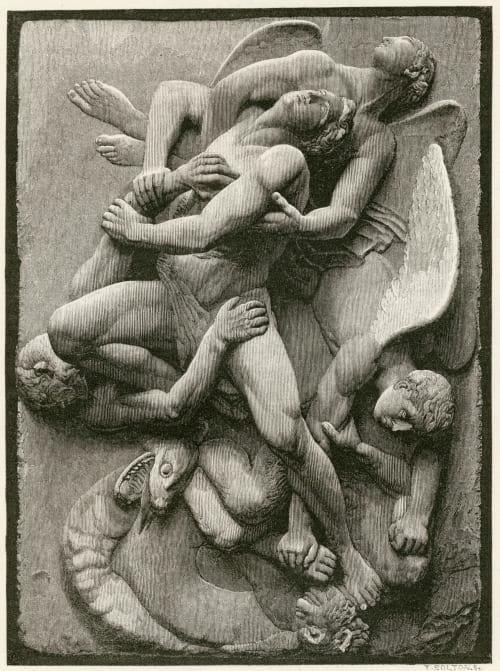
Deliver Us From Evil, by John Flaxman (1755-1826)

God, don’t shut me out;
    don’t give me the silent treatment, O God.
Your enemies are out there whooping it up,
    the God-haters are living it up;
They’re plotting to do your people in,
    conspiring to rob you of your precious ones.
“Let’s wipe this nation from the face of the earth,”
    they say; “scratch Israel’s name off the books.”
And now they’re putting their heads together,
    making plans to get rid of you….

My God! I’ve had it with them!
    Blow them away!
Tumbleweeds in the desert waste,
    charred sticks in the burned-over ground.
Knock the breath right out of them, so they’re gasping
    for breath, gasping, “God.”
Bring them to the end of their rope,
    and leave them there dangling, helpless.
Then they’ll learn your name: “God,”
    the one and only High God on earth. (The Message)

The psalms are the church’s prayer book. Many of the psalms are laments; and many of them are worshipful songs of praise. And there are also the “imprecatory” (pronounced im-PRECK-a-tory) psalms. To “imprecate” means to invoke evil upon someone; it is to pronounce a curse. 

The reason for the imprecatory psalm is that it is not any person’s place to engage in revenge or retaliation. Instead, for people who are genuinely caught in the crosshairs of evil and have sinful persons dogging them, prayer is their most effective recourse; an appeal to God is their best chance at survival and hope.

Sometimes you have to tell it like it is. There’s a time to do your best in putting up a good face and dealing with people who never stop gossiping, slandering, and trying to get their way. But there is also a time to call such behavior “evil” and cry out to God for help.

There are a lot of folks who consider imprecatory psalms a problem because of their detailed expressions of imprecation, of cursing. Yet, such psalms refuse to put a positive spin on malevolent motives, wicked words, and destructive actions.

Desperate people utter desperate prayers. Their unflinching sense of injustice will not allow them to sugarcoat the villainous plans of corrupt people.

Evil is never toppled with tepid prayers from wimpy worshipers. Rather, nefarious agendas are thwarted in the teeth of specific, focused, and intense prayers directed with spiritual precision and passion to the very core of diabolical forces.

We need not be shy about being real with God, even with praying imprecatory prayers. There really are people in this world, maybe even in your own life, that have malicious intent against you or others. Our job is not personal revenge, but to entrust ourselves to the God who fights for the poor, the oppressed, and the needy against the arrogant and the powerful. Let your prayers, then, reflect your life.

Along with psalms of praise lifted during times of celebration, so imprecatory psalms are not to be ignored but need to be uttered equally loud as prayers to almighty God in seasons of desperate evil.

If you have a gut feeling deep down that wicked people are running amok, then use this psalm as a prayer against the darkness which seeks to envelop the earth.

Jesus Christ will build his church and the gates of hell shall not overcome it (Matthew 16:18). The picture Jesus portrayed is one of faithful believers equipped with righteousness and justice storming the gates of hell, not shying away from it. Baked within the Lord’s words were the promise that evil atrocities will not have the day – that God’s people will not be destroyed or overwhelmed because of demonic and satanic power.

There is a time to flee and then there is a time to engage. I am suggesting that the chief way of mitigating evil is to punch it in the mouth with imprecatory psalms prayed with righteous flavor and focused directly against the powers of this present darkness. Why pray, out of all the things we could do, in order to deal with the evil of this world?…

For we do not wrestle against flesh and blood, but against principalities, against powers, against the rulers of the darkness of this age, against spiritual hosts of wickedness in the heavenly places. (Ephesians 6:12, NKJV)

Spiritual problems require spiritual implements to solve. And the tool of imprecatory psalms is a major way of pushing back the dark forces of this world, as well as the means of spiritual assertiveness against all forms of heinous acts and acerbic words from depraved people and evil systems.

God’s wrath is an expression of God’s love – because God is not okay with evil taking root in the lives and institutions of humanity. Prayer is our privilege of coming to the God who upholds justice and righteousness. For if God is for us, who can be against us?

Almighty God, hear me in the day of my trouble and send help from your holy sanctuary and strengthen my faith. Do not let me amble down the path of temptation, but deliver me from the evil one.

Holy Spirit, breathe your enablement into me and inspire me with a passion for goodness, truth, justice, and righteousness.

Lord Jesus be present with me in your risen power and protect me from harm and from everything that hinders your healing presence in this world. You overcame the forces of Satan, redeemed the world, then ascended to the Father.

Blessed Holy Trinity – Father, Son, and Sprit – the God whom I serve: May you be with me and within me; before me and behind me; on my right and on my left; above me and beneath me; and around me always, for the sake of your glory. Amen.