The Redeemed and Responsive Soul (Psalm 107:1-7, 33-37)

O give thanks to the Lord, for he is good,
    for his steadfast love endures forever.
Let the redeemed of the Lord say so,
    those he redeemed from trouble
and gathered in from the lands,
    from the east and from the west,
    from the north and from the south.

Some wandered in desert wastes,
    finding no way to an inhabited town;
hungry and thirsty,
    their soul fainted within them.
Then they cried to the Lord in their trouble,
    and he delivered them from their distress;
he led them by a straight way,
    until they reached an inhabited town…

He turns rivers into a desert,
    springs of water into thirsty ground,
a fruitful land into a salty waste,
    because of the wickedness of its inhabitants.
He turns a desert into pools of water,
    a parched land into springs of water.
And there he lets the hungry live,
    and they establish a town to live in;
they sow fields and plant vineyards
    and get a fruitful yield. (New Revised Standard Version)

The responsive spirit

A soul full of spiritual abundance responds freely and organically to God with offerings of gratitude for divine rescue and redemption.

The spiritually responsive person is at peace, content, and able to love with a sensitivity to God because they have had their needs for safety, satisfaction, and relational connection fulfilled. So, as a result, they are able to:

  • worship joyfully and praise God
  • speak words of thanksgiving
  • be attentive to self-care and personal well-being
  • use their resources wisely, feeling capable and confident of making good decisions that bless both the church and the world
  • know they are secure in the loving hands of God

The reactive spirit

Conversely, a soul that is empty from spiritual deprivation reacts predictably and robotically to others with frustration and fear.

The spiritually reactive person seems perpetually upset and in chronic emotional pain, feeling rattled and worried most of the time. They do not reflexively look to the Lord. Their needs for safety, satisfaction, and relational connection have not been met. So, as a result, they are:

  • hypervigilant, on the lookout for the bad, which they are convinced is coming
  • focused narrowly with tunnel vision, having lost sight of the big picture
  • prone to overgeneralizing their negative experiences as being the only experiences they ever have
  • searching for continual stimulation, just to seem alive and feel something
  • insecure, wanting constant validation from others because they cannot give themselves any encouragement

So, what do you do when always feeling between a rock and a hard place, experiencing racing thoughts, being anxious more than not, feeling like an abandoned town in the Old West with nothing but tumbleweed moving down the street?

A redeemed soul

In your desperation, call out to God. The Lord can:

  • get you out in the nick of time and deliver you soul from trouble so that you can be grateful for divine love
  • put your feet walking on a wonderful road of grace that leads to a good place of transformation
  • meet your needs for freedom, contentment, and loving relational networks, so that your spirit is full of right relationships, purity, mercy, and peace

You can once again, or maybe for the first time, feel like:

  • A flowing river, instead of sunbaked mud
  • A fruitful orchard, instead of dry dead tree
  • A farmer with much grain and many animals, instead of a homeless person sitting on a pile of dung
  • A person loved and valued by God, instead of a waste of space, breathing air that others could have
  • A sheep who knows the shepherd is watching over them, instead of an insect that everyone steps on

Keep in mind, that the experience of blessing, the encounter of abundance, and the feeling of peace, is not like a simple math equation – as if God were a divine genie that you happened to find and got three wishes.

Rather, the fulfilling spiritual life involves a persistent faith, confident hope, and constant love. These come from God, and are accessed through humility. The proud person will not realize a life of faith, hope, and love, because they believe they already know what is best.

The humble admit their ignorance, their failings, their shame, their guilt, and their desperation.

Approaching God with humility doesn’t mean to heap deprecation and curses on oneself. It just means to be honest with where you are spiritually, emotionally, mentally, and physically. And to cry out for help, knowing you have nothing to offer in return.

In God’s economy, the currency is grace – and not some give-and-take, I’ll-scratch-your-back-if-you-scratch-mine sort of mentality. God’s steadfast love endures forever. God’s kingdom spins on the axis of grace.

The Lord is not a reactive God but a responsive God. The Lord responded to Israel’s cry for deliverance not just with food and drink, but with a city. God did not only meet the immediate needs of the ancient Israelites, for whom the psalmist is one, along with the original recipients; the Lord took care of their larger, long term needs. 

The people needed a place where they could settle down, raise their own crops and tend their own livestock, and have a dependable means of making a living. God satisfied this, and more, by giving them a city where they could settle, be safe, secure, and content.

God can do anything, you know—far more than you could ever imagine or guess or request in your wildest dreams. God does it not by pushing us around, but by working within us, the Spirit deeply and gently providing us with our deepest and greatest needs.

Blessed heavenly Father, you have filled the world with divine beauty: Open our eyes to behold your gracious hand in everything you have done, so that, rejoicing in all your creation, we may learn to serve you with gladness; for the sake of him through whom all things were made, your Son Jesus Christ, our Lord, who with you and the Holy Spirit are one God, now and forever. Amen.

The Radiant Face of Moses (Exodus 32:29-35)

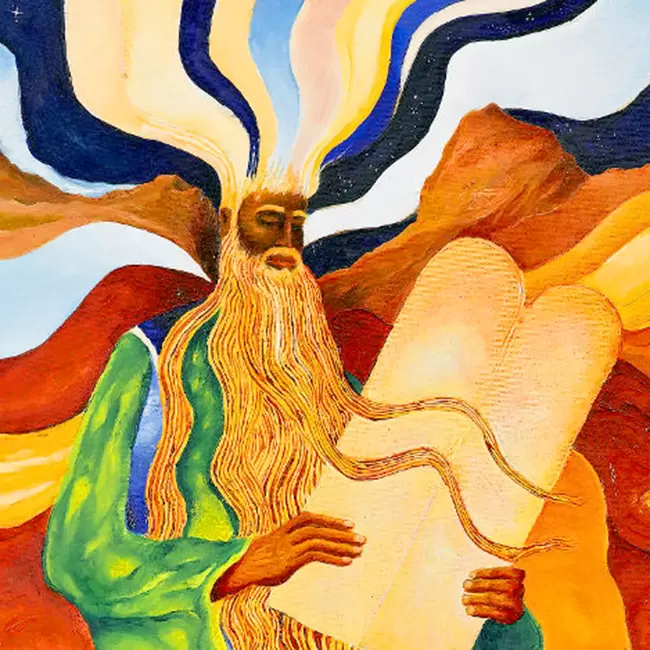
Moses and the Fire of Sinai, by Darius Gilmont

When Moses came down from Mount Sinai with the two tablets of the covenant law in his hands, he was not aware that his face was radiant because he had spoken with the Lord. When Aaron and all the Israelites saw Moses, his face was radiant, and they were afraid to come near him. But Moses called to them; so Aaron and all the leaders of the community came back to him, and he spoke to them. Afterward all the Israelites came near him, and he gave them all the commands the Lord had given him on Mount Sinai.

When Moses finished speaking to them, he put a veil over his face. But whenever he entered the Lord’s presence to speak with him, he removed the veil until he came out. And when he came out and told the Israelites what he had been commanded, they saw that his face was radiant. Then Moses would put the veil back over his face until he went in to speak with the Lord. (New International Version)

I’ve never seen anyone on Halloween dressed like Moses, complete with a shiny glowing face – even though the sight of Moses as he came down the mountain made the Israelites afraid to come near him. The face of Moses had been transformed in a way that made him appear haunted house scary to them.

Moses had actual face-to-face time with God on the mountain. And this seems to have changed his visage. Yet, Moses had stood before God previously without any change to his face. Moses had even interceded with God on other occasions with no special Halloween effect.

God made the new covenant and gave the new tablets because Moses smashed the old ones at the golden calf experience (see Exodus 32, especially verse 19). It could be that, with the radiant face of Moses, God was displaying before the people a tangible sign of God’s presence.

After all, the people had doubted God’s presence again and again during their time in the desert. So, when God’s seemingly ghostly presence was offered this time around, they were too afraid to be that closely connected to the divine.

Just as the loincloth that God made for the disobedient Adam and Eve in the Garden of Eden; and just as the sign of the rainbow God put in the sky after the world wide flood, so the Lord was making a new way for the people, a visible sign and demonstration of God’s presence – which was both reassuring and frightening.

It seems God wanted to show that Moses was still the leader, still God’s man, and that the people needed to not give him a hard time or rebel against God’s commands. At the same time, the Lord was assuring the Israelites that they were not abandoned, that Yahweh remains their God, full of mercy and grace, slow to anger, and abounding in steadfast love.

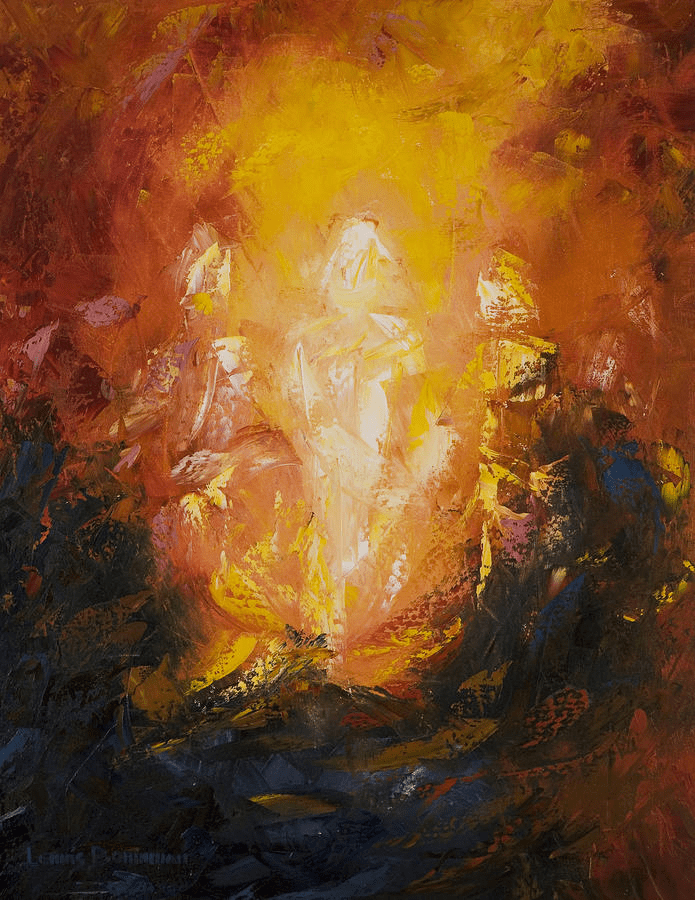
Transfiguration, by Lewis Bowman

In a similar way, the Transfiguration of Jesus in the New Testament Gospels does the same. The disciples were frightened on the mountain, seeing Jesus changed and probably much brighter than the face of Moses. And yet, they were also reassured that God was present with them in the person of Jesus Christ.

Just like the doubting people in Exodus, the disciples caught a glimpse of the great and awesome God, up close and personal. And like the people in the wilderness, the disciples did not understand everything that was going on. Both the ancient Israelites, and Christ’s disciples, did not fully comprehend what God was showing them. Each showed the fear of humanity, while God demonstrated God’s own character of love, faithfulness, and patience with frail humanity.

Certainly, when the face of Moses shone, it was an affirmation of the covenant’s renewal by God. The shiny face is also an indicator of the sort of relationship Moses had with God – and of his openness and vulnerability before God and before the community. It was a sign that Moses trusted God and that Israel, in turn, could trust God and Moses as their leader.

Whether veiled or unveiled, the face of Moses is a reminder of his unique relationship with God and with Israel. It’s a sign of God’s care and continual presence, and that God’s grace prevailed, even in the midst of Israel’s sin.

Another way of putting it, is that the radiant face of Moses represents a reversal of outcome concerning the golden calf idolatrous episode. It represents hope in the midst of a disaster in which all seemed hopeless.

In our own contemporary day and time of national upheavals and national disasters, it’s no wonder that many people would question whether there is any hope for our world, or not. Yet, no matter how dismal it may look; and no matter how unpromising the times we presently live in, today’s story about ancient Israel is a reminder to all of us to keep persevering and hold onto our confident hope that God is with us. There are better days ahead.

It might be Halloween, but the Advent of Christ is just around the corner.

Lord Jesus, Son of Man, Son of God, you encouraged us to come to you, all of us who labor and are heavy laden, and that you will give us rest. So, I now take your yoke upon myself, and learn from you because you are gentle and lowly in heart, and I know I will find rest for my soul. For your yoke is easy, and your burden is light. Help me to refocus from all that’s wrong in this old fallen world, and trust in you, through the enablement of the Holy Spirit. Amen.

Our Dwelling Place (Psalm 90:1-6, 13-17)

Lord, you have been our dwelling place
    in all generations.
Before the mountains were brought forth
    or ever you had formed the earth and the world,
    from everlasting to everlasting you are God.

You turn us back to dust
    and say, “Turn back, you mortals.”
For a thousand years in your sight
    are like yesterday when it is past
    or like a watch in the night.

You sweep them away; they are like a dream,
    like grass that is renewed in the morning;
in the morning it flourishes and is renewed;
    in the evening it fades and withers…

Turn, O Lord! How long?
    Have compassion on your servants!
Satisfy us in the morning with your steadfast love,
    so that we may rejoice and be glad all our days.
Make us glad as many days as you have afflicted us
    and as many years as we have seen evil.
Let your work be manifest to your servants
    and your glorious power to their children.
Let the favor of the Lord our God be upon us
    and prosper for us the work of our hands—
    O prosper the work of our hands! (New Revised Standard Version)

Out of the 150 psalms we have in the biblical psalter, only this one is attributed to Moses. At Mount Sinai, when God was entering into covenant with the Israelites, the Lord had Moses come up the mountain to receive the Law. Meanwhile, the people began to rebel and became idolatrous.

And God was angry with them – so angry that the Lord was ready to do away with them all, and start from scratch with Moses. Yet, at that time, Moses interceded for the people and implored God saying:

“O Lord, why does your wrath burn hot against your people, whom you brought out of the land of Egypt with great power and with a mighty hand? Why should the Egyptians say, ‘It was with evil intent that he brought them out to kill them in the mountains and to consume them from the face of the earth’? Turn from your fierce wrath; change your mind and do not bring disaster on your people. 

Remember Abraham, Isaac, and Israel, your servants, how you swore to them by your own self, saying to them, ‘I will multiply your descendants like the stars of heaven, and all this land that I have promised I will give to your descendants, and they shall inherit it forever.’” (Exodus 32:11-13, NRSV)

Moses prayed for God to turn and change his mind. And, amazingly, God did.

In a terrible event of the golden calf experience, Moses had the wherewithal to step back and see the larger perspective.

And it is this view of time which governs the prayer of Psalm 90. This psalm sees the transience of human life and the permanence of an eternal God.  From this perspective, we gain wisdom in order to pray as we ought. The center of Moses’ prayer states:

For all our days pass away under your wrath;
    our years come to an end like a sigh.
The days of our life are seventy years
    or perhaps eighty, if we are strong;
even then their span is only toil and trouble;
    they are soon gone, and we fly away.

Who considers the power of your anger?
    Your wrath is as great as the fear that is due you.
So teach us to count our days
    that we may gain a wise heart. (Psalm 90:9-12, NRSV)

Today’s psalm lesson is a genuine prayer that begs for divine wisdom so that we may live with an eternal perspective. Armed with such a view, the psalmist prays for divine mercy so that our lives may be redeemed and we might know joy. And from wisdom and mercy, prayer is offered for divine blessing upon the work of our hands.

God’s presence ought to cause the people’s acknowledgment and obedience. If it doesn’t, then that presence can turn to wrath. This is precisely why we need wisdom to live rightly – to seek the Lord and know the spiritual laws of the universe. Ignorance leads to death, but wisdom to life.

We do not always live as we ought – which is why we need to seek grace and mercy from God. The psalmist trusts that God can redeem times of evil and the darkness of the human heart. The Lord is able to overcome for us what we cannot overcome for ourselves. God can (and will, in God’s own good time) deliver us from our unhealthy spiritual condition.

Moses led the people out of Egyptian slavery. But it was God who delivered the Israelites and was present with them always. Eventually, Moses died because God took him (Deuteronomy 34:5). And, at that time, the people had not yet entered the Promised Land; they were landless and homeless.

God, however, was their true dwelling place; the presence of God was there and continues to be there. The Lord has not taken a vacation. The Lord’s presence and power is still operative in this world. It’s the perspective of eternity.

Home, for the believer, is God. The Lord is our dwelling place, with us no matter where we go. God is the One who keeps redeeming our time, blessing us with joy, and prospering our work.

“O God, Our Help in Ages Past” by Isaac Watts, 1719, verses 1-3

O God, our Help in ages past,
our Hope for years to come,
our Shelter from the stormy blast,
and our eternal Home.

Under the shadow of Thy throne
Thy saints have dwelt secure;
sufficient is Thine arm alone,
and our defense is sure.

Before the hills in order stood,
or earth received its frame,
from everlasting Thou art God,
to endless years the same.

Fear vs. Faith (Numbers 13:1-2, 17-33; 14:1-9)

The Spies Return with Discordant Views, by Yoram Raanan

The Lord said to Moses, “Send some men to explore the land of Canaan, which I am giving to the Israelites. From each ancestral tribe send one of its leaders”…

When Moses sent them to explore Canaan, he said, “Go up through the Negev and on into the hill country. See what the land is like and whether the people who live there are strong or weak, few or many. What kind of land do they live in? Is it good or bad? What kind of towns do they live in? Are they unwalled or fortified? How is the soil? Is it fertile or poor? Are there trees in it or not? Do your best to bring back some of the fruit of the land.” (It was the season for the first ripe grapes.)

So they went up and explored the land from the Desert of Zin as far as Rehob, toward Lebo Hamath. They went up through the Negev and came to Hebron, where Ahiman, Sheshai and Talmai, the descendants of Anak, lived. (Hebron had been built seven years before Zoan in Egypt.) 

When they reached the Valley of Eshkol, they cut off a branch bearing a single cluster of grapes. Two of them carried it on a pole between them, along with some pomegranates and figs. That place was called the Valley of Eshkol because of the cluster of grapes the Israelites cut off there. At the end of forty days they returned from exploring the land.

They came back to Moses and Aaron and the whole Israelite community at Kadesh in the Desert of Paran. There they reported to them and to the whole assembly and showed them the fruit of the land. They gave Moses this account:

“We went into the land to which you sent us, and it does flow with milk and honey! Here is its fruit. But the people who live there are powerful, and the cities are fortified and very large. We even saw descendants of Anak there. The Amalekites live in the Negev; the Hittites, Jebusites and Amorites live in the hill country; and the Canaanites live near the sea and along the Jordan.”

Then Caleb silenced the people before Moses and said, “We should go up and take possession of the land, for we can certainly do it.”

But the men who had gone up with him said, “We can’t attack those people; they are stronger than we are.” And they spread among the Israelites a bad report about the land they had explored. They said, “The land we explored devours those living in it. All the people we saw there are of great size. We saw the Nephilim there (the descendants of Anak come from the Nephilim). We seemed like grasshoppers in our own eyes, and we looked the same to them.”

That night all the members of the community raised their voices and wept aloud. All the Israelites grumbled against Moses and Aaron, and the whole assembly said to them:

“If only we had died in Egypt! Or in this wilderness! Why is the Lord bringing us to this land only to let us fall by the sword? Our wives and children will be taken as plunder. Wouldn’t it be better for us to go back to Egypt?” And they said to each other, “We should choose a leader and go back to Egypt.”

Then Moses and Aaron fell face down in front of the whole Israelite assembly gathered there. Joshua son of Nun and Caleb son of Jephunneh, who were among those who had explored the land, tore their clothes and said to the entire Israelite assembly:

“The land we passed through and explored is exceedingly good. If the Lord is pleased with us, he will lead us into that land, a land flowing with milk and honey, and will give it to us. Only do not rebel against the Lord. And do not be afraid of the people of the land, because we will devour them. Their protection is gone, but the Lord is with us. Do not be afraid of them.” (New International Version)

“Pessimism has done infinitely more harm than atheism.”

Pierre Teilhard de Chardin

Fear can be debilitating. At its core, we fear either what we don’t know, or believe to be bad. For example, if I am convinced that my boss does not have my best interests at mind, then I will likely be afraid and hold back.

The majority of the ancient Israelites were paralyzed by fear because of the anxiety and fearfulness of those who came back from spying out the Promised Land. They had a low view of God. Yet Caleb, and only a few others, acknowledged that God is good for divine promises, and so, trusted the Lord completely in confidence, not fear.

If we view God as being angry all the time, then we will not use the incredible gifts given to us for fear of messing up and bringing divine wrath upon us. We will be plagued with uncertainty and only see giants in the land who we cannot begin to deal with.

Yet, if we commit ourselves to knowing God through seeking the divine will and trusting in divine promises, then we understand that God is gracious and generous, always having our backs. We live by faith, not by sight, and discern that giants in the land are really nothing more than gnats.

Fear is maybe the devil’s greatest tool to prevent God’s people from being productive and responsible in serving the church and the world. Beneath that fear are powerful feelings of inferiority, inadequacy, and a low view of self – which is really born of a low view of God. Being afraid wastes what impact a person could have for God, and waters-down life so that it’s ineffective.

Enjoy the Lord, and he will give what your heart asks.

Psalm 37:4, CEB

We are to enjoy the gracious and generous God; and in our enjoyment, the Lord places within us godly dreams that are a delight for God to fulfill. Our enjoyment of the Lord gives us the security and confidence to act upon those godly desires and wed them to divine promises from Holy Scripture.   

But put fear in the mix, and it dilutes and destroys everything. It makes you do nothing. And the fear is a result of not knowing the Lord, of not seeking God’s mind or will.

God had a grand vision and a big dream for the Israelites to enter the Promised Land. But ten of the twelve spies who came back after checking out the land were paralyzed by fear, feeling like grasshoppers next to the people in the land. 

Caleb and Joshua, however, had a different view of taking the land because they had a different view of God. They didn’t see giants – they saw a gracious and generous God who could easily take care of whoever might be in the land, and they wanted to act on the faith they had in a mighty and merciful God. 

The God of the other spies wasn’t big enough to handle the giants. Their low view of themselves as grasshoppers betrayed their low view of God.

“We wrap a lot of our fears in morbidly sanctified self-belittling.  We piously cover this self-despising and call it consecration and self-crucifixion.”

David Seamands

Too many people feel good about feeling bad – and then use those feelings to make spiritual excuses for not exploring what God promises, expects, commands, and dreams for them. 

It is high time for us to get into the world with our witness in a far greater way because we serve a God who sees giants as gnats; and we will, too, if we have a high view of God.

Yet, holding us back, is fear of criticism, of taking a risk, of going outside of the way we’ve always done it, and of what others may think or say. 

If you once dreamed something and you think your dream is dead because you destroyed it by your sins or bad habits, you are wrong. Dreams are destroyed by fear, by being tricked into thinking that we are nothing but grasshoppers and God doesn’t care, and so we do nothing.

Unfortunately, it appears the most common way of coping with feelings of fear, insecurity, and inferiority is by withdrawing from other people – because you cannot give yourself fully to your family, church, neighborhood, vocation, and the world without a healthy robust view of and relationship with God. 

Give God a chance to work in and through your life. May you step up and step out because you have a God behind you that is gracious and generous. Amen.