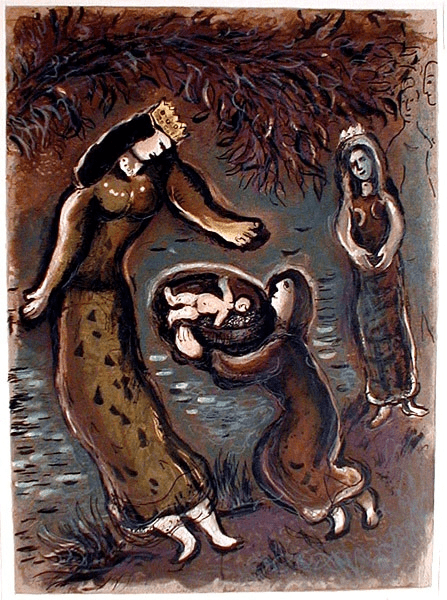
God Will Make a Way (Exodus 2:1-10)

Moses is saved from the water by Pharaoh’s daughter, by Marc Chagall, 1966

Now a man from Levi’s household married a Levite woman. The woman became pregnant and gave birth to a son. She saw that the baby was healthy and beautiful, so she hid him for three months. When she couldn’t hide him any longer, she took a reed basket and sealed it up with black tar. She put the child in the basket and set the basket among the reeds at the riverbank. The baby’s older sister stood watch nearby to see what would happen to him.

Pharaoh’s daughter came down to bathe in the river, while her women servants walked along beside the river. She saw the basket among the reeds, and she sent one of her servants to bring it to her. When she opened it, she saw the child. The boy was crying, and she felt sorry for him. She said, “This must be one of the Hebrews’ children.”

Then the baby’s sister said to Pharaoh’s daughter, “Would you like me to go and find one of the Hebrew women to nurse the child for you?”

Pharaoh’s daughter agreed, “Yes, do that.” So the girl went and called the child’s mother. Pharaoh’s daughter said to her, “Take this child and nurse it for me, and I’ll pay you for your work.” So the woman took the child and nursed it. After the child had grown up, she brought him back to Pharaoh’s daughter, who adopted him as her son. She named him Moses, “because,” she said, “I pulled him out of the water.” (Common English Bible)

A new Pharaoh was enthroned in Egypt. Enough time had gone by that the legacy of Joseph as the administrator in saving many Egyptian people was lost. So, because the Israelites had grown to such large numbers, Pharaoh was afraid.

The politics of fear typically results in somebody getting oppressed. Indeed, fear became the driving force to a series of escalating oppressive policies initiated by Pharaoh, even to the point of planned infanticide. The Jewish midwives were instructed toward this end.

But the midwives did not fear the Egyptian Pharaoh. Instead they had a healthy fear of God (Exodus 1:17, 21). With such rightly ordered fear, the Jewish midwives defied the order of Pharaoh and openly disobeyed the royal command to murder Hebrew boys.

Here then, we have the setting for a special Hebrew baby to be born named Moses. He is the healthy child of two devout Levites. And although God’s name is not referenced in the verses for today, we can nonetheless see the providence and protection of the Lord within the narrative.

Through a complex chain of events, both the birth mother and the royal daughter care for this baby, protecting his life, with a divine provision for the needs of the infant Moses. Most stories in the Old Testament have contrasting characters within them, and today’s is no exception.

Pharaoh was the ruler over all of Egypt, and yet, he feared a loss of power and the status quo because of the Israelites – even though he reigned during a time of political peace, with hegemony reaching into the Middle East. As Pharaoh’s paranoid fear rose, so did God’s response of divine sovereignty over him, by providing protection against his diabolical intentions.

In contrast to Pharaoh, a powerless and non-descript Hebrew couple were married, conceived and bore a family of a daughter and two sons – Moses being the youngest. They had nothing, yet everything; whereas Pharaoh had everything, yet nothing. Thriving and flourishing has to do with a lot more than wealth and material resources.

Maternal care is powerful. And it finds a way to win the day and not only save a baby, but also to ensure that the baby grows, lives, and thrives. No royal edict can defeat the resilient strength of maternal compassion.

Despite Pharaoh’s increasing oppression, the compassion of several women ends up raising the very one who will lead the Israelites into liberation from this oppression.

With the Lord, a way will be found where there is no way. God + nothing = everything.

For us today, there is often a tendency to look back on the good old days when God did great things, and to look ahead when the Lord will return and make all things new and right. Yet we too often neglect to be mindful and live in the present moment, and know the God who is present with us right now.

We may remember the awesome deeds that God once did; and rejoice in biblical stories which demonstrate the Lord’s power, provision, and protection. We may look forward to the fulfillment of God’s promises in the person of Jesus when he returns, and gain hope from that.

Now, in this present evil age, and in this messed up world, we also have the God of the present tense. God will make a way, in this present time, where there seems to be no way. God is doing something new and amazing for us today.

And that way will be clear enough for us to know – and incredible enough for us to not predict or imagine. For God’s watch-care and deliverance can (and does) take many forms. When the Lord fulfills divine plans, it sometimes comes in the most creative and incredible way possible, so that we will have no doubt where it came from.

“God Will Make a Way” by Don Moen

God will make a way, Where there seems to be no way
He works in ways we cannot see, He will make a way for me
He will be my guide, Hold me closely to His side
With love and strength, For each new day
He will make a way He will make a way

By a roadway in the wilderness, He’ll lead me
And rivers in the desert will I see
Heaven and earth will fade
But His Word will still remain
He will do something new today


Deborah the Prophet and Judge (Judges 4:8-24)

Illustration from “Woman in Sacred History, A Series of Sketches Drawn from Scriptural, Historical, and Legendary Sources” by Harriet Beecher Stowe, 1873

“I’m not going unless you go!” Barak told her.

“All right, I’ll go!” she replied. “But I’m warning you that the Lord is going to let a woman defeat Sisera, and no one will honor you for winning the battle.”

Deborah and Barak left for Kedesh, where Barak called together the troops from Zebulun and Naphtali. Ten thousand soldiers gathered there, and Barak led them out from Kedesh. Deborah went too.

At this time, Heber of the Kenite clan was living near the village of Oak in Zaanannim, not far from Kedesh. The Kenites were descendants of Hobab, the father-in-law of Moses, but Heber had moved and had set up his tents away from the rest of the clan.

When Sisera learned that Barak had led an army to Mount Tabor, he called his troops together and got all 900 iron chariots ready. Then he led his army away from Harosheth-Ha-Goiim to the Kishon River.

Deborah shouted, “Barak, it’s time to attack Sisera! Because today the Lord is going to help you defeat him. In fact, the Lord has already gone on ahead to fight for you.”

Barak led his 10,000 troops down from Mount Tabor. And during the battle, the Lord confused Sisera, his chariot drivers, and his whole army. Everyone was so afraid of Barak and his army, that even Sisera jumped down from his chariot and tried to escape. Barak’s forces went after Sisera’s chariots and army as far as Harosheth-Ha-Goiim.

Sisera’s entire army was wiped out. Only Sisera escaped. He ran to Heber’s camp, because Heber and his family had a peace treaty with the king of Hazor. Sisera went to the tent that belonged to Jael, Heber’s wife. She came out to greet him and said, “Come in, sir! Please come on in. Don’t be afraid.”

After they had gone inside, Sisera lay down, and Jael covered him with a blanket. “Could I have a little water?” he asked. “I’m thirsty.”

Jael opened a leather bottle and poured him some milk, then she covered him back up.

“Stand at the entrance to the tent,” Sisera told her. “If someone comes by and asks if anyone is inside, tell them ‘No.’ ”

Sisera was exhausted and soon fell fast asleep. Jael took a hammer and drove a tent-peg through his head into the ground, and he died.

Meanwhile, Barak had been following Sisera, and Jael went out to meet him. “The man you’re looking for is inside,” she said. “Come in and I’ll show him to you.”

They went inside, and there was Sisera—dead and stretched out with a tent-peg through his skull.

That same day God defeated the Canaanite King Jabin while the Israelites looked on, and his army was no longer powerful enough to attack the Israelites. Jabin grew weaker while the Israelites kept growing stronger, until at last the Israelites destroyed him. (Contemporary English Version)

The biblical book of the Judges is a sad account of Israel’s downward spiral into ignorance and wickedness. Because of this situation, God would occasionally raise up leaders, or judges, to help the people whenever they cried out in their distress.

Deborah was one of those judges, and the only woman leader during the time of the judges. She was recognized in Israel as both a judge and a prophet. In the time of Deborah, the Israelites had once again become oppressed by Canaanites who had not been dislodged from the land.

Having both legal and prophetic authority, Deborah called for a holy war and became the leader. Her army general, Barak, mustered the troops and led them into battle. The opposing general, Sisera, drew up his forces to attack, but God got involved. The Lord threw Sisera’s soldiers into a panic, and the general ended up fleeing for his life, his army defeated.

Sisera had a safe place in mind to go. Heber, an ally and friend, was in the area with his tents. So, Sisera believed he would find hospitality and protection. Heber’s wife, Jael, however, was no friend of Sisera. She took care of him, lulled him to sleep, and then proceeded to kill him with some surprisingly skilled precision.

Eventually, Barak came along, and Jael showed him the dead general. Deborah’s prophecy that a woman would prevail was realized. We are not told in the text why Jael sided with the Israelites and deliberately brought an end to Sisera. Yet, by killing him, Jael clearly proved sympathetic to Israel.

Whatever was really going on there, it’s illustrative of a prominent theme in the book of Judges. Since the Canaanites were not expelled completely from the land, they would continue to exert religious and ethical influence on the Israelites.

Judges is a book that, as you read it, becomes progressively mixed between Israelite and Canaanite – piety with the Lord and pagan practices were more and more synchronized, so that an odd religious amalgam happened. The people claimed to follow the Lord, and yet, they became increasingly violent and adoptive of the surrounding nations with their bloody practices.

We have, dramatized before us in today’s lesson, the effects and consequences of only a partial obedience to God. Like putting one bad apple into the pie, it causes the whole thing to become rotten.

In our own day, it will not do to dedicate a Sunday or a specific time to the Lord, then walk away and do whatever you want the rest of the time, without any concern to the words and ways of Jesus. We will only please the Lord if we engraft God’s universal law into our entire lives, and not just the religious parts.

Eventually a life only partially attentive to God will crack and then crumble to pieces. We must plan to live the spiritual life with perseverance, endurance, and consistency, each and every day of our lives.

The foundation of our life is built on the cornerstones of the body, mind, emotions, and spirit. A whole and healthy life pays attention to all four with equal consideration, energy, and focus. It won’t do to have any one cornerstone a different size than the others; a life cannot be constructed on such an uneven foundation.

This is why the Israelites in the time of the judges found themselves in such dire straits, time and time again. And it is also a testament to the infinite patience and grace of God, that the Lord continued to respond with mercy whenever the people cried out.

What’s more, today’s story points to the necessity for gender equity and inclusion, as well. We must pay attention to everyone in the community, and not put limitations on particular individuals because they are different. Deborah and Jael, the women, were the heroes of the story – and not just because the men didn’t step up – but because they were the divinely ordained people for the job.

We have enough on our plate in dealing with issues of obedience and disobedience, without adding to it by defining which people can be used of God, or not. Commit yourself to the Lord with your whole life, and the rest will mostly work itself out.

I thank you, Lord, that you love to do extraordinary things through ordinary people like me. Release me from any limitations I, others, or the enemy have put on my life that have kept me from the great plans you have for me, so that I might wake up and arise to shine the glory of the Lord! Amen.

A Real Change of Life (Matthew 12:43-45)

“When an evil spirit leaves a person, it goes into the desert, seeking rest but finding none. Then it says, ‘I will return to the person I came from.’ So it returns and finds its former home empty, swept, and in order. Then the spirit finds seven other spirits more evil than itself, and they all enter the person and live there. And so that person is worse off than before. That will be the experience of this evil generation.” (New Living Translation)

Nature abhors a vacuum. A tilled plot of soil will be overtaken with weeds if nothing is planted and nurtured in the turned-over dirt. 

The pecking order of a brood of chickens cannot handle the death of the top hen without filling the position almost immediately. 

In the spiritual realm, the exorcising of a demon will not simply leave a person empty of evil – their life will be filled with something in its place.

Jesus told a story about a man who was delivered from an unclean (evil) spirit. It’s a powerful and simple narrative on the necessity of true repentance, that is, on what a real change of life is like. 

Genuine freedom is more than getting rid of something bad and destructive; the evil must be replaced with something good and useful. In other words, biblical repentance, a true transformation of a person, is both a turning away from ungodliness and an embrace of righteousness.

We are delivered from evil so that we can start living into right and peaceful relationships, as God intends for us.

For example, the Apostle Paul exhorted the Ephesian believers to not only stop stealing but also to get a job and start sharing with others. They were not only to stop lying and using their tongues for gossip and slander and start using their words to speak truth that builds up others. (Ephesians 4:25-32)

The spiritual principle is the same as the nature principle: A empty vacuum will always be filled. The man who did not fill his life with God ended up having a problem with evil seven times greater than when he started. If anything, or anyone, is emptied of its unhealthy elements and practices, it is imperative that the hole be immediately filled with healthy disciplines for life.

Whether dealing with addictions, bad habits, or any kind of evil influence, a two-pronged approach is needed for its eradication. We expel the evil by replacing it with godliness. 

For example, the man struggling with pornography or adultery must not only stop the behavior but take up the mantle of being a champion for women’s issues; or the woman who has no healthy boundaries and allows herself to be used and abused must not only separate from the problem or person but adopt her identity in Christ as a precious child of God and enforce righteous limitations. 

These examples are not meant to be simplistic answers to complex situations. Rather, they illustrate why so many people do not experience freedom and continue to have even greater enslavement to their passions and sufferings. Freedom is realized through replacing old practices with new disciplines that directly attack the old.

We all have needs. How we get those needs met is often a mixed bag of both legitimate and illegitimate ways. In a perfect world, everyone would be aware of their needs and be able to express them to one another without shame, anxiety, or anger. Since we live on a blemished fallen planet, we end up trying to meet our needs indirectly through hustling for love, hoarding resources, and controlling others – all harmful ways which destroys souls and relationships.

In order to focus on meeting our needs in a wise and healthy manner, we must take a step beyond ending a toxic relationship, cutting up a credit card, or saying “no” to another responsibility. We often get into our mess to begin with because we are out of touch with ourselves and our needs. We need affection and encouragement, and there is no shame in needing this. We need security and safety, and there is no problem in acquiring this. There are some things we need to control, and that is okay.

If we fail to address our needs, we might do the necessary work of deliverance, then turn right around and become worse off than before by filling the empty place of our lives with:

  • Being all things to all people, as if we were the Messiah.
  • Being successful so that we stay ahead of being needy.
  • Pulling inside ourselves and trusting nobody.
  • Distancing from our needs and pretending they are not there.
  • Being continually vigilant so that we are never hurt that way again.
  • Keeping a positive spin on everything, as if there is no negative stuff in the world.
  • Challenging other’s opinions and behaviors to keep the focus off our needs.
  • Becoming a wallflower so that we can never be the brunt of someone else’s vitriol or evil.

Instead, we can let Jesus fill the emptiness with love, purpose, peace, joy, attention, and grace. Christ is the Savior who delivers us from evil, and the Holy Spirit is the Sanctifier who carefully applies the work of salvation to our lives. When our hearts and minds are full of God, there is no place for the demons to get in.

True change and transformation equally forsakes evil and embraces righteousness; replaces the unhealthy with the healthy; jettisons the illegitimate and seeks the legitimate; and puts away unnecessary suffering and pursues peace and joy in the Spirit.

O God, I no longer want to live with saying I’m sorry and going right back to the old pig slop of sin. I cannot change on my own. I need Jesus to both take away the sin and give me a new life of living for him. Help me to make choices that put to death the old way of life, and the courage to live into my forgiveness in the power of the Holy Spirit. Amen.

Stop and Listen (Judges 2:16-23)

Yahweh raised up judges, who saved them out of the hand of those who plundered them. Yet they didn’t listen to their judges; for they prostituted themselves to other gods, and bowed themselves down to them. They quickly turned away from the way in which their fathers walked, obeying Yahweh’s commandments. They didn’t do so. 

When Yahweh raised up judges for them, then Yahweh was with the judge, and saved them out of the hand of their enemies all the days of the judge; for it grieved Yahweh because of their groaning by reason of those who oppressed them and troubled them. 

But when the judge was dead, they turned back, and dealt more corruptly than their fathers in following other gods to serve them and to bow down to them. They didn’t cease what they were doing, or give up their stubborn ways. 

Yahweh’s anger burned against Israel; and he said, “Because this nation transgressed my covenant which I commanded their fathers, and has not listened to my voice, I also will no longer drive out any of the nations that Joshua left when he died from before them; that by them I may test Israel, to see if they will keep Yahweh’s way to walk therein, as their fathers kept it, or not.” So Yahweh left those nations, without driving them out hastily. He didn’t deliver them into Joshua’s hand. (World English Bible)

Listening seems to be a lost art and a forgotten skill. Genuine focused attention on another person through careful listening requires a lot of practice. Maybe that’s one reason there is so little authentic hearing these days – it’s just so doggone hard. Throw into the mix that a lot of folks like hearing their own voice, and you have a recipe for poor communication.

God is good at everything, especially listening. The Lord is the Master Listener. In fact, God is so good at listening, that divine ears hear the prayers of people all over the world. The same careful attention is given to both the little girl in the West who intercedes for her parents and teddy bear at night, as well as halfway around the world with the national leader who requests wisdom for decisions in a heated meeting.

The Lord God Almighty is gracious, merciful, and kind, hearing us when we call, and listening when we our hearts long for the divine. God always bends low in a posture of listening to all creation.

As creatures in the image of God, we were meant from the very beginning of creation to listen well. Yet, ever since humanity fell into disobedience, people have the tendency to talk more than they listen; and to sometimes refuse to hear what another is saying. There are even those who ignore God’s speech.

The ancient Israelites in the book of Judges were fickle in their attention to God. When things were bad, they cried out to the Lord. Because God attentively listens, they were heard, and a merciful divine response came. However, when things were better, the people went about their business, forgot about God’s deliverance, and stopped listening.

For the waywardness of the simple will kill them,
    and the complacency of fools will destroy them;
but whoever listens to me will live in safety
    and be at ease, without fear of harm. (Proverbs 1:32-33, NIV)

God sent judges, rulers, and leaders, to the people for their own welfare. But instead of graciously receiving this gift of leadership from God, the people were quick to be unfaithful; they refused to listen to the divinely sent judges.

Listening, really listening with focused attention, was not a high value to the people. They talked and talked, incessantly droning on, and so could not hear what God through the divinely appointed rulers was saying.

We must learn to listen well because God listens well. We need to pay attention and hear because we are designed by our Creator to do so.

Perhaps our society would not be so perpetually upset and polarized if we would just take the time to notice and receive advice through a posture of humble hearing.

Try this little exercise of listening: Take just ten minutes and do not talk, read, check your phone, or do anything but listen to the sounds around you…. What do you hear?… What do you think God is saying to you through those sounds?… How will you respond?

Stillness reveals the secrets of eternity, allowing us to hear the still small voice of God. Sound is amplified through silence.

If we desire a clear word from the Lord, then stillness and silence are the spiritual practices that allow it to happen. Life’s most precious moments are not always loud or uproarious; silence and stillness have their own virtues which connect us with the divine.

Never underestimate the power of doing nothing, and simple listening.

God of all creation, you have made me with two ears for listening. Help me to so hear and distinguish you through creation, and the voices of others, so that I will follow Christ with confidence in my daily life.

Almighty and everlasting God, you are always more ready to hear than we to pray, and to give more than we either desire or deserve. Pour upon us the abundance of your mercy, forgiving us those things of which our conscience is afraid, and giving us those good things for which we are not worthy to ask, except through the merits and mediation of Jesus Christ our Savior, who lives and reigns with you and the Holy Spirit, one God, forever and ever. Amen.