Learning to Trust (Psalm 4)

Answer me when I cry out, my righteous God!
    Set me free from my troubles!
        Have mercy on me!
        Listen to my prayer!

How long, you people,
    will my reputation be insulted?
How long will you continue
    to love what is worthless
    and go after lies?
Know this: the Lord takes
    personal care of the faithful.
The Lord will hear me
    when I cry out to him.
So be afraid, and don’t sin!
    Think hard about it in your bed
    and weep over it!
Bring righteous offerings,
    and trust the Lord!

Many people say,
    “We can’t find goodness anywhere.
    The light of your face has left us, Lord!”
But you have filled my heart with more joy
    than when their wheat and wine are everywhere!
I will lie down and fall asleep in peace
    because you alone, Lord, let me live in safety. (Common English Bible)

The psalmist, David, was a man after God’s own heart. But that did not mean that he was inoculated from trouble and hardship.

David had a lot of adversity and much difficulty throughout his life. So, it only made sense to him to cry out to the Lord for deliverance and help. God had helped David in the past, and David was confident that the Lord would help him yet again.

We all find ourselves in a tight spot, between a rock and hard place, at times. It’s what we do when we are in that position that is critical. David had a history of looking to God, seeking God’s grace, and soliciting answers to prayer.

David, the psalmist, was a real victim of slander and lies. More than once in his life, he had people out to get him, to actually take his life. Whatever your understanding of stress is, it doesn’t get much more stressful than someone hunting you down like an animal to literally kill you. I’m sure that many times David wondered how long this surreal madness was going to go on.

Whenever we are especially stressed, it can be hard to even breathe. If we aren’t mindful of ourselves, we will take lots of short staccato breaths that only feed anxious signals to the brain. It leaves us in a perpetual state of hypervigilance, almost unable to pray and have thoughts of God.

But we absolutely need to take deep breaths and trust in God’s sustaining presence. We’ll never get to sleep, nor stay at rest, without a sense of the divine presence.

Insomnia happens for a lot of reasons. Many people have diagnosed sleep disorders that are very real medical conditions. Others can’t get a good night’s rest because of poor sleep hygiene by not planning for adequate sleep, drinking too much caffeine during the day, inattention to a healthy diet, or a host of other habits. Some have issues of chronic pain which can make it difficult to sleep well.

And then there are yet others who suffer from racing thoughts, anxiety, and depression. The stress of their waking life is so significant that several hours of deep sleep seems only like some pipe dream. It’s impossible to sleep when the weight of the day is pressing on you. Finding a sense of calm before bed isn’t easy—especially when you can’t unplug from the demands of your day.

I am wondering if many of us will even allow ourselves to unplug and establish some quiet wind-down time. Reading a real book – not one on a backlit tablet device – or talking with a friend or family member are simple ways of easing our anxiety and letting rest come.

The psalmist, David, had a regular practice of meditating on Scripture, recalling the events of God, and expressing gratitude and praise for answered prayer. Each of us has a built-in spiritual rhythm just like we have a circadian rhythm. Always trying to buck those God-given rhythms will inevitably result in being “off,” at the least, and experiencing debilitating depression, at the worst.

Yet, when we learn to move with the unforced rhythms of grace, there is a groove we slip into which serves us well. In other words, what I am trying to say, is that by allowing ourselves to be human, we can discover health.

David neither had delusions, nor illusions, about his enemies, friends, others, and himself. He didn’t try to be somebody he was not. Instead, David had firm and confident convictions about God and the place of prayer.

By taking in a steady diet of David’s psalms, we can learn to hold together both faith and doubt, confidence and confusion, perseverance and perplexity, in ways which strengthens our faith.

Everyone of us who desire God must learn to trust; and it’s in the school of hard knocks where our faith is developed in order to sustain us for a lifetime of service and resilience.

There will always be those who believe ill of us through slander, lies, or outright oppression. In such times, let’s cry out to God for both peace and guidance; and ask the Lord for help in learning to breathe, lie down, and get some rest.

As our trust develops, we may even find the grace and courage to confront our oppressors, so that they can seek their own peace with God.

May Christ be with you, and within you;
May Christ go before you, and linger behind you;
May Christ be on your right, and on your left;
May Christ hover above you, and bring support beneath you;
May the Lord Jesus Christ completely and thoroughly surround you, now and forever. Amen.

Keep Your Spiritual Confidence (Psalm 135)

Praise the Lord!
    Praise the name of the Lord;
    give praise, O servants of the Lord,
you who stand in the house of the Lord,
    in the courts of the house of our God.
Praise the Lord, for the Lord is good;
    sing to his name, for he is gracious.
For the Lord has chosen Jacob for himself,
    Israel as his own possession.

For I know that the Lord is great;
    our Lord is above all gods.
Whatever the Lord pleases he does,
    in heaven and on earth,
    in the seas and all deeps.
He it is who makes the clouds rise at the end of the earth;
    he makes lightnings for the rain
    and brings out the wind from his storehouses.

He it was who struck down the firstborn of Egypt,
    both humans and animals;
he sent signs and wonders
    into your midst, O Egypt,
    against Pharaoh and all his servants.
He struck down many nations
    and killed mighty kings—
Sihon, king of the Amorites,
    and Og, king of Bashan,
    and all the kingdoms of Canaan—
and gave their land as a heritage,
    a heritage to his people Israel.

Your name, O Lord, endures forever,
    your renown, O Lord, throughout all ages.
For the Lord will vindicate his people
    and have compassion on his servants.

The idols of the nations are silver and gold,
    the work of human hands.
They have mouths, but they do not speak;
    they have eyes, but they do not see;
they have ears, but they do not hear,
    a nose, but there is no breath in their mouths.
Those who make them
    and all who trust them
    shall become like them.

O house of Israel, bless the Lord!
    O house of Aaron, bless the Lord!
O house of Levi, bless the Lord!
    You who fear the Lord, bless the Lord!
Blessed be the Lord from Zion,
    he who resides in Jerusalem.
Praise the Lord! (New Revised Standard Version)

Idolatry in the Bible is greatly discouraged. To trust in or worship an idol is a big deal in Holy Scripture, precisely because it is totally worthless. Trusting an idol to do anything for you would be like talking to a bowling ball and asking it to balance your checkbook. In other words, there is no chance whatsoever of a bowling ball or an idol helping you in your life with anything at all.

An idol has zero power or authority to accomplish what you need. Idols are impotent and helpless and can do nothing. Anybody who focuses on something that has no agency to act in the world will soon lose their own personal agency to act in the world. One who practices idolatry will become just like their idol: worthless.

So, if idolatry is so irrelevant, then why do many people put their trust in “gods” other than God? Because so many of us have a form of spiritual attention deficit disorder in which we become attracted to all the shiny deities in front of us. It is no coincidence that idols are consistently lacquered over with gold or silver in order to display an extravagant wealth, communicate prestige, and attract new worshipers.

Slick idol marketing presents that worthless thing as valuable, as something you cannot live without. This ability to seduce others into placing trust and value into the irrelevant object is largely why much of the Old Testament condemns idolatry and encourages destruction of idols.

But this is how you must deal with them; break down their altars, smash their pillars, hew down their sacred poles, and burn their idols with fire… The images of their gods you shall burn with fire. Do not covet the silver or gold that is on them and take it for yourself, because you could be ensnared by it; for it is abhorrent to the Lord your God. (Deuteronomy 7:5, 25, NRSV)

Idolatry drains the energy we could be using for worship and life toward the One true God. The idols are an affront to a committed life of faith relational connections. They are a distraction, siphoning away resources that are better used elsewhere. Perhaps most of all, idolatry skews our worldview; the idolator ceases using common sense, and begins moving toward useless endeavors that do not enrich the entire community.

Instead, we can praise the Lord, because God is good and has our best interests at mind. Not only that, but God also has the ability to follow through with divine promises made. A bowling ball can’t do that! (it can’t even make it so you can throw a perfect 300 bowling game).

God is gracious, and holds us close. We belong to God. Remember all the ways the Lord has delivered people in the past, and let that memory give you confidence moving forward.

One of the best ways to know if the worship of God is intact, is by noticing if worshipers act in generous, gracious ways to uphold the unity and peace of the faith community.

But if a community is characterized by division and special interest groups, and by distortions of faith that only champion their particular brand of belief, then you are likely looking at idolatry. If you observe this, get out fast, while you can.

Whenever people are able to bless one another and bless the world, they themselves have received blessing from God. But if they continually curse each other and bemoan the world, then its time to leave. This earthly life is too short for messing around with a bunch of useless idolatry that gets us nowhere.

Maintaining faith in God – and not in something or someone else – will enable us to deal with our doubts and see the power of the Lord all around us.

O God, come to my assistance; O Lord, make haste to help me. Glory to the Father, and to the Son, and to the Holy Spirit—as it was in the beginning, is now, and will be forever. Amen. Alleluia.

Handling a Stressful Situation (Daniel 2:24-49)

Daniel Interprets Nebuchadnezzar’s Dream, by David Martin (1639-1721)

So Daniel went to Arioch, the man the king had appointed to wipe out Babylon’s sages. Daniel said to him, “Don’t wipe out the sages of Babylon! Bring me before the king, and I will explain the dream’s meaning to him.”Wasting no time, Arioch brought Daniel before the king, telling him, “I have found someone from the Judean exiles who will tell the dream’s meaning to the king.”

In reply the king said to Daniel (whose name was Belteshazzar), “Can you really tell me the dream that I saw, as well as its meaning?”

Daniel answered the king, “Sages, enchanters, dream interpreters, and diviners can’t explain to the king the mystery he seeks.But there is a God in heaven, a revealer of mysteries, who has shown King Nebuchadnezzar what will happen in the days to come! Now this was your dream—this was the vision in your head as you lay in your bed:

“As you lay in bed, Your Majesty, your thoughts turned to what will happen in the future. The revealer of mysteries has revealed to you what will happen. Now this mystery was revealed to me, not because I have more wisdom than any other living person but so that the dream’s meaning might be made known to the king, and so that you might know the thoughts of your own mind.

“Your Majesty, you were looking, and there, rising before you, was a single, massive statue. This statue was huge, shining with dazzling light, and was awesome to see.The statue’s head was made of pure gold; its chest and arms were made from silver; its abdomen and hips were made of bronze.Its legs were of iron, and its feet were a mixture of iron and clay.You observed this until a stone was cut, but not by hands; and it smashed the statue’s feet of iron and clay and shattered them.Then all the parts shattered simultaneously—iron, clay, bronze, silver, and gold. They became like chaff, left on summer threshing floors. The wind lifted them away until no trace of them remained. But the stone that smashed the statue became a mighty mountain, and it filled the entire earth.

“This was the dream. Now we will tell the king its meaning:You, Your Majesty, are the king of kings. The God of heaven has given kingship, power, might, and glory to you!God has delivered into your care human beings, wild creatures, and birds in the sky—wherever they live—and has made you ruler of all of them. You are the gold head.But in your place, another kingdom will arise, one inferior to yours, and then a third, bronze kingdom will rule over all the earth.Then will come a fourth kingdom, mighty like iron. Just as iron shatters and crushes everything; so like an iron that smashes, it will shatter and crush all these others.As for the feet and toes that you saw, which were a mixture of potter’s clay and iron, that signifies a divided kingdom; but it will possess some of the unyielding strength of iron. Even so, you saw the iron mixed with earthy clayso that the toes were made from a mixture of iron and clay. Part of the kingdom will be mighty, but part of it will be fragile.Just as you saw the iron mixed with earthy clay, they will join together by intermarrying, but they will not bond to each other, just as iron does not fuse with clay.

“But in the days of those kings, the God of heaven will raise up an everlasting kingdom that will be indestructible. Its rule will never pass to another people. It will shatter other kingdoms. It will put an end to all of them. It will stand firm forever, just like you saw when the stone, which was cut from the mountain, but not by hands, shattered the iron, bronze, clay, silver, and gold. A great God has revealed to the king what will happen in the future. The dream is certain. Its meaning can be trusted.”

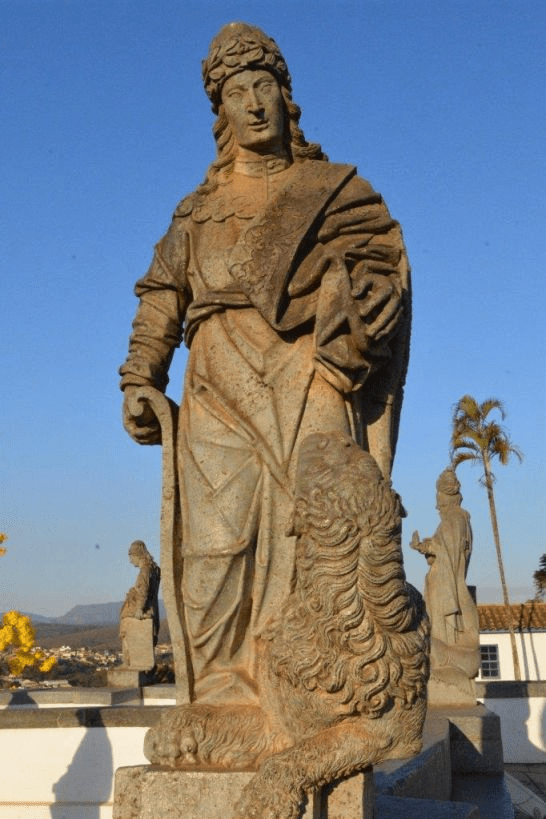
The Prophet Daniel, by Brazilian sculptor Aleijadinho (1738-1814)

Then King Nebuchadnezzar bowed low and honored Daniel. The king ordered that grain and incense offerings be made to Daniel. The king declared to Daniel, “No doubt about it: your God is God of gods, Lord of kings, and a revealer of mysteries because you were able to reveal this mystery!” Then the king exalted Daniel and lavished gifts on him, making him ruler over all the province of Babylon and chief minister over all Babylon’s sages. At Daniel’s urging, the king appointed Shadrach, Meshach, and Abednego to administer the province of Babylon, but Daniel himself remained at the royal court. (Common English Bible)

That was a close one. All the wise men of Babylon, along with Daniel and his three companions, were nearly snuffed out by the rage of a powerful king. Good thing God is the One who is really in charge of things!

King Nebuchadnezzar demanded that his court sages tell him the troubling dream he had, along with an interpretation. Daniel alone was able to provide both the dream’s content and its meaning, precisely because he immediately went to prayer and beseeched God to reveal the mystery. A lot of lives were on the line. And God answered him.

Daniel calmly and confidently handled the life-or-death situation with some deft wisdom. There are likely two reasons for his ability to step into a situation fraught with such heavy stress: 1) he was already a consistent person of prayer; and, 2) he was truly doing this for the benefit of everyone, not just himself. In other words, Daniel was humble, full of faith, and concerned for the common good of all.

It’s interesting to me that Daniel didn’t get all caught up in the specifics of the dream. What was most important to him was communicating to the king that it was the Lord who provided the dream and its interpretation; and doing his very best to ensure something like this wasn’t going to happen again.

After being made the acting ruler over the province of Babylon, Daniel’s first act was encouraging the king to put his three companions in charge of the province. Daniel himself remained at the royal court, close to King Nebuchadnezzar. Not only was Daniel wise in how he handled the potential debacle, but he was also quite wise in discerning that he was needed courtside. I picture Daniel becoming something of Nebuchadnezzar’s handler – maintaining a significant position in order to check the ego and the arrogance of the king.

What stands out to me most about today’s story is not the particulars about ancient history, with the empires coming and going. It’s about Daniel doing what needed to be done, being willing to step into a stress-filled situation and take it on. Then, when things settled down and he was recognized and awarded, Daniel didn’t get caught up in the hoopla near as much as diligently worked behind the scenes for stability in the royal court. Such humility is worth emulating, and is much needed in today’s world.

Gracious God, have mercy on me. As the day unfolds, please grant me humility, kindness, and courage to move toward the situations you have in front of me. Bring glory to yourself, gentleness to my heart, and a good and just outcome. Amen.

What Can I Do in an Impossible Situation? (Daniel 2:1-23)

Daniel Interprets King Nebuchadnezzar’s Dream, by Mattia Preti (1613-1699)

In the second year of Nebuchadnezzar’s rule, he had many dreams. The dreams made him anxious, but he kept sleeping. The king summoned the dream interpreters, enchanters, diviners, and Chaldeans to explain his dreams to him. They came and stood before the king.

Then the king said to them: “I had a dream, and I’m anxious to know its meaning.”

The Chaldeans answered the king in Aramaic: “Long live the king! Tell your servants the dream, and we will explain its meaning.”

The king answered the Chaldeans: “My decision is final: If you can’t tell me the dream and its meaning, you will be torn limb from limb, and your houses will be turned into trash dumps. But if you do explain the dream and its meaning, you’ll receive generous gifts and glorious honor from me. So explain to me the dream as well as its meaning.”

They answered him again: “The king must tell his servants the dream. We will then explain the meaning.”

The king replied: “Now I definitely know you are stalling for time, because you see that my decision is final and that if you can’t tell me the dream, your fate is certain. You’ve conspired to make false and lying speeches before me until the situation changes. Tell me the dream now! Then I’ll know you can explain its meaning to me.”

The Chaldeans answered the king: “No one on earth can do what the king is asking! No king or ruler, no matter how great, has ever asked such a thing of any dream interpreter, enchanter, or Chaldean. What the king is asking is impossible! No one could declare the dream to the king but the gods, who don’t live among mere humans.”

At this, the king exploded in a furious rage and ordered that all Babylon’s sages be wiped out. So the command went out: The sages were to be killed. Daniel and his friends too were hunted down; they were to be killed as well.

Then Daniel, with wisdom and sound judgment, responded to Arioch the king’s chief executioner, who had gone out to kill Babylon’s sages. He said to Arioch the king’s royal officer, “Why is the king’s command so unreasonable?” After Arioch explained the situation to Daniel, Daniel went and asked the king to give him some time so he could explain the dream’s meaning to him. Then Daniel went to his house and explained the situation to his friends Hananiah, Mishael, and Azariah so that they would ask the God of heaven for help about this mystery, in hopes that Daniel and his friends wouldn’t die with the rest of Babylon’s sages. Then, in a vision by night, the mystery was revealed to Daniel! Daniel praised the God of heaven:

God’s name be praised
    from age to eternal age!
        Wisdom and might are his!
God is the one who changes times and eras,
    who dethrones one king, only to establish another,
        who grants wisdom to the wise and knowledge to those with insight.
God is the one who uncovers what lies deeply hidden;
    he knows what hides in darkness;
I acknowledge and praise you, my fathers’ God!
    You’ve given me wisdom and might,
        and now you’ve made known to me what we asked of you:
            you’ve made known to us the king’s demand. (Common English Bible)

Daniel Interprets Nebuchadnezzar’s Dream, 1917

The King’s Trouble

Nebuchadnezzar was quite the guy – a stereotypical ancient king, in many ways. In our story for today, he certainly comes across as a demanding sovereign, expecting his wishes and commands to be done, no matter how difficult or unreasonable they seem to others.

The king was bothered by a troubling dream. So, in expected kingly fashion, Nebuchadnezzar called for his court appointed sages to explain it to him. And in an over-the-top expectation, even for an arrogant king, Nebuchadnezzar had no intention of telling them what it is he had dreamt.

The sages, of course, had no idea what to do with this exaggerated command. The king’s wise men replied that no one – except the gods – can reveal such secrets as what was dreamt. But in King Nebuchadnezzar’s line of thinking, since the gods of the sages cannot reveal the dream – and thus an interpretation of the dream – then those gods must be weak, ineffective, and useless.

The King’s Anger

In reading and listening to the story, we can feel the response of Nebuchadnezzar coming, and know that it isn’t going to be good. Indeed, the king flew into a rage. The wise men’s failure to provide the contents of the dream, and so, a solid interpretation for the dream, led King Nebuchadnezzar to order them all killed. In issuing such a command, this meant that Daniel and his wise friends were to be killed, as well.

Daniel was a Jewish exile, brought to Babylon after Nebuchadnezzar’s conquest of Jerusalem. He was wise, godly, and even-keeled. Daniel calmly intervened and offered to do exactly what the king requested in the first place. All he asked was for some time. Then, Daniel immediately went to his godly and wise friends, and together they looked to the Lord in prayer.

Sure enough, just as God had come to Nebuchadnezzar in a dream, so God came to Daniel and revealed the mystery to him. Daniel’s prayer of thanksgiving makes it clear that the source of the wisdom is the God of heaven, and not Daniel himself. Thus, we are meant to make the connection that Daniel’s God is vastly superior than the gods of the court sages.

The King’s Limits

King Nebuchadnezzar’s sovereignty and control was not universal. It is God who grants wisdom. Yes, we do our part in gaining knowledge and understanding as best we can. We look into Holy Scripture for guidance and seek to obey biblical commands and live into divine promises. Yet, there is also an aspect of wisdom that is given by God.

Ultimate insight comes as a result of both human observation and learning, and divine revelation and response to prayer. Throughout the book of Daniel, a prominent theme is the importance of prayer as the prerequisite to receiving wisdom. Daniel and his three friends joined in prayer together, immediately after hearing of the king’s situation and command.

An even greater theme in the book of Daniel is that God can give wisdom because there is nothing hidden from the Lord; God understands everything. And it is this theological conviction which underlies prayer. Daniel and his companions were supported and emboldened by their knowledge of God.

Believers in every historical age have the privilege of beseeching God for wisdom when circumstances are rough and dire. As the Apostle James says in the New Testament:

My friends, be glad, even if you have a lot of trouble. You know you learn to endure by having your faith tested. But you must learn to endure everything, so you will be completely mature and not lacking in anything. If any of you need wisdom, you should ask God, and it will be given to you. God is generous and won’t correct you for asking. (James 1:2-5, CEV)

Whenever facing opposition and suffering, it is important to know that God is in control, and that divine enablement and insight is only a prayer away.

Blessed God, Light of the world, shine upon us and disperse the clouds of our selfishness and stubbornness, so that we may reflect the power of the resurrection in our life together. Amen.