The Divine/Human Dialogue (Psalm 95)

Psalm 95: “If today you hear His voice, harden not your heart.” By Gina Lazarchik

Come, let us sing to the Lord!
    Let us shout joyfully to the Rock of our salvation.
Let us come to him with thanksgiving.
    Let us sing psalms of praise to him.
For the Lord is a great God,
    a great King above all gods.
He holds in his hands the depths of the earth
    and the mightiest mountains.
The sea belongs to him, for he made it.
    His hands formed the dry land, too.

Come, let us worship and bow down.
    Let us kneel before the Lord our maker,
    for he is our God.
We are the people he watches over,
    the flock under his care.

If only you would listen to his voice today!
The Lord says, “Don’t harden your hearts as Israel did at Meribah,
    as they did at Massah in the wilderness.
For there your ancestors tested and tried my patience,
    even though they saw everything I did.
For forty years I was angry with them, and I said,
‘They are a people whose hearts turn away from me.
    They refuse to do what I tell them.’
So in my anger I took an oath:
    ‘They will never enter my place of rest.’” (New Living Translation)

Praise and thanksgiving.

Complaining and grumbling.

Those two phrases are antithetical to each other.

And yet, out of the same mouth can come both worship and whining.

Maybe the psalmist was trying to teach us a thing or two by inviting us to sing and bow to the Lord, as well as hear God’s voice.

Worship and listening are meant to go hand in hand. Revelation and response are to be the spiritual rhythm of the believer. True worship is a divine conversation between us and God. The Lord speaks. We listen and answer. Back and forth we go together. God and God’s people are to be involved in a divine/human dialogue.

When the worship rhythm is off, then our response will be off.

And that is what happened to the ancient Israelites. They were miraculously delivered from their cruel bondage in Egypt. You can imagine the kind of praise and worship service the people had in the desert! After four-hundred years of slavery, freedom!

Yet, before you know it, the thanksgiving turned sour; there began some rumblings of grumbling.

At the first encounter of adversity, when there was no water to drink, it was as if the people had some sort of collective dementia take them over. Suddenly, hearts started hardening. Soon, everything coming out of the mouth was a constant stream of complaints, as if the entire world revolved around the complainers.

One minute, hands are raised in praise; the next minute, those same hands clench into fists shaking at God.

The people forgot that life is an ongoing dialogue with God – and not a one and done conversation of revelation and response.

God acted by delivering the people. The people responded with praise and thanksgiving. And they didn’t want it to stop. Yet, all of life is a rhythm. What goes up, comes down. Good times eventually fade into tough times. The real muster of any person or group is the response when the hardship comes.

The Lord purposely brought the Israelites out into the desert to face a difficult circumstance. God was teaching them to trust. The Lord wanted a response of faith and prayer to the adverse situation.

But the people weren’t looking for a dialogue. They were looking for water. And when they didn’t have it, their hearts hardened through murmuring, bellyaching, and dissatisfaction. Then, all the people could see was their own stuff – blinding them to others, especially God.

However, God was still in the conversation. The generation who saw the incredible deliverance from bondage would die in the desert, never setting eyes on the Promised Land. And it all began because of grumbling.

We need to take complaining seriously. Why? Because it rots the soul, like Mr. Grinch who incessantly complained every year about Christmas. Grumbling makes one into a Grinch-like creature, like the song says:

You’re as cuddly as a cactus
You’re as charming as an eel…

You got termites in your smile
You have all the tender sweetness
Of a seasick crocodile…

Your heart’s an empty hole
You got garlic in your soul.

It was only when the Grinch forsook his isolation of complaining and began connecting in conversation with the folks in Whoville, that he had his rhythm restored.

When the divine/human rhythm is off kilter, what will it take to get it back?

The author of the New Testament letter to the Hebrews helps us here. After quoting our psalm lesson for today, the writer responded to the biblical revelation by saying:

Be careful, brothers and sisters, that none of you ever develop a wicked, unbelieving heart that turns away from the living God. Encourage each other every day while you have the opportunity. If you do this, none of you will be deceived by sin and become stubborn. 

After all, we will remain Christ’s partners only if we continue to hold on to our original confidence until the end. Scripture says, “If you hear God speak today, don’t be stubborn. Don’t be stubborn like those who rebelled.” (Hebrews 3:12-15, God’s Word Translation)

Revelation and response is the rhythmic dynamism of the Christian community.

Lone Ranger Christians are an oxymoron, as well as moronic. We are hard-wired by God for community. All of us need to encourage one another – every day. Without the communal connections of encouraging conversations, it will be difficult to sustain a divine dialogue of God speaking, with people listening and responding in obedient faith.

Celebration is wonderful. We need times and experiences of celebrating deliverance from bondage. Eventually, when Christ returns, there will be unending worship in the form of jubilation.

That time is not yet here. This side of heaven, we must learn to engage God in ways which address our hardships and difficulties. Otherwise, our hearts will become stubborn and hard.

Let your heart become open enough to receive encouragement. And let it also be brave enough to encourage others.

Lord Jesus Christ, by your patience in suffering you caused earthly pain to be holy. And you gave us the example of obedience to your Father’s will. Be near me in my time of weakness and pain. Sustain me by your grace so that my strength and courage may not fail. Heal me according to you will. Help me always believe that what happens to me here is of little account if you hold me in eternal life, my Lord and my God. Amen.

The Good Shepherd (John 10:11-18)

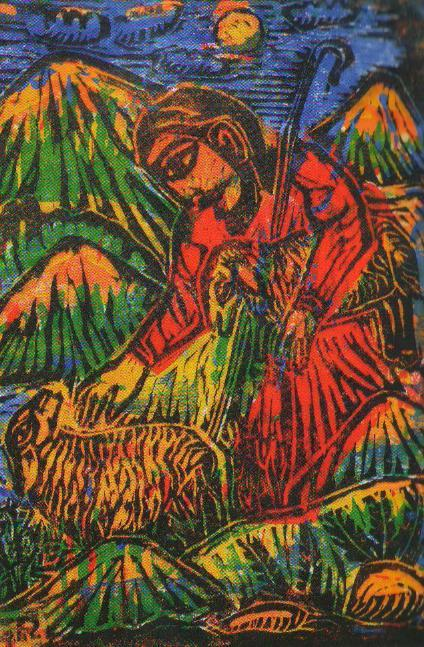
Jesus the Good Shepherd, by Solomon Raj (1921-2019)

“I am the good shepherd. The good shepherd lays down his life for the sheep. When the hired hand sees the wolf coming, he leaves the sheep and runs away. That’s because he isn’t the shepherd; the sheep aren’t really his. So the wolf attacks the sheep and scatters them. He’s only a hired hand and the sheep don’t matter to him.

“I am the good shepherd. I know my own sheep and they know me, just as the Father knows me and I know the Father. I give up my life for the sheep. I have other sheep that don’t belong to this sheep pen. I must lead them too. They will listen to my voice and there will be one flock, with one shepherd.

“This is why the Father loves me: I give up my life so that I can take it up again. No one takes it from me, but I give it up because I want to. I have the right to give it up, and I have the right to take it up again. I received this commandment from my Father.” (Common English Bible)

This is a beautiful passage of Scripture, as we look at it now, two-thousand years removed from its original context. Yet, at the time, Jesus spoke these words after a smack down conflict with the religious authorities, complete with plans to stone him.

In healing a man born blind, Jesus not only restored his physical sight, but he also gave him clear spiritual vision. In contrast, Christ’s opponents remained in their spiritual darkness, unable to see the light of life. And in their spiritual blindness, they couldn’t lead anybody anywhere without falling into a pit and making things worse.

Jesus is the good shepherd, the caring leader who is aware, and has the sheep’s best interests in mind, and at heart. The religious authorities proved to be bad shepherds who only wanted to fleece the sheep of their wool; such persons steal, harm, and kill. Jesus, however, offers abundant life.

The good shepherd provides altruistic care at a great cost. Whereas the hired hand runs away when the wolves come and threaten the flock, Jesus as the Good Shepherd puts his life on the line to protect the sheep. Three times we are told that Christ lays his life down for the benefit of others.

Bad shepherds have no such concern. And, unfortunately, such leaders have been around ever since the fall of humanity into sin. They cut and run when things get risky and dangerous.

This is what the Sovereign Lord says: “Woe to you shepherds of Israel who only take care of yourselves! Should not shepherds take care of the flock? You eat the curds, clothe yourselves with the wool and slaughter the choice animals, but you do not take care of the flock. You have not strengthened the weak or healed the sick or bound up the injured. You have not brought back the strays or searched for the lost. You have ruled them harshly and brutally. 

So they were scattered because there was no shepherd, and when they were scattered they became food for all the wild animals. My sheep wandered over all the mountains and on every high hill. They were scattered over the whole earth, and no one searched or looked for them.” (Ezekiel 34:2-6, NIV)

Jesus, in his incarnation, embodies the love and concern of God for the people of this world. Christ takes the initiative to do what needs to be done for the benefit of the at-risk sheep.

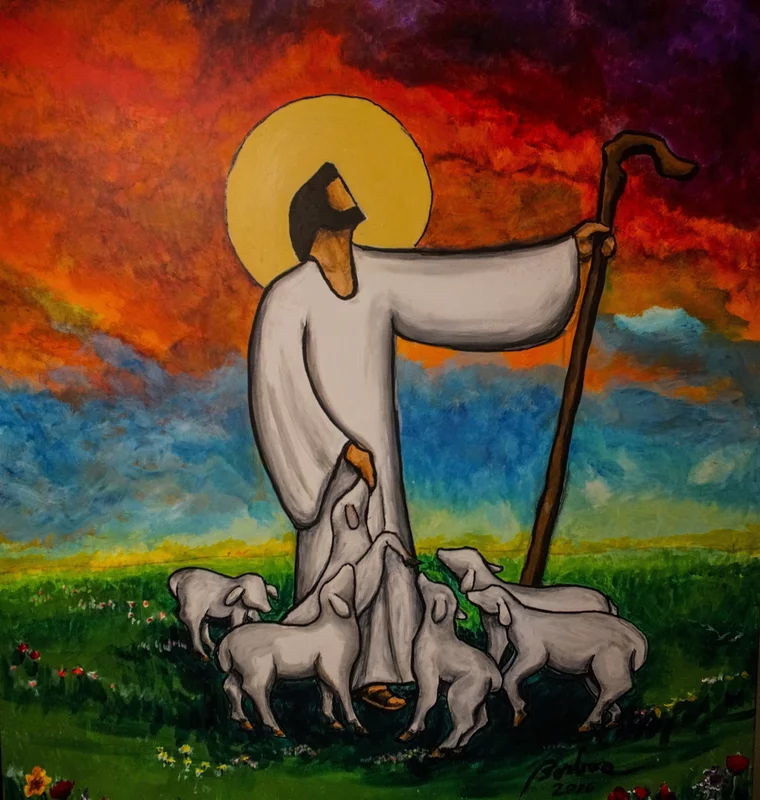
Jesus the Good Shepherd, by Francisco Borboa

For this is what the Sovereign Lord says: “I myself will search for my sheep and look after them. As a shepherd looks after his scattered flock when he is with them, so will I look after my sheep. I will rescue them from all the places where they were scattered on a day of clouds and darkness. I will bring them out from the nations and gather them from the countries, and I will bring them into their own land. I will pasture them on the mountains of Israel, in the ravines and in all the settlements in the land. I will tend them in a good pasture, and the mountain heights of Israel will be their grazing land.

There they will lie down in good grazing land, and there they will feed in a rich pasture on the mountains of Israel. I myself will tend my sheep and have them lie down, declares the Sovereign Lord. I will search for the lost and bring back the strays. I will bind up the injured and strengthen the weak, but the sleek and the strong I will destroy. I will shepherd the flock with justice.” (Ezekiel 34:11-16, NIV)

Since Jesus is the Good Shepherd, he has the unique ability and authority to decide who is in the sheep fold, and who is out. Nobody else gets to make those sorts of decisions. This way, ultimate issues of eternal life and abundant life are handled with perfect justice and righteousness.

It’s okay that this is all a mystery to us. We sheep need only to keep the Shepherd in our line of sight, and let him do his job of caring for us – without whining or complaining. After all, we could easily have a bad shepherd herding us around like a bunch of stupid cows, and treating us with indifference, even meanness.

The Holy Trinity of God – Father, Son, and Spirit – work as One. The Father loves the Son and the Spirit, and also loves those whom the Son and Spirit have touched. The Son loves the Father and the Spirit, and obeys all things from the Father, while listening to the Spirit. And the Spirit loves the Father and the Son, knowing them intimately and always operating in love for the benefit of the sheep’s deliverance from wolves.

In particular, the Son, Jesus, lays down his own life, but takes it up again. He does so because of love. The perfect unity and love of the blessed Holy Trinity spills out in Christ’s care for us.

The laying down and taking up of life on the part of the Good Shepherd is not only an expression of great love and faithfulness toward us sheep, but it is also a deep abiding love and commitment toward the Father from whom all blessings flow.

To put it another way, this motley flock of sheep are purposely drawn into the unity, harmony, and love between the Father and the Son. And when we glimpse and experience such overwhelming love, we choose to remain connected to this incredible loving dance.

Our world is much too characterized by selfish concerns and shortsighted actions. In the loving embrace of the Good Shepherd, we have an opportunity to experience peace and rest, grace and abundance, light and life. To know such love is to never turn back to old self-centered ways of living.

Shepherd of all, by laying down your life for the flock, you reveal your love for all. Lead us from the place of death to the place of abundant life, so that guided by your care for us, we may rightly offer our lives in love for you and our neighbors. Amen.

Receive the Blessing (Genesis 48:8-19)

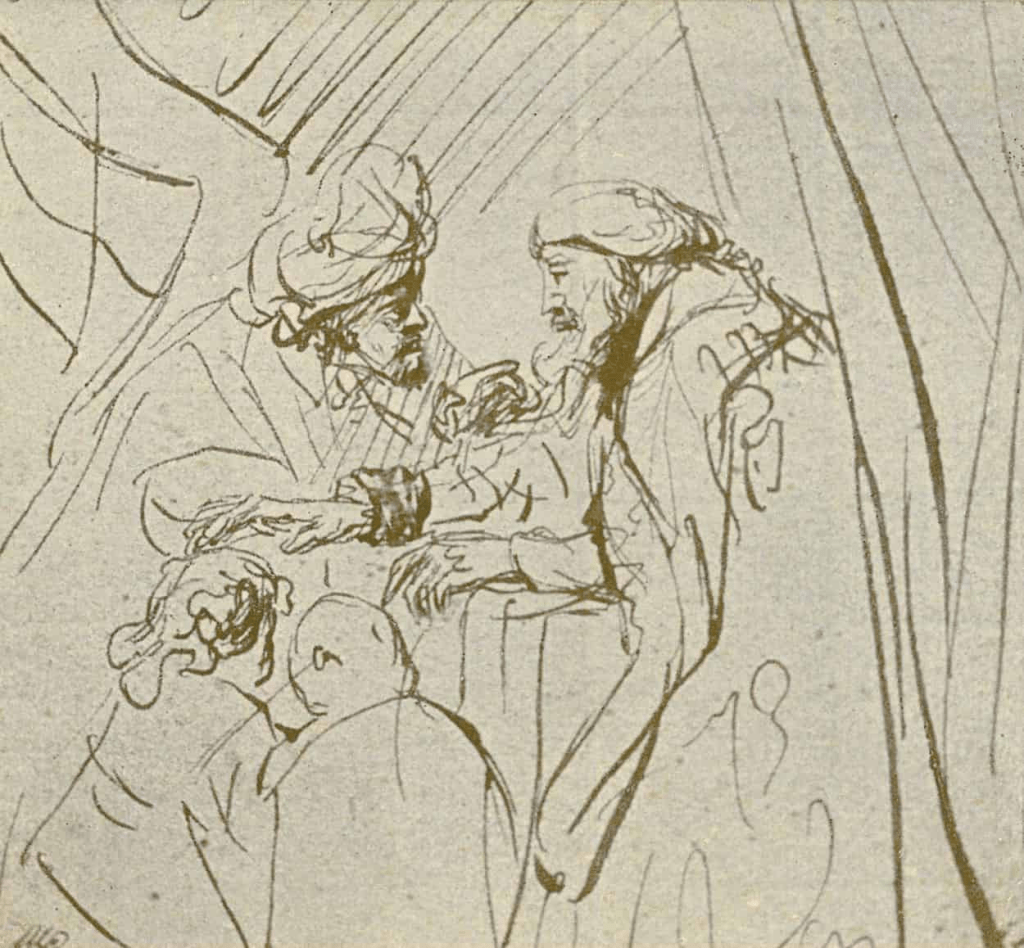
Jacob Blessing Ephraim and Manasseh, by Rembrandt van Rijn (1606-1669)

When Israel saw the sons of Joseph, he asked, “Who are these?”

“They are the sons God has given me here,” Joseph said to his father.

Then Israel said, “Bring them to me so I may bless them.”

Now Israel’s eyes were failing because of old age, and he could hardly see. So Joseph brought his sons close to him, and his father kissed them and embraced them.

Israel said to Joseph, “I never expected to see your face again, and now God has allowed me to see your children too.”

Then Joseph removed them from Israel’s knees and bowed down with his face to the ground. And Joseph took both of them, Ephraim on his right toward Israel’s left hand and Manasseh on his left toward Israel’s right hand, and brought them close to him. But Israel reached out his right hand and put it on Ephraim’s head, though he was the younger, and crossing his arms, he put his left hand on Manasseh’s head, even though Manasseh was the firstborn.

Then he blessed Joseph and said,

“May the God before whom my fathers,
    Abraham and Isaac, walked faithfully,
the God who has been my shepherd
    all my life to this day,
the Angel who has delivered me from all harm
    —may he bless these boys.
May they be called by my name
    and the names of my fathers, Abraham and Isaac,
and may they increase greatly
    on the earth.”

When Joseph saw his father placing his right hand on Ephraim’s head he was displeased; so he took hold of his father’s hand to move it from Ephraim’s head to Manasseh’s head. Joseph said to him, “No, my father, this one is the firstborn; put your right hand on his head.”

But his father refused and said, “I know, my son, I know. He too will become a people, and he too will become great. Nevertheless, his younger brother will be greater than he, and his descendants will become a group of nations.” (New International Version)

Jacob Blessing Ephraim and Manasseh, by Frederick Pickersgill (1820-1900)

Jacob (Israel) was on his deathbed. His son, Joseph, was in charge of all Egypt. Jacob had Joseph bring his two sons to him so that he could bless them. Joseph fully expected that his father would follow the convention of primogeniture, that is, the elder son receives a double inheritance. But that is not what happened. Jacob purposely went against normal convention.

It was not, however, against biblical convention. In the stories of Ishmael and Isaac, Esau and Jacob, the rights of the first-born are superseded by the promises of the next-born.

Family rules, ethnic customs, and cultural procedures are fine. Yet, when those practices become inflexible laws which are never to be different, then we get into trouble. Joseph had an expectation of how the blessing of his sons was to go. Jacob had another idea about it.

“We’ve never done it that way before,” are the seven last words of any institution. Any group organized around that belief is doomed. If we cannot make a distinction between the letter and the spirit of a law, rule, or custom, then our inflexibility will eventually break us.

In the ancient world, and even in many cultures today, birth order determines how things go with families, societal rights, and personal obligations. The firstborn occupies an esteemed position. In Judaism, when the temple still stood, the first fruits and firstborn of animals were considered the best sacrifices.

By blessing the younger son, and going against expected convention, Jacob taught future generations a valuable lesson: A person’s actions and character matter more than birth order. What’s more, being blessed first or last or whenever is not what guarantees future success.

Jacob had firsthand knowledge and experience that life is unpredictable and requires faith in God. One’s life cannot be projected and determined along an upward linear trajectory. We cannot predict what will happen in our lives by laying things out with Cartesian coordinates. Ultimate control belongs to God, not us. And that’s a good thing, because the Lord is good, all the time.

Our Lord, everything you do
    is kind and thoughtful,
and you are near to everyone
    whose prayers are sincere.
You satisfy the desires
    of all your worshipers,
and you come to save them
    when they ask for help.
You take care of everyone
who loves you,
    but you destroy the wicked. (Psalm 145:17-20, CEV)

It’s best to trust in pure goodness than to rely upon human ingenuity. Abraham – who was not a firstborn son, but the youngest of three – received the call from God to receive blessing. Isaac inherited the birthright over his older half-brother Ishmael. Jacob himself received the birthright over his older twin brother Esau. And Joseph, next to the youngest in a long line of sons from Jacob, was the clear head of the clan.

In matters of human faith and divine promises, birth order and typical cultural mores don’t apply. More important is fidelity to God, concern for one’s fellow humanity, and upholding love for the family. And it is these very things that are important going forward. Inevitably, suffering comes. And when it does, birth order, primogeniture, and societal expectations aren’t going to get you through it.

It is likely that the main reason why some folks embrace the adage “we’ve never done it that way before” is because of fear. Doing the same thing over and over again, even if it isn’t helpful anymore or is useless in a particular situation, still feels normal and secure. Moving out in faith is scary; we don’t really know how things are going to shake out.

This is why our concept and understanding of God is so crucial. A good God acts on our best interests and does not act with malevolence toward us.

I prayed to the Lord, and he answered me;
    he freed me from all my fears.
The oppressed look to him and are glad;
    they will never be disappointed. (Psalm 34:4-5, GNT)

Only obeying the letter of the law leads to fear. Only acknowledging the spirit of the law results in bondage. Only by observing both the letter and the spirit of the law will we experience freedom from fear and deliverance from anxious striving for blessing.

Blessing is given freely by the God who delights in doing so. Let the Lord bless you in the ways God wants to do so.

May God have mercy on you, bless you, and show you kindness, today and every day. And may the grace of the Lord Jesus, the love of God the Father, and the encouragement of the Holy Spirit be with you, now and forever. Amen. 

The Lord Is My Shepherd (Psalm 23)

Psalm 23, by Cliff Gleason

The Lord is my shepherd;
    I have all that I need.
He lets me rest in green meadows;
    he leads me beside peaceful streams.
    He renews my strength.
He guides me along right paths,
    bringing honor to his name.
Even when I walk
    through the darkest valley,
I will not be afraid,
    for you are close beside me.
Your rod and your staff
    protect and comfort me.
You prepare a feast for me
    in the presence of my enemies.
You honor me by anointing my head with oil.
    My cup overflows with blessings.
Surely your goodness and unfailing love will pursue me
    all the days of my life,
and I will live in the house of the Lord
    forever. (New Living Translation)

This is one of the best known places in the Bible – even for people who are not religious. And that is for good reason. The psalm is timeless in it’s relating to us in our human condition. It taps into our human need for a compassionate presence, secure protection, and abundant provision. I believe that, most of all, Psalm 23 effectively goes to our inner selves and reminds us of our greatest need: God.

My underlying conviction concerning this wonderful psalm is that the reason we adore it so much is because we humans have an innate primal desire for God. Whether we are consciously religious or not, our deepest longing is for connection with the Divine.

Much of humanity, it seems to me, have repressed this desire. Many people bury this longing underneath multiple layers of other interests and competing desires. Others experience the primal desire for God as a yearning for wholeness, completion, or fulfillment.

Yet, regardless of how particular individuals or groups may frame it, humanity’s basic need is to love and be loved – to move ever closer to the source of love. This inner craving is the essence of the human spirit, and it is captured well in a biblical psalm which pictures a person who settled into the God who is Love.

“Our hearts are forever restless until we rest in God.”

St. Augustine

With Psalm 23, our human longing is spelled out in a mere 50 or so words – we can imagine not only being transported, but also being actually transformed into an enjoyable divine/human relationship, set within an idyllic landscape of settled peace, safety, and strength.

Serenity for our anxious racing thoughts becomes a real hope, for there is a shepherd who protects the human flock and ensures that they have everything they need.

It is understandable that the relationship between God and humans is likened to that of a shepherd and sheep. In reality, sheep need a shepherd. They require someone to look out for them and provide for them. Sheep, in my opinion, are not stupid and clueless; they are skittish animals who only function well if they are non-anxious and at peace.

The presence of a caring shepherd makes all the difference. And, more than that, the shepherd does a myriad of needed things for the sheep that they are not able to do themselves, such as protecting them from wolves, finding adequate pasture to feed upon, and relieving them of the intestinal gas from eating all that grass which would literally kill them without the shepherd’s intervention.

Whereas human shepherds may or may not be faithful in their duties and extend genuine care to the flock, God is always present and loving. Moving to the rich pasture of the New Testament, Jesus is described as the Good Shepherd who will care for and preserve the sheep in every way needed. (John 10:1-21)

Psalm 23, by Cliff Gleason

Indeed, with Jesus as the consummate shepherd, people want for nothing and have everything they need. No wolf can snatch them out of his hand, and the mundane tasks of washing their feet is lovingly done for them. With Jesus, the deep yearning of the inner person becomes satisfied; the soul is restored.

Even the implements of a rod and a staff are used for good, and not for ill. An unfaithful shepherd will likely beat the sheep and berate them, only concerned for fleecing them to sell their wool on the market. But Jesus uses the rod to guide and direct in the way we ought to go, for our benefit and well-being. And the staff – the shepherd’s crook – is benevolently used to rein in the strays who don’t realize how in danger they’re in.

Truly, discipline and encouragement are not mutually exclusive concepts; they instead go together as two forms of loving leadership and care. Only those who take the time and effort to correct another are the ones who really care enough to do so.

In the shepherd’s presence, we can exist with a sense of security, even though there is danger all around us. Our longing for peace, and to be secure within oneself, is not a pipe dream, but a real possibility. To be provided for by God in the face of hard circumstances strengthens faith, awakens hope, and fosters love. It becomes an overflowing feast of the soul.

And this goodness is not fleeting. It can be a continuous present reality. Since God is good, all the time, and there is never a time when God is not good, we are continually and actively pursued and shepherded by goodness and not by harm, all the days of our lives.

The threat of death – and even death itself – cannot thwart the avenues of righteousness from being available to us. We can walk the true path toward inner peace and fulfillment, of genuine connection with God and others, without moral or spiritual harm.

There are good and right paths of life. Those avenues are guarded by a gracious God; they will never be destroyed or damaged. If the psalm is correct, and if my core convictions are right, then there is no longer any reasonable or justified basis for fear.

A good care-taking Shepherd is protecting the flock, and providing the sheep with everything they need. We can live a morally strong, ethically sound, and eminently happy life, without being constantly afraid.

Blessed and Good Shepherd of all, by laying down your life for the flock, you reveal your love for all. Lead us from the place of death to the place of abundant life, so that guided by your care for us, we may rightly offer our lives in love for you and our neighbors. Amen.