Psalms 42 & 43 – Longing for Another World

As a deer gets thirsty
    for streams of water,
I truly am thirsty
    for you, my God.
In my heart, I am thirsty
for you, the living God.
    When will I see your face?
Day and night my tears
    are my only food,
as everyone keeps asking,
    “Where is your God?”

Sorrow floods my heart,
    when I remember
leading the worshipers
    to your house.
I can still hear them shout
    their joyful praises.
Why am I discouraged?
Why am I restless?
    I should trust you, Lord.
I will praise you again
because you help me,
    and you are my God.

I am deeply discouraged,
    and so I think about you
here where the Jordan begins
at Mount Hermon
    and at Mount Mizar.
Your vicious waves
    have swept over me
like an angry ocean
    or a roaring waterfall.

Every day, you are kind,
    and at night
you give me a song
as my prayer to you,
    the God of my life.

You are my mighty rock.
    Why have you forgotten me?
Why must enemies mistreat me
    and make me sad?
Even my bones are in pain,
    while all day long
my enemies sneer and ask,
    “Where is your God?”

Why am I discouraged?
Why am I restless?
    I trust you, Lord!
And I will praise you again
because you help me,
    and you are my God…

Show that I am right, God!
Defend me against everyone
    who doesn’t know you;
rescue me from each
    of those deceitful liars.
I run to you for protection.
Why do you turn me away?
Why must enemies mistreat me
    and make me sad?

Send your light and your truth
    to guide me.
Let them lead me to your house
    on your sacred mountain.
Then I will worship
at your altar because you
    make me joyful.
You are my God,
    and I will praise you.
Yes, I will praise you
    as I play my harp.

Why am I discouraged?
Why am I restless?
    I trust you, Lord!
And I will praise you again
because you help me,
    and you are my God. (Contemporary English Version)

Longing is a universal human experience. It is also an integral part of the human condition.

“If we find ourselves with a desire that nothing in this world can satisfy, the most probable explanation is that we were made for another world.”

C.S. Lewis

Before that statement, Lewis spoke of the nature of longing – how all that we experience in this life is not the ultimate object of our desire, of our longing. The beauty and satisfaction we seek:

“was not in them, it only came through them, and what came through them was longing. These things—the beauty, the memory of our own past—are good images of what we really desire; but if they are mistaken for the thing itself they turn into dumb idols, breaking the hearts of their worshipers. For they are not the thing itself; they are only the scent of a flower we have not found, the echo of a tune we have not heard, news from a country we have never yet visited.”

C.S. Lewis, The Weight of Glory

If we follow the path of any pain, any psychological or emotional wounding, it will lead us to this one primal pain: the pain of separation.

That’s because, having been born into this world, we are banished from Paradise and carry the scars of our Edenic estrangement – the separation from God.

Although it may sound counter-intuitive, if we will but embrace this suffering, if we allow it to lead us deep within ourselves, it will take us deeper than any healing this world can offer.

In other words, longing is itself the cure. It is when our hearts break that they become open for the love to come pouring out of it.

The grief we acknowledge and express draws us toward intimacy with the Divine and with others. It brings union, not separation. The problem itself becomes the cure.

“Do not seek for water. Be thirsty.”

Jalāl al-Dīn Muḥammad Rūmī (1207-1273)

The longing for love, belonging, and connection needs to be deeply felt, because it is really the only way of actually loving another. It is in hungering and thirsting – that is, in longing – which leads us to pray and seek to end our separation.

Prayer is the voice we give to our longings.

Naming our sadness for what it is, even our depression, is most necessary. Since we are emotional creatures, profound sadness even to the point of depression and/or despondency will happen.

Yet, despite the universal nature of discouragement, tears, and the longing for better and beauty, many Christians buck the feelings. Far too many believers focus so exclusively on victory in Jesus through his resurrection, ascension, and glorification that they use religion as their denial when unwanted emotions come banging at the doorstep of their soul.

Depression is not sin. To be discouraged is not the Enemy. And our longings are the evidence that this is so. We must sit with our emotions and feel the breadth and depth of them. Both our spiritual and emotional health come through an awareness and robust engagement with our feelings. Refusing to feel is, in reality, putting the stiff arm to God.

The psalmist does anything but deny his feelings. He brings them before the Lord and spreads them out before the Divine. Why am I discouraged? Why am I restless? Why the sadness? Could it be that God has forgotten me? Where is the Lord? Is God angry with me? Are my troubles the result of divine wrath?

To blandly say we have never uttered or thought such questions is a telltale sign of denying our deep longings. The bottom line for many folks is that they do not want to feel discouraged or cry any tears because it complicates their lives. Besides, it hurts!. “Why feel,” we reason, “when it only brings pain?”

Ah, yes, the avoidance of pain. And there is no pain quite like emotional and spiritual pain of separation and longing for things to be different.

Much like an open wound which needs a liberal application of painful peroxide, so our spiritual wounds must sting with the salve of emotional feeling. Healing is neither cheap, easy, nor painless. It typically hurts like hell.

The psalmist’s own pain revolved around feelings of alienation from God, being cut off from fellow worshipers, and harassed by others around him. Understandably, he experienced despondency and loneliness. The psalmist wondered if anyone, including God, even cared what he was going through. In other words, he is desperate for God to show up. So, he prayed as if his life depended on it.

The psalmist did not get answers to his questions. But that was never the point of the asking.

Hope arises from holding the big picture of the past, present, and future together at the same time. When present circumstances are difficult, and it appears we are about to swallowed up into the now, we must hold the past and future along with it, in careful tension.

While we desperately search for a cure, none will be found in this life – at least not in full. We are occasionally and surprisingly graced with glimpses of our deepest longings whenever we experience the kindness of a stranger, an answer to a prayer we uttered years ago, or the peace of an unexpected rest.

Then, our trust reawakens, and we are encouraged to take another step in the long walk of life – a walk in which God is beside us, even if we cannot discern it.

Gracious God, help us to know wonder in our waiting, patience in our wonderings, and a vision of how life is supposed to be lived. May our deepest longing find its satisfaction in you and in the many ways you mercifully hold the world together, through Jesus Christ our Lord. Amen.

Ephesians 4:7-16 – Be Mature

Christ has generously divided out his gifts to us. As the Scriptures say,

“When he went up
    to the highest place,
he led away many prisoners
    and gave gifts to people.”

When it says, “he went up,” it means that Christ had been deep in the earth. This also means that the one who went deep into the earth is the same one who went into the highest heaven, so he would fill the whole universe.

Christ chose some of us to be apostles, prophets, missionaries, pastors, and teachers, so his people would learn to serve, and his body would grow strong. This will continue until we are united by our faith and by our understanding of the Son of God. Then we will be mature, just as Christ is, and we will be completely like him.

We must stop acting like children. We must not let deceitful people trick us by their false teachings, which are like winds that toss us around from place to place. Love should always make us tell the truth. Then we will grow in every way and be more like Christ, the head of the body. Christ holds it together and makes all of its parts work perfectly, as it grows and becomes strong because of love. (Contemporary English Version)

The Body of Christ, without love as its skeletal structure, would be as ridiculous and silly as a boneless chicken ranch. 

The Apostle Paul, a concerned spiritual father, was encouraging the Church toward maturity, to act as adults in the faith and not like immature children.

Just as the physical body begins small, then grows and matures over time, so the spiritual body (the church) is to focus on incremental slow growth across the years so that it realizes maturity. And the consummate evidence of that spiritual development is strong bonds of love.

Ten days after the Lord Jesus ascended to heaven, the Day of Pentecost occurred. On that day, the Holy Spirit came upon the small band of believers and the church became a full-fledged phenomenon, growing and expanding. (Acts 2:1-47)

The gracious gifts of the Spirit are given to each and every Christian so that growth and strength will come to the Body of Christ through love. Each spiritual gift might be different from person to person, but every one of them is meant to be used in love for the benefit of the entire church.

Without any bones or skeleton, the church will be weak and ineffective. It might look like a church but will not be able to do anything in the world. 

For spiritual maturity to happen, it is necessary for every single Christian in the church to discover their spiritual gift, and then, use it in love to build up the entire Body. This is the God-ordained means of realizing a healthy functioning church. 

It may appear that you and I, as believers in and followers of Jesus, have the luxury of pursuing other interests rather than providing loving and gifted service to Christ’s Church. After all, church attendance, Christian mission and service are all voluntary, right? A volunteer can choose to sit out, right?

Uh-hem (clearing of throat). Wrong. That sort of thinking is based in the goofy notion that the Church is a voluntary society which we choose to become a part of, or not. It isn’t. The Body of Christ, the Church, the people for whom Christ died, was chosen by God – and not the other way around.

Before we chose God, God chose us. We can no more choose to decline Christian mission and service anymore than a physical heart or bodily organ can decide it needs to go do something else – as if they could simply leave the Body or just stop doing what they’re doing without consequence.

No, my friends, for the Body to function, it must work in concert, paying attention to the unique parts which keep it alive and thriving, while at the same time, maintaining the overall health of all the Bodily systems.

Bottom line: We need one another. Going off and continually doing my own thing or picking up my marbles and going home because I’m mad or frustrated, is what children do. When adults act like children, we rightly discern they are immature and need to grow up.

So, instead of lacking self-awareness or being pouty about my blog post, focus on the following questions:

What is your passion and desire for Christ’s church? 

What issues stir you emotionally? 

What group of people do you feel most attracted to reach? 

What area of Christian mission or church ministry would you most like to influence? 

Are there people whom you notice that others seem to ignore? 

Will you step out in faith and learn how God has wired you for ministry? 

Will you speak and serve in the name of Jesus through the enablement of the Spirit?

Loving God, I ask you to give me a heart of faith to trust the Spirit and the Spirit’s work in my life. I ask for a heart that desires the gifts of the Spirit for the common good of all persons. I ask you to help me be open to the gifts of the Spirit in others. I ask for jealousy of others’ gifts to be quieted in me. I pray that my gifts would build up the church. Most of all, I ask for the gift of love. Use me for the strengthening of Christ’s church, and for a positive influence in the world. Amen.

Proverbs 4:1-9 – Pay Attention to Wisdom

Listen, children, to a father’s instruction,
and pay attention so that you may gain discernment.
Because I hereby give you good instruction,
do not forsake my teaching.

When I was a son to my father,
a tender, only child before my mother,
he taught me, and he said to me:
“Let your heart lay hold of my words;
keep my commands so that you will live.
Acquire wisdom, acquire understanding;
do not forget and do not turn aside from the words I speak.
Do not forsake wisdom, and she will protect you;
love her, and she will guard you.
Wisdom is supreme—so acquire wisdom,
and whatever you acquire, acquire understanding!
Esteem her highly and she will exalt you;
she will honor you if you embrace her.
She will place a fair garland on your head;
she will bestow a beautiful crown on you.” (New English Translation)

Pay Attention to Instruction

Once, when I was a kid growing up on the farm, I was playing hide-and-seek with my brother and got lost in a cornfield. The stalks were taller than me, and I couldn’t jump up and try to see over them. I started to panic.

Then, I got my wits about me and looked straight up into the sky. Even though I was only seven or eight years old, I had looked up at the sky a bajillion times in my short lifetime. My dad had taught me how to read the sky and the weather above us. Fortunately, I had listened well and paid attention to all those times we looked up together.

I knew that the position of the sun in the bright blue sky would give me a fixed point of direction. Once I did that, I walked in the direction I was certain would take me out of the cornfield, trying not to let fear take hold of me. In no time at all, I was out. I lost the game of hide-and-seek. But I didn’t care.

Wisdom is personified in the book of Proverbs as a sage woman and a discerning counselor for whom we must hear and heed her advice. 

In the Old Testament, wisdom is the practical daily application of knowledge and understanding. It’s the ability to take the knowledge of God and use it in everyday life in a way that leads to human peace, contentment, and flourishing. There are two important aspects to wisdom. 

Pay Attention to Knowledge

First, the individual must possess some body of knowledge. If we are ignorant (without knowledge) then we have no ability to exercise wisdom. More than once, I rescued cousins and friends from the cornfield while playing hide-and-seek, because they didn’t have the same understanding of the sky that I did.

So, it’s absolutely imperative for us to actively seek understanding. It’s not going to simply drop into our lap. We must purposely strive to look up and see the Son, to view life from God’s perspective, and to put ourselves in another person’s shoes. 

To gain wisdom, we must become readers, listeners, and devoted learners. Why? Because without books to read, without spiritual directors to consult and listen to, and without adopting the humble posture of learning from others, we will never realize wisdom.

The telltale sign of one who fails to read, listen, and learn, is that they continually opine on everything with no evidence to back up their opinions, no insight into the human condition, and no grace in their language. In the book of Proverbs, such as a person is labeled the “fool.”

Pay Attention to Behavior

The second aspect to wisdom is that the individual must use the acquired knowledge to have good behavior and to live well. 

Knowledge by itself, apart from actual practical use, only produces puffed-up pride (1 Corinthians 8:1). The reason for accumulating understanding is to use it for the welfare of others, for the benefit of the common good. 

We have quite enough preening peacocks in this world who have answers for every earthly problem under the sun. This world needs much less of them, and more of those who seek the humility that comes from biblical wisdom. As the Apostle James in the New Testament once put it, we must be doers of the Word and not hearers only (James 1:22).

Wisdom is realized whenever there is learning that has come through both the head and the hands. Proverbs is a very good place to begin constructing a life of wisdom. Reading one chapter a day, for one month, will get you through the entire book. 

Make a wise plan to carefully go through Proverbs sometime this spring or summer. You’ll be glad you did. And so will those around you.

Pay Attention to Prayer

God of all wisdom, save me from pride and arrogance, and take me to the place where Christ’s humility is center stage, where I’m lifting up clean hands and a pure heart to you.

Spirit of discernment, take me to the place where I’m no longer looking with panic or anxiety at the cornfields and situations I face, but look up to you, where I can see clearly, and my decisions are flooded with your bright light, truth, and justice.

Jesus, teacher of all that is right and good, I submit to your instruction and humbly seek to live into your words and ways. I keep my ears open to receive your counsel, my heart open to receive your eternal wisdom, and my eyes open to see your risen and ascended glory.

Just, right, and wise God – Father, Son, and Spirit, the God whom I serve – know that I love wisdom. I desire it more than money, fame, or power. Help me to use biblical common sense, spiritual savvy, and Scriptural discernment so that I might learn the good and the beautiful. Amen.

Ephesians 4:1-6 – Realizing Unity and Peace through Humility

As a prisoner for the Lord, then, I urge you to live a life worthy of the calling you have received. Be completely humble and gentle; be patient, bearing with one another in love. Make every effort to keep the unity of the Spirit through the bond of peace. There is one body and one Spirit, just as you were called to one hope when you were called; one Lord, one faith, one baptism; one God and Father of all, who is over all and through all and in all. (New International Version)

In the economy of God, unity isn’t a privilege but a necessity. Unity is not an ancillary or side issue to the real work of the Church and the Christian life; it is very much at the center of Christianity. 

Christians have been fashioned through the Holy Spirit into a single harmonious religious community of redeemed people, called to exemplify a counter-cultural presence in the world. 

There is a solid theological reason for this: God is one. Just as the triune God exists as one deity in three persons, so the church is to reflect God’s image through its unified oneness.

Although unity has been accomplished through the finished work of Jesus on the cross, the practical implications must be daily worked out. This is why we are to strive, or to put significant effort into, having unity. 

Simply getting along outwardly with someone or some group, while inwardly harboring animosity toward them, is not unity. Just because two people are not at each other’s throats does not mean there is peaceful unity. 

Unity only occurs when the Body of Christ works together in its diverse gifts toward a common goal of knowing Christ and making him known… with humility.  

In yesterday’s blog post on Ephesians 1:17-19, I laid down the challenge of praying chapter one’s prayer daily for two weeks. To up the ante on the prayer, try doing it with another person in the church. Having a common unity of purpose in mind and heart through prayer is a beautiful thing. 

In fact, if there is to be any sort of church revitalization, personal renewal, and national revival, it will begin in the prayer rooms of unified believers who share a common love for God and neighbor, a similar attitude of humility and gentleness, and a shared commitment of showing patience toward others.

This is the way of unity and peace. And it requires a great deal of effort to unpack these gracious spiritual gifts which have been mercifully given to us.

Unity is at the center of the earliest ecumenical creeds of the Church. The early church fathers (and mothers) wisely discerned the great importance of a unified faith and striving toward peace with all believers.

We believe in one God,

            the Father, the Almighty,

            maker of heaven and earth,

            of all that is, seen and unseen.

We believe in one Lord, Jesus Christ,

            the only Son of God,

            eternally begotten of the Father….

We believe in the Holy Spirit, the Lord, the giver of life,

            who proceeds from the Father and the Son….

We believe in one holy catholic and apostolic Church.

            We acknowledge one baptism for the forgiveness of sins. – The Nicene Creed

There is one Father, not three fathers; one Son, not three sons; one Holy Spirit, not three spirits.

And in this Trinity, no one is before or after, greater or less than the other; but all three persons are in themselves, coeternal and coequal; and so, we must worship the Trinity in unity and the one God in three persons….

Although he is God and man, he is not divided, but is one Christ.

He is united because God has taken humanity into himself; he does not transform deity into humanity.

He is completely one in the unity of his person, without confusing his natures.

For as the rational soul and body are one person, so the one Christ is God and man. – The Athanasian Creed

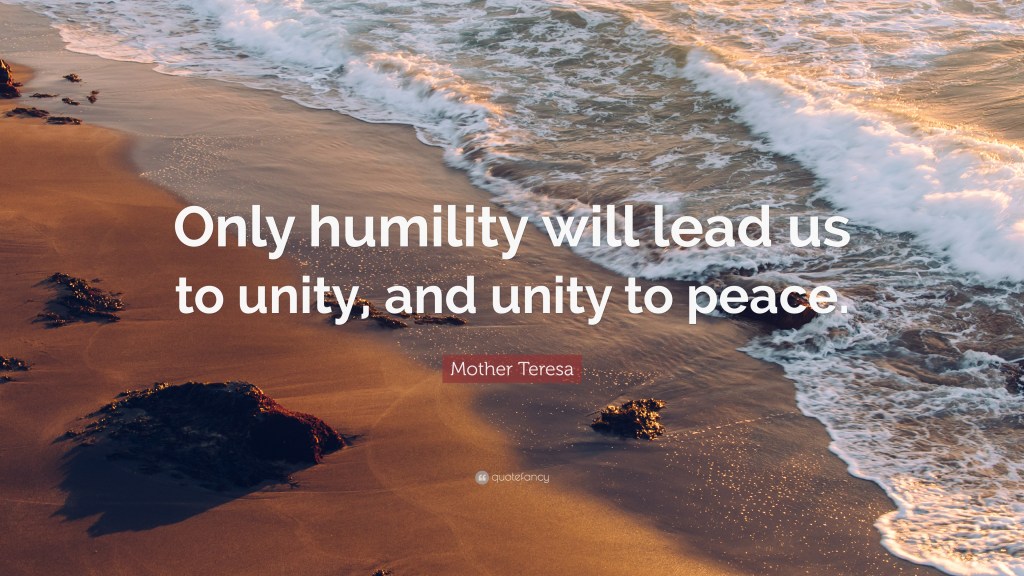
Since God is one, we are to be one people. This is the path of peace. One God. One people. There cannot be unity and peace apart from humility.

Invalidating a person’s feelings or thoughts does no one any good. It happens because of pride and a profound lack of humility.

Imagine going to see a doctor who turns out to be arrogant. He doesn’t really listen to you. He just gives a quick exam and offers his diagnosis with a regimen of more pills to take. You’re left sitting there while he’s off to another patient, colonizing another person’s mind and emotions with his expertise.

I’m not giving doctors a hard knock. I know many physicians, and they do wonderful compassionate work. Yet, it’s likely that you, like me, have had that occasional experience of the doctor, all full of themselves, having all the right answers on your pain and situation.

You may have also had the unfortunate experience of having a pastor, therapist, or counselor assess your situation with little information and even smaller compassion. Like writing a script for pills, they give you a few Bible verses and tell you to quit sinning and live obediently.

If pride and arrogance are the original sin, then the remedy to that malady is humility. No matter who we are – whether doctors, pastors, laypersons, patients, or whomever – we are meant and designed by our Creator God to live a humble life.

Humility is the cornerstone to the unity and peace we desire. Jesus said:

“Blessed are the poor in spirit, for theirs is the kingdom of heaven.” (Matthew 5:3, NIV)

The door of God’s kingdom swings-open on the hinges of humility. The Apostle Paul, seeking to follow his Master Jesus in his teaching and humility said:

“Since God chose you to be the holy people he loves, you must clothe yourselves with tenderhearted mercy, kindness, humility, gentleness, and patience.” (Colossians 3:12, NLT)

Basic human kindness with one another is grounded in humility.

The beauty of a humility-based existence is that multiple people discover together how to grow, thrive, and flourish in a situation where it isn’t currently happening. Breakthroughs occur in the soil of humility when all voices are heard and given weight.

We live with the confidence of the Psalmist:

“God leads humble people to do what is right and teaches them the way.” (Psalm 25:9, GW)

In the end, it’s a common commitment to exercise humility which realizes unity and enjoys peace.

May it be so, to the glory of God and for the sake of the world.

Blessed Holy Trinity, the God whom I serve, may your church on earth be one as you are one. I pray our unity of love and purpose will transform individuals, churches, organizations, systems, and the entire world for the glory of the Father, and of the Son, and of the Holy Spirit, one God, now and forever. Amen.