Waiting with Hope (Romans 8:22-25)

Art depicting cracked earth, a dry riverbed, white plastic shapes, a lack of life and the red glow of fire. The figures are separated, lacking any real connection. By artist Chris De Hoog

For we know that all creation has been groaning as in the pains of childbirth right up to the present time. And we believers also groan, even though we have the Holy Spirit within us as a foretaste of future glory, for we long for our bodies to be released from sin and suffering.

We, too, wait with eager hope for the day when God will give us our full rights as his adopted children, including the new bodies he has promised us. We were given this hope when we were saved. (If we already have something, we don’t need to hope for it. But if we look forward to something we don’t yet have, we must wait patiently and confidently.) (New Living Translation)

Salvation is not only personal; it’s also cosmic.

That is, freedom from the power of sin, death, and hell is not only for an individual person, but this deliverance is for all of creation, for the entire earth.

So then, all of creation – not just people – long for and groan for the advent of Christ. My oak tree in the backyard longs for it. My dog whines for it. When it rains, the sky is wondering how long it will have to keep up its tears.

Together with the entire cosmos, we look forward to the complete fulfillment of our inheritance as God’s creation, as God’s creatures.

Since that is true, it is Christians who need to see the privilege and responsibility of conducting ourselves with unity, harmony, and non-violence. We are to live this way because we are foreshadowing the end of the world’s story.

There is a day coming when there will be no more malevolent and selfish posturing for power and control. No more oppression and victimization. No more injustice.

And we have the chance to begin living that way now, and not only in a future time. We get to do this because of Christ.

But that doesn’t mean we don’t suffer anymore. Presently, along with all creation, we have pain like that of a woman in childbirth. This is no papercut inconvenient pain; this is “I hurt like hell” pain. That sort of pain has us awaiting the redemption of our bodies.

I work as a hospital chaplain. Every day, I see suffering, some of it unimaginable. I listen to stories of people longing for healing, and grasping at hope. And I hear plenty of groaning (both the actual physical groans, as well as the more quiet internal sighs and groans).

I say to you: The human body is not meant to be destroyed. Our physical selves are not destined for elimination. No, our bodies are meant to be redeemed; they are meant for salvation. It will not always be this way!

So, we hope.

The Christian has the confident expectation that not only is the soul redeemed, but the body, as well. We can enjoy spiritual salvation now. But we must wait for the physical deliverance. There must be patience on our part until Resurrection Day.

The Apostle Paul was calling on believers to hope. Five times he said it in only two verses. Paul was emphasizing the need for spiritual endurance because we have not yet arrived.

In case you haven’t noticed, we aren’t in heaven; this isn’t a renewed earth; people around the globe are not all presently singing kumbaya together.

Therefore, it is imperative that we live with the tension between the “now” and the “not yet.” It’s a weird existence, this Christian life. But, in reality, we exist in the paradox of being saved now, and not yet being saved.

Another way of putting this is that God’s adopted children have not yet received their inheritance.

But that doesn’t mean we’ve been left to ourselves. We have the first fruits of our salvation: the Holy Spirit.

We presently, right now, enjoy a real and significant portion of God’s freedom and deliverance. We have God’s gift of presence. There is the continuing presence of Jesus Christ with us, the blessed Holy Spirit.

And this divine presence is what today helps us to endure and hold onto hope. By holding this future hope, we learn to accept, cope, and transcend our circumstances through love.

Therefore, since we have been made right in God’s sight by faith, we have peace with God because of what Jesus Christ our Lord has done for us. Because of our faith, Christ has brought us into this place of undeserved privilege where we now stand, and we confidently and joyfully look forward to sharing God’s glory.

We can rejoice, too, when we run into problems and trials, for we know that they help us develop endurance. And endurance develops strength of character, and character strengthens our confident hope of salvation. And this hope will not lead to disappointment. For we know how dearly God loves us, because he has given us the Holy Spirit to fill our hearts with his love. (Romans 5:1-5, NLT)

The very suffering which we so often try to avoid and get out of, becomes the means of connecting us with Christ and with others.

The problem becomes the answer.

The Spirit groans with our own spirit, and we all become connected together.

I point out, however, that not everyone wants this sort of connection. There are many people who want nothing to do with solidarity.

Some folks want to remain in their own little huddle or small world; and they take offense at anyone outside of their group who seeks to understand and connect with that group’s suffering.

Although everyone’s pain and suffering is unique – and no one can fully know another’s sorrow – that does not mean solidarity and connection are impossible, or undesirable.

I don’t need to have cancer in order to connect with a cancer patient. I don’t have to become victimized to show genuine empathy and extend competent comfort. Yet, sadly, some persons only want connection and consolation from a certain person or group.

But I say to that: Who are you to tell God whom God can love you through?

To suffer is one thing, because we all must suffer in some way. But to compound your suffering by your own volition is another thing altogether.

You deserve better than harming yourself through cutting off help.

It could be that today is the day you reach out to that person you know will be there for you. Or, perhaps now is the time to quite putting off making space for prayer and reflection.

Whatever it is that you need to do, it’s okay to do it, without putting it off until tomorrow.

Lord Jesus Christ, by your patience in suffering you hallowed earthly pain and gave us the example of obedience to your Father’s will: Be near me in my time of weakness and pain; and sustain me by your grace, so that my strength and courage may not fail. Heal me according to you will; and help me always to believe that whatever happens to me here is of little account if you hold me in eternal life. Amen.

Second Sunday of Advent – Prepare the Way (Luke 3:1-6)

The Call from John the Baptist to Repent, by Renier de Huy, 12th century

In the fifteenth year of the reign of Tiberius Caesar, when Pontius Pilate was governor of Judea, and Herod was ruler of Galilee, and his brother Philip ruler of the region of Ituraea and Trachonitis, and Lysanias ruler of Abilene, during the high priesthood of Annas and Caiaphas, the word of God came to John son of Zechariah in the wilderness. He went into all the region around the Jordan, proclaiming a baptism of repentance for the forgiveness of sins, as it is written in the book of the words of the prophet Isaiah,

“The voice of one crying out in the wilderness:
‘Prepare the way of the Lord;
    make his paths straight.
Every valley shall be filled,
    and every mountain and hill shall be made low,
and the crooked shall be made straight,
    and the rough ways made smooth,
and all flesh shall see the salvation of God.’ ” (New Revised Standard Bible)

In this Christian season of Advent, we are reminded that God is not only high above us, transcendent, far away; God is also close to us, immanent, and with us.

We remember at this time of year that God does not remain distant, but entered our time and space at a particular moment in history, for a distinct purpose.

The Roman Empire was powerful, large, and very much in control of every place where it existed. The litany of imperial rulers and authorities which the Gospel writer Luke listed is meant to give us a feel of the Roman weight, and how much Roman might was ensconced in Judea.

The world at the turn of the common era was under the dominion of powerful people with lots of influence. But God did not come to any of them. Instead, God came to a loner – a man who spent his time out in the wilderness. His name was John, the son of Zechariah. We know him as John the Baptist.

With God coming to John at a precise point of time in a particular place, that made John a prophet with a singular message. John was born for this. (Luke 1:76)

It is fitting that a man hanging out on the fringes of society all by himself would be the one to prepare the way for Messiah.

After all, Messiah’s message would be one of bringing good news to the poor, proclaiming release to prisoners, and freeing those who are oppressed. (Luke 4:18-19; Isaiah 61:1-2)

God’s prophetic calling for John was one of preparation. John was to prepare the way of the Lord. He was to get the people ready to receive Messiah.

John went about his ministry of preparation by calling folks to repent, to change their minds and amend their ways, so that there might be forgiveness.

In a reference from the prophet Isaiah, Luke alluded to Jewish exiles returning from their Babylonian captivity. The actual physical road from Babylon to Jerusalem was a hard journey due to the distance and topography.

The “road” or the “way” in Holy Scripture is also a metaphor for the spiritual journey we take in this life. And that road has a lot of challenges to it. The very act of walking as a pilgrim over a long arduous journey changes a person.

It is rarely the destination that makes a person; it’s the journey itself which leads one to a changed life of thinking differently, and seeing things from a perspective we’ve never seen before.

The smoothing out of the road is a way of saying God is making it easier for people to return to the Lord, to get them ready for a new life with promises fulfilled and unexpected joy.

In other words, valleys raised and mountains flattened represent God’s efforts at helping us experience a complete transformation of life. The Lord will do everything possible to make renewal and restoration happen for us.

The Lord will set things right. In our contemporary world that is now largely controlled by powerful oligarchs and the super-rich, God will turn it upside-down. All of the world’s current powerful people will find themselves looking up, not down.

It would be nice and reassuring if I could give you certainty about the journey ahead. But I cannot do that. Yet, what I can do is assure us of what is at the end of the road. Look beyond the current days of self-centered leadership and popular ignorance, and understand that all flesh shall see the salvation of God.

Prepare the way of the Lord. We do that by how we go about walking the road. Each step we take every day is important and makes a difference. And when we stumble, there is plenty of grace to help get us back on our feet and moving forward.

We are all collectively journeying together to Bethlehem. And as we daily move and walk, at the end of our journey, Jesus is there.

But when the fullness of time had come, God sent his Son, born of a woman, born under the law, in order to redeem those who were under the law, so that we might receive adoption as children. (Galatians 4:4, NRSV)

And nothing can stop us or separate us from the love of God that is in Jesus Christ our Lord.

For I am convinced that neither death, nor life, nor angels, nor rulers, nor things present, nor things to come, nor powers, nor height, nor depth, nor anything else in all creation will be able to separate us from the love of God in Christ Jesus our Lord. (Romans 8:38-39, NRSV)

The journey may be arduous. You might feel like giving up. But Jesus is our Immanuel, God with us. In him, is our hope and our joy.

O Holy One of Israel, out of the embrace of mercy and righteousness, you have brought forth joy and dignity for your people. Remember now your ancient promise; make straight the paths that lead to you, and smooth the rough ways, so that in our day we might bring forth your compassion for all humanity. Amen.

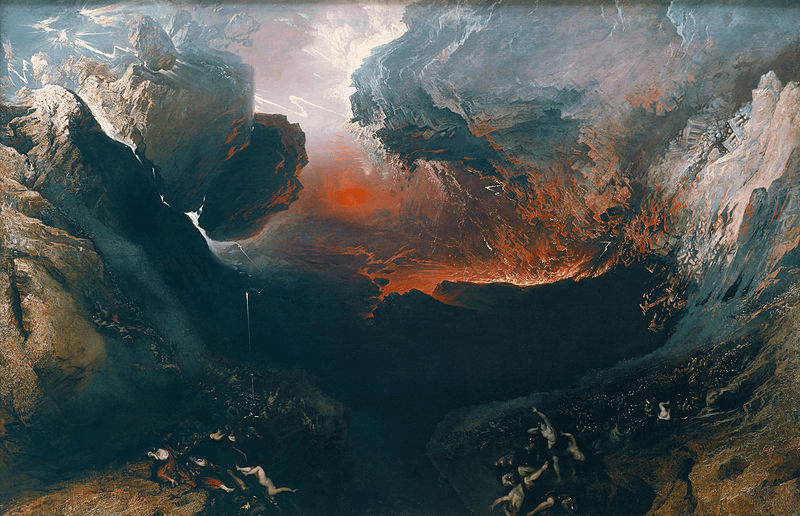
The Day Is Coming (Malachi 4:1-6)

The Great Day of His Wrath, by John Martin, c.1851

“Surely the day is coming; it will burn like a furnace. All the arrogant and every evildoer will be stubble, and the day that is coming will set them on fire,” says the Lord Almighty. “Not a root or a branch will be left to them. But for you who revere my name, the sun of righteousness will rise with healing in its rays. And you will go out and frolic like well-fed calves. Then you will trample on the wicked; they will be ashes under the soles of your feet on the day when I act,” says the Lord Almighty.

“Remember the law of my servant Moses, the decrees and laws I gave him at Horeb for all Israel.

“See, I will send the prophet Elijah to you before that great and dreadful day of the Lord comes. He will turn the hearts of the parents to their children, and the hearts of the children to their parents; or else I will come and strike the land with total destruction.” (New International Version)

These are the final words of the Old Testament, the concluding message of the prophet Malachi.

Malachi’s vision of God’s future action describes a Day of Judgment, a time of utter destruction for all those who devoted themselves to wickedness. The faithful, however, will receive healing by means of bright righteousness. God will restore a good, right, and just order of things.

The divine restoration will cause joy and celebration. In their freedom, the faithful will ensure that the wicked shall not have power and authority ever again.

Therefore, the conclusion to the Book of Malachi – and of all the Old Testament – is a call to obedience, to observe the law. Finally, it is communicated that Elijah – one of the greatest prophets in Jewish history – will return in order to turn the hearts of family members toward one another. And without this change of heart and behavior within the family, there isn’t anything good to look forward to.

In other words, justice and righteousness, humility and gentleness, mercy and peace, all begin within the home. If we are to get things right out in the world, it will be because we have learned how to develop and maintain right relationships and provide for one another in our families.

So, how is that project going? (said in a sarcastic tongue-in-cheek sort of way).

And, how is the religious and spiritual progress going? (said in that same obnoxious sort of tone)

Furthermore, what are you and I doing to help the situation, and not to bring harm to it? (said in an actual serious tone)

It will not do for any of us to simply blame others – even though those others likely have a lot to answer for themselves. You and I cannot control others, especially family members (although some folks do their darndest to try and do it!).

Therefore, we must practice self-control, and do what is within our own power to do in order to help bring blessing – not judgment – to the earth.

All of us need to allow accountability into our lives, so that we may continue in living good and responsible lives.

Yet, that does not always happen. Graciously, the world is not presently spinning on its axis because of me or you. Our mistakes, foibles, screw-ups, and sins are not good, but they are also not going to stop the sun from coming up tomorrow.

It is terribly sad that there is so much war, death, destruction, harm, malevolence, disease, and disaster in this old world. It’s as if the earth is under a curse, which it is. But the world is also loved by God.

The faithful ultimately trust in the grace and mercy of God. The Christian, specifically, looks to Jesus to provide the righteousness and justice that we ourselves have not been able to accomplish.

The judgment of God exists, so that the justice and mercy of God can be fulfilled.

He himself bore our sins in his body on the cross, so that we might die to sins and live for righteousness; by his wounds you have been healed.

1 Peter 2:24, NIV

In union with Christ, the faithful know what a change of heart truly means. And they know what to do in order to affect that change in their lives today:

For we know that our old self was crucified with him so that the body ruled by sin might be done away with, that we should no longer be slaves to sin—because anyone who has died has been set free from sin.

Now if we died with Christ, we believe that we will also live with him. For we know that since Christ was raised from the dead, he cannot die again; death no longer has mastery over him. The death he died, he died to sin once for all; but the life he lives, he lives to God.

In the same way, count yourselves dead to sin but alive to God in Christ Jesus. Therefore do not let sin reign in your mortal body so that you obey its evil desires. Do not offer any part of yourself to sin as an instrument of wickedness, but rather offer yourselves to God as those who have been brought from death to life; and offer every part of yourself to him as an instrument of righteousness. (Romans 6:6-13, NIV)

So then, let us restore right relationships with others, and especially with family. Let us live as people who have been lifted from a curse, and are free from divine judgment.

Let’s get up each day and live into the freedom we possess from the power of guilt, shame, and plain old-fashioned sin.

Let’s be people who choose to look both backward and forward:

  • We look back at the redemptive events of Jesus, to his coming to this earth in a miraculous incarnation, and to his death, resurrection, and ascension.
  • We look forward to the return of Christ, a second advent, when he will save his people, judge all people, and restore all things.

We can do this, my friends. We can live as we ought to live, love as we ought to love, and give as we ought to give – because of the One who has gone before us, is with us, and is coming again.

The Day is coming. Make sure that when it does, we are found faithful.

“For even the Son of Man did not come to be served, but to serve, and to give his life as a ransom for many.”

Mark 10:45, NIV

To him who loves us and has freed us from our sins by his blood, and has made us to be a kingdom and priests to serve his God and Father—to him be glory and power for ever and ever! Amen. (Revelation 1:5b-6, NIV)

The Righteous and the Wicked (Malachi 3:13-18)

“You have spoken arrogantly against me,” says the Lord.

“Yet you ask, ‘What have we said against you?’

“You have said, ‘It is futile to serve God. What do we gain by carrying out his requirements and going about like mourners before the Lord Almighty? But now we call the arrogant blessed. Certainly evildoers prosper, and even when they put God to the test, they get away with it.’”

Then those who feared the Lord talked with each other, and the Lord listened and heard. A scroll of remembrance was written in his presence concerning those who feared the Lord and honored his name.

“On the day when I act,” says the Lord Almighty, “they will be my treasured possession. I will spare them, just as a father has compassion and spares his son who serves him. And you will again see the distinction between the righteous and the wicked, between those who serve God and those who do not. (New International Version)

The righteous and the wicked. Depending upon what sort of faith tradition you grew up in as a child; or by what belief system you currently adhere to, this may likely determine your understanding of those two words.

The terms “righteous” and “wicked” vary amongst differing groups of people. But however you understand those words, I want us to notice how the prophet Malachi understands them.

To be “righteous” means to have a right relationship with both God and others. It is to be close enough to knowing God to carry out what is important to God.

Righteous folk actually listen and talk to one another. They consult and collaborate with each other. They enjoy good relations because the righteous understand that relationships are a high value. They discern that people are important.

And so, God’s justice is very important to the righteous, because God wants everyone’s basic needs met. The Lord desires people to be treated well, with respect and dignity, in order to make a living and enjoy life.

To be “wicked” means to be arrogant, proud, and boastful. It is to have a string of messed up relationships with both God and others because they insist on their own way.

The wicked are far from God, and do whatever they want to do, regardless of how it may affect others. They view justice and righteousness as dispensable, and unnecessary, unless it can be used as leverage for selfish desires. Even though the wicked might be rich and powerful in this life, they will not be spared from God’s judgment.

Wicked persons – those who carry out injustice and seek to care only for themselves – are called to repent, to change, to amend their evil ways. Their negative statements about God, and their mistreatment of others, has not gone unnoticed.

A typical tactic of wicked persons is to blame others. In Malachi’s day, they were blaming God, and ironically, accusing the Lord of injustice. That’s because the wicked person’s understanding of God is that the Lord exists for their personal benefit.

So, if the wicked person is not receiving some benefit from God, then God isn’t being God, and then is accused and blamed as being the problem to any sort of adverse situation.

But in reality, the righteous are God’s treasured possession, because they consistently serve the Lord, no matter the circumstances. The righteous are faithful, and so, they will be spared on the day of God’s judgment.

So far, I have made this all seem quite black and white. But that was only to make clear the contrast between righteousness and wickedness. The truth is that all of us are a bit of both. We are not always completely right, nor are we always wrong.

We are in the middle of things. Most folks have not rejected God through a lack of belief. Yet, they also have not fully accepted God’s intentions for this world and are not fully living into them.

The prophet Malachi calls such persons (which is perhaps all of us?) to a day when trying circumstances will make the distinction between the wicked and the righteous much more clear.

Then, we will be able to change, fully convinced and knowing the difference between right and wrong, truth and error, faith and fear.

Charlatans will eventually be found out and known. And the consistently faithful people will eventually be noticed and held up by God for others to see and know.

If everything presently appears murky, shadowy, and unclear, please know that it will not always be this way for you.

I am assuming that there very few “wicked” persons actually reading or listening to this. Simply because they see no value in doing so. It doesn’t get them anywhere they want to go.

The wicked may seem to know what they’re doing, but they don’t. Life for them is very nebulous and unclear. They’re only spit-balling through life, trying to look out for number one, that is, themselves.

But you who are reading or listening to this likely want nothing to do with wickedness. You want to stay away from evil.

You are looking to make a difference on this earth, and to improve your little corner of the world. You desire good things for yourself and others. You seek to live as justly and rightly as you can.

Good for you! The Lord is noticing your faith and patience.

So do not throw away your confidence; it will be richly rewarded.

You need to persevere so that when you have done the will of God, you will receive what he has promised. For,

“In just a little while,
    he who is coming will come
    and will not delay.”

And,

“But my righteous one will live by faith.
    And I take no pleasure
    in the one who shrinks back.”

But we do not belong to those who shrink back and are destroyed, but to those who have faith and are saved. (Hebrews 10:35-39, NIV)

Eternal God, in whose perfect kingdom no sword is drawn but the sword of righteousness, no strength known but the strength of love: So mightily spread abroad your Spirit, that all peoples may be gathered under the banner of the Prince of Peace, as children of one Father; to whom be dominion and glory, now and forever. Amen.