Psalm 2 – God

Why are the nations so angry?
    Why do they waste their time with futile plans?
The kings of the earth prepare for battle;
    the rulers plot together
against the Lord
    and against his anointed one.
“Let us break their chains,” they cry,
    “and free ourselves from slavery to God.”

But the one who rules in heaven laughs.
    The Lord scoffs at them.
Then in anger he rebukes them,
    terrifying them with his fierce fury.
For the Lord declares, “I have placed my chosen king on the throne
    in Jerusalem, on my holy mountain.”

The king proclaims the Lord’s decree:
“The Lord said to me, ‘You are my son.
    Today I have become your Father.
Only ask, and I will give you the nations as your inheritance,
    the whole earth as your possession.
You will break them with an iron rod
    and smash them like clay pots.’”

Now then, you kings, act wisely!
    Be warned, you rulers of the earth!
Serve the Lord with reverent fear,
    and rejoice with trembling.
Submit to God’s royal son, or he will become angry,
    and you will be destroyed in the midst of all your activities—
for his anger flares up in an instant.
    But what joy for all who take refuge in him! (New Living Translation)

Our view of God determines how we live. If our perception of God is a being who is small and ineffective or does not really see or care about everything that happens on earth, then the response of the nations in Psalm 2 is likely.

Demagogues and delegates meet for summit talks; God-deniers, the Messiah-defiers get together and say, “Let’s get free of God! Cast loose from Messiah!” (The Message)

However, if we discern that God is far larger than we can ever imagine and sees all, then we know that in heaven the Lord breaks out in laughter as he sits on the sovereign throne, as if amused by such insolence. 

People who think they can distance themselves from the God of the universe are, at best, delusional, and, at worst, in danger of being swept away like an ant hill.

In the past, God spoke through the prophets to our ancestors in many times and many ways. In these final days, though, he spoke to us through a Son. God made his Son the heir of everything and created the world through him. 

The Son is the light of God’s glory and the imprint of God’s being. He maintains everything with his powerful message. After he carried out the cleansing of people from their sins, he sat down at the right side of the highest majesty. And the Son became so much greater than the other messengers, such as angels, that he received a more important title than theirs.

After all, when did God ever say to any of the angels:

You are my Son.
        Today I have become your Father? (Hebrews 1:1-5, NIV)

The sovereign Lord blesses and protects all who seek what is right, fair, just, and true. So, we are to be smart and show respect. Because the fact of the matter is that God is bigger than anyone or anything. That’s good news for those who serve God and bad news for those who don’t. 

For the faithful, nothing can separate us from God’s steadfast love; and for the unfaithful, no nation has more power than God; and no organization, institution, or government can continue unabated in their unethical ways. 

So, when we face adversity, hardship, and difficulty we have a very large God who has our back. It may seem, in the short term, that evil is winning, and arrogant people are having their day, but ultimately God will deal with it. Jesus is king, and we are not.

The presence of God is everywhere. Whenever nations or institutions or governments or communities or individual people fail to discern this, then all hell breaks loose.

Sensing the Lord’s presence, knowing the love of God in Christ, is of upmost importance.

Parishioners must desire the presence of God in a church building more than the building itself. 

Christians must desire the presence of God in their liturgies, spiritual practices, and ministries, more than the programs themselves. 

Clergy must desire the presence of God with them at all times more than the presence of budgets, books, and butts in the pew. 

Spiritual parents and grandparents must desire the presence of God in their families more than the presence of kids, or order in the house, or wanting everything to be up to our standards.

God wants our hearts where they belong: desiring the divine love and presence of the Lord more than anything. Many religious folk in biblical times lost their true sense of purpose as God’s people. They neither perceived nor focused on God’s presence but cared more about the presence of animals and sacrifices, making money, and keeping their social positions secure. 

Failing to seek God’s presence, we are then likely not to see it, even when it stares us in the face. 

A few years ago, the Washington Post orchestrated an interesting experiment. They had arguably the best violinist in the world, Joshua Bell, play in the train station as a regular looking street musician complete with open violin case to catch monetary offerings. 

Not only did Bell play some of the most difficult pieces of music for the violin, but he also played them on a Stradivarius worth $3.5 million dollars. 

His earnings for a few hours of work were exactly $32.17, which is less than just one $100 ticket at a Boston concert hall he played three weeks before. No one noticed the extreme talent right in front of their faces, much like those who merely discern God as a pathetically ineffective deity, or those who only see Jesus as a regular guy.

“The Christian ideal has not been tried and found wanting. It has been found difficult; and left untried.”

G.K. Chesterton

Immense God, you are sovereign above all creation and everything in the earth. I choose this day to submit to the words and ways of Jesus, who is the true ruler of all. May all the nations come to see you for who you really are, the great and wondrous king. Amen.

Psalm 139:1-6, 13-18 – Known and Loved by God

The Inescapable God by Mike Moyers

You have looked deep
into my heart, Lord,
    and you know all about me.
You know when I am resting
    or when I am working,
and from heaven
    you discover my thoughts.

You notice everything I do
    and everywhere I go.
Before I even speak a word,
    you know what I will say,
and with your powerful arm
you protect me
    from every side.
I can’t understand all of this!
Such wonderful knowledge
    is far above me….

You are the one
who put me together
    inside my mother’s body,
and I praise you because of
the wonderful way
    you created me.
Everything you do is marvelous!
    Of this I have no doubt.

Nothing about me
    is hidden from you!
I was secretly woven together
    out of human sight,
but with your own eyes you saw
    my body being formed.
Even before I was born,
you had written in your book
    everything about me.

Your thoughts are far beyond
    my understanding,
much more than I
    could ever imagine.
I try to count your thoughts,
but they outnumber the grains
    of sand on the beach.
And when I awake,
    I will find you nearby. (Contemporary English Version)

Many people struggle with their basic self-image. And it’s no wonder why.

Beautiful people reign over the television and the movies; the rich and powerful are highlighted in the media; and those with perfect teeth and immaculate attire are splashed in front of us in the daily barrage of advertisements. 

Meanwhile, the rest of us 99% of the population, quickly notice we do not measure up to such a high standard. You don’t have to be a people watcher to know that less than perfect bodies are the norm and that most folks do not have a budget to live like the other 1% humanity.

If we make comparisons with others too much and for too long, it gets downright depressing. Yet, into this dark abyss of one’s self-image enters the biblical truth that each one of us, no matter our station in life, was personally hand-crafted by a heavenly Being who loves us dearly.

We are indeed fearfully and wonderfully made. The Creator took great care to make us and form us just so. 

The real standard from which we ought to judge ourselves is this: God knows us intimately, inside-and-out, and neither condemns us nor shames us but loves us wholly.

So then, rather than wasting our emotional energy and mental faculties on wishing we looked different or were more like so-and-so who seems to always have it all together, try practicing what the psalmist David did: Praise God. 

Whenever we have the notion that we do not measure up to our imposed arbitrary standard, keep in mind that the only real measurement is grace. No matter who we are, the entire race of humanity has been created in the image of God, and, on that basis alone, we have inherent value, worth, and majesty. Let us, then, treat ourselves and others with the yardstick of grace.

The inner critic, that is, the inner judgmental dialogue we have with ourselves, needs to be replaced with the truth of Psalm 139. Although we might be rather hard on ourselves and say things in the reclusive parts of our minds and hearts that we would never say to others, nor tolerate others saying about someone else – God speaks to us with tender words of grace.

Perhaps you think that only you know the depth of your own sorrows, hurts, fears, insecurities, and worries. Except… God. The Lord knows it all intimately – and is not one bit repulsed. 

You see, God knows that the answer to all the self-doubts is Divine care and protection. You and I have the freedom to plumb the recesses of our hearts and souls – to bring out all that is inside the cluttered closet of our minds and lay it on the table without fear of God calling you what you call yourself.

Therefore, please do not quickly pass over the inspired words from Holy Scripture contained in today’s psalm. Take the time to carefully digest each phrase slowly so that the message becomes internalized and believed in real-time experience.

One of the theories of human psychology is that people are driven by two primary needs: 

  1. To intimately know another person.
  2. To be intimately known by another person. 

God knows us even better than we know ourselves – and still loves us! There is nothing we learn about ourselves that God does not already know. No human relationship can even come close to the level of knowing that God has for us and about us.

To know God is perhaps the greatest and highest pursuit we could ever enjoy. God is so immense and infinite that we will spend an eternity getting to know the Lord and will never get to the end of it. That is the kind of God we serve. 

Be encouraged today and always with the reality that you are known, and can know, God – and even more, loved deeply as a specially fashioned creature.

O God, thank you that I am wonderfully made in your likeness. I praise you that I am fully accepted, even when I do not accept myself. In Jesus Christ you have demonstrated the height of your love and mercy. May this grace be with me every day so that I will conduct myself in a manner worthy of being part of the human family. Amen.

Psalm 58 – Curse the Wicked

Do you rulers indeed speak justly?
    Do you judge people with equity?
No, in your heart you devise injustice,
    and your hands mete out violence on the earth.

Even from birth the wicked go astray;
    from the womb they are wayward, spreading lies.
Their venom is like the venom of a snake,
    like that of a cobra that has stopped its ears,
that will not heed the tune of the charmer,
    however skillful the enchanter may be.

Break the teeth in their mouths, O God;
    Lord, tear out the fangs of those lions!
Let them vanish like water that flows away;
    when they draw the bow, let their arrows fall short.
May they be like a slug that melts away as it moves along,
    like a stillborn child that never sees the sun.

Before your pots can feel the heat of the thorns—
    whether they be green or dry—the wicked will be swept away.
The righteous will be glad when they are avenged,
    when they dip their feet in the blood of the wicked.
Then people will say,
    “Surely the righteous still are rewarded;
    surely there is a God who judges the earth.” (New International Version)

The term “imprecatory” means to call down a curse on a person or group of people. There are eighteen imprecatory psalms within the Old Testament psalter, all of which make a clear petition for God to turn the evil back on the people who inflict it (or try to) on others. Maybe this surprises you that there is such language in the Bible.

There is nothing sanitized about imprecatory psalms. They are as raw and real as it gets, expressing deep anger. Whatever you might think about how a proper pious person ought to pray, imprecatory curses are likely not your first thought. But here they are, contained in Holy Scripture for our use.

One reason for the imprecatory psalms is that it is not any person’s place for revenge or retaliation. Instead, for people who are genuinely caught in the crosshairs of evil, for those who have awful trouble dogging them, prayer is their most effective recourse.

Sometimes you just have to tell it like it is. There is a time to do your best in putting up a good face so that you can deal with people who keep gossiping, slandering, and trying to get their way. Yet, there is also a time to call such behavior “evil” and cry out to God for help.

There are many folks who consider imprecatory psalms a problem because of their detailed expressions of cursing. Yet, such psalms refuse to put a positive spin on malevolent motives, wicked words, and destructive actions.

Desperate people utter desperate prayers. Their unflinching sense of injustice will not allow them to sugarcoat the villainous plans of corrupt people.

Evil is never toppled with tepid prayers from wimpy worshipers. Rather, nefarious agendas are thwarted in the teeth of specific, focused, and intense prayers directed with spiritual precision to the very core of diabolical forces.

We need not be shy about being real with God, even with praying imprecatory prayers. There really are people in this world, maybe even in your own life, that have malicious intent against you or others. Our job is not personal revenge, but to entrust ourselves to the God who fights for the poor, the oppressed, and the needy against the arrogant and the powerful. Let your prayers reflect your life.

With no cursing of evil, our emotional pain and spiritual anger come out sideways in an unkind sort of “snarky-ness” toward each other. What I am proposing is that our terrible hurt and our rage needs to be acknowledged and voiced.

Our bitterness must have an outlet, not directed toward one another, but toward the evil itself – and even toward God because God is big enough to handle our rage, whereas other humans are not.

Victimization needs a voice, and a bit of raging and cursing is the means to do it. Giving voice to our deep anger is cathartic and therapeutic. Our speech needs to be congruent with the intensity of our pain because where there are no valued words of assault for victims, the risk of hurting each other becomes much higher.

Despair with no voice and no one to hear will eventually transition to harming others.

Spiritual problems require spiritual implements to solve. And the imprecatory psalms are a major tool for pushing back the dark forces of this world. They are a significant means of spiritual assertiveness against heinous acts, acerbic words, systemic evil, depraved people, and horrible circumstances.

God’s wrath is an expression of God’s love because God is not okay with evil taking root in the lives and institutions of humanity.

Prayer is our privilege of coming to the God who upholds justice and righteousness. For if God is for us, who can be against us?

Matthew 20:20-28 – Leadership as Service to Others

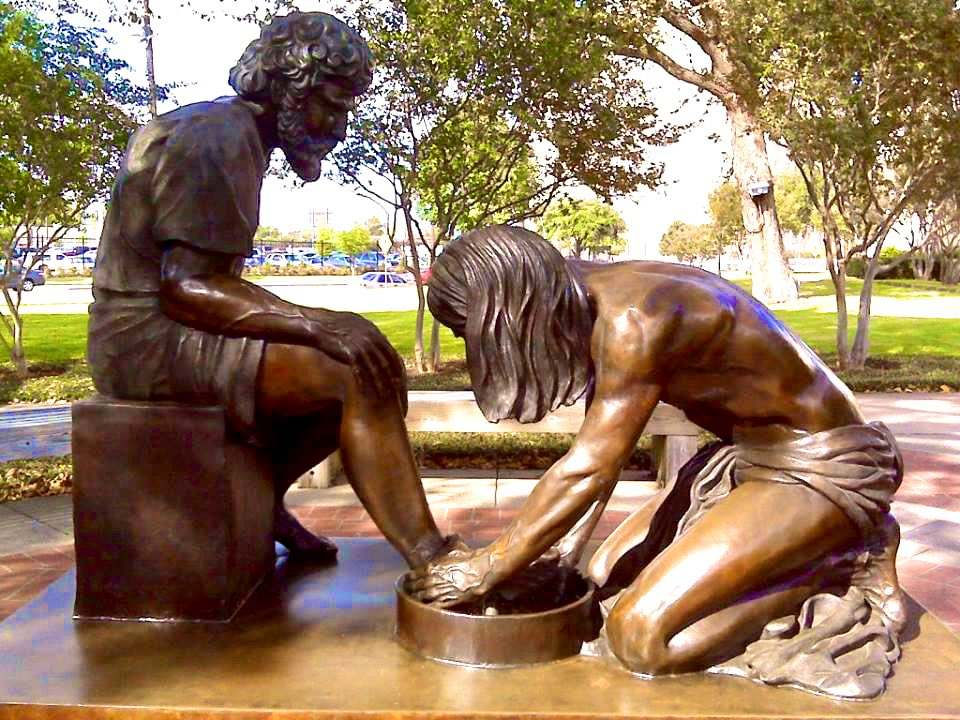
Statue of Jesus washing Peter’s feet, in Pittsburgh, Texas. Photo by Carol Highsmith

The mother of Zebedee’s sons came to Jesus with her sons and, kneeling down, asked a favor of him.

“What is it you want?” he asked.

She said, “Grant that one of these two sons of mine may sit at your right and the other at your left in your kingdom.”

“You don’t know what you are asking,” Jesus said to them. “Can you drink the cup I am going to drink?”

“We can,” they answered.

Jesus said to them, “You will indeed drink from my cup, but to sit at my right or left is not for me to grant. These places belong to those for whom they have been prepared by my Father.”

When the ten heard about this, they were indignant with the two brothers. Jesus called them together and said, “You know that the rulers of the Gentiles lord it over them, and their high officials exercise authority over them. Not so with you. Instead, whoever wants to become great among you must be your servant, and whoever wants to be first must be your slave—just as the Son of Man did not come to be served, but to serve, and to give his life as a ransom for many.” (New International Version)

Jesus and his disciples were not on the same page. That’s because they each had differing agendas.

Jesus was clear with the disciples about how things were going to shake out with him: torture, insults, crucifixion, and death was ahead. It seems the disciples and the mother of James and John missed the memo on this. Christ’s words went way over their heads.

It could be the disciples simply did not hear what Jesus was saying to them (repeatedly!). It’s more likely that the message of Jesus got filtered through an existing agenda of how they believed things ought to go.

The disciples, along with a lot of other Jewish folk in the first century, were looking for a Messiah in the mold of King David – a strong leader who would come and beat up the Romans, exert all kinds of power and influence, and establish an earthly rule over all the people they don’t like.

Submission to torture, humility before the very people they detested, and being killed by them were not factors into the disciples understanding of leadership and government.

Much like the powerful Aslan who had a thorough understanding of the world’s deep magic and submitted himself to the White Witch and death in C.S. Lewis’s The Lion, the Witch, and the Wardrobe – Jesus knew what he was doing, while everyone else seemed clueless about the true power which exists in the universe.

Let’s be clear about what that true power really is: grace. Yes, grace. Powerful, resplendent, subversive, scandalous, and radical grace.

Mercy was the missing factor in the disciples’ agenda. Jesus is not like other rulers. He does not operate by throwing his weight around to forcefully impose a crushing my-way-or-the-highway kind of rule (even though, ironically, he is The Way).

No, Jesus freely and unabashedly uses grace with its merciful tools of humility, gentleness, kindness, goodness, and love to introduce and establish a new kind of rule which is not posturing for self-serving authority.

Power, authority, and the positions which go with them are to be used for the common good of all persons. To be in any sort of leadership position is to be a servant of grace for the benefit of humanity and the world.

If Christ’s disciples had looked a bit closer into the Scriptures, they might have noticed, for all his power and authority, that King David trafficked in grace.

David, at the pinnacle of power, looked over the kingdom to see who from the family of his enemy, the former King Saul (who was into the power thing for himself) was around so he could show grace (2 Samuel 9). It was typical of ancient kings to secure their rule and power through killing-off rivals and family members of previous kings. Not so with David. And not so with Jesus.

Wherever there is posturing for position, preening for power, and a pestering for privilege – there you will find everything grace is not:

  • Reliance on making and calling-in favors
  • Arrogant and overinflated egos
  • Unrealistic expectations
  • Hatred and suspicion of others
  • Judgment and condemnation
  • An insistence on recognition
  • Compulsive manipulation and control over everything and everyone
  • Unilateral decision-making
  • Shaming of others
  • Hoarding resources
  • Coups and in-fighting
  • A demand of rights

We in the western world may not be in the habit of offing leaders and killing others to consolidate power, yet we still too often rely on violent speech and language, partisan policies, and good-old-boy systems which are foreign to the way of Christ.

In contrast to this, grace exists. It is the deep magic which resides within. Wherever grace operates, there you will find the heart of a servant:

Attending to the needs of all persons, especially the least, the last, and the lost

  • Freely consulting and collaborating with others
  • Focusing on responsibility
  • Loving discipline
  • Embracing accountability
  • Pursuing truth and integrity
  • Sharing power and resources
  • Encouraging feedback
  • Giving generously
  • Looking for ways to show mercy

This old world desperately needs leaders with a dutiful sense of public service which is compassionate and kind. Wielding authority is not about a show of strength; it is in the understanding that when I am weak, then I am strong.

Yes, this approach to leadership may bring some short-term suffering. Grace, however, results in longevity of righteousness and peace for those who have been trained by it. True service is being a servant of grace.

May it be so, to the glory of God, and for the blessing of the world. Amen.