Who Are We Listening To? (Jeremiah 23:9-22)

My head is reeling,
    my limbs are limp,
I’m staggering like a drunk,
    seeing double from too much wine—
And all because of God,
    because of his holy words.

Now for what God says regarding the lying prophets:

“Can you believe it? A country teeming with adulterers!
    faithless, promiscuous idolater-adulterers!
They’re a curse on the land.
    The land’s a wasteland.
Their unfaithfulness
    is turning the country into a cesspool,
Prophets and priests devoted to desecration.
    They have nothing to do with me as their God.
My very own Temple, mind you—
    mud-spattered with their crimes.” God’s Decree.
“But they won’t get by with it.
    They’ll find themselves on a slippery slope,
Careening into the darkness,
    somersaulting into the pitch-black dark.
I’ll make them pay for their crimes.
    It will be the Year of Doom.” God’s Decree.

“Over in Samaria I saw prophets
    acting like silly fools—shocking!
They preached using that no-god Baal for a text,
    messing with the minds of my people.
And the Jerusalem prophets are even worse—horrible!—
    sex-driven, living a lie,
Subsidizing a culture of wickedness,
    and never giving it a second thought.
They’re as bad as those wretches in old Sodom,
    the degenerates of old Gomorrah.”

So, here’s the Message to the prophets from God-of-the-Angel-Armies:

“I’ll cook them a supper of maggoty meat
    with after-dinner drinks of strychnine.
The Jerusalem prophets are behind all this.
    They’re the cause of the godlessness polluting this country.”

A Message from God-of-the-Angel-Armies:

“Don’t listen to the sermons of the prophets.
    It’s all hot air. Lies, lies, and more lies.
They make it all up.
    Not a word they speak comes from me.
They preach their ‘Everything Will Turn Out Fine’ sermon
    to congregations with no taste for God,
Their ‘Nothing Bad Will Ever Happen to You’ sermon
    to people who are set in their own ways.

“Have any of these prophets bothered to meet with me, the true God?
    bothered to take in what I have to say?
    listened to and then lived out my Word?
Look out! God’s hurricane will be let loose—
    my hurricane blast,
Spinning the heads of the wicked like tops!
    God’s raging anger won’t let up
Until I’ve made a clean sweep,
    completing the job I began.
When the job’s done,
    you’ll see that it’s been well done.

“I never sent these prophets,
    but they ran anyway.
I never spoke to them,
    but they preached away.
If they’d have bothered to sit down and meet with me,
    they’d have preached my Message to my people.
They’d have gotten them back on the right track,
    gotten them out of their evil ruts. (The Message)

Jeremiah had a hard gig as a prophet of the Lord. And what made it especially difficult was the continual stream of false prophets, preaching their “everything will turn out just fine” sermons in the face of economic injustice, social unrighteousness, emotional denial, and spiritual adultery.

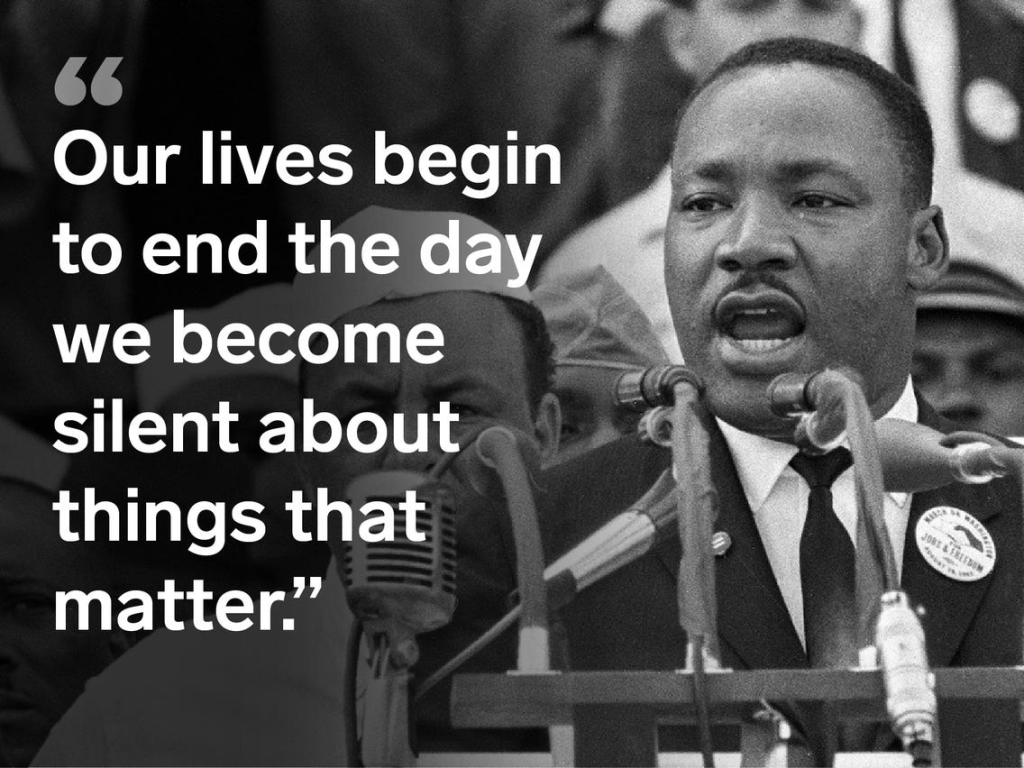
Methinks that Martin Luther King, Jr. must have felt a kinship with the prophet Jeremiah. After all, he was much like a modern-day prophet. In word and deed, he kept asking people to close the distance between the values they espoused and their actual behavior. 

The terrible treatment King and his allies received during the civil rights movement through non-violent marches and demonstrations, brought-out the awful gap between espoused American values of freedom, fairness, and tolerance, and the reality that Blacks really did not possess these in any manner close to the white population. 

Every prophetic ministry compels people to come face-to-face with the disparity between beliefs and behaviors.
Jeremiah knew all about the gulf between expressed values and actual conduct. And he faced a very large chasm between the two. 

Like Reverend King, Jeremiah was imprisoned, had rocks thrown at him, and was jeered for his message of calling people to live up to God’s agenda for humanity. 

White supremacy, or at least white privilege, was taken for granted in much of America before King. In the same way, Israelite privilege was taken for granted in Jerusalem, in Jeremiah’s day. Unfaithful prophets kept proclaiming Jewish supremacy and insisted that the Lord would be on their side of things. 

But the Lord insisted that these supposed prophets have neither attended a meeting of any divine council in heaven nor ever heard God speak to them.

I urge you, brothers and sisters, to keep an eye on those who create dissensions and hindrances, in opposition to the teaching that you have learned; avoid them. For such people do not serve our Lord Christ but their own appetites, and by smooth talk and flattery they deceive the hearts of the simple-minded. (Romans 16:17-18, NRSV)

The spirit of the age simply accepted power, privilege, and pedigree as the norm that ought to always endure. But God thinks differently about it. And so, the Lord sends prophets to call people back to justice, righteousness, and peace for the benefit of all persons.  

The zeitgeist of our own age is one of turmoil, uncertainty – and even chaos, violence, and death. We have our own contemporary self-appointed prophets who proclaim peace where there is no peace; safety, at the expense of others’ protection; militant forms of xenophobia; and an American exceptionalism which places a thin veneer of respectability over the graves of dead people’s bones.

The Lord will not contend with this forever.

An exercise in healthy introspection would be to consider these questions:

  • What are our most cherished values?
  • Where did we get them? Who are we listening to?
  • Are they God’s values? 
  • Who is really in control as the arbiter of values?
  • How might godly values of justice, righteousness, and peace be expressed in our everyday actions and behaviors?
  • Will we seek to engraft such values into our organizations, systems, faith communities, neighborhoods, and governments?
  • Can we work together in humility?
  • Do we have the courage to change, to share power, and to seek the common good of all persons?

Lord, have mercy, and grant us your peace.

All-Seeing God, you know the true state of every heart and every people group. Do your work of making me holy in all I do and say so that your values, and the words and ways of Jesus, might be expressed through me in the power of the Holy Spirit. Amen.

Dealing with Grinding Pain (Psalm 79:1-9)

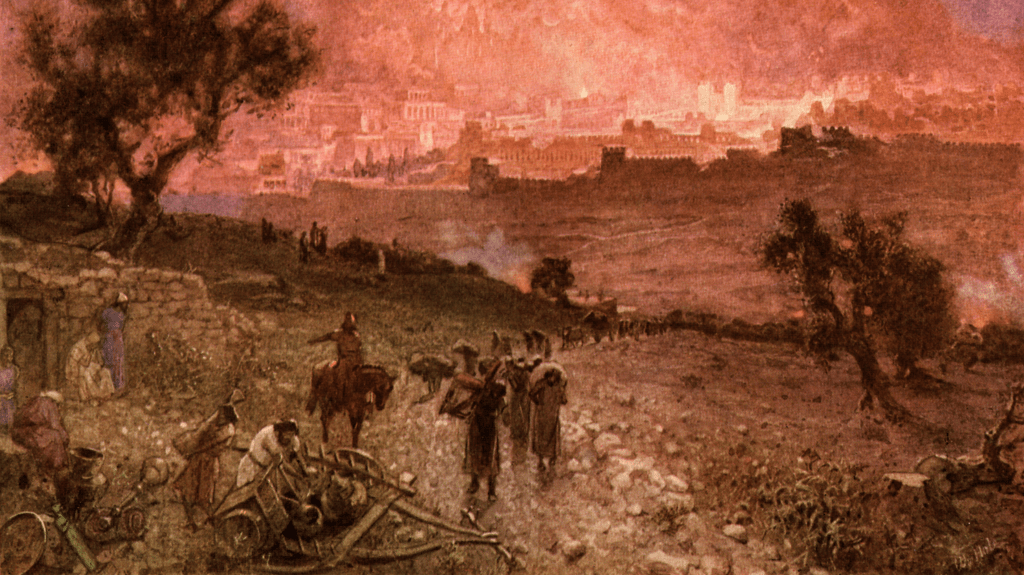
The Babylonian conquest of Jerusalem, by William Hole (1846-1917)

God, nations have come against your chosen people.
    They have ruined your holy Temple.
    They have turned Jerusalem into ruins.
They have given the bodies of your servants as food to the wild birds.
They have given the bodies of those who worship you to the wild animals.
They have spilled blood like water all around Jerusalem.
    No one was left to bury the dead.
We are a joke to the other nations;
    they laugh and make fun of us.

Lord, how long will this last?
    Will you be angry forever?
    How long will your jealousy burn like a fire?
Be angry with the nations that do not know you
    and with the kingdoms that do not honor you.
They have gobbled up the people of Jacob
    and destroyed their land.
Don’t punish us for our past sins.
    Show your mercy to us soon,
    because we are helpless!
God our Savior, help us
    so people will praise you.
Save us and forgive our sins
    so people will honor you. (New Century Version)

I don’t like evil. And I really don’t like arrogant people who want what they want and leave a path of destruction behind them.

The setting behind today’s Psalm is the destruction of the temple. It was razed by a conquering army who proudly gloated over their victory. This psalm, as all psalms, is a prayer. It’s a bitter and angry cry for God to step in and act on behalf of the humiliated people.

The psalm is more than a simple plea for help; it is a deeply passionate appeal. As a child of the 1960’s, my phrase for the psalmist’s entreaty is, “God, stick it to the man!”

There is no polite knock at the side door of God’s house in the face of such evil. This is a pounding on the front door with the demand for God to do something about this terrible trouble. For the psalmist, the incongruence between who God is and what has happened to God’s people is inconceivable and unacceptable.

To profane God’s temple is to profane God; and to kill and maim God’s people is to flip the middle finger at God. The psalmist is beside himself and overwhelmed with emotion.

There is something very instructive here that we ought not miss. When we have been brutalized, victimized, and/or demoralized, we just want someone, especially the Lord we serve, to take notice and feel what we are feeling.

Never underestimate the power of empathy and solidarity. To feel alone and bereft of help is an awful feeling.

Perhaps the psalmist’s prayer offends some sensibilities. I wonder, for those who find the language difficult, have ever had a daughter raped or a house destroyed by fire or seen a person killed without mercy in front of their own eyes. Methinks they have not. The feelings of helpless despair and sheer anger defy human words. These are not casual affronts but malicious destructions of property and people.

We need someone to affirm the raw ruthlessness of it all, to have some understanding of the impossible place we are in with such wanton cruelty. When our very support is ripped from our lives, the madness within is too much to bear.

Who will rescue us from this body of death?

God is big enough to handle our rage and our hurt. The Lord is available and hears our desperate voice of prayer. Yet, God is not always going to directly and immediately answer on the terms we stipulate. God acts out of God’s own providence and justice, and not from our expectations. And that is a good thing, not a bad thing.

God sees, knows, and feels with us. This realization enables us to recenter and reorient ourselves around faith, hope, and love. New life is never a gift in a vacuum; it comes out of agonizing struggle in reckoning with existing evil.

So, when someone goes through a hellish experience, we are to exercise our capacity to listen and witness their horrible spiritual pain. Healing hurts: it is not a pleasant affair. We are to hang in there and walk alongside another in their hour of need, even when their vitriol seems over the top to us.

For only in telling our story to another will any of us find relief and renewed hope.

The psalms permit us to use language appropriate to what has happened to us. They also allow us to move beyond the venom to the God who restores broken lives.

Lord Jesus Christ, by your patience in suffering you hallowed earthly pain and gave us the example of obedience to your Father’ will.

Be near me in my time of weakness and pain; sustain me by your grace, that my strength and courage may not fail; heal me according to you will; and help me always to believe that what happens to me here is of little account if you hold me in eternal life, my Lord and my God.

As the Lord Jesus cried out on the cross, I cry out to you in pain, O God my Creator. Do not forsake me. Grant me relief from this suffering and preserve me in peace, through the power of the Holy Spirit. Amen.

How To Handle Trouble (Psalm 94)

Lord, you are a God who punishes;
    reveal your anger!
You are the judge of us all;
    rise and give the proud what they deserve!
How much longer will the wicked be glad?
    How much longer, Lord?
How much longer will criminals be proud
    and boast about their crimes?

They crush your people, Lord;
    they oppress those who belong to you.
They kill widows and orphans,
    and murder the strangers who live in our land.
They say, “The Lord does not see us;
    the God of Israel does not notice.”

My people, how can you be such stupid fools?
    When will you ever learn?
God made our ears—can’t he hear?
    He made our eyes—can’t he see?
He scolds the nations—won’t he punish them?
    He is the teacher of us all—hasn’t he any knowledge?
The Lord knows what we think;
    he knows how senseless our reasoning is.

Lord, how happy are those you instruct,
    the ones to whom you teach your law!
You give them rest from days of trouble
    until a pit is dug to trap the wicked.
The Lord will not abandon his people;
    he will not desert those who belong to him.
Justice will again be found in the courts,
    and all righteous people will support it.

Who stood up for me against the wicked?
    Who took my side against the evildoers?
If the Lord had not helped me,
    I would have gone quickly to the land of silence.
I said, “I am falling”;
    but your constant love, O Lord, held me up.
Whenever I am anxious and worried,
    you comfort me and make me glad.

You have nothing to do with corrupt judges,
    who make injustice legal,
    who plot against good people
    and sentence the innocent to death.
But the Lord defends me;
    my God protects me.
He will punish them for their wickedness
    and destroy them for their sins;
    the Lord our God will destroy them. (Good News Translation)

Courageous, brave, bold, and strong – it seems most people do not characterize themselves this way, especially when they are in the throes of overwhelming circumstances.

Whenever one feels crushed under the weight of adverse situations caused by evil, it can be hard for them to see their resilience and strength.

I suppose it makes sense as to why we lose sight of this, because we can all readily recall times and events in which we wilted with fear; did not speak up; or were not assertive.

The many conversations we have in our heads for which will never take place, are testament to our supposed withdrawal in the face of adversity. We have far too many discussions with ourselves of how something should have gone; and too many brave retorts for someone whom we really have no intention of saying those words toward.

If this all sounds like the convoluted musings of a wimpy kid, that’s not far off the mark. When we get bullied, even as adults, it can be easy to wilt, or to take it, or to simply find a way to avoid the bully. With some folks, we even create elaborate internal reasons why it’s our fault someone is upset with us. In such times, bravery and courage seem a long way from our true selves.

Faced with a daunting task or an ornery person at work, home, or school, we may wonder if we really have the internal stuff to deal with it. We feel that maybe someone else would be better suited to handle the trouble. 

Yet, what if I told you that you are, indeed, brave, strong, and confident?

What if I insisted that courage resides within you, even if you yourself cannot see it right now?

And, what if I told you that bravery isn’t something you must go on a quest to find, but that it’s been in you all along? 

If you are already enough, then you only need to be aware of it, acknowledge it, and let it out.

You intuitively know I’m on to something here. After all, the most common exhortation and assurance in the entirety of Holy Scripture is to not be afraid because God is with us:

So do not fear, for I am with you;
    do not be dismayed, for I am your God.
I will strengthen you and help you;
    I will uphold you with my righteous right hand. (Isaiah 41:10, NIV)

God has said, “Never will I leave you; never will I forsake you.” So, we say with confidence, “The Lord is my helper; I will not be afraid. What can mere mortals do to me?” (Hebrews 13:5-6, NIV)

In the great litany of fear, we face every day, spiritual confidence and personal bravery is not so much commanded by God, as it is a calling forth of something which is already within you.

Now, before you go thinking I’m some looney-tune, hear me out. From the beginning of the world, in God’s creative activity, the Lord did it all by calling forth creation from within himself. What I mean is this: God did not simply command everything into being; instead, he said, “Let there be…”  God let out what was already there in God’s very Being. It was almost as if God belched-out from the great depth of his Being and let out all this wondrous creation.

Concerning our fear and bravery, God does not so much command us to be courageous but wants us to draw from the great reservoir within. The Lord has already created us strong, as creatures in the divine image. We just need to get in touch with what is already there. 

“Do not let your hearts be troubled,” said Jesus to his disciples, because he knew his followers had it in them to walk in his way without fear. (John 14:6, NRSV)

“Let not your heart faint, and be not fearful,” said God to the prophet Jeremiah, in the face of a terrible destruction that was about to unfold against Jerusalem, because the Lord knew that Jeremiah could face what was going to happen. (Jeremiah 51:46, ESV)

Christians can act with boldness because Jesus is the pioneer of our salvation. He is the One which enables us to draw from the deep well of courage:

So then, since we have a great High Priest who has entered heaven, Jesus the Son of God, let us hold firmly to what we believe. This High Priest of ours understands our weaknesses, for he faced all of the same testing we do, yet he did not sin. So let us come boldly to the throne of our gracious God. There we will receive his mercy, and we will find grace to help us when we need it most. (Hebrews 4:14-16, NLT)

I insist that you are brave, you are strong, and you are good. Those are not words meant to make you believe something which may or may not be true, as if I were trying to convince you to take some panacea to feel better.  No, I say it because it is true. 

You really can face the immense mountain in front of you and climb it. You can surmount the adversity you are in the middle of – not because of some words I say, but because you were created for courage.

So, how do you let out the bravery and let the boldness shine? 

You already know the answers to your own questions. You have all the knowledge you need to face your problems. So, the real question is:

Will you let your bravery come out to play, or will you keep it hidden beneath layers of insecurity?

It’s a whole lot easier to let me tell you what to do than to draw from what you already know, deep down, how to handle that troublesome something. 

I’m not going to give you a simple three-step process out of fear and into courage. That’s because you already have been endowed with the process. 

This certainly isn’t a sexy way to end a blog post, but it just might be the most effective and lasting.

1 Timothy 4:6-16 – Train Yourself to Be Godly

If you explain these things to the brothers and sisters, Timothy, you will be a worthy servant of Christ Jesus, one who is nourished by the message of faith and the good teaching you have followed. Do not waste time arguing over godless ideas and old wives’ tales. Instead, train yourself to be godly. “Physical training is good, but training for godliness is much better, promising benefits in this life and in the life to come.” This is a trustworthy saying, and everyone should accept it. This is why we work hard and continue to struggle, for our hope is in the living God, who is the Savior of all people and particularly of all believers.

Teach these things and insist that everyone learn them. Don’t let anyone think less of you because you are young. Be an example to all believers in what you say, in the way you live, in your love, your faith, and your purity. Until I get there, focus on reading the Scriptures to the church, encouraging the believers, and teaching them.

Do not neglect the spiritual gift you received through the prophecy spoken over you when the elders of the church laid their hands on you. Give your complete attention to these matters. Throw yourself into your tasks so that everyone will see your progress. Keep a close watch on how you live and on your teaching. Stay true to what is right for the sake of your own salvation and the salvation of those who hear you. (New Living Translation)

There are several metaphors throughout the New Testament illustrating the nature of the Christian life and Christian community.

God’s people are the temple of the Holy Spirit, the house where the Lord dwells; the Body of Christ, a group working together and strengthening one another in faith; the army of the Lord, advancing with the shared purpose of proclaiming good news and extending God’s benevolent rule – just to name a few.

All the metaphors are embedded with the need for training, for spiritual disciplines and practices which strengthen faith and promote spiritual health.

Just as an army of recruits needs intense basic training and ongoing discipline; and just as the body needs hourly movement and daily exercise of its muscles; so, Christian communities require spiritual development with a variety of forms and functions to elicit and establish a solid godly life.

The curriculum in the school of faith; the liturgy within the spiritual temple; the boot camp for the Lord’s soldier; and the repetitions for Christ’s Body, all involve reading and listening to Holy Scripture. And furthermore, to do so with rhythms of personal and corporate integrity, confident faith, steadfast love, encouraging words, and virtuous behavior.

If we dedicate ourselves to these things, there will be no room for entertaining wacky stories which have no basis in truth. Instead, there will be lush spiritual growth, teachable spirits, humble service, supportive beliefs, compassionate ministry, and open fellowship.

The high values of the worthy servant of Christ need to be both used and guarded. With all of our treasured earthly possessions, whatever they may be, we handle them appropriately and carefully – keeping them in a secure place when not used – and using them with care when out.

Our faith, our life and doctrine, is both a precious possession to be guarded, as well as a necessary tool to do the will of God.

Just as our bodies have physical muscles, so the Body of Christ has spiritual muscles.

Faith is a muscle which needs to be stretched, exercised, rested, and supplied with plenty of protein and necessary nutrients. Overtaxed muscles will fatigue and can be damaged through too much exertion. And underused muscles will wither and atrophy, unable to handle even the smallest of strain when we need them.

So, it is best to have proper spiritual hygiene and exercise through a regimen of tried and true practices designed to improve and maintain healthy faith. If you want to build your faith, consider the following 10 ways:

  1. Increase your amount of reading. There is no substitute for daily repetitions of reading the Bible. Supporting a growing faith will require more voluminous reading.
  2. Focus on listening to the biblical text. Reading is only as good as our listening skills. For the Christian, paying attention to the Holy Spirit’s gentle whispers is a must.
  3. Decrease your media time. For all the good stuff out there, a lot of media information is based in myth, half-truths, and opinions masked as facts – not to mention all the hack and huckster preachers.
  4. Pray more. In fact, pray continually.
  5. Practice gratitude – not complaining. Need I say more?
  6. Snack on good spiritual reading. Consuming a good book before bed keeps the faith muscle fed longer.
  7. Rest! When God created and instituted seven days, the first day was a day of rest; the workdays came after. Don’t flip-flop the divine order.
  8. Supplement with good spiritual conversation. Half-baked theological ideas come from remaining in one’s own cave-like head. Consultation, collaboration, and fellowship help create a rich and full faith.
  9. Don’t overtrain. Good idea: Read the Bible in a year. Bad idea: Read the Bible in a month. Good idea: Digest the contents of ecumenical Creeds and church Confessions. Bad idea: Stuff a bunch of knowledge down your gullet without any love to wash it down. Savor the meal. Don’t be a pig.
  10. Don’t lift too heavy for your faith muscle. The ancient desert fathers spent years developing their faith and could do incredible feats of spiritual strength. Christianity isn’t a competition of keeping up with the Francis of Assisi’s and Martin Luther’s of history. Use the measure of faith given to you and focus on those small daily decisions of trust.

Christianity is a marathon, not a 100-meter sprint. We persevere to the end, not flame out after taxing ourselves with expectations and responsibilities God never gave us.

Be safe. Be strong. Be smart. Be spiritual. We are all in this together.

Gracious God, fill your Church with truth, the truth with peace, and the peace with love. Where our faith is weak, make it strong; where it is misguided and in error, correct and direct it; where it is amiss, reform it; where it is in want, provide for it; where it is divided, reunite it, for the sake of Jesus Christ your Son our Savior. Amen.