A Parable of Two Sons (Matthew 21:28-32)

The Lord of the Parables by Argentine artist Jorge Cocco Santángelo

“What do you think? A man had two sons. Now he came to the first and said, ‘Son, go and work in the vineyard today.’

“‘No, I don’t want to,’ he replied. But later he changed his mind and went.

“The father said the same thing to the other son, who replied, ‘Yes, sir.’ But he didn’t go.

“Which one of these two did his father’s will?”

They said, “The first one.”

Jesus said to them, “I assure you that tax collectors and prostitutes are entering God’s kingdom ahead of you. For John came to you on the righteous road, and you didn’t believe him. But tax collectors and prostitutes believed him. Yet even after you saw this, you didn’t change your hearts and lives and you didn’t believe him. (Common English Bible)

Contemporary persons aren’t the only ones who want to know whose in and whose out; it’s been around forever.

In the ancient world of Jesus, people were always concerned about conformity to the established system and society of the way things are. For religious folk, who gets in and who gets left out was an important issue .So, Jesus decided to tell a parable about entrance into the kingdom of God.

Turns out, there are spiritual insiders on the outside of the kingdom, and spiritual outsiders who are the true inheritors of the kingdom.

The parable, at its core, is a warning to all the spiritually serious insiders: Beware, lest your energies be spent in correctness of behavior, conformity of belonging, and cockiness of belief rather than following Jesus. And, at the same time, the parable encourages spiritually estranged outsiders with the wonderful possibilities of a changed life. 

Far too many people arrogantly assume they have the inside track by what they believe, and not by doing God’s will.

It may be challenging for us to imagine how truly offensive Christ’s story was to the original hearers of the parable, so I restate it in a more contemporary form:

There was a man who was well respected in the community and had two sons. One son grew up and became a respectable member of the community, too. He was a successful businessman and gave lots of money to causes in his community, including new lights for the school football field – which was no small cost. He only asked that appropriate and prominent recognition be given him with a plaque bearing his name on each of the light poles. 

The other son was not so successful. He was the one in school who the teachers said, “Why can’t you be more like your brother?” There was nothing spectacular about this son. In fact, he lived an “alternative lifestyle” and people murmured behind his back. 
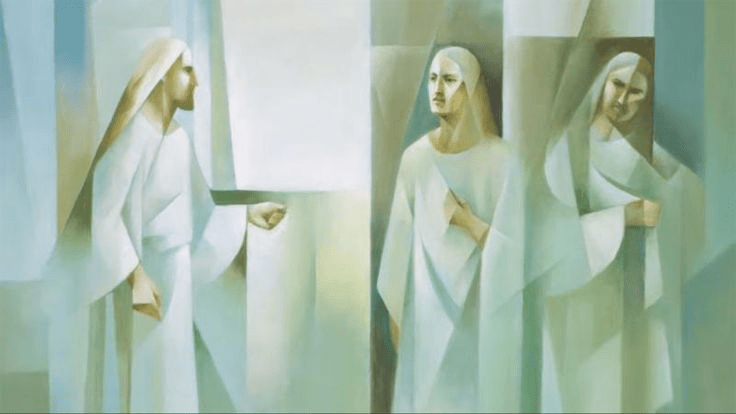
The Parable of the Two Sons by Jorge Cocco Santángelo

One day the father said to this son: “Son, go and work at my place of business today; I am going away and need you to do some of the tedious paperwork I have gotten behind on.” “No way!” he answered, but later felt heartsick about the way he spoke to his father and decided to go and do all the grunt work his father needed done.

The father went to the well-respected son and said the same thing about needing him to do all the thankless paperwork that was piled up. That son answered, “Yes, sir, I will; anything you need I will do.” But that son did not go. Instead, he chose to go golfing with some people whom he was trying to coy favor with.

After telling the story, Jesus asked all the upstanding faith leaders and the people listening: “Which of the two did what his father wanted?” “The first,” they answered.

Jesus said, “I tell you the truth, folks with different sexual orientations, unemployed persons on the low rung of society, the religiously different with esoteric beliefs, immigrants from other countries, ex-convicts living in half-way houses, and persons with addictions are all entering the kingdom of God ahead of you.

For you have had heard thousands of sermons about grace and the way of righteousness, yet you did not believe by putting God’s Word into practice; but the others did. And even after you saw how God can change a person’s life from the inside-out, you yourselves did not repent and believe.

It was parables like this that created a religious scandal and eventually got Jesus killed.

The offense for many upstanding citizens is this: that their right doctrine and clean living is not the way of salvation.

Tax collectors and prostitutes were some of the most despised people in Christ’s time. It was simply assumed they were on the outside and would be judged by God.

However, the proof of genuine faith is not lip service but actively obeying God when no one is looking:

My friends, what good is it to say you have faith, when you don’t do anything to show that you really do have faith? Can that kind of faith save you? 

If you know someone who doesn’t have any clothes or food, you shouldn’t just say, “I hope all goes well for you. I hope you will be warm and have plenty to eat.” What good is it to say this, unless you do something to help? 

Faith that doesn’t lead us to do good deeds is all alone and dead!

Suppose someone disagrees and says, “It is possible to have faith without doing kind deeds.” I would answer, “Prove that you have faith without doing kind deeds, and I will prove that I have faith by doing them.” 

You surely believe there is only one God. That’s fine. Even demons believe this, and it makes them shake with fear. (James 2:14-19, CEV)

The Christian life comes down to obedience, not cheap talk. Jesus wants to bless a lost world in need of God’s love and grace.
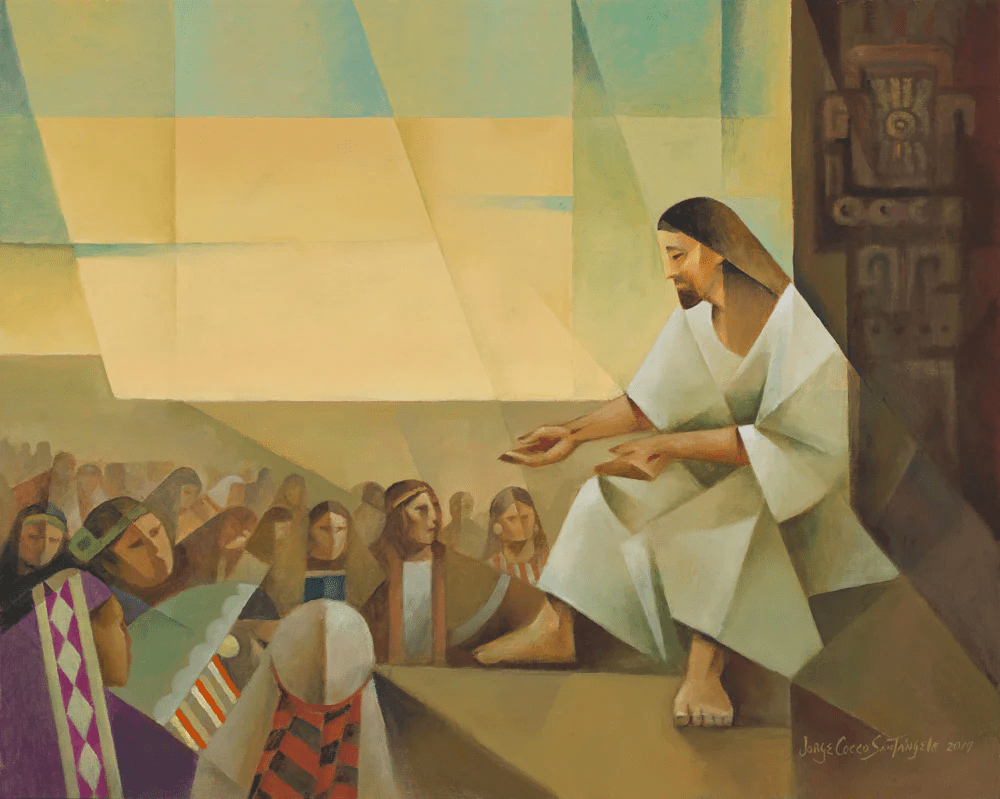
Jesus Preaching to the Multitude by Jorge Cocco Santángelo

If we have the spiritual ears to listen, we can hear numerous lost souls crying in the dark.

If we have the spiritual eyes to see, we can observe people overwhelmed with life circumstances standing in front of us.

If we have the spiritually strengthened hands willing to labor, we can support needy folks around us who can neither help themselves nor ask for it.

Whenever we take the focus off who is in and who is out, then without judgment and a heart full of compassion, we can address the:

  • Loneliness of so many people living alone and dying alone.
  • Shame which thousands secretly carry every day.
  • Pain of broken bodies, broken hearts, broken spirits, and broken minds experienced by individuals everywhere.

The Lord Jesus feels the loneliness, shame, and pain of people – which is why he told a parable like he did. Christ is looking to activate grace through his people, the church, to a world sinking in the depths of incredible human need.

Christ’s parable, however, is more than a warning; it is a story that flings open the door of mercy for unlikely people seemingly far from God – people who ruined their lives by saying “no” to God. The parable is an invitation for all the screw-ups and those with little faith to come to Jesus.

There is a rather obscure Scripture reference, tucked away in the Old Testament. David was on the outside looking in. King Saul was on the inside trying to capture and kill him, even though David had done nothing wrong. Here is what happened:

David got away and escaped to the Cave of Adullam. When his brothers and others associated with his family heard where he was, they came down and joined him. Not only that, but all who were down on their luck came around—losers and vagrants and misfits of all sorts. David became their leader. There were about four hundred in all. (1 Samuel 22:1-2, MSG)

This rag-tag group of outsiders in Israel became Israel’s insiders as David eventually became king and these were the “mighty men,” the ones who helped bring Israel into prominence. 

Jesus Christ came into this world and identified himself as the Savior to the outsider when he quoted the prophet Isaiah:

“The Spirit of the Lord is upon me,
    because he has anointed me
        to bring good news to the poor.
He has sent me to proclaim release to the captives
    and recovery of sight to the blind,
        to let the oppressed go free,
to proclaim the year of the Lord’s favor.”

And he rolled up the scroll, gave it back to the attendant, and sat down. The eyes of all in the synagogue were fixed on him. Then he began to say to them, “Today this scripture has been fulfilled in your hearing.” (Luke 4:18-21, NRSV)

In Christ, there are no lost causes and no persons too far on the outside to be redeemed.

Therefore, now is the time to act on what we believe – to not only affirm right doctrine, but to live out that doctrine in obedience to God’s call. Amen.


Don’t Let Suffering Surprise You (1 Peter 4:12-19)

Dear friends, do not be surprised at the fiery ordeal that has come on you to test you, as though something strange were happening to you. But rejoice inasmuch as you participate in the sufferings of Christ, so that you may be overjoyed when his glory is revealed. 

If you are insulted because of the name of Christ, you are blessed, for the Spirit of glory and of God rests on you. If you suffer, it should not be as a murderer or thief or any other kind of criminal, or even as a meddler. 

However, if you suffer as a Christian, do not be ashamed, but praise God that you bear that name. For it is time for judgment to begin with God’s household; and if it begins with us, what will the outcome be for those who do not obey the gospel of God? And,

“If it is hard for the righteous to be saved,
    what will become of the ungodly and the sinner?”

So then, those who suffer according to God’s will, should commit themselves to their faithful Creator and continue to do good. (New International Version)

In a culture of toxic positivity, we can never quite bring ourselves around to the reality of suffering. Being uncomfortable with the unwanted emotions associated with suffering seems to be the modus operandi of the Western world.

Like it, or not, none of us gets off this fallen planet without experiencing a host of circumstances we neither asked for nor wanted. And no amount of plastic smiles, fake-it-till-you-make-it approaches, and spin doctoring of attitudes will ever take the pain completely away – or even fully understand it’s mystery. In the long run, whitewashing pain only exacerbates the suffering.

Yet, despite all hardship and hurt, joy and the ability to rejoice still remains a necessary part of life, even in the worst of situations. The problem is: We tend to believe that we cannot hold seemingly opposing feelings at the same time – even though we actually do it all the time.

When the youngest child leaves home and the parents are empty nesters, they feel the simultaneous emotions of proud joy and deep sadness.

And when an aging parent or grandparent dies, the family experiences the bittersweet feelings of knowing that suffering is ended, yet also this dear loved one is gone from us.

Or when you are treated unfairly and spoken of unkindly, there is a mix of emotions from anger about what is happening to some sense of peace that this person or group of people have shown their real colors to the world.

I am going to make one of the simplest observations about God’s people in the Bible: they suffered; they were seen.

Whether Abel dying by the hand of his own brother, Noah enduring the ridicule of his neighbors, Abraham facing an uncertain future, Jeremiah weeping over Jerusalem’s calloused destruction, or Paul enduring persecution, everyone who wants to live a godly life will face suffering.

Every New Testament Epistle has a message about how to handle the inevitability of human suffering.

Fifth Station of the Cross, by Candido Portinari, 1953

The Apostle Peter, in his epistle, made it clear that every Christian should neither be surprised nor shocked when they suffer. If our Lord suffered (which he did, even to the extreme) then we, too, will also suffer, as those who follow him. 

Yet, Peter balances the harsh reality of suffering with the need for followers of Jesus to properly interpret that suffering. The Apostle learned the hard way that our means of accepting, coping with, and transcending hardship is by interpreting our personal suffering in light of Christ’s own suffering.

He insisted that the Christian’s suffering is a privilege, even a blessing. It is a mark of belonging – a sign that God’s Spirit is within us. 

If we do stupid things, we face the consequences for our foolishness. But when we do the good, right, and altruistic thing – then suffer some adverse effect – it puts us in solidarity with Christ. We can be glad for the chance to suffer as Christ suffered. It prepares the believer for even greater happiness when Jesus returns to judge the living and the dead.

I’m under no illusions or delusions here. Interpreting our suffering through specifically Christian lenses is no easy task. Sometimes it’s rough and downright hard. And it gets complicated when the suffering doesn’t let up and is compounded daily for weeks, months, even years at a time.

So, what shall we do in such times? Peter says that if your suffering originates in obedience to God, then keep the faith, keep on doing the right, the just, and the good thing.

A bad attitude, giving up, and revenge are not options on the table for the Christian. I believe most followers of Jesus understand that. The greater temptation, however, is a more subtle and insidious approach toward suffering: going with “meh.”

“Meh” is a spiritual, emotional, and mental stance of simply going with the flow, getting along on the surface of things, and hoping all the unpleasantness goes away soon. In facing the adversity with all it’s painful suffering, the “meh” person just shrugs their shoulders and says, “Meh, whatever; what’s a guy to do, anyway?”

Thanks for asking. We persevere. Don’t let suffering surprise you when it shows up at your door like an unwanted guest. Here’s some practical ways of getting through it:

  1. Tell your story to others and don’t go it alone and be the martyr. We already have a Martyr, and his name is Jesus.
  2. Do something that isn’t nothing. Avoid piddly busywork. Instead, when renewal and rest are needed, read a good book or have a stimulating conversation.
  3. Have a support system in place before suffering comes upon you. Trials to faith will happen. It will be overly difficult to face them without a community of persons around you.
  4. Ask for help, for God’s sake! People are hard-wired by their Creator for community. Rugged individualism is a myth; it doesn’t exist and isn’t even possible.
  5. Be comfortable with being uncomfortable. Comfort is not the summum bonum of life. Hedonism only masks pain and does not take it away. Expand your ability to handle diverse situations.
  6. Realize that Christianity is a process of becoming more and more like Jesus Christ. Christianity is not a one-and-done uttering a sinner’s prayer and waiting to cash-in a divine life insurance policy in order to stay out of hellfire. If you actually believe this, I suggest reading the Bible.
  7. Keep living your life. The earth is still spinning on its axis. The sun will still come up in the morning. God’s steadfast and faithful love will still be waiting for you when you wake up.

God sees and will vindicate the godly attitude, the ongoing work, and all the blood, sweat, and tears that go with our commitment to Christ and perseverance in the faith.

You’re already signed-up for suffering just by being a person. Welcome to the human condition. What will you do with your pain?

Saving and sustaining God, it is a small thing for me to suffer in light of your great suffering on my behalf through the cross. Empower me, and all your people everywhere, to do right every day so that praise, glory, and honor for Jesus Christ will always be on my lips through the enablement of the Holy Spirit. Amen.

He Has Done Great Things For Me (Luke 1:46-55)

Madonna of the Magnificat by Sr. Mary Grace Thul

And Mary said,

“My soul magnifies the Lord,
    and my spirit rejoices in God my Savior,
for he has looked with favor on the lowly state of his servant.
    Surely from now on all generations will call me blessed,
for the Mighty One has done great things for me,
    and holy is his name;
indeed, his mercy is for those who fear him
    from generation to generation.
He has shown strength with his arm;
    he has scattered the proud in the imagination of their hearts.
He has brought down the powerful from their thrones
    and lifted up the lowly;
he has filled the hungry with good things
    and sent the rich away empty.
He has come to the aid of his child Israel,
    in remembrance of his mercy,
according to the promise he made to our ancestors,
    to Abraham and to his descendants forever.” (New Revised Standard Version)

Mary’s great song of praise, her “Magnificat” came from having grasped the reality of being pregnant with the Messiah. She affirmed that the all-powerful God “has done great things for me.” 

Indeed, the Lord shows mercy to everyone who worships and adores such mighty acts. It strikes me that Mary, instead of being full of worry and afraid of the future, and as an unmarried teen with child, is full of the Spirit and faith. 

Mary, the mother of Jesus, neither complained nor fretted for the nine months of her pregnancy; she praised God and had clear-headed faith about the grace shown to her. Mary’s canticle gives us insight into the mystery of the Christ’s incarnation: God chooses the weak, those of low esteem, and the powerless.

Mary was quite ordinary for her day. She had no wealth. There was nothing which caused anyone to pick her out of a crowd. Yet, she is the one chosen by God.

Her wonderful response to God’s grace demonstrated that there is so much more to any person than what we can see with our eyes and perceive through our earthly glasses of high positions and strength of personalities.

What’s more, Mary had the wisdom to discern that her situation typified the Lord’s egalitarian work of leveling the field so that all persons have what they need.

Her son, the Messiah, would carry this into his own life and ministry – declaring good news to the poor, comforting the brokenhearted, proclaiming freedom for captives, telling those who mourn that the time of the Lord’s favor has come.

Statue of Mary, Stella Maris Chapel, St. Joseph, Minnesota

God is full of grace, mercy, and strength to those who are powerless and in need of help. The Lord has our back. Perhaps if we all, both individually and corporately, continually used our words to identify and declare the great things God has done, then we would realize and have awareness of the Lord’s abiding blessing. 

One good way of gaining a greater awareness and appreciation of God’s gravity of grace is by journaling.

I encourage you to take some time today and write out some of the ways God has been good to you in the past days, weeks, or months.

Perhaps you might even craft your own song of praise, like Mary, and poetically and/or musically express your gratitude. Or maybe, instead of using words, a sketch or a painting may better communicate the great things God has done for you.

However you choose to do it, like Mary, offer praise for each act of mercy which comes to your memory. 

An outsider, looking in, might judge Mary to be helpless and weak, not the sort of a person who could carry a Messiah. Yet, we get a view from the inside, a glimpse into Mary’s heart. All along, she had her heart calibrated to detect the grace of God when it was present.

May we all follow her example of faith and confidence.

My Soul Magnifies The Lord ~ Chris Tomlin 

O Lord Jesus Christ, Son of God, Son of Humanity: Make me worthy to understand the profound mystery of your holy incarnation, which has happened for our sake and for our salvation.

Truly there is nothing so great and wonderful that you, my God, the Creator and Sustainer of all things, should become a creature, so that we might become children of God.

You have humbled yourself and made yourself small that we might be made mighty.

You have taken the form of a servant, so that you might confer upon us a royal and divine beauty.

You, who are beyond our understanding, have made yourself understandable to us in Jesus Christ.

You, who are the uncreated God, have made yourself a creature for us.

You, who are the untouchable One, have made yourself touchable to us.

You, who are Most High, make us capable of understanding your amazing love and the wonderful things you have done for us.

Make us able to understand the mystery of your incarnation, the mystery of your life, example, and doctrine, the mystery of your cross and passion, the mystery of your resurrection and ascension. Blessed are you, O Lord, for coming to earth as a man.

You have done great things for me!

Amen, and amen.

The Finite and the Infinite (Psalm 65)

God of Zion, to you even silence is praise.
    Promises made to you are kept—
    you listen to prayer—
    and all living things come to you.
When wrongdoings become too much for me,
    you forgive our sins.
How happy is the one you choose to bring close,
    the one who lives in your courtyards!
We are filled full by the goodness of your house,
    by the holiness of your temple.

In righteousness you answer us,
    by your awesome deeds,
    God of our salvation—
    you, who are the security
        of all the far edges of the earth,
        even the distant seas.
    You establish the mountains by your strength;
    you are dressed in raw power.
    You calm the roaring seas;
        calm the roaring waves,
        calm the noise of the nations.
Those who dwell on the far edges
        stand in awe of your acts.
    You make the gateways
        of morning and evening sing for joy.
You visit the earth and make it abundant,
    enriching it greatly
        by God’s stream, full of water.
You provide people with grain
    because that is what you’ve decided.
Drenching the earth’s furrows,
        leveling its ridges,
    you soften it with rain showers;
        you bless its growth.
You crown the year with your goodness;
    your paths overflow with rich food.
Even the desert pastures drip with it,
    and the hills are dressed in pure joy.
The meadowlands are covered with flocks,
    the valleys decked out in grain—
        they shout for joy;
        they break out in song! (Common English Bible)

The biblical psalms present God as sovereign over all creation. Today’s psalm extols the Lord of the universe as God of both temple and terra, of people and the earth.

God of the temple

Praise is the appropriate offering to God – because it is the Lord who listens, forgives, and chooses to fill persons with the holiness and goodness of God’s presence, exemplified in the temple.

Infinite righteousness cannot be fulfilled by finite beings. In other words, we need God.

The nineteenth century philosopher and theologian, Søren Kierkegaard (1813-1855) insisted that the humans did not established themselves; therefore, no one can simply exercise their will toward better and brighter circumstances.

Kierkegaard argued that humanity, at its core, is a synthesis of the infinite and the finite, the temporal and the eternal. A finite human is not a self; only when connected and aware of the infinite is someone a self. (The Sickness Unto Death)

Creatures can never lift themselves above anxiety, worry, distress, or hardship with only finite resources; we need infinite supplies and divine capital, to tap into the image of God within us, to realize that our true identity is inextricably dependent upon our Creator.

“Prayers” by Yoram Raanan

We are more than bodies and brain synapses; we are also souls. And as souls, we shall never realize our true selves through the temporary means of possessions, prestige, and power. A person cannot construct a self, by themselves, to bear the weight of who we really are. That’s because our real identity is hidden with Christ in God. (Colossians 3:3)

Just as the temple in Jerusalem was much more than a physical structure, so we, as the people of God, are so much more than tangible beings.

Do you not know that you are God’s temple and that God’s Spirit dwells in you? (1 Corinthians 3:16, NRSV)

Praise, prayer, and worship are practices designed to connect with the infinite God. Indeed, the kingdom of God is much nearer than we know.

Jesus said, “The kingdom of God is not coming with things that can be observed, nor will they say, ‘Look, here it is!’ or ‘There it is!’ For, in fact, the kingdom of God is among you.” (Luke 17:20-21, NRSV)

God of terra

We walk upon and inhabit this present terra firma, this earth. The earth, and all that is in it, belongs to the Lord. God is something of a cosmic farmer, taking care of the earth, watching over it, tending to its needs.

All that takes place on this celestial ball we live upon is under the gracious and loving eye of God. It is the Lord who brings the seasons and the rains, calming the storms of the seas, as well as the storms of our lives.

One of the reasons we find ourselves in such an impending climate debacle on this earth, is that we continue to utilize all the finite resources we can muster and fail to acknowledge and become aware of the grand infinite wherewithal we have with our Creator and Sustainer.

“I am the Lord, your savior;
I am the one who created you.
I am the Lord, the Creator of all things.
    I alone stretched out the heavens;
    when I made the earth, no one helped me. (Isaiah 44:24, GNT)

The earth is beautiful. Yet, in our insistence upon merely using the temporal and physical, ugliness has come upon the earth, obscuring the true nature of God’s good creation. Distancing ourselves from the Creator only builds bigger obstacles to solving the earth’s most significant issues.

Self-imposed and ensconced impediments need to be cleared away. The weeds have overtaken the garden; we can no longer see the good plants that are supposed to grow and produce a harvest. And yet, as any farmer or gardener knows, you cannot simply yank such weeds from the ground without also pulling up what you are trying to preserve.

The Lord will provide – but if we keep to our stubborn independence from God, the process of weeding the garden will take much longer to accomplish. Yet, God is patient, not wanting any to perish but all to come around to the infinite. (2 Peter 3:9)

Conclusion

Let us come to God in our neediness and failure. We must see ourselves as infinite souls with finite solutions who can cry out to the God who hears and forgives. We need to connect with the Lord who hears our prayers. It is imperative that we rely upon the infinite Creator who is concerned to cultivate justice and righteousness upon an earth which is full of plenty for everyone.

Praise, pray, give thanks, and be connected to the infinite One whom we need for life and godliness in this present, evil, and finite age.

Stay joined to me and I will stay joined to you. No branch can produce fruit alone. It must stay connected to the vine. It is the same with you. You cannot produce fruit alone. You must stay joined to me. (John 15:4, ERV)

Blessed God and Father of all, yours is the kingdom, the power, and the glory forever. To you belongs the heavens and the earth. It is you who made all that is – sun, moon, stars, rivers, forests, minerals, birds, animals, fish, and us – and pronounced it all “good.” We seek your divine mercy and help so that our work and our worship may curb the sin that so easily entangles and bring your intended shalom to the earth. Amen.