Hope for the Grieving (Jeremiah 31:15-22)

Orthodox icon of Rachel weeping for the children

This is what the Lord says:

“A voice is heard in Ramah,
    mourning and great weeping,
Rachel weeping for her children
    and refusing to be comforted,
    because they are no more.”

This is what the Lord says:

“Restrain your voice from weeping
    and your eyes from tears,
for your work will be rewarded,”
declares the Lord.
    “They will return from the land of the enemy.
So there is hope for your descendants,”
declares the Lord.
    “Your children will return to their own land.

“I have surely heard Ephraim’s moaning:
    ‘You disciplined me like an unruly calf,
    and I have been disciplined.
Restore me, and I will return,
    because you are the Lord my God.
After I strayed,
    I repented;
after I came to understand,
    I beat my breast.
I was ashamed and humiliated
    because I bore the disgrace of my youth.’
Is not Ephraim my dear son,
    the child in whom I delight?
Though I often speak against him,
    I still remember him.
Therefore my heart yearns for him;
    I have great compassion for him,”
declares the Lord.

“Set up road signs;
    put up guideposts.
Take note of the highway,
    the road that you take.
Return, Virgin Israel,
    return to your towns.
How long will you wander,
    unfaithful Daughter Israel?
The Lord will create a new thing on earth—
    the woman will return to the man.” (New International Version)

The bereavement of losing someone you care about is awful. A parent experiencing the death of a child is next level grief. There is no bereavement like it.

As a hospital chaplain, I occasionally attend to a grieving mother who just lost her baby. I have shown up for premature and stillborn deaths, full term births, then death, sudden infant death, and more. The grief is indescribable.

On some level, there is no comfort – and never will be. I know that, for me, providing grief support to mothers who are enduring the death of a baby or young child has profoundly changed me and forever impacted my soul. So, I can only imagine what it’s like for a mother.

Many Christians will recognize the verse of Rachel weeping for her children as part of the early story surrounding Jesus:

An angel of the Lord appeared to Joseph in a dream. “Get up,” he said, “take the child and his mother and escape to Egypt. Stay there until I tell you, for Herod is going to search for the child to kill him.”

So he got up, took the child and his mother during the night and left for Egypt,where he stayed until the death of Herod. And so was fulfilled what the Lord had said through the prophet: “Out of Egypt I called my son.”

When Herod realized that he had been outwitted by the Magi, he was furious, and he gave orders to kill all the boys in Bethlehem and its vicinity who were two years old and under, in accordance with the time he had learned from the Magi. Then what was said through the prophet Jeremiah was fulfilled:

“A voice is heard in Ramah,
    weeping and great mourning,
Rachel weeping for her children
    and refusing to be comforted,
    because they are no more.”(Matthew 2:13-18, NIV)

It’s really hard to have hope when you’re in the throes of lamenting the death of children. We need hope. It’s necessary to life. We cannot survive, let alone thrive, without it.

It is possible to simultaneously experience hopelessness and hope. At the same time, we hold both despair and desire, anguish and anticipation, in our hearts. While we may never forget who we have lost, we make it through our days believing that another child can change the world for the better. We place our faith in the Christ child, in Jesus.

Wily old King Herod massacred innocent toddlers in order to ensure the destruction of Jesus. Behind his atrocity was the devil himself who knew that Jesus was the coming King who would one day bring salvation. But the old King’s sinister plan didn’t work. 

Reflecting on a vision of Christ’s birth, the Apostle John stated:

The dragon stood in front of the woman who was about to give birth, so that it might devour her child the moment he was born. She gave birth to a son, a male child, who “will rule all the nations with an iron scepter.” And her child was snatched up to God and to his throne. (Revelation 12:4-5, NIV)

Satan wars against God’s Son and God’s people, whose roots go all the way back to the first prophecy of Christ:

And I will put enmity
    between you and the woman,
    and between your offspring and hers;
he will crush your head,
    and you will strike his heel.” (Genesis 3:15, NIV)

There has been bad blood, ever since the Fall of humanity, between the serpent and the seed of the woman. The Old Testament Israelites were continually being threatened with extermination; they were constantly tempted to conform to pagan ways for handling their suffering and grief. 

Herod was just another in a long line of demonically animated men trying to perpetuate the kingdom of darkness. The devil knows that his time is short; and he uses twisted persons like Herod for his insidious schemes.

Many people experience hell on earth because Satan is on a rampage; mothers and their children are often the collateral damage.

The holiday season is a hard time of year for many people, filled with depression instead of joy, grieving over lost loved ones for whom you will not spend another Christmas with. And yet, there is a reunion coming, the hope of a bodily resurrection in which we will be with Jesus and God’s people forever.

Satan’s most powerful weapon, death, has lost its sting because of Jesus. Death does not have the last word; resurrection does. And this hope for the future helps us in the present to keep going and not give up.

The prophet Jeremiah was dealing with children lost in war to the invading Babylonians. His words are a lament in the context of the hope that captivity and exile will not be forever. 

Matthew wants us to see that the exile is over for us; Jesus has arrived, and the tears that were shed will shortly dry up. There may be a time of suffering that we must endure, but there is glory ahead.

Jesus is the Great Deliverer who brings us out of the grip of death, grief, and lament and into the promises of God. Christ is our hope. Amen, and amen.

The Who, What, When, Why, Where, and How of Praise (Psalm 148)

By Stushie Art

Praise the Lord!
Praise the Lord from the heavens;
    praise him in the heights!
Praise him, all his angels;
    praise him, all his host!

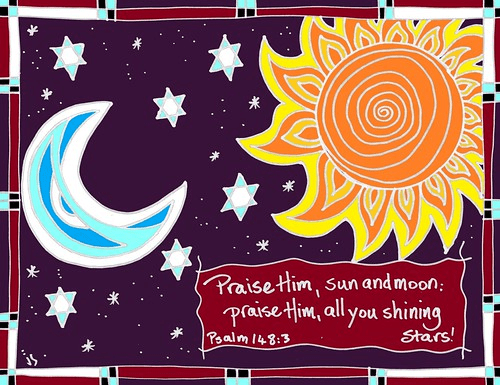
Praise him, sun and moon;
    praise him, all you shining stars!
Praise him, you highest heavens
    and you waters above the heavens!

Let them praise the name of the Lord,
    for he commanded, and they were created.
He established them forever and ever;
    he fixed their bounds, which cannot be passed.

Praise the Lord from the earth,
    you sea monsters and all deeps,
fire and hail, snow and frost,
    stormy wind fulfilling his command!

Mountains and all hills,
    fruit trees and all cedars!
Wild animals and all cattle,
    creeping things and flying birds!

Kings of the earth and all peoples,
    princes and all rulers of the earth!
Young men and women alike,
    old and young together!

Let them praise the name of the Lord,
    for his name alone is exalted;
    his glory is above earth and heaven.
He has raised up a horn for his people,
    praise for all his faithful,
    for the people of Israel who are close to him.
Praise the Lord! (New Revised Standard Version)

By Stushie Art

Everything in all creation points to a Creator who cares for us. The 12 days of Christmas (December 25–January 5) are a great celebration. King Jesus has come; he is the rightful Sovereign over all creation. Believers recognize Christ’s incarnation – affirming the identity of Jesus as both full human and fully divine. 

Worshipers praise the Lord. It’s in our spiritual DNA to give adoration, praise, and honor to God. Today’s Psalm is not only meant for good times; it’s also for the despondent, difficult, and downright hard times. There’s always an open season on praising the Lord, no matter what’s going on in and around us. 

Psalm 148 helps to re-orient us around praise to God, instead of remaining stuck in being disoriented.  Whether in good times or bad, we praise the Lord. 

Who should praise the Lord?

Everyone. Everything. 

God has created and continues to impact every nook and cranny of creation. Therefore, the entire universe – every creature and all humanity – acknowledge the Lord with praise. 

The outer reaches of the universe, on everything out there which we cannot even see, praise the Lord. 

The earth and everything in it praise the Lord. 

The forces of nature praise the Lord. 

The landscape, the flora and fauna, animals and humans, together with all creation, praise the Lord. 

Young people, old people, men and women – no matter who they are or where they come from – praise the Lord. 

The proper purpose of everything and everyone that exists is giving adoration and praise to God.

In the Ancient Near East, the sun, moon, and stars were considered gods by the various people groups. This Psalm was, therefore, more than a summons to praise – this was a call to recognize the One true God as the sovereign and the rightful ruler of all. Thus, the ancient peoples understood this psalm as a claim that their gods must bow to Israel’s God.

What is praise to the Lord?

Praise to the Lord is a recognition that God deserves praise from everyone and everything. Praise is physical posture and a heart stance of bowing, yielding, and submitting to God. “Praise the Lord” in the Hebrew language is “hallelujah.” And “hallelujah literally means “to raise the hands.”

We are told 10 times in the 14 verses of Psalm 148 to praise the Lord, that is, to raise our hands. It’s a symbol of submission and joy. To have open hands lifted toward heaven conveys our obedience and commitment to God. 

When do we praise the Lord?

Praising the Lord and lifting the hands, is not only to occur in church or worship setting; praise happens everywhere.

We lift our arms in reverent submission at our workplaces when we land a client or have a good day; and when cranky and critical people demean us. Praising the Lord isn’t limited to good circumstances.

We raise our hands and praise the Lord when our neighbors care about us and look out for us, as well as when they make noise and irritate us with their less than kept up yards and houses. Yielding to God’s purposes for our lives is not dependent upon whether we have good neighbors or not. 

We praise the Lord and raise our hands when our marriages are life-giving and thriving, as well as when our relationship with our spouse is dry, dull, and going nowhere. It’s always open season on praising the Lord and reflecting his image through love. 

By Stushie Art

We praise the Lord for our kids, not only when they do what’s right; but also when they’re complete stinkers and drive us nuts. We are to use our hands for praise and enact obedience, and not for violence through finger pointing or physical punishment.

In adversity, we praise the Lord because it gives us a chance to put our faith into action. In times when someone is being insensitive and callous, it provides the opportunity to praise the Lord and love them because God loves us.

At all times, in all places, in every circumstance, and with each situation we raise our hands in hallelujah to Jesus for saving us from our misguided ways and bringing us back into fellowship with God. 

Lift your hands, always! And when, like Moses, we can no longer lift them, let others help hold them up we so that we can keep praising God. (Exodus 17:11-12)

Why praise the Lord?

Because God created everything and everyone. 

The Lord designed every living thing and fashioned a man and a woman in the divine image as the pinnacle of creative work. 

Adam and Eve walked with God and had perfect praise of the Lord and fellowship with each other. Yet, tragedy happened. The people God formed were deceived into thinking that the Lord was holding out on them by not letting them eat from a certain tree in the garden. So, they disobeyed, ate the fruit, and so plunged the world into darkness.

However, God did not turn away from humanity. Holy Scripture is the revelation of a God who goes out of the way to do whatever it takes to reclaim people back to fellowship so that they can fulfill their original design to praise the Lord. 

The height of God’s love is sending the Son, the Lord Jesus. God became one of us so that he could save us from ourselves. 

Whenever we have exhausted all the avenues this world has to offer in bringing fulfillment, satisfaction, and peace to our lives – there stands Jesus, crucified, risen, ascended, and waiting with open arms for you and me to lift our hands and see that he has the only way for us to live. 

The reason you have felt for so long that you are a square peg in a round hole is that your life is meant to praise the Lord. You are not meant to fit into the world; you are meant for God.

Where do we praise the Lord?

From the heavens and the earth. From everywhere in all creation, and from everyone as creatures, there is to be praise to the Lord.

Humanity is one part of a big grand chorus of praise that arises from all creation. Some of the psalmist’s pairings of praise are quite informative. 

The sun that praises God during the daytime and the moon that offers its praise at night, reminds us that God’s praise is never silenced. 

The highest heavens and waters above the sky, along with the earth and what’s under its waters, helps us recall that God’s creation, from top to bottom, praises the Lord. 

The mountains and hills, with creatures and flying birds on them and circling them, communicates to us that both the noticeable and scarcely noticeable offer their praises to our God and King.

All creation burps out their praise – which means that some folk really are dumber than rocks because even the rocks know enough to praise the Lord. 

We praise the Lord – outdoors, indoors, at home, at work, in the neighborhood, with family, church, from every place there is to be a lifting of the hands to God.

How do we praise the Lord?

Of course, we raise our hands in adoration for the God who gives us life and watches over us in such a way that not a hair on our heads can fall apart from the divine will. 

We praise the Lord by being the people God created us to be – walking in fellowship with the Lord and enjoying the divine/human relationship forever.

No matter our current situation, every day and every situation is a summons to praise the Lord. God’s claim upon our lives leads us toward raising our hands to heaven. 

The person who praises God is marked by a deep humility of understanding that they are not God; expressive gratitude for God’s actions; patient confidence in God’s promises; and a sense of unity, participating in harmony with God, others, and all creation in praising the Lord!

Most High, all-powerful, all-good Lord,
All praise is Yours, all glory, honor and blessings.
To you alone, Most High, do they belong;
no mortal lips are worthy to pronounce Your Name.

We praise You for all Your creatures,
especially for Brother Sun,
who is the day through whom You give us light.
He is beautiful and radiant with great splendor,
of You Most High, he bears Your likeness.

We praise You for Sister Moon and the stars,
in the heavens You have made them bright, precious and fair.

We praise You for Brothers Wind and Air,
fair and stormy, all weather’s moods,
by which You cherish all that You have made.

We praise You, for Sister Water,
so useful, humble, precious and pure.

We praise You for Brother Fire,
through whom You light the night.
He is beautiful, playful, robust, and strong.

We praise You for Sister Earth,
who sustains us
with her fruits, colored flowers and herbs.

We praise You for those who pardon,
or who for love of You bear sickness and trial.

Blessed are those who endure in peace,
by You they will be crowned.

We praise You for Sister Death,
from whom no-one living can escape.
Woe to those who die in their sins!
Blessed are those that She finds doing Your Will.
No second death can do them harm.

We praise and bless You Lord,
give You thanks,
and humbly serve You. Amen.

 – A canticle of praise from St. Francis of Assisi

Mary’s Song of Praise (Luke 1:46b-55)

The Magnificat, a woodcut by Sr. Mary Grace Thul

Mary said,

“My heart praises the Lord;
    my soul is glad because of God my Savior,
    for he has remembered me, his lowly servant!
From now on all people will call me happy,
    because of the great things the Mighty God has done for me.
His name is holy;
    from one generation to another
    he shows mercy to those who honor him.
He has stretched out his mighty arm
    and scattered the proud with all their plans.
He has brought down mighty kings from their thrones,
    and lifted up the lowly.
He has filled the hungry with good things,
    and sent the rich away with empty hands.
He has kept the promise he made to our ancestors,
    and has come to the help of his servant Israel.
He has remembered to show mercy to Abraham
    and to all his descendants forever!” (Good News Translation)

It strikes me that Mary, instead of being full of worry and afraid of the future, and as an unmarried teen with child, is full of the Spirit and faith. Mary neither complained nor fretted for the nine months of her pregnancy; she praised God and was clear-headed about the grace shown to her.

Mary’s canticle gives us insight into the mystery of the incarnation: God chooses the weak, those of low esteem, and the powerless.

Mary was rather ordinary. She had no wealth. She possessed nothing which would cause anyone to pick her out of a crowd. Yet, she is the one chosen by God. And her wonderful response to grace demonstrated that there is so much more to any person than what we can see with our eyes and perceive through our earthly glasses of high positions and strength of personalities.

The mother of Jesus had the wisdom to discern that her situation typified the Lord’s egalitarian work of leveling the field. Mary’s pregnancy normalized the needs of all people. Her son, the Deliverer, would carry this understanding into his own life and ministry – declaring good news to the poor, comforting the brokenhearted, proclaiming freedom for captives, telling those who mourn that the time of the Lord’s favor has come.

Mary’s is the kind of song that has been sung by people of faith throughout the ages. It’s not only a song of faith but a declaration of resistance, in defiance of all evil powers which ignore the poor, such as Mary.

It was not a completely new sort of song; it’s in harmony with songs that other faithful followers of the Lord have sung in past generations.

Moses and Miriam sang a song to the Lord of freedom from powerful Egyptian bondage and oppression:

“I will sing to the Lord, because he has won a glorious victory;
    he has thrown the horses and their riders into the sea.
The Lord is my strong defender;
    he is the one who has saved me.
He is my God, and I will praise him,
    my father’s God, and I will sing about his greatness.
The Lord is a warrior;
    the Lord is his name.” (Exodus 15:1-3, 21, GNT)

Hannah, unable to conceive and have children, endured a long stretch of affliction from her rival – that is, until the Lord stepped in and opened her womb:

“No one is holy like the Lord;
    there is none like him,
    no protector like our God.
Stop your loud boasting;
    silence your proud words.
For the Lord is a God who knows,
    and he judges all that people do.
The bows of strong soldiers are broken,
    but the weak grow strong.
The people who once were well fed
    now hire themselves out to get food,
    but the hungry are hungry no more.
The childless wife has borne seven children,
    but the mother of many is left with none.
The Lord kills and restores to life;
    he sends people to the world of the dead
    and brings them back again.
He makes some people poor and others rich;
    he humbles some and makes others great.
He lifts the poor from the dust
    and raises the needy from their misery.
He makes them companions of princes
    and puts them in places of honor.
The foundations of the earth belong to the Lord;
    on them he has built the world. (1 Samuel 2:2-8, GNT)

Stained glass window of Hannah offering her son Samuel to the Lord by Phil Watkins

The psalmist declares his song about the Lord who turns the tables on the unfortunate and brings them privilege:

He always keeps his promises;
    he judges in favor of the oppressed
    and gives food to the hungry.

The Lord sets prisoners free
    and gives sight to the blind.
He lifts those who have fallen;
    he loves his righteous people.
He protects the strangers who live in our land;
    he helps widows and orphans,
    but takes the wicked to their ruin. (Psalm 146:6b-9, GNT)

God’s people throughout history have faced oppression. And, when in the teeth of that adversity, they have sung God’s songs of resistance against the evil powers of this world.

Along with Holy Scripture, let us also in these days of Advent just before Christmas Day, sing our traditional songs of resistance, deliverance, and hope:

“Come, Thou Long Expected Jesus”

By Charles Wesley

Come, thou long expected Jesus,
born to set thy people free;
from our fears and sins release us,
let us find our rest in thee.
Israel’s strength and consolation,
hope of all the earth thou art;
dear desire of every nation,
joy of every longing heart.

Born thy people to deliver,
born a child and yet a King,
born to reign in us forever,
now thy gracious kingdom bring.
By thine own eternal spirit
rule in all our hearts alone;
by thine all sufficient merit,
raise us to thy glorious throne.

“It Came upon the Midnight Clear” (vs.3-4)

By Edmund Sears

And ye, beneath life’s crushing load,
whose forms are bending low,
who toil along the climbing way
with painful steps and slow,
look now! for glad and golden hours
come swiftly on the wing.
O rest beside the weary road,
and hear the angels sing!

For lo! the days are hastening on,
by prophet seen of old,
when with the ever-circling years
shall come the time foretold
when peace shall over all the earth
its ancient splendors fling,
and the whole world send back the song
which now the angels sing.

“O Come, O Come, Emmanuel” (vs.1, 4, 6)

By J.M. Neale

O come, O come, Immanuel,
and ransom captive Israel
that mourns in lonely exile here
until the Son of God appear.

O come, O Branch of Jesse’s stem,
unto your own and rescue them!
From depths of hell your people save,
and give them victory o’er the grave.

O come, O Bright and Morning Star,
and bring us comfort from afar!
Dispel the shadows of the night
and turn our darkness into light.

Christ came to stand against sin, death, and the power of the Devil.

God is full of grace, mercy, and power to the powerless and the needy. The Lord has our backs. Perhaps if we all, both individually and corporately, continually used our words to identify and declare the great things God has done we would realize the consistent blessing of the Lord. 

As we near the night of our Lord’s birth, take some time to reflect on the ways God has been good to you in this Advent season, and like Mary, offer praise for each act of mercy. Mary exhibited no helplessness but had her heart calibrated to detect the grace of God when it was present – and to resist the injustice of this world.

Soli Deo Gloria

Slave or Free? (Galatians 4:21-5:1)

Tell me, you who want to be under the law, are you not aware of what the law says? For it is written that Abraham had two sons, one by the slave woman and the other by the free woman. His son by the slave woman was born according to the flesh, but his son by the free woman was born as the result of a divine promise.

These things are being taken figuratively: The women represent two covenants. One covenant is from Mount Sinai and bears children who are to be slaves: This is Hagar. Now Hagar stands for Mount Sinai in Arabia and corresponds to the present city of Jerusalem, because she is in slavery with her children. But the Jerusalem that is above is free, and she is our mother. For it is written:

“Be glad, barren woman,
    you who never bore a child;
shout for joy and cry aloud,
    you who were never in labor;
because more are the children of the desolate woman
    than of her who has a husband.”

Now you, brothers and sisters, like Isaac, are children of promise. At that time the son born according to the flesh persecuted the son born by the power of the Spirit. It is the same now. But what does Scripture say? “Get rid of the slave woman and her son, for the slave woman’s son will never share in the inheritance with the free woman’s son.” Therefore, brothers and sisters, we are not children of the slave woman, but of the free woman.

It is for freedom that Christ has set us free. Stand firm, then, and do not let yourselves be burdened again by a yoke of slavery. (New International Version)

Get your hermeneutics together, man

First of all, I want to say that I have little tolerance for Bible readers who insist on an exclusive literal interpretation of Scripture – because it’s downright nonsensical.

Today’s New Testament lesson is one of many biblical passages which really ought to put a wooden stake to the heart of such a misguided hermeneutic. The Apostle Paul himself uses an allegorical or figurative approach to interpreting an Old Testament story.

Holy Scripture interprets itself in many ways. It is, at the least, hubris to believe one has the corner on biblical interpretation through a single mode of literal Bible interpretation; and it is, at the worst, damaging to other’s souls to restrict them in their reading and reflection – not to mention destructive whenever a literalist (who is typically also a legalist) brings their judgmentalism forward to condemn the other approaches.

Okay, I feel better now, getting that off my chest. But, unfortunately, we’ve still got to deal with legalism – which is what Paul set out to do with his writing to the churches in the region of Galatia.

Let go of the legalism

There can be something oddly comforting about law. Having clear black-and-white no-nonsense rules can give a sense of security. You always know where you stand. You’re either in or you’re out, either pure or sinful. 

Yet, here’s the score on the law: it is meant for the immature and is designed as a guide to lead us to maturity. 

If we live by law, we are bound by law. Law can only take us so far in our walk with God. A slavish commitment to rules must, at some point, give way to the greater virtues of grace and love. 

The Galatian churches wanted a religion they could see and hold in their hands. But Paul would have none of it; he was dogged about the devotion to a life of grace. Since Christ has set us free, we are truly and really free. So now, we are to embrace the freedom and never go back to being slaves to the law again – which is closely akin to relapsing into spiritual immaturity. 

We (hopefully) expect a kid to be a kid. When the kid grows up and is an adult with adult responsibilities, we expect him to speak and act like an adult, not a kid.

What’s more, we ought also to expect the adults in the room to treat one another like adults. Layering a bunch of rules and regulations on grown-up people is nothing more than handling them like they’re kids. It’s a nonsensical approach to dealing with each other.

Embrace your freedom

Freedom means that we have no obstacles in expressing grace, love, and hope to others. We are free to bask in the forgiveness we possess in Christ. 

If our Christianity is reduced to a point system or following a list of juvenile rules, then we have missed what the law was all about in the first place. The law is meant to lead us to Christ, and it must, at some point, give way to the larger law of love.

The law has its place. Yet, if we are perpetual slaves to it and never outgrow it’s intended purpose for us, then we need to move onto maturity and embrace the freedom we have in Christ. 

To live in freedom doesn’t mean we can simply do whatever we want, as if there’s no consequences to our words and actions. It’s not “anything goes.” Rather, Christian freedom is a life attuned to the Spirit; an awareness of living for Jesus through the fruit of the Spirit. It doesn’t break laws; it fulfills them. 

All Christians must grow up and become spiritual adults. That means leaving childish ways of the law behind and embracing the freedom of the Spirit. 

So, where are you in your Christian life? Are you a slave to Law or a free person to Love?