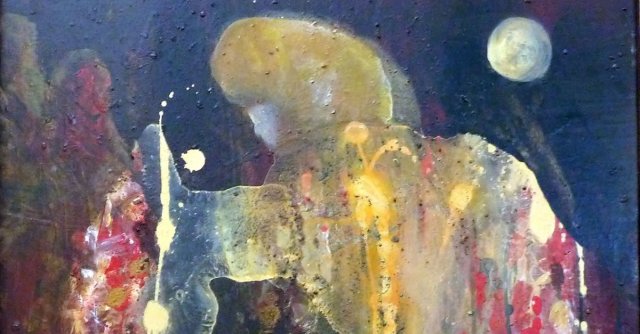
Jacob’s Dream (Genesis 28:10-22)

Jacob’s Ladder by Darius Gilmont

Jacob left the town of Beersheba and started out for Haran. At sunset he stopped for the night and went to sleep, resting his head on a large rock. In a dream he saw a ladder that reached from earth to heaven, and God’s angels were going up and down on it.

The Lord was standing beside the ladder and said:

I am the Lord God who was worshiped by Abraham and Isaac. I will give to you and your family the land on which you are now sleeping. Your descendants will spread over the earth in all directions and will become as numerous as the specks of dust. Your family will be a blessing to all people. Wherever you go, I will watch over you, then later I will bring you back to this land. I won’t leave you—I will do all I have promised.

Jacob woke up suddenly and thought, “The Lord is in this place, and I didn’t even know it.” Then Jacob became frightened and said, “What a frightening place! It must be the house of God and the gateway to heaven.”

When Jacob got up early the next morning, he took the rock that he had used for a pillow and stood it up as a place of worship. Then he poured olive oil on the rock to dedicate it to God, and he named the place Bethel. Before that it had been named Luz.

Jacob solemnly promised God, “If you go with me and watch over me as I travel, and if you give me food and clothesand bring me safely home again, you will be my God. This rock will be your house, and I will give back to you a tenth of everything you give me.” (Contemporary English Version)

“Dreams are impartial, spontaneous products of the unconscious psyche, outside the control of the will. They are pure nature; they show us the unvarnished, natural truth, and are therefore fitted, as nothing else is, to give us back an attitude that accords with our basic human nature when our consciousness has strayed too far from its foundations and run into an impasse.

Carl Jung, Collected Works, Vol. 10

Not all unconscious dreams are the same, any more than all conscious experiences are alike.

Some dreams are not much more than a thing which occurs while we’re sleeping; they’re akin to the tedious or pedantic things we do while awake. Yet, other dreams are loaded with symbolic significance and have complex patterns of organization and relating.

However, all dreams which we carry with us into conscious waking – no matter whether mundane or extraordinary – are telling us a similar message: “Hey! Pay attention to this!”

In other words, our unconscious brains are usually aware of what we need more than our conscious minds; and dreams become the vehicle by which our unconscious alerts our conscious selves of something we need to focus upon.

Jacob’s Ladder by Ben Avram

Jacob needed to pay attention to something that he was not consciously aware of. Before his dream, Jacob had left home at the behest of his aging father. Mom and Dad wanted Jacob to have a good wife, so they sent him off to a specific place to find one.

Now, mind you, Jacob was a mama’s boy; he stuck close to home and was attached to his mother. Off on his first outing away from familiar confines, Jacob would have been understandably anxious and fearful. Although he had the blessing of his parents, Jacob’s unconscious self knew he also needed the blessing of almighty God.

So, the Lord showed up in a dream. To Jacob’s credit, he paid attention by acknowledging the importance of the dream. Jacob also made the Lord a promise that he would give back a tenth of anything and everything he acquired because of God’s blessing.

I wonder: How many times do you and I fail to acknowledge that the Lord’s presence is in the very place we are? Maybe our dreams are trying to tell us something – that the God of all things, including dreams, is with us in our own particular place and situation.

It can be frightening to be in a new place or new situation that you’ve never been in before. Yet, there is no place any of us can go where God is not already there.

You have looked deep
into my heart, Lord,
    and you know all about me.
You know when I am resting
    or when I am working,
and from heaven
    you discover my thoughts.

You notice everything I do
    and everywhere I go.
Before I even speak a word,
    you know what I will say,
and with your powerful arm
you protect me
    from every side.
I can’t understand all of this!
Such wonderful knowledge
    is far above me.

Where could I go to escape
from your Spirit
    or from your sight?
If I were to climb up
to the highest heavens,
    you would be there.
If I were to dig down
to the world of the dead
    you would also be there.

Suppose I had wings
like the dawning day
    and flew across the ocean.
Even then your powerful arm
    would guide and protect me.
Or suppose I said, “I’ll hide
in the dark until night comes
    to cover me over.”
But you see in the dark
because daylight and dark
    are all the same to you. (Psalm 139:1-12, CEV)

The Lord is with you. Your dreams have already confirmed it.

O God, give me strength for this day, and not to turn coward in the face of difficulty or duty. Let me not lose faith in other people. Keep my heart pure and caring, free from all ingratitude or meanness. Open wide the eyes of my soul so that I may see the good in all things. Grant me today a new vision of your truth; and for tonight, may the Lord Jesus be in my dreams so that I might awake again and serve him in joy and gladness, in the power of the Holy Spirit. Amen.

Promise and Pilgrimage (Genesis 12:1-7)

The Lord said to Abram,

“Leave your land,
your relatives,
and your father’s home.
Go to the land that I will show you.
I will make you a great nation,
I will bless you.
I will make your name great,
and you will be a blessing.
I will bless those who bless you,
and whoever curses you, I will curse.
Through you every family on earth will be blessed.”

So Abram left, as the Lord had told him, and Lot went with him. Abram was 75 years old when he left Haran. Abram set out for Canaan. He took along his wife Sarai, his nephew Lot, and all the possessions they had accumulated and the servants they had acquired in Haran.

They arrived in Canaan, and Abram traveled through the land to the oak tree belonging to Moreh at Shechem. At that time the Canaanites were in the land. Then the Lord appeared to Abram and said, “I’m going to give this land to your descendants.” So he built an altar there to the Lord, who had appeared to him. (God’s Word Translation)

Abram (later having a name change to “Abraham”) knew quite a lot about new beginnings.

It isn’t every day that the Lord comes along and completely upends a person’s life. Abram had lived his entire life in the same city, Ur, in Chaldea (present day Iraq). By all accounts, Abram was completely fine living where he was living. He had neither the ambition nor need to leave his home city.

The Lord, however, had other plans for Abram. And they were radical plans. This was no rearranging of the furniture; it was a wholesale life-altering change. Ur was an important cosmopolitan city, a trade center, located at a pivotal point where the Tigris and Euphrates Rivers run into the Persian Gulf. Thus, Ur was a wealthy city, the citizens enjoying a level of comfort unknown in other parts of Mesopotamia.

Actor Eddie Albert as the out of place city lawyer trying to make it in the country on “Green Acres” which aired on CBS from 1965-1971

So, Abram being called to move from the city and go to some unknown place in the west would be something like growing up in Manhattan, New York and being called by God to head for Brewster, Nebraska – which is pretty much in the middle of nothing. It makes “Green Acres” look like a night out at the opera.

The Lord’s First Promise to Abram

It wasn’t all unknown change; there was a promise attached to the call. Having every family on earth blessed through you is a really big promise. There was a lot riding on Abram’s response.

Perhaps there was some pushback on Abram’s end of things. But we don’t have any record of it if it even happened. Instead, we get a simple statement telling us that he left, just as the Lord told him to do.

Lest we think Abram had some incredible relationship with the Lord before this call came, we need to think again:

“This is what the Lord God of Israel says: Long ago your ancestors, Terah and his sons Abraham and Nahor, lived on the other side of the Euphrates River and served other gods. But I took your ancestor Abraham from the other side of the Euphrates River. I led him through all of Canaan and gave him many descendants.” (Joshua 24:2-3, GW)

The One true God wasn’t even on Abram’s radar. He was merrily serving the pagan gods of Sumer, seemingly without a care in the world. It wasn’t as if Abram was bored watching old reruns of “Green Acres” and wishing for a change. And it sure wasn’t because he was attuned to knowing anything about Yahweh.

Whatever went down between Abram and the Lord was likely so compelling that Abram left willingly and without any pushback.

The Lord’s Second Promise to Abram

To travel from Ur of the Chaldees to the land of Canaan is an approximate distance of 800 miles. That’s slow going when you’re traveling in a caravan by donkey and camel. It took a while to get to the land that the Lord had in mind for Abram.

Once there, God gave Abram another promise: The land that he reached will be his home, the new land, the Promised Land. It would be yet another 500+ years before Abram’s descendants took full possession of that land and the promise realized.

Abram had a lot of time to consider and reflect on the Lord’s calling and promises. And that is precisely why pilgrimage is so very important. Yes, the destination is significant; yet it is the journey itself that really matters.

Pilgrimage

Those who put their strength in you are truly happy;
    pilgrimage is in their hearts. (Psalm 84:5, CEB)

Abram journeys into the unknown by Yoram Raanan

The way of pilgrimage is for all, like Abram, who walk in faith and patience, awaiting the fulfillment of God’s promises.

By faith Abraham obeyed when he was called to go out to the place which he would receive as an inheritance. And he went out, not knowing where he was going. 

By faith he dwelt in the land of promise as in a foreign country… for he waited for the city which has foundations, whose builder and maker is God…. Therefore from one man, and him as good as dead, were born as many as the stars of the sky — innumerable as the sand which is by the seashore.

These all died in faith, not having received the promises, but having seen them afar off were assured of them, embraced them and confessed that they were strangers and pilgrims on the earth. 

For those who say such things declare plainly that they seek a homeland. And truly if they had called to mind that country from which they had come out, they would have had opportunity to return. But now they desire a better, that is, a heavenly country. Therefore God is not ashamed to be called their God, for He has prepared a city for them. (Hebrews 11:8-16, NKJV)

Each day, we have the opportunity to be pilgrims, walking by faith, exercising patient hope, persevering in love for one’s fellow humanity.

Just because we live in a microwave society which values speed and customer service above all else, doesn’t mean our religion has to follow suit. The best things in life are slow in coming; they require a great deal of blood, sweat, and tears.

Go ahead and enjoy an episode or two of “Green Acres;” just remember to listen when the Lord calls and go to make disciples of all nations.

All-powerful God, you always show mercy toward those who you love, and you are never far away for those who seek you. Be with your servants on this pilgrimage and guide their way in accord with your will. Amen.

The Light of the World (John 8:12-19)

Jesus spoke to the Pharisees again. “I am the light of the world,” he said. “Whoever follows me will have the light of life and will never walk in darkness.”

The Pharisees said to him, “Now you are testifying on your own behalf; what you say proves nothing.”

“No,” Jesus answered, “even though I do testify on my own behalf, what I say is true, because I know where I came from and where I am going. You do not know where I came from or where I am going. You make judgments in a purely human way; I pass judgment on no one. But if I were to do so, my judgment would be true, because I am not alone in this; the Father who sent me is with me. It is written in your Law that when two witnesses agree, what they say is true. I testify on my own behalf, and the Father who sent me also testifies on my behalf.”

 “Where is your father?” they asked him.

“You know neither me nor my Father,” Jesus answered. “If you knew me, you would know my Father also.” (Good News Translation)

Light has many uses and a lot of facets to it. The sun’s light gives life; without it we wouldn’t survive. In the form of a fixture or flashlight, it illumines the way so that we can function. The gift of light allows us not to remain in darkness.

The Son, Jesus, is also the Light which gives life. Throughout Holy Scripture, light represents awareness and deliverance; it represents God’s ability to guide us and save us. Jesus helps us find our way in this world.

The Apostle John talked a great deal about light in his Gospel and Epistles:

The Word was the source of life, and this life brought light to people. The light shines in the darkness, and the darkness has never put it out. (John 1:4-5, GNT)

Jesus said, “The light will be among you a little longer. Continue on your way while you have the light, so that the darkness will not come upon you; for the one who walks in the dark does not know where he is going. (John 12:35, GNT)

Now the message that we have heard from his Son and announce is this: God is light, and there is no darkness at all in him. If then, we say that we have fellowship with him, yet at the same time live in the darkness, we are lying both in our words and in our actions. But if we live in the light—just as he is in the light—then we have fellowship with one another, and the blood of Jesus, his Son, purifies us from every sin. (1 John 1:5-7, GNT)

Light is life, and Jesus, as the Light of the World, is eternal life.

As our Light and our Life, Jesus fulfills the prophetic role, as described by the prophet Isaiah:

“I, the Lord, have called you and given you power
    to see that justice is done on earth.
Through you I will make a covenant with all peoples;
    through you I will bring light to the nations.” (Isaiah 42:6, GNT)

As people of the Light, we are to let that light shine in the darkness so that others can also find direction and deliverance:

“You are like light for the whole world. A city built on a hill cannot be hid. No one lights a lamp and puts it under a bowl; instead it is put on the lampstand, where it gives light for everyone in the house. In the same way your light must shine before people, so that they will see the good things you do and praise your Father in heaven.” (Matthew 5:14-16, GNT)

Not everyone, of course, buys into this distinctively Christian way of seeing things – which is why it’s important for all Christians and Churches everywhere to be characterized by the Light and not by the darkness.

Humanity is a strange alchemy of both light and dark, hopefulness and hopelessness, awareness and ignorance, love and hate. We must acknowledge the light, bring it out, let it shine. Hiding the light only gives the dark forces of this world an opportunity to grip people in the shadows of guilt and shame.

Light must be respected. Long exposure to the sun brings a nasty sunburn to the skin. Being drawn to the fire’s light will also get you burnt if you get too close. And some light masquerades as good when it really isn’t.

False apostles lie about their work and disguise themselves to look like real apostles of Christ. Well, no wonder! Even Satan can disguise himself to look like an angel of light! So it is no great thing if his servants disguise themselves to look like servants of righteousness. In the end they will get exactly what their actions deserve. (2 Corinthians 11:13-15, GNT)

The deception typically happens whenever one lacks awareness of their own light, or forgotten, like a misplaced sock under the bed. Then, there’s no means by which to discern the bogus righteousness.

There are many ways of becoming more self-aware and recognizing the light of Christ, such as:

  • Keep a daily journal. Answer for yourself questions like, “What did you do well today?” “What didn’t go so well?” “Why?” and “How will you be and do things differently next time?”

“If I don’t write to empty my mind, I go mad.” Lord Byron (1788-1824)

  • Debrief with others about your experiences. Merely interrogating yourself all the time leads to twisted thinking.

“We do not learn from experience…we learn from reflecting on experience.” John Dewey (1859-1952)

  • Fight evil. Read books. Meditatively read Scripture. Reading not only helps one to become more knowledgeable and well-rounded, but it also builds empathy and emotional intelligence.

“To read without reflecting is like eating without digesting.” Edmund Burke (1729-1797)

  • Practice gratitude. Giving thanks illumines the path. A critical spirit makes others small and limits your own spiritual eyesight. So, be gracious, all the time, every day, no matter what.

“Gratitude, like faith, is a muscle. The more you use it, the stronger it grows.” Alan Cohen

O Lord, your Word is a lamp to our feet and a light to our path. Give us grace to receive your truth in faith and love, and strength to follow on the path you set before us; through Jesus Christ, Amen.

Perfect Peace (Isaiah 26:1-9)

In that day, everyone in the land of Judah will sing this song:

Our city is strong!
    We are surrounded by the walls of God’s salvation.
Open the gates to all who are righteous;
    allow the faithful to enter.
You will keep in perfect peace
    all who trust in you,
    all whose thoughts are fixed on you!
Trust in the Lord always,
    for the Lord God is the eternal Rock.
He humbles the proud
    and brings down the arrogant city.
    He brings it down to the dust.
The poor and oppressed trample it underfoot,
    and the needy walk all over it.

But for those who are righteous,
    the way is not steep and rough.
You are a God who does what is right,
    and you smooth out the path ahead of them.
Lord, we show our trust in you by obeying your laws;
    our heart’s desire is to glorify your name.
In the night I search for you;
    in the morning I earnestly seek you.
For only when you come to judge the earth
    will people learn what is right. (New Living Translation)

Peace comes through trust; faith is the smooth path to settled rest and wholeness of being.

We all, of course, want peace. Personal peace. Family peace. National peace. World peace. And yet, so many of us lack peace to the degree that we have to medicate ourselves to get any sleep.

Avoiding family seems normal, just to keep the peace. National peace almost sounds oxymoronic. World peace is merely wishful thinking for far too many people. Perhaps we are in such a befuddled conundrum because of this reason:

We already possess what we so desperately want. The search for peace is really the search within.

“I am leaving you with a gift—peace of mind and heart. And the peace I give is a gift the world cannot give. So don’t be troubled or afraid.”

Jesus (John 14:27, NLT)

The Christian needs to understand that Jesus has left us his peace. He gave it to us. We have it. Perhaps we have misplaced it? Maybe its lost in that huge stack on the desk?  Most likely, we plain old forgot about it.

God’s peace is here with us. Right now. This very minute. We have exactly what we want.

This peace is about far more than the absence of war, conflict, and/or infighting. Perfect peace is the settled and restful calm and confidence of being with God, of an intimate union with the divine.

Peace neither occurs by happenstance nor magically appears. Peace was achieved for us; it’s a gift which needs to be unpacked, used, and enjoyed. Practices of peace and peacemaking must be acknowledged and engrafted into our lives if we are going to experience it on the daily practical level (Romans 14:13-15:7).  

Like the delivery guy who leaves a package in an odd place, we could be searching for the ongoing gift of peace somewhere on our property. It’s there – it just seems so darned elusive. Yet, peace, the perfect peace that is harmony and unity, can neither be found in perfect circumstances nor in idyllic families and faith communities. Divine peace is the security of relationship with God, smack in the middle of life’s crud.

As the divine life takes root and grows within us, our hearts are healed with that presence, and we experience peace. It’s the kind of peace which drives fear and anxiety away; the kind of peace which only comes through trusting God.

Therefore, there’s no need to try and miraculously conjure up peace with positive thoughts.

It is the glorious, gracious, and mystical union between the divine and the human which creates peace. All obstacles have been surmounted and tossed into the trash for the garbage guy to haul away. And, no, you did not accidentally throw your peace in the dumpster. There really is no need for any dumpster diving. God’s already done that work for you and me.

In such topsy-turvy times as these, I come back again and again to deep spiritual convictions which inform what I do each day. One of those underlying creeds is this:

The Lord is trustworthy, no matter whether my faith or the faith of others is small or great. It isn’t faith itself that heals, saves, or grants peace – it is God.

It isn’t about the level of faith, but about where the faith is placed.

For the Christian, faith itself doesn’t mean much if it isn’t in Jesus. If I place a large and sincere faith in an inanimate object such as money; in a position of power; or, even in my own independence, my faith isn’t worth much. 

If I have a huge faith in a doctor or a psychiatrist to heal my body or my mind, I will quickly discover there are limits to their abilities. 

If I have a confident faith that my family will meet all my needs, my faith will eventually run into failure when they let me down. 

If all my faith eggs are in the church basket, my faith will eventually face a crisis because it is a misplaced faith.  Furthermore, the answer I provide for others is not simply getting them to attend church or to adopt my moral code.

God’s love remains continually steadfast, even if my trust is fickle and inconsistent.

We know with certainty that circumstances change; everyday seems to bring new levels and permutations of unprecedented alterations to our lives – and through it all, the Lord remains as the ever-present Sovereign, responding to even the slightest mustard seed of faith.

A woman in the crowd had suffered for twelve years with constant bleeding. She had suffered a great deal from many doctors, and over the years she had spent everything she had to pay them, but she had gotten no better. In fact, she had gotten worse. She had heard about Jesus, so she came up behind him through the crowd and touched his robe. For she thought to herself, “If I can just touch his robe, I will be healed.” Immediately the bleeding stopped, and she could feel in her body that she had been healed of her terrible condition.

Jesus realized at once that healing power had gone out from him, so he turned around in the crowd and asked, “Who touched my robe?”

His disciples said to him, “Look at this crowd pressing around you. How can you ask, ‘Who touched me?’”

But he kept on looking around to see who had done it. Then the frightened woman, trembling at the realization of what had happened to her, came and fell to her knees in front of him and told him what she had done. And he said to her: 

“Daughter, your faith has made you well. Go in peace. Your suffering is over.”

(Mark 5:24-34, NLT)

May your trust in the Lord open the way of perfect peace for you, now and always. Amen.