The Divine Helper (Psalm 121)

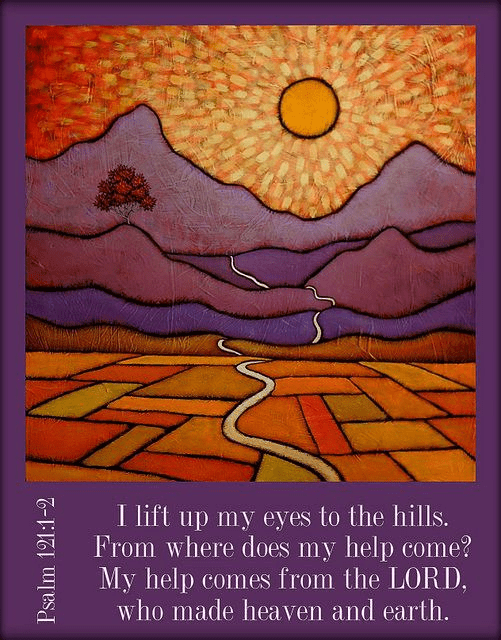
I lift up my eyes to the mountains—
    where does my help come from?
My help comes from the Lord,
    the Maker of heaven and earth.

He will not let your foot slip—
    he who watches over you will not slumber;
indeed, he who watches over Israel
    will neither slumber nor sleep.

The Lord watches over you—
    the Lord is your shade at your right hand;
the sun will not harm you by day,
    nor the moon by night.

The Lord will keep you from all harm—
    he will watch over your life;
the Lord will watch over your coming and going
    both now and forevermore. (New International Version)

Not a one of us gets off this planet without needing help – a lot of help! Even people who are in helping professions or who identify themselves primarily as helpers need help themselves.

There is no such thing as complete, total, and irrevocable independence. We humans are hard-wired by our Creator for community. That means we can only find our greatest fulfillment within interdependent relationships; and, furthermore, discover our highest happiness in a dependent relationship to God.

To need others, and especially to need God, is not a weakness; it’s a sign of strength. To have an awareness that help is needed allows us to make wise and confident choices. Only the fool goes it alone, believing they can pull themselves up by their bootstraps. “God helps those who help themselves,” was originally said by Benjamin Franklin, not Holy Scripture.

So, the question becomes: To whom and to where do we go for help? Who do we consult? With whom do we collaborate?

The most important step any of us can make is to realize that our own personal resources, although important and necessary, are inadequate. Therefore, we must admit, “I need help with this.” The next step is to go to the right source for that help.

The psalmist insists that the Lord is our helper, our keeper. Keeping is a large part of helping. God as our Divine Keeper means that the Lord watches over us, guards our lives, and seeks to preserve us from harm, wrongdoing, injustice, and oppression.

The very identity of God is wrapped up in being a Protector, Guard, and Watchkeeper. The Lord shields and shelters us, much like a mother hen over her chicks. God watches over us, just as a watchman keeps guard over a city at night when the residents are sleeping. And since the Lord is everywhere present, there is a continual divine presence in all of our life journeys. The dangers of both the day and the night are no match for the God who is our Keeper.

The promises of safety in today’s psalm are not meant to suggest that those who walk in the shelter of God will never endure harm or that nothing ill will ever befall them. The Psalter knows all too well that the wicked are everywhere and that they thrive unjustly.

Rather, these divine promises are general promises—they are blessings God does for those who rely on the Lord, call upon God’s name, and seek divine help. We are to have a continual awareness of God’s presence in this world. Although we are not inoculated from pain, God is always with us in our hurt and bewilderment.

It can be hard to ask for help. Our pride, stubbornness, and independence might cause us to experience harm rather than seek assistance. Be specific about the help needed. The following are some “helpful” ways of approaching God by answering some basic newsgathering type questions. The goal isn’t to convince the Lord to help us, but rather to enable us in connecting with what we truly need and being specific about God’s assistance for us or for others:

Who needs help?

Be clear and specific if the help is for yourself, another, or a group of people.

When Jesus had entered Capernaum, a centurion came to him, asking for help. “Lord,” he said, “my servant lies at home paralyzed, suffering terribly.”

Jesus said to him, “Shall I come and heal him?”

The centurion replied, “Lord, I do not deserve to have you come under my roof. But just say the word, and my servant will be healed. (Matthew 8:5-8, NIV)

How will God’s intervention help?

God is an expert listener. Tell the story of what you have tried already and where you fall short.

Jesus asked the boy’s father, “How long has he been like this?”

“From childhood,” he answered. “It has often thrown him into fire or water to kill him. But if you can do anything, take pity on us and help us.”

“‘If you can’?” said Jesus. “Everything is possible for one who believes.”

Immediately the boy’s father exclaimed, “I do believe; help me overcome my unbelief!” (Mark 9:21-24, NIV)

Why are you asking for God’s help?

Explain what’s going on and the reasons why you believe the Lord is the One to help. Mention the divine attributes and actions of God, as well as your own personal connection.

Then Asa called to the Lord his God and said, “Lord, there is no one like you to help the powerless against the mighty. Help us, Lord our God, for we rely on you, and in your name we have come against this vast army. Lord, you are our God; do not let mere mortals prevail against you.” (2 Chronicles 14:11, NIV)

Where is the help needed?

Is it a geographical location, a specific spot in the human body, or a place such as a building or home?

Jesus left the synagogue and went to the home of Simon. Now Simon’s mother-in-law was suffering from a high fever, and they asked Jesus to help her. So, he bent over her and rebuked the fever, and it left her. She got up at once and began to wait on them. (Luke 4:37-39, NIV)

When do you need help?

Immediately? Tomorrow? At a specific time?

O Lord, God of my salvation,

    when, at night, I cry out in your presence,

let my prayer come before you;

    incline your ear to my cry.

For my soul is full of troubles,

    and my life draws near to Sheol. (Psalm 88:1-3, NRSV)

What, exactly, is the need?

Spell out what you want in detail, holding nothing back. Don’t be concerned about the words or saying it right. Speak in your own plain language.

Help, O Lord, for the godly are fast disappearing!

    The faithful have vanished from the earth!

Neighbors lie to each other,

    speaking with flattering lips and deceitful hearts.

May the Lord cut off their flattering lips

    and silence their boastful tongues. (Psalm 12:1-3, NLT)

The help you and I need is in the name of the Lord who made heaven and earth. We only need to ask, and it will be given; seek, and we will find; knock, and the answer will open to us.

I Cannot Do This Alone

A Prayer by Dietrich Bonhoeffer

O God, early in the morning I cry to you.
Help me to pray and to concentrate my thoughts on you;
I cannot do this alone.
In me there is darkness, but with you there is light;
I am lonely, but you do not leave me; I am feeble in heart, but with you there is help;
I am restless, but with you there is peace. In me there is bitterness, but with you there is patience;
I do not understand your ways, but you know the way for me….
Restore me to liberty, and enable me to live now, that I may answer before you and before men.
Lord whatever this day may bring, Your name be praised. Amen.

Pain, Stress, and Chickens (Psalm 32)

A modern mosaic of a mother hen protecting her chicks—on the altar of Dominus Flevit Church on the Mount of Olives, Jerusalem

Oh, what joy for those
    whose disobedience is forgiven,
    whose sin is put out of sight!
Yes, what joy for those
    whose record the Lord has cleared of guilt,
    whose lives are lived in complete honesty!
When I refused to confess my sin,
    my body wasted away,
    and I groaned all day long.
Day and night your hand of discipline was heavy on me.
    My strength evaporated like water in the summer heat.

Finally, I confessed all my sins to you
    and stopped trying to hide my guilt.
I said to myself, “I will confess my rebellion to the Lord.”
    And you forgave me! All my guilt is gone.

Therefore, let all the godly pray to you while there is still time,
    that they may not drown in the floodwaters of judgment.
For you are my hiding place;
    you protect me from trouble.
    You surround me with songs of victory.

The Lord says, “I will guide you along the best pathway for your life.
    I will advise you and watch over you.
Do not be like a senseless horse or mule
    that needs a bit and bridle to keep it under control.”

Many sorrows come to the wicked,
    but unfailing love surrounds those who trust the Lord.
So rejoice in the Lord and be glad, all you who obey him!
    Shout for joy, all you whose hearts are pure! (New Living Translation)

The body knows the truth of what is happening in the spirit. Our physical selves carry the weight of our mental thoughts and emotional feelings.

Our bodies have their way of making sounds of protest and pain if our spirits are silent. For example, physical weariness and tiredness can be a lighthouse, alerting us to pay attention to our inner suffering.

In other words, stated positively, pain and stress are a gift.

“I imagine one of the reasons people cling to their hates so stubbornly is because they sense, once hate is gone, they will be forced to deal with pain.”

James Baldwin

What is stress?

Stress is any type of change that causes physical, emotional, mental, or spiritual strain. Stress is a normal reaction to everyday pressures. However, stress can become unhealthy when it upsets our daily functioning and ability to live well. Stress itself is neither good nor bad. The issue is the appropriate amount of tension we need to live a healthy life.

Where do you typically carry stress in your body?

Whenever we are under a great deal of stress – and are having difficulty either recognizing it or managing it – the body gives us clues about how to pay attention to that stress. Our mental, emotional, relational, and spiritual issues usually show up in the body as physical problems.

Why do individuals handle stress differently?

The combination of past trauma, abuse, and neglect within families and communities is unique to the individual – as well as variations in personality traits and inherited genetics.  In other words, how we deal with stress is a result of both nature and nurture.

What are some common connections between stress and the body?

  • Shoulders: Feeling overwhelmed through carrying the weight of the world’s problems.
  • Gut (stomach and intestines): Feeling anxious for not letting go of a problem.
  • Vomiting or diarrhea: Feeling emotionally sick about a situation and wanting to be rid of it once and for all.
  • Hemorrhoids or constipation: Straining or working very hard to make something happen in your life and it doesn’t come to pass.
  • Headache: Feeling afraid through overthinking that something bad will happen.
  • Chest/heart: Feeling angry or sad through either trauma or secondary trauma.
  • Lungs: Feeling suffocated, like you cannot breathe, because of difficult circumstances, e.g. asthma
  • Spine/knees/hips: Feeling discouraged and wanting to give up because you cannot take one more step.
  •  

How can I deal with my stress in a healthy way?

  1. Let go. Ask for help. Talk to God, as well as a friend, faith leader, or other about why you are stressed.
  2. Reach out. Connect with family members. Get involved in a faith community. Volunteer in an organization you care about.
  3. Eat well. Make healthy choices about food. Find someone or a group of people who share your nutrition goals.
  4. Meditate. Focus on the present moment because there is only now. Read Scripture. Pray.
  5. Walk. Take daily strolls through nature. Walk the dog. Walk with a friend. Walk with the Lord.
  6. Read. Read or listen to a good book. Do it with a cup of coffee or tea.

“The truth is that stress doesn’t come from your boss, your kids, your spouse, traffic jams, health challenges, or other circumstances. It comes from your thoughts about your circumstances.”

Andrew Bernstein

The psalmist went on to release his silence and give voice to his spiritual stress and emotional pain, thus finding relief.

Who is the stress reliever?

God. The Lord is akin to a mother hen who protects her chicks.

My youngest daughter once had a pet chicken named “Gina” (I have no idea why she named the chicken this). Gina would lay an egg or two and keep them warm and nestled underneath herself. Indeed, the eggs were in a special hiding place, protected from outside forces.

My daughter also sang to Gina (which helped her to lay more eggs) and made sure she had plenty of space to find grubs, worms, shrews, and other delectables from the ground. Gina wasn’t the only pet chicken; there were others, too. Chickens are very social and require other chickens to be happy; a solitary hen is likely to not lay any eggs, at all.

Whenever we are “chicken” and run about with anxiety and fear, God gathers us together with other believers, protects us from trouble, surrounds us with songs of deliverance, and makes sure we have everything we need for life and godliness in this present age.

The Lord will take care of us – no matter the situation, the stress, or the pain it produces.

Blessed heavenly Father and Mother Hen, your Divine presence, power, provision, and protection gives us grace and truth. May this season of Lent – a time of repentance and faith – bring us the blessing of your forgiveness and the joy of salvation, through Jesus Christ our Lord. Amen.

Against Hate (Genesis 4:1-16)

Cain and Abel by Keith Vaughan, 1946

Adam slept with Eve his wife. She conceived and had Cain. She said, “I’ve gotten a man, with God’s help!”

Then she had another baby, Abel. Abel was a herdsman and Cain a farmer.

Time passed. Cain brought an offering to God from the produce of his farm. Abel also brought an offering, but from the firstborn animals of his herd, choice cuts of meat. God liked Abel and his offering, but Cain and his offering didn’t get his approval. Cain lost his temper and went into a sulk.

God spoke to Cain: “Why this tantrum? Why the sulking? If you do well, won’t you be accepted? And if you don’t do well, sin is lying in wait for you, ready to pounce; it’s out to get you, you’ve got to master it.”

Cain had words with his brother. They were out in the field; Cain came at Abel his brother and killed him.

God said to Cain, “Where is Abel your brother?”

He said, “How should I know? Am I his babysitter?”

God said, “What have you done! The voice of your brother’s blood is calling to me from the ground. From now on you’ll get nothing but curses from this ground; you’ll be driven from this ground that has opened its arms to receive the blood of your murdered brother. You’ll farm this ground, but it will no longer give you its best. You’ll be a homeless wanderer on Earth.”

Cain said to God, “My punishment is too much. I can’t take it! You’ve thrown me off the land and I can never again face you. I’m a homeless wanderer on Earth and whoever finds me will kill me.”

God told him, “No. Anyone who kills Cain will pay for it seven times over.” God put a mark on Cain to protect him so that no one who met him would kill him.

Cain left the presence of God and lived in No-Man’s-Land, east of Eden. (The Message)

For this is the message you heard from the beginning: We should love one another. Do not be like Cain, who belonged to the evil one and murdered his brother. And why did he murder him? Because his own actions were evil and his brother’s were righteous.

1 John 3:11-12, NIV

Despite being brothers, Cain and Abel couldn’t have been any more different.

Abel became a shepherd. He took the absolute best of his flock and made it an offering, with the intent of giving God an appropriate gift. The Lord was pleased and approved of Abel’s actions because they demonstrated a good attitude and a sensitive heart. Abel’s belief and practice worked together.

Cain became a farmer. He cobbled together some of the leftovers from his vegetable harvest and gave them a nonchalant toss to God. The Lord did not look favorably on Cain’s actions because they evidenced a bad attitude and a hard heart. As a result, Cain became sullen, upset, and angry. His emotions reflected his actions. Cain didn’t listen to God. Instead, he let hate takeover and killed his brother.

God sets faithful people apart to demonstrate love and to be the hope of the world. God’s people reflect their divine image when lives are changed for the better; hatreds are overcome; failures are forgiven; grace melts hard hearts; selfishness is diminished; and compassion grows into blessing others – not hating them.

Humanity was created for love, not hate.

We know that we have transferred from death to life, because we love the brothers and sisters. The person who does not love remains in death. (1 John 3:14, CEB)

Love is the distinguishing mark of the spiritual person and the follower of Christ. The person with hate has so many barnacles built up on their underside that they cannot move through the water of life with any joy or fulfillment. What’s more, they drag down the rest of the fleet that seeks to move in concert together in love.

Everyone who hates a brother or sister is a murderer, and you know that no murderers have eternal life in them. (1 John 3:15, NCV)

Yes, we ought to love – which means we also should not put up with hate. You and I are under no obligation whatsoever to listen to hateful speech and allow hateful actions. That’s because people are meant to be a reflection of God’s loving and healing acceptance of people. 

Love doesn’t let others spew hate in front of you, no matter who they are. Maybe you could respond to hateful words by saying, “Sounds to me like you need to let God pressure-wash some barnacles off your heart.”

If someone chronically complains to you, and there is never any love behind what they say, then there is hate behind it. In such a case, the person needs deliverance from the Evil One.

Every institution and organization on God’s good earth must have a zero-tolerance policy toward hate, and a 100% commitment to love. 

God has not called us to hate anyone, but to love. And God’s people are only the hope of the world when they love others. 

The world will know that there is a God in heaven, and a Christ in the church, when people within local congregations love one another, when particular Christian denominations go out of their way to bless others, and when the love of Jesus compels them to drip grace on the most unlovely of people. Indeed, they will know we are Christians by our love.

Cain is Exhibit A of modeling the way of hatred and death. He separated himself from his brother, Abel, in every way possible – relationally, emotionally, mentally, and finally, physically through outright killing of the body.

The message from Holy Scripture is: Do not be like Cain. Be like Abel. Love others. Do not hate them. Live for others. Die to self. Avoid violent speech and actions. Don’t be a murderer.

Lord Jesus Christ, through your death on the cross you disarmed the powers of evil. Help us, we pray you, to enter into your victory and to stand in your authority against all evil. Send forth your light and your truth. Bring to light the deeds of darkness and let plans of violence and murder be revealed. By the power of your Holy Spirit, convict those who have allowed their minds to be dominated by evil. Lead them to repentance so that they may receive new life and rejoice in your forgiving love. Amen.

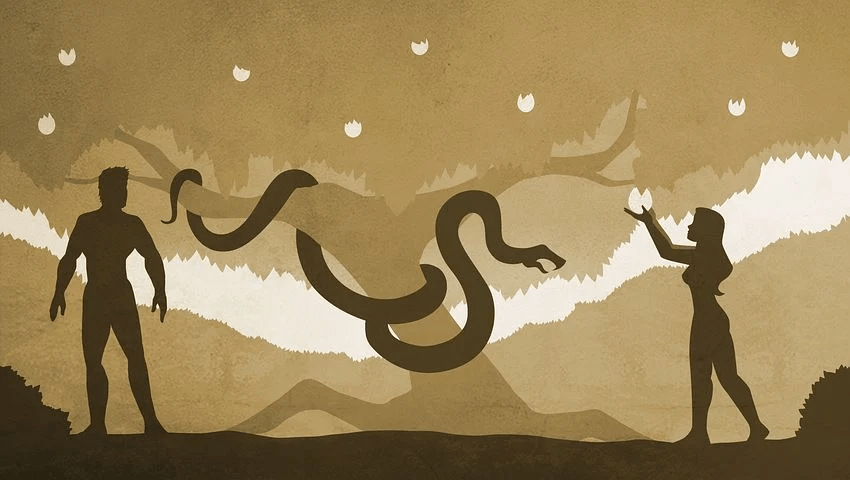
The Fall of Humanity (Genesis 2:15-17, 3:1-7)

The Lord God took the man and put him in the Garden of Eden to work it and take care of it. And the Lord God commanded the man, “You are free to eat from any tree in the garden; but you must not eat from the tree of the knowledge of good and evil, for when you eat from it you will certainly die….”

Now the serpent was more crafty than any of the wild animals the Lord God had made. He said to the woman, “Did God really say, ‘You must not eat from any tree in the garden’?”

The woman said to the serpent, “We may eat fruit from the trees in the garden, but God did say, ‘You must not eat fruit from the tree that is in the middle of the garden, and you must not touch it, or you will die.’”

“You will not certainly die,” the serpent said to the woman. “For God knows that when you eat from it your eyes will be opened, and you will be like God, knowing good and evil.”

When the woman saw that the fruit of the tree was good for food and pleasing to the eye, and also desirable for gaining wisdom, she took some and ate it. She also gave some to her husband, who was with her, and he ate it. Then the eyes of both of them were opened, and they realized they were naked; so they sewed fig leaves together and made coverings for themselves. (New International Version)

Lent is a 40-day season of preparation and repentance for Christians anticipating Good Friday’s cross of Christ and the victory over sin in Easter’s celebration of Christ’s resurrection. To understand why there is a need for repentance, let’s turn to where disobedience, shame, and guilt first entered the world.

Ever since humanity’s fall into sin, our human nature tends to look at the one thing we can’t do, instead of seeing all the range of possibilities that we can do.  The serpent (the devil) was successful in getting Adam and Eve to focus on that one tree they needed to avoid. In our fallen condition, just tell us what we can’t do and we’ll probably be sure to do it – rather than enjoy all the vast prospects we presently have and can actually do with God. 

What’s more, the devil subtly planted a terrible and untruthful idea in the heads of Adam and Eve – that God was somehow holding out on them and was not providing everything they really needed and wanted in life.

Sin may look attractive, and even initially taste good. Yet, disobedience has an awful aftertaste and damages our insides. Indeed, sin always over-promises and under-delivers.

Perhaps the greatest and deepest effect of sin is the shame of disobedience which causes us to hide from God, one another, and even ourselves. All this hiding causes spiritual blindness. We end up sleepwalking through hell, unaware of our awful spiritual plight. 

Because of this reality, we need deliverance; we need a Savior to intervene and save us from our ignorance and guilt. As mere dust, we need God’s Spirit to breathe new life into us so that we may again enjoy the Lord in Paradise.

Our fallen spiritual condition does not want to acknowledge our need for the sheer grace of God. Sewing some fig leaves together is symbolic of Adam and Eve’s new independence from God; from now on, they’re going to operate on their own.  The introduction of sin into the world causes people to look for ways to cope and deal with life apart from God.

We want to return to Paradise. We don’t want to hurt and struggle and be overburdened anymore. So, we devise all kinds of ideas and ways of doing that. And the Paradise we seek always seems to be “out there” somewhere, just out of our reach. 

In our fallen condition, we are plagued with the “if only” syndrome:

If only I had _____ (fill-in the blank) then I would be happy and be in Paradise.

If only I could meet the right person, then that special someone could meet my needs and complete me.

If only the people in my life were better, then everything would be okay and I could enjoy Paradise.

If only I had more money, a bigger house, another car, more power and influence.

If only other people would stop being jerks, care more, serve more, love more. If only my family would listen to me.

If only I could have my way, then there would surely be a restoration to Paradise.

The point to all the “if only” is that it twists us all up into believing that I’m either unlovable or that everyone else is the problem. If they would just change, then the world would be a better place. Or if only I was better, then I wouldn’t have so many problems.

The truth, however, is that we already have what we are so desperately looking for. And since we are unaware that God is with us, and wants to provide for us, we sew fig leaves together and look love in all the wrong places.

No man or woman is going to complete you because no person can fix what is broken in your heart. If you had your ideal relationship, perfect family, and dream job, you would still be empty. Why? Because you and I need a Savior to deliver us from our sin.

We all need deliverance from our disordered loves and misguided attempts to find Paradise in this life apart from God. The temptation after The Fall is to try and manufacture happiness outside of God through perfect relationships and ideal circumstances. 

What to do? Repent. Turn from the shame and guilt of disobedience and deal with the brokenness in our own lives. And that is what the season of Lent is all about.

Without God there are hidden feelings of mistrust, alienation, conditional love, selfishness, greed, and injustice. But with God there is forgiveness, grace, and unconditional love – the very kind of love that we need.

In this season of Lent, we must repent of our hiding and wishing for everything and everyone else to be different without any cost to myself. 

What do you need to repent of in this season? 

Who are the people that you look to do for you what only God can do? 

Have you forsaken your first love of Jesus Christ? 

How is the state of your relationship with God? Has it been stale, dull, and lacking passion, desire, and energy?  Has distance replaced intimacy between you and God? 

Do you avoid the spiritual disciplines of bible reading and prayer because you believe something else will satisfy the real needs of your heart? 

Are you keeping up appearances and hiding, while on the inside you have doubt, depression, and despair that things will never change? 

The prayers of this season are to be prayers of repentance:

Merciful God, we confess that we have hungered after things which do not satisfy.  We have doubted your ability to provide for us. Forgive our lack of faith. Restore in us such trust and love that we may again walk with you in Paradise. 

Loving God, we admit that we’ve given ground to Satan by believing his deception that we can find ultimate happiness in things other than you. So, in the name of the Lord Jesus Christ, we resist all of the devil’s strategies to hold us in spiritual blindness and darkness. 

Blessed Holy Spirit, we invite you to bring the fullness of your power to convict us and lead us into faith in Jesus. We humbly ask that you bring all the power of Christ’s crucifixion and resurrection directly against all forces of darkness seeking to destroy us. Set us free from all that blinds us and keeps us in bondage. 

Grant us, O God, the grace to be faithful and persistent in our walk with you.  Amen.