The Necessity of Mentoring Relationships: Paul, Tom, and Timothy (2 Timothy 3:10-15)

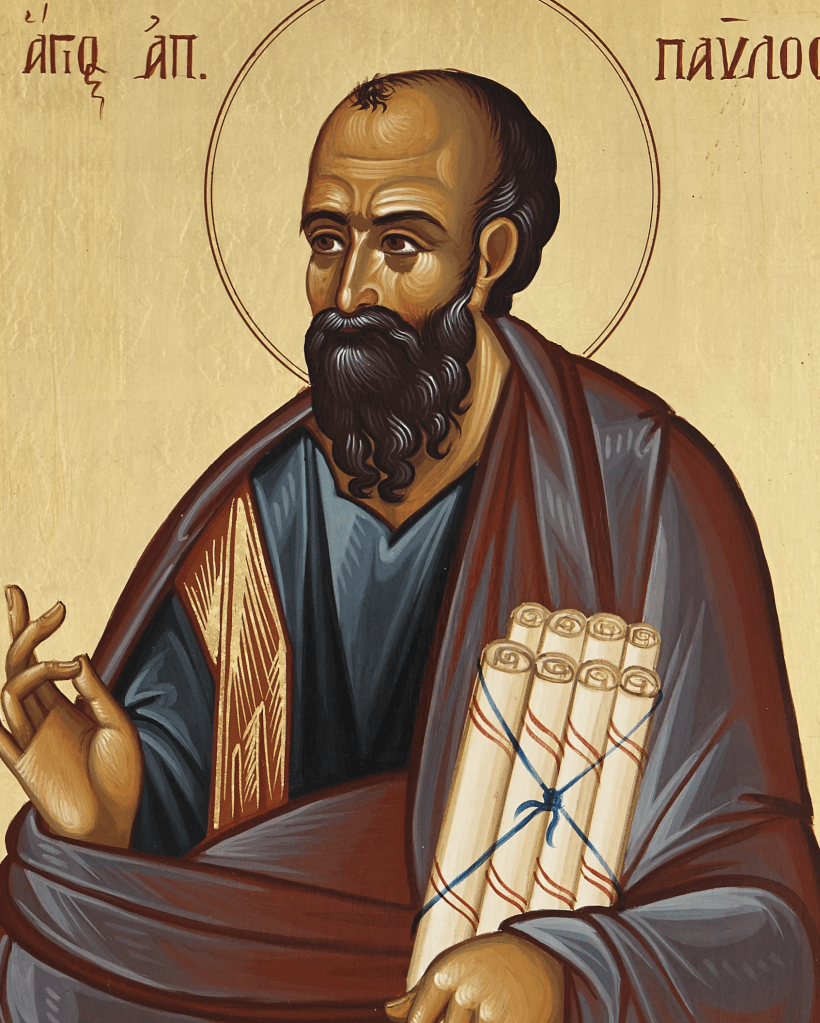
Orthodox icon of St. Paul
Orthodox icon of St. Timothy

You’ve been a good apprentice to me, a part of my teaching, my manner of life, direction, faith, steadiness, love, patience, troubles, sufferings—suffering along with me in all the grief I had to put up with in Antioch, Iconium, and Lystra. And you also well know that God rescued me! Anyone who wants to live all out for Christ is in for a lot of trouble; there’s no getting around it. Unscrupulous con men will continue to exploit the faith. They’re as deceived as the people they lead astray. As long as they are out there, things can only get worse.

But don’t let it faze you. Stick with what you learned and believed, sure of the integrity of your teachers—why, you took in the sacred Scriptures with your mother’s milk! There’s nothing like the written Word of God for showing you the way to salvation through faith in Christ Jesus. (The Message)

Paul and Timothy had a special relationship. Paul, the Apostle and mentor in the faith; and Timothy, the apprentice.

Together, they saw it all – and experienced it all. And through it all, the Christian tradition was passed on because of Paul’s purposeful mentoring of others, especially Timothy, by both verbal teaching and life example. In this, Paul helped set Christianity on a trajectory of modeling the words and ways of Jesus.

Faith is a gift given by God through Scripture and faithful people – and then received by us. Christianity is designed for community; it is not merely a solitary affair between the individual and God. Anyone trying to go it alone in the Christian life will soon discover they are overwhelmed and in over their heads with trouble.

Contemporary pastoral ministry still needs to follow in the footsteps of the Apostle Paul. Just one of the many reasons why churches in the West are in such decline is that Christian leaders are not intentionally focused to passing-on a solid body of teaching, along with a consistent example of how to put it into practice, through close relationships.

Anyone who has been in the pastoral ministry gig for a long time, remaining consistent and faithful, has most certainly had a good spiritual teacher and guide shepherding them through their Christian experience. A good long ministerial life isn’t happenstance; it’s the result of a solid foundation through a Paul-and-Timothy sort of relationship.
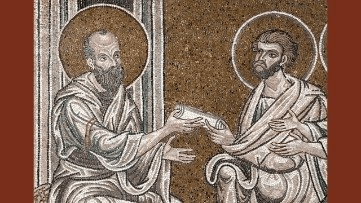
Mosaic of Paul and Timothy, Cathedral of Monreale, Sicily, Italy

By God’s grace, I’ve had several persons influence my life in profound ways in such a relationship. One of the earliest and longest was with Tom – a campus minister on my university who built into my life as an undergraduate and a very young Christian. We remained connected and became good friends for nearly four decades until his untimely death.

Tom knew what he was doing with me. To this day, even with multiple academic degrees and many professional ministry experiences, I attribute most of what I know about Christian faith and practice as simply saying and doing what I saw Tom say and do. And, I might add, Tom consistently saw my true self, even when I didn’t see it myself.

A good model in the faith has the same qualities and insights as the Apostle Paul of old. For example, here are just a few of the important things I learned from Tom:

  • Christian ministry is interpersonal; time must be spent with others, getting to know them and building relationships. Doing pastoral ministry from afar is an oxymoron. From what we know of Paul, at times he had a team of up to seventy persons following him around on missionary endeavors.
  • There are always going to be charlatans and bad apples around. Don’t simply ignore them. Confront them in grace and truth. I still remember a time when I went along with Tom, not knowing where we were going or what he was up to. In retrospect, he probably knew I would bolt if I caught wind of what he was about to do. We went to the dorm room of a believer whom Tom flat-out confronted on his talking and living being inconsistent with his professed Christianity. My eyes got huge when Tom said, “In the name of Jesus Christ I rebuke you and I call you to repent.” This was said in a gracious and conversational tone, not in anger, which communicated concern and love for this individual student.
  • Develop relationships. And the best way of doing this is by having the Timothy tag along with the Paul. Tom continually brought me along to whatever he was doing, whether it was a weekend retreat he was leading, or going to the grocery store. We cannot learn from others if we aren’t around them, and Tom understood this better than most. As a result, I learned more than lessons; I learned a life.
  • It’s not about me. Tom never took himself too seriously. And because of that, I observed him never becoming overwhelmed or obsessing over the trouble he would sometimes get into. In fact, he typically welcomed the trouble whenever he saw it was not of his own making.
  • Openness and vulnerability are necessary. More than once, Tom strolled into a bible study with me and some other guys, flopped down and said, “Man, I really blew it today…” and then went on to explain some boneheaded thing he did. We unpacked the entire situation together. Not once do I ever recall Tom trying to look like the perfect Christian leader. He embraced who he was and was always willing to shine the light on the shadowy places of his heart.
  • Holy Scripture is central to Christian life and ministry. Inevitably, Tom’s question to us, after describing his bonehead move, was to ask, “What are you learning in God’s Word? Do you have any encouragement for me?” On a daily basis, without fail, Tom asked this question of me: “So, what is God teaching you in the Word?”

Through both Holy Scripture and the significant relationships I’ve had throughout my life, I can confidently state that there are two indispensable elements to effective Christian ministry:

  1. It must be firmly grounded in objective theory derived from God’s Word.
  2. It must be intentionally practiced with subjective experience derived from interpersonal relationships.

Objective theory without lived practice leads to being puffed-up with knowledge and no love – because love requires people. And subjective experience without a grounded theory is nothing but a form of spiritual A.D.D. in which whatever shiny thing we see grabs our attention.

I always considered Tom as my spiritual father (and his wife as a dear spiritual mother!). They have shown me not only how to live the faith, but also how to be a spiritual father myself. And as a result, my own dear wife and I have many spiritual children scattered throughout the country.

This is the consummate Christian: Coming to faith by God’s grace, mediated to us through actual flesh-and-blood people; being taught and mentored in that faith by proven Christians; and then, simply saying and doing what you have seen and heard from holy leaders and Holy Scripture.

It’s not rocket science. It’s not abstract art. It’s a life. It’s relationships. And it’s absolutely necessary in order for both the church and the world to be blessed.

But he’s already made it plain how to live, what to do,
    what God is looking for in men and women.
It’s quite simple: Do what is fair and just to your neighbor,
    be compassionate and loyal in your love,
And don’t take yourself too seriously—
    take God seriously. (Micah 6:8, MSG)

Soli Deo Gloria. Amen.

Matthew 20:20-28 – Leadership as Service to Others

Statue of Jesus washing Peter’s feet, in Pittsburgh, Texas. Photo by Carol Highsmith

The mother of Zebedee’s sons came to Jesus with her sons and, kneeling down, asked a favor of him.

“What is it you want?” he asked.

She said, “Grant that one of these two sons of mine may sit at your right and the other at your left in your kingdom.”

“You don’t know what you are asking,” Jesus said to them. “Can you drink the cup I am going to drink?”

“We can,” they answered.

Jesus said to them, “You will indeed drink from my cup, but to sit at my right or left is not for me to grant. These places belong to those for whom they have been prepared by my Father.”

When the ten heard about this, they were indignant with the two brothers. Jesus called them together and said, “You know that the rulers of the Gentiles lord it over them, and their high officials exercise authority over them. Not so with you. Instead, whoever wants to become great among you must be your servant, and whoever wants to be first must be your slave—just as the Son of Man did not come to be served, but to serve, and to give his life as a ransom for many.” (New International Version)

Jesus and his disciples were not on the same page. That’s because they each had differing agendas.

Jesus was clear with the disciples about how things were going to shake out with him: torture, insults, crucifixion, and death was ahead. It seems the disciples and the mother of James and John missed the memo on this. Christ’s words went way over their heads.

It could be the disciples simply did not hear what Jesus was saying to them (repeatedly!). It’s more likely that the message of Jesus got filtered through an existing agenda of how they believed things ought to go.

The disciples, along with a lot of other Jewish folk in the first century, were looking for a Messiah in the mold of King David – a strong leader who would come and beat up the Romans, exert all kinds of power and influence, and establish an earthly rule over all the people they don’t like.

Submission to torture, humility before the very people they detested, and being killed by them were not factors into the disciples understanding of leadership and government.

Much like the powerful Aslan who had a thorough understanding of the world’s deep magic and submitted himself to the White Witch and death in C.S. Lewis’s The Lion, the Witch, and the Wardrobe – Jesus knew what he was doing, while everyone else seemed clueless about the true power which exists in the universe.

Let’s be clear about what that true power really is: grace. Yes, grace. Powerful, resplendent, subversive, scandalous, and radical grace.

Mercy was the missing factor in the disciples’ agenda. Jesus is not like other rulers. He does not operate by throwing his weight around to forcefully impose a crushing my-way-or-the-highway kind of rule (even though, ironically, he is The Way).

No, Jesus freely and unabashedly uses grace with its merciful tools of humility, gentleness, kindness, goodness, and love to introduce and establish a new kind of rule which is not posturing for self-serving authority.

Power, authority, and the positions which go with them are to be used for the common good of all persons. To be in any sort of leadership position is to be a servant of grace for the benefit of humanity and the world.

If Christ’s disciples had looked a bit closer into the Scriptures, they might have noticed, for all his power and authority, that King David trafficked in grace.

David, at the pinnacle of power, looked over the kingdom to see who from the family of his enemy, the former King Saul (who was into the power thing for himself) was around so he could show grace (2 Samuel 9). It was typical of ancient kings to secure their rule and power through killing-off rivals and family members of previous kings. Not so with David. And not so with Jesus.

Wherever there is posturing for position, preening for power, and a pestering for privilege – there you will find everything grace is not:

  • Reliance on making and calling-in favors
  • Arrogant and overinflated egos
  • Unrealistic expectations
  • Hatred and suspicion of others
  • Judgment and condemnation
  • An insistence on recognition
  • Compulsive manipulation and control over everything and everyone
  • Unilateral decision-making
  • Shaming of others
  • Hoarding resources
  • Coups and in-fighting
  • A demand of rights

We in the western world may not be in the habit of offing leaders and killing others to consolidate power, yet we still too often rely on violent speech and language, partisan policies, and good-old-boy systems which are foreign to the way of Christ.

In contrast to this, grace exists. It is the deep magic which resides within. Wherever grace operates, there you will find the heart of a servant:

Attending to the needs of all persons, especially the least, the last, and the lost

  • Freely consulting and collaborating with others
  • Focusing on responsibility
  • Loving discipline
  • Embracing accountability
  • Pursuing truth and integrity
  • Sharing power and resources
  • Encouraging feedback
  • Giving generously
  • Looking for ways to show mercy

This old world desperately needs leaders with a dutiful sense of public service which is compassionate and kind. Wielding authority is not about a show of strength; it is in the understanding that when I am weak, then I am strong.

Yes, this approach to leadership may bring some short-term suffering. Grace, however, results in longevity of righteousness and peace for those who have been trained by it. True service is being a servant of grace.

May it be so, to the glory of God, and for the blessing of the world. Amen.

Luke 6:1-5 – Lord of the Sabbath

One Sabbath Jesus was going through the grainfields, and his disciples began to pick some heads of grain, rub them in their hands and eat the kernels. Some of the Pharisees asked, “Why are you doing what is unlawful on the Sabbath?”

Jesus answered them, “Have you never read what David did when he and his companions were hungry? He entered the house of God, and taking the consecrated bread, he ate what is lawful only for priests to eat. And he also gave some to his companions.” Then Jesus said to them, “The Son of Man is Lord of the Sabbath.” (New International Version)

We Christians tend to be rather hard on the Pharisees. Yet, most of them, much like us, were just trying to uphold their understanding of God’s commands. They wanted to do God’s will. And so did Jesus.

The problem in the New Testament Gospels is that Jesus and some of the Pharisees (not all of them, e.g., Nicodemus) were at loggerheads about how to view and interpret the Law. Jesus wanted them to see the purpose of the law, the heart and spirit of the law, and who was the lord of the law. For Jesus, many of the Pharisees were spiritually blind. They either would not or could not discern who Jesus was and what he was all about.

So, when we refer to spiritual blindness, let’s have a bit of humility about it. Although for the Apostle Paul, a dramatic event happened in which the scales of blindness (both physically and spiritually) fell from his eyes, most folks have a gradual ability to see, an awakening which requires a process of time and growing awareness. This was true of Christ’s original disciples. They believed, yet their faith was an extended process over three years. It wasn’t until after Christ’s resurrection and Pentecost that their faith became complete.

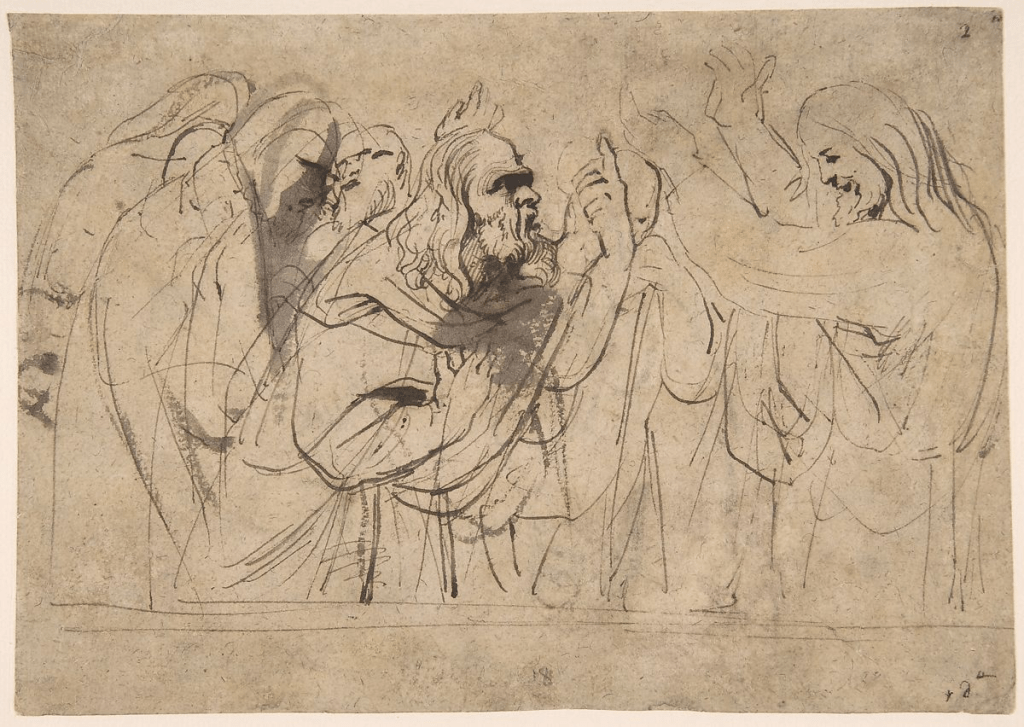
Christ and the Pharisees by Belgian artist Anthony van Dyck (1599-1641)

Jesus didn’t like it that those who should know better, those persons for whom the light of God’s truth ought to be clear and present, were in darkness. When leaders are blind, then we have the blind leading the blind, and nobody finds the door of God’s kingdom.

Many of the Pharisees in the New Testament, most of the heretics in the early church, and some of the spiritual phonies of today are actually not charlatans, that is, they are not deliberately trying to deceive or lead others astray; they are not trying to keep people out of God’s kingdom – they think they are doing the right thing when they are actually leading others astray. 

One of the eye-opening realities I discovered, when I first began studying church history, is that the early heresies condemned at the church councils were doctrines promoted and put forth by men who were not evil bad people – they were just sincerely misguided. They thought they were helping the church better understand the nature of God and Christ, when in fact they were promoting unhealthy doctrine – unintentionally closing the door of God’s kingdom to some people. 

And later when I worked on my master’s thesis in nineteenth century American religious history, I read hundreds of sermons from southern preachers before the American Civil War. I learned that they had a biblical defense for the institution of black chattel slavery. Many of them were pastors of large churches and led many people to Christ, that is, white people. They were slamming the door of God’s kingdom in the faces of African-Americans, and teaching others to do the same.

We can unwittingly slam the door of God’s kingdom in the faces of people when we say God’s grace is for all and then turn around and avoid particular people; or whenever we have explicit written statements or rules that exclude people from serving or being served; or when we bind people to human traditions and practices instead of Holy Scripture. 

The seven deadly words of the Church, believing it is doing the Lord’s will, is, “We’ve-never-done-it-that-way-before… We cannot have somebody out in the field picking heads of grain and rubbing them in their hands. That’s reaping; it’s work; and you can’t do that on the Sabbath.”

Never mind that there are people trying to eat or attempting to enter the kingdom of God. So, we lose sight that the Law was meant to benefit people, to help them thrive and flourish, to lead them into the grace and knowledge of God. The Law gets turned on its head by becoming a heavy burden to carry instead of an easy yolk which brings freedom.

No matter the issue, the last word to everything is grace, God’s grace in Jesus Christ.  

Just as the priest in David’s day was gracious in giving him and his men the consecrated bread meant only for the priests, so Jesus was gracious in giving himself, the Bread of Life, for the benefit of the whole world.

For the Christian, the Law points to Christ, who is the Law’s fulfillment. Now, we carry one another’s burdens, and in doing so, we fulfill the Law of Christ.

O God the Holy Spirit, Sanctifier of the faithful: Make us holy through your abiding divine presence. Enlighten the minds of your people more and more with the light of the everlasting Gospel. Bring erring souls to the knowledge of our Savior Jesus Christ; and those who are walking in the way of life, keep them steadfast in faith to the end.

Give patience to the sick and afflicted and renew them in body and soul. Guard those who are strong and prosperous from forgetting you. Increase in us your many gifts of grace and make us all fruitful in good works. This we ask, O blessed Spirit, whom with the Father and the Son we worship and glorify, one God, world without end. Amen.

1 Timothy 3:1-9 – Be, Not Just Do

Photo by Krivec Ales on Pexels.com

Here is a trustworthy saying: Whoever aspires to be an overseer desires a noble task. Now the overseer is to be above reproach, faithful to his wife, temperate, self-controlled, respectable, hospitable, able to teach, not given to drunkenness, not violent but gentle, not quarrelsome, not a lover of money. He must manage his own family well and see that his children obey him, and he must do so in a manner worthy of full respect. (If anyone does not know how to manage his own family, how can he take care of God’s church?) He must not be a recent convert, or he may become conceited and fall under the same judgment as the devil. He must also have a good reputation with outsiders, so that he will not fall into disgrace and into the devil’s trap.

In the same way, deacons are to be worthy of respect, sincere, not indulging in much wine, and not pursuing dishonest gain. They must keep hold of the deep truths of the faith with a clear conscience. (New International Version)

For the Church everywhere, Jesus Christ is to form and inform everything we do – including leadership.

This is why character formation is at the core of being an elder and a deacon in Christ’s Church – because the elder’s ministry of oversight, shepherding, and discernment of God’s will comes from the inner resources of knowing Christ; and a deacon’s ministry of outreach and service comes from a close walk of faith with Jesus, who desires to work through those individuals. 

Church leaders are to be the light of Jesus to their congregations. It is a high calling. The Apostle Paul gave to the Church seven requirements of Christian morality and seven requirements of a daily walk for leaders. Together, these fourteen requirements are the basis for Christian leaders so that the responsibility of the Church’s mission might be kept on track of bringing people to Jesus and bringing those who know Jesus to know him better.

The first set of seven requirements have to do with the morals of the person. A church leader is to:

1) Be trustworthy. Have a good reputation in both the church and the world

2) Be devoted in the marriage relationship (This doesn’t mean that a church leader must be married, because then even Jesus wouldn’t qualify as a church leader!)

3) Be clear-minded, even-keeled, and consistent

4) Be self-controlled (and not controlling others)

5) Be brave, possessing moral courage, through speaking truth with grace and not being a complainer

6) Be a friend of strangers through practicing hospitality

7) Be an able teacher, gently and carefully instructing others in a way that builds them up and does not tear them down 

The second set of seven requirements have to do with the ethical conduct of the person in everyday life. A church leader is to: 

1) Be sober and not a drunkard, conducting oneself in all moderation

2) Be respectable and not given to anger outbursts and constantly carrying a chip on their shoulder about something

3) Be gentle with everyone and in all situations

4) Be cordial and foster healthy relations, and not always picking a fight about something

5) Be generous and not thinking about the all-mighty dollar in every decision

6) Be caring in the family and give rules with relationship, so as to curb rebellion in a child

7) Be mature and not a novice in the faith so that those outside the church can see there is something wonderfully different about the way things are handled and done among those who profess Jesus Christ.

In addition to this, we have seven related requirements for deacons: 

1) Be dignified in every kind of relation, a person worthy of respect

2) Be sincere and not double-tongued, saying one thing to one person and something different to another

3) Be moderate in all things, especially when it comes to drink

4) Be benevolent and altruistic, and not greedy for either stuff or attention

5) Be holy and pure, keeping very close to faith in Christ with a good heart

6) Be a servant who is able to handle attention without falling apart

7) Be faithful, keeping promises and vows, especially in marriage and with family

God calls and sets apart individuals for service so that the Divine presence might be manifested among the people. Jesus Christ wants the church to be built up through faithful service. Notice what today’s New Testament lesson does not say about church leaders:

  • Be a listener to complaints.

Do everything without complaining or arguing (Philippians 2:14, ERV)

  • Be a representative of the people. Nowhere in Scripture do we find church leaders are supposed to operate like an American form of democracy. Instead of being representatives of the people to do their will, church leaders are rather representatives of God to the people so that God’s will is done in all things. 

Guard yourselves and God’s people. Feed and shepherd God’s flock—his church, purchased with his own blood—over which the Holy Spirit has appointed you as leaders. (Acts 20:28, NLT)

  • Be ingenious. Church leaders are not called to be the smartest, most creative, and best idea people in the room. They are to be servants, leading others in prayer, outreach, and acts of mercy.

I have a special concern for you church leaders. I know what it’s like to be a leader, in on Christ’s sufferings as well as the coming glory. Here’s my concern: that you care for God’s flock with all the diligence of a shepherd. Not because you have to, but because you want to please God. Not calculating what you can get out of it but acting spontaneously. Not bossily telling others what to do, but tenderly showing them the way. (1 Peter 5:1-3, MSG)

These requirements of Holy Scripture are not just for leaders; they are to be sought after by every member of God’s holy Church. We are all together to aspire to the highest of ideals of Christ in the way we operate in the church and in the world. 

Let no debt remain outstanding except the continuing debt to love one another (Romans 13:8). Godly leaders help us to maintain that biblical mandate.

Now may the God of peace, who through the blood of the eternal covenant brought back from the dead our Lord Jesus, that great Shepherd of the sheep, equip you with everything good for doing his will, and may he work in us what is pleasing to him, through Jesus Christ, to whom be glory for ever and ever. Amen. (Hebrews 13:20-21, NIV)