I Am the Bread of Life (John 6:35, 41-51)

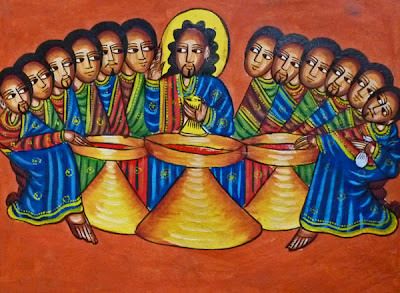
Ethiopian Orthodox depiction of Jesus sharing with the disciples

Jesus said to them, “I am the bread of life. Whoever comes to me will never be hungry, and whoever believes in me will never be thirsty…

Then the Jews began to complain about him because he said, “I am the bread that came down from heaven.” They were saying, “Is not this Jesus, the son of Joseph, whose father and mother we know? How can he now say, ‘I have come down from heaven’?” 

Jesus answered them, “Do not complain among yourselves. No one can come to me unless drawn by the Father who sent me, and I will raise that person up on the last day. It is written in the prophets, ‘And they shall all be taught by God.’ Everyone who has heard and learned from the Father comes to me. Not that anyone has seen the Father except the one who is from God; he has seen the Father. Very truly, I tell you, whoever believes has eternal life. I am the bread of life. Your ancestors ate the manna in the wilderness, and they died. This is the bread that comes down from heaven, so that one may eat of it and not die. I am the living bread that came down from heaven. Whoever eats of this bread will live forever, and the bread that I will give for the life of the world is my flesh.” (New Revised Standard Version)

The lesson for today begins with the first of seven “I am” statements in John’s Gospel from Jesus:

  1. “I am the bread of life. Whoever comes to me will never be hungry, and whoever believes in me will never be thirsty.” (John 6:35)
  2. “I am the light of the world. Whoever follows me will never walk in darkness but will have the light of life.” (John 8:12)
  3. “I am the gate. Whoever enters by me will be saved and will come in and go out and find pasture.” (John 10:9)
  4.  “I am the good shepherd. The good shepherd lays down his life for the sheep.” (John 10:11)
  5. “I am the resurrection and the life. Those who believe in me, even though they die, will live,and everyone who lives and believes in me will never die.” (John 11:25-26)
  6. “I am the way and the truth and the life. No one comes to the Father except through me.” (John 14:6)
  7. “I am the true vine, and my Father is the vine-grower. He removes every branch in me that bears no fruit. Every branch that bears fruit he prunes to make it bear more fruit. I am the vine.” (John 15:1-2)

Also, for the first time in the Gospel of John, the Jews are named and identified as the ones who cause conflict for Jesus. John, of course, did not mean every single Jew; he was referring chiefly to the Jewish religious establishment, the leaders. And even then, he, of course, was not making reference to every single rabbi or person in the ruling council.

It’s important to say that, because Jews throughout the centuries have had far too much persecution from Christians who think all Jews have it in for Jesus. So, please, exercise some plain common sense and basic human kindness when it comes to reading the New Testament Gospels; they are most definitely not anti-Semitic.

The religious leaders were taking issue with the claims of Jesus, his “I am” statement. They argued that Jesus was a plain ordinary Jew from a typical Jewish family. There’s no need, the authorities contended, for Jesus to think of himself any other way than a common Jew.

Instead of entertaining the complaint against him, Jesus pointed to God the Father. God initiated the action by sending Jesus; and takes action by drawing people to Jesus. And Christ does his part by raising those people up at the last day; and teaching them about God’s actions of deliverance.

When it comes to the earthly ministry of Jesus, seeing is believing, and hearing is learning. Trust what you see with Jesus; and believe it. Have faith in what you hear from Jesus; and learn from it.
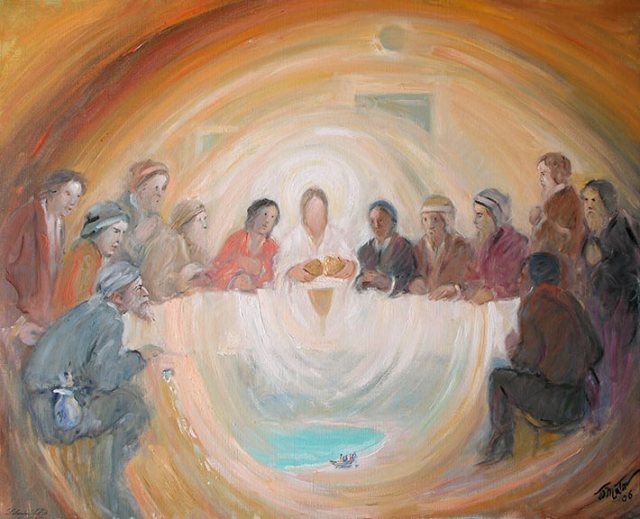
I Am the Bread of Life, by Joseph Matar

I like Jesus. I like metaphors. Jesus is a metaphor guy. I like that. Jesus said that he is the bread of life. Those who come to Jesus are satisfied. Those who eat him, live forever. This isn’t cannibalism, it’s a metaphor. The bread that Jesus gives for the life of the world is his flesh.

Metaphors help us relate to the concept, and grasp the message. If you’re hungry, just looking at a loaf of bread isn’t going to help you be satisfied. Obviously, you have to eat the bread and do more than see it, smell it, and touch it.

What’s more, people do more than eat once. We eat repeatedly, every day, at least a few times a day, in order to be healthy and alive.

Come and see Jesus. But do more than that. Ingest him. Take Jesus into your life. Let the bread of life come into you and thoroughly satisfy you. And do it every day. Do it several times a day. Make sure your soul is continually full of Jesus.

Then, you will have life to the full, an abundant life, filled with good things and right relationships.

Jesus is the bread of life. He is the great “I am.” And so much more.

Yet, perhaps at first glance, Jesus is just one person amongst a panoply of historical characters and religious figures. However, if we will but taste Jesus, we will come to see something very different about him. He’s more than a human being, more than a compelling teacher, and more than a miracle worker.

Jesus may appear, to many, as nothing more than a common person. But there’s really nothing ordinary about him, at all. Taking the time to have a good look at the Gospel of John, and watching Jesus move from village to village, and person to person will help us see a rather uncommon person who was no ordinary human being.

He moved to the beat of a different drum, and danced an alternative jig. And if we observe more closely, we can see the other two dance partners with him.

And with our two ears, when he says, “I am,” we can respond with an emphatic, “He is.”

Merciful Father, you heard the prayers of your people in the wilderness and fed them bread from heaven despite their sin. Graciously hear us today and feed us, too, with the Bread of Life from heaven, our Lord Jesus Christ, who lives and reigns with you and the Holy Spirit, one God, now and forever. Amen.


Psalms 42 & 43 – Longing for Another World

As a deer gets thirsty
    for streams of water,
I truly am thirsty
    for you, my God.
In my heart, I am thirsty
for you, the living God.
    When will I see your face?
Day and night my tears
    are my only food,
as everyone keeps asking,
    “Where is your God?”

Sorrow floods my heart,
    when I remember
leading the worshipers
    to your house.
I can still hear them shout
    their joyful praises.
Why am I discouraged?
Why am I restless?
    I should trust you, Lord.
I will praise you again
because you help me,
    and you are my God.

I am deeply discouraged,
    and so I think about you
here where the Jordan begins
at Mount Hermon
    and at Mount Mizar.
Your vicious waves
    have swept over me
like an angry ocean
    or a roaring waterfall.

Every day, you are kind,
    and at night
you give me a song
as my prayer to you,
    the God of my life.

You are my mighty rock.
    Why have you forgotten me?
Why must enemies mistreat me
    and make me sad?
Even my bones are in pain,
    while all day long
my enemies sneer and ask,
    “Where is your God?”

Why am I discouraged?
Why am I restless?
    I trust you, Lord!
And I will praise you again
because you help me,
    and you are my God…

Show that I am right, God!
Defend me against everyone
    who doesn’t know you;
rescue me from each
    of those deceitful liars.
I run to you for protection.
Why do you turn me away?
Why must enemies mistreat me
    and make me sad?

Send your light and your truth
    to guide me.
Let them lead me to your house
    on your sacred mountain.
Then I will worship
at your altar because you
    make me joyful.
You are my God,
    and I will praise you.
Yes, I will praise you
    as I play my harp.

Why am I discouraged?
Why am I restless?
    I trust you, Lord!
And I will praise you again
because you help me,
    and you are my God. (Contemporary English Version)

Longing is a universal human experience. It is also an integral part of the human condition.

“If we find ourselves with a desire that nothing in this world can satisfy, the most probable explanation is that we were made for another world.”

C.S. Lewis

Before that statement, Lewis spoke of the nature of longing – how all that we experience in this life is not the ultimate object of our desire, of our longing. The beauty and satisfaction we seek:

“was not in them, it only came through them, and what came through them was longing. These things—the beauty, the memory of our own past—are good images of what we really desire; but if they are mistaken for the thing itself they turn into dumb idols, breaking the hearts of their worshipers. For they are not the thing itself; they are only the scent of a flower we have not found, the echo of a tune we have not heard, news from a country we have never yet visited.”

C.S. Lewis, The Weight of Glory

If we follow the path of any pain, any psychological or emotional wounding, it will lead us to this one primal pain: the pain of separation.

That’s because, having been born into this world, we are banished from Paradise and carry the scars of our Edenic estrangement – the separation from God.

Although it may sound counter-intuitive, if we will but embrace this suffering, if we allow it to lead us deep within ourselves, it will take us deeper than any healing this world can offer.

In other words, longing is itself the cure. It is when our hearts break that they become open for the love to come pouring out of it.

The grief we acknowledge and express draws us toward intimacy with the Divine and with others. It brings union, not separation. The problem itself becomes the cure.

“Do not seek for water. Be thirsty.”

Jalāl al-Dīn Muḥammad Rūmī (1207-1273)

The longing for love, belonging, and connection needs to be deeply felt, because it is really the only way of actually loving another. It is in hungering and thirsting – that is, in longing – which leads us to pray and seek to end our separation.

Prayer is the voice we give to our longings.

Naming our sadness for what it is, even our depression, is most necessary. Since we are emotional creatures, profound sadness even to the point of depression and/or despondency will happen.

Yet, despite the universal nature of discouragement, tears, and the longing for better and beauty, many Christians buck the feelings. Far too many believers focus so exclusively on victory in Jesus through his resurrection, ascension, and glorification that they use religion as their denial when unwanted emotions come banging at the doorstep of their soul.

Depression is not sin. To be discouraged is not the Enemy. And our longings are the evidence that this is so. We must sit with our emotions and feel the breadth and depth of them. Both our spiritual and emotional health come through an awareness and robust engagement with our feelings. Refusing to feel is, in reality, putting the stiff arm to God.

The psalmist does anything but deny his feelings. He brings them before the Lord and spreads them out before the Divine. Why am I discouraged? Why am I restless? Why the sadness? Could it be that God has forgotten me? Where is the Lord? Is God angry with me? Are my troubles the result of divine wrath?

To blandly say we have never uttered or thought such questions is a telltale sign of denying our deep longings. The bottom line for many folks is that they do not want to feel discouraged or cry any tears because it complicates their lives. Besides, it hurts!. “Why feel,” we reason, “when it only brings pain?”

Ah, yes, the avoidance of pain. And there is no pain quite like emotional and spiritual pain of separation and longing for things to be different.

Much like an open wound which needs a liberal application of painful peroxide, so our spiritual wounds must sting with the salve of emotional feeling. Healing is neither cheap, easy, nor painless. It typically hurts like hell.

The psalmist’s own pain revolved around feelings of alienation from God, being cut off from fellow worshipers, and harassed by others around him. Understandably, he experienced despondency and loneliness. The psalmist wondered if anyone, including God, even cared what he was going through. In other words, he is desperate for God to show up. So, he prayed as if his life depended on it.

The psalmist did not get answers to his questions. But that was never the point of the asking.

Hope arises from holding the big picture of the past, present, and future together at the same time. When present circumstances are difficult, and it appears we are about to swallowed up into the now, we must hold the past and future along with it, in careful tension.

While we desperately search for a cure, none will be found in this life – at least not in full. We are occasionally and surprisingly graced with glimpses of our deepest longings whenever we experience the kindness of a stranger, an answer to a prayer we uttered years ago, or the peace of an unexpected rest.

Then, our trust reawakens, and we are encouraged to take another step in the long walk of life – a walk in which God is beside us, even if we cannot discern it.

Gracious God, help us to know wonder in our waiting, patience in our wonderings, and a vision of how life is supposed to be lived. May our deepest longing find its satisfaction in you and in the many ways you mercifully hold the world together, through Jesus Christ our Lord. Amen.

Amos 8:4-12 – A Spiritual Famine

Listen to this, you who walk all over the weak,
    you who treat poor people as less than nothing,
Who say, “When’s my next paycheck coming
    so I can go out and live it up?
How long till the weekend
    when I can go out and have a good time?”
Who give little and take much,
    and never do an honest day’s work.
You exploit the poor, using them—
    and then, when they’re used up, you discard them.

God swears against the arrogance of Jacob:
    “I’m keeping track of their every last sin.”
God’s oath will shake earth’s foundations,
    dissolve the whole world into tears.
God’s oath will sweep in like a river that rises,
    flooding houses and lands,
And then recedes,
    leaving behind a sea of mud.

“On Judgment Day, watch out!”
    These are the words of God, my Master.
“I’ll turn off the sun at noon.
    In the middle of the day the earth will go black.
I’ll turn your parties into funerals
    and make every song you sing a dirge.
Everyone will walk around in rags,
    with sunken eyes and bald heads.
Think of the worst that could happen
    —your only son, say, murdered.
That’s a hint of Judgment Day
    —that and much more.

“Oh yes, Judgment Day is coming!”
    These are the words of my Master God.
“I’ll send a famine through the whole country.
    It won’t be food or water that’s lacking, but my Word.
People will drift from one end of the country to the other,
    roam to the north, wander to the east.
They’ll go anywhere, listen to anyone,
    hoping to hear God’s Word—but they won’t hear it. (The Message)

Four hundred years of silence….  That’s how long it was between the Old and New Testaments of the Bible. In that period, there was no word from God. No prophets sent by God. No divine message, at all, of either judgment or grace. There was complete silence from the Lord… until the fullness of time, when the incarnation of Jesus changed everything. Why so long to hear from God?

The prophet Amos delivered a scathing message to God’s people about their total disregard for the poor and needy in the land. Those in positions of authority and power in Israel merely looked on the less fortunate as commodities – as pawns to be taken advantage of for the rich merchants. 

Because the wealthy never took the time to listen to the poor, God would not listen to them. A famine was coming – neither about hungering for food in short supply, nor about thirsting for clean water. Instead, there will be a scarcity of hearing words from God. Folks can search far and wide just to get a wordy tidbit or even a crumb of a message from the Lord, but they won’t find it.

Whenever people refuse listening to the poor, the entire human community is at risk of experiencing a famine of God’s speech. That’s for all people, not just some. Justice is the responsibility of everyone, and not just a few.

“If you can’t feed a hundred people, then feed just one.”

Mother Teresa

Scripture says people don’t live on food alone but by every word that comes from the mouth of God (Deuteronomy 8:3; Matthew 4:4). God’s Word is necessary sustenance, just as much as the need for three square meals a day. Withholding both physical and spiritual resources from others, either through sheer inattention or blatant disregard, damns a society to experiencing famine in the total sense of the word – for all, not just some.

We live in a day when the poor are often disregarded. Either they are ignored altogether or are given hand-outs and services without ever having any significant human contact.  In other words, very few people take the time to listen and get to know the real face of poverty. After all, we are busy making money and checking our stocks, and…. 

Oh, my, perhaps we have the answer as to why there is such a lack of revival in the land. The Lord shows such solidarity with the poor that to ignore them is to ignore God. No matter our financial picture and outlook, every one of us can grace the poor with the gift of time and listening to them. For in doing so we might just be listening to the voice of God.

God identifies closely with the poor, distressed, and needy. The Lord listens to the lowly. So, we as God’s people, are to share this same concern.

God will rescue the needy person who cries for help
and the oppressed person who has no one’s help.
He will have pity on the poor and needy
and will save the lives of the needy. (Psalm 73:12-13, GW)

Those who mock the poor insult their Maker; those who rejoice at the misfortune of others will be punished. (Proverbs 17:5, NLT)

Those who are gracious to the poor lend to the Lord, and the Lord will fully repay them. (Proverbs 19:17, CEB)

If you close your ear to the cry of the poor, you will cry out and not be heard. (Proverbs 21:13, NRSV)

Those who give to the poor will lack nothing, but those who turn a blind eye will be greatly cursed. (Proverbs 28:27, CEB)

Give your food to the hungry
    and care for the homeless.
Then your light will shine
    in the dark;
your darkest hour will be
    like the noonday sun. (Isaiah 58:10, CEV)

The Spirit of the Sovereign Lord is on me,
    because the Lord has anointed me
    to proclaim good news to the poor. (Isaiah 61:1, NIV)

 Jesus said, “If you want to be complete, go, sell what you own, and give the money to the poor. Then you will have treasure in heaven.” (Matthew 19:21, CEB)

 If we are rich and see others in need, yet close our hearts against them, how can we claim that we love God? My children, our love should not be just words and talk; it must be true love, which shows itself in action. (1 John 3:17-18, GNT)

We already have words from God. What will we do with them?…

Gracious God, you are found everywhere – both the halls of power, and the back alleys of slums.  As I seek you more and more, may I see the face of Jesus in everyone I encounter, whether rich or poor so that I can share the gift of life with them all in this season of anticipation.  Amen.

John 4:31-38 – Real Food

Meanwhile his disciples urged him, “Rabbi, eat something.”

But he said to them, “I have food to eat that you know nothing about.”

Then his disciples said to each other, “Could someone have brought him food?”

“My food,” said Jesus, “is to do the will of him who sent me and to finish his work. Don’t you have a saying, ‘It’s still four months until harvest’? I tell you, open your eyes and look at the fields! They are ripe for harvest. Even now the one who reaps draws a wage and harvests a crop for eternal life, so that the sower and the reaper may be glad together. Thus, the saying ‘One sows, and another reaps’ is true. I sent you to reap what you have not worked for. Others have done the hard work, and you have reaped the benefits of their labor.” (New International Version)

Today’s Gospel narrative reads something like the stereotypical mother concerned for her son saying, “Sit down and eat some of Mama’s pasta. You need some food!” As if preparing and serving a meal will make everything better.

Food has both the power to bring us together, as well as separate us. A meal can create the conditions for fellowship, acceptance, and enjoyment. Eating can bond people together through hospitable love. On the other hand, sitting down to eat can also be a way to avoid painful emotions. In this manner, eating becomes an obstacle to giving and receiving love.

It seems Christ’s disciples were doing the latter. They were uncomfortable and perhaps a bit stressed. Looking to fill up with food instead of with God, the disciples’ sense of unfulfillment was coming out sideways by opening the refrigerator, poking through the meager leftovers, and putting the emphasis on feeling better.

I know we can be hard on the disciples in the Gospels. Their ups and downs from faith to fear and back to faith again can be weird. Yet, through it all, I believe their hearts (excepting Judas Iscariot) were in the right place.

Jesus could see through the entire scenario and put the focus off eating. He addressed the disciples’ soul hunger through putting the spotlight on doing the will of God. Deep within they were hungering and thirsting for righteousness.

Paying attention to our vocation and discovering our humble work in the service of God, rather than a vacation to the pantry to cover our unwanted feelings, is the essence of Christ’s interaction with his disciples.

People are much more ready for the gospel of Jesus than we think. There are times we can become so insular, and lost within our own heads, that we are then unable to see the world as ripe for a harvest of people who are actually eager to be gathered into the community of the redeemed.

Jesus just had a significant interaction with the Samaritan woman. Back in that day, you just didn’t have dialogues with half-breed Samaritans – an unholy mix of Jewish and hated ancient Assyrian Gentile blood – let alone a man talking with a woman of disrepute who experienced several failed marriages.

Christ had a way of doing the will of God, despite conventional thinking of the time. And a lot of people got their undies in a bundle from it. The disciples, having a front seat to most of Christ’s shenanigans, did a few too many palms to the forehead, believing their Rabbi’s un-orthopraxis was going to make him unpopular. They feared no one would follow him.

Looks like the disciples didn’t quite get that one right.

The Samaritan woman received Jesus as Living Water, having her ultimate needs met by the penultimate Lord of all. The disciples hadn’t quite caught up to this, so fell back on their old ways of physical food and drink to assuage the weirdness happening inside them.

The woman was gushing over with Living Water, becoming a wellspring of good news to her community. Whereas the disciples (eventually becoming an incredible fountain of the gospel after Christ’s death and resurrection) are here nothing but an annoying drip from the kitchen faucet.

A non-descript ethnically suspect woman of dubious character coming to faith was meant by Jesus to open the disciples’ eyes to a new reality: The good news of Christ is meant for the world, not just Jewish men.

The disciples were given the opportunity to participate in the world’s takeover – a mission of bringing the love of God where love wasn’t present, of helping all kinds of people awaken to the deep spirituality within them, of lifting their downcast faces of guilt and shame to see the Living God wanting to bless the world with the body and blood of Jesus.

For this is real food and real drink.

Many believers in Jesus today think they are working hard for the Lord by seeking people for their churches. Yet, the real work is being done by the triune God – the heavenly Father who scans the world and seeks spiritual misfits to bless; the gracious and truthful Son who put hands and feet to that blessing; and the wild Holy Spirit who moves in unpredictable ways – are working infinitely harder for our churches, our families, our neighborhoods, and our world.

All of our work, no matter how big or small, is made possible by the pre-work of the Holy Trinity. The great Three-in-One has done all the preparations of chopping the onions, mincing the garlic, slicing the carrots, and peeling the potatoes so that we, his followers, can make a savory stew of diverse people sharing a common pot of God’s love and hospitality.

This is the food we know nothing about, and that God knows intimately.

O God, you made us in your own image, and you have redeemed us through your Son Jesus Christ: Look with compassion on the whole human family; take away the arrogance and hatred which infect our hearts; break down the walls that separate us; unite us in bonds of love; and work through our struggle and confusion to accomplish your purposes on earth; that, in your good time, all nations and races may serve you in harmony around your heavenly throne; through Jesus Christ our Lord. Amen.

*Above painting: Ethiopian Orthodox Church depiction of the Last Supper