Mercy Is Coming (Micah 7:8-20)

“Justice Tempered with Mercy,” an oil painting by Emil Bisttram, 1936

Do not rejoice over me, my enemy,
        because when I fall, I will rise;
            if I sit in darkness, the Lord is my light.
I must bear the raging of the Lord,
    for I have sinned against him,
        until he decides my case and provides justice for me.
    He will bring me out into the light;
        I will see by means of his righteousness.
    Then my enemy will see;
        shame will cover her who said to me:
            “Where is the Lord your God?”
    My eyes will see her ruin;
        now she will become something to be trampled,
            like mud in the streets.

A day for the building of your walls!
        On that day, the boundary will be distant.
        On that day, they will come to you from Assyria and the cities of Egypt,
            from Egypt to the River,
            from sea to sea,
            and from mountain to mountain.
And the earth will become desolate because of her inhabitants,
        because of the fruit of their actions.

Shepherd your people with your staff,
        the sheep of your inheritance,
        those dwelling alone in a forest in the midst of Carmel.
    Let them graze in Bashan and Gilead, as a long time ago.

As in the days when you came out of the land of Egypt,
        I will show Israel wonderful things.

Nations will see and be ashamed of all their strength;
        they will cover their mouths;
        their ears will be deaf.

They will lick dust like the snake,
        like things that crawl on the ground.
They will come trembling from their strongholds to the Lord our God;
        they will dread and fear you!
Who is a God like you, pardoning iniquity,
        overlooking the sin of the few remaining for his inheritance?
    He doesn’t hold on to his anger forever;
        he delights in faithful love.
He will once again have compassion on us;
        he will tread down our iniquities.
You will hurl all our sins into the depths of the sea.
You will provide faithfulness to Jacob, faithful love to Abraham,
        as you swore to our ancestors a long time ago. (Common English Bible)

The prophecy of Micah was directed to the people because of the nation’s messed up social and political relations. Unrighteousness had thoroughly drenched the land. In this situation, the nation groaned; Micah responded to them and interceded for the people; God agreed with it all; and Micah concluded with a theological reminder of who God is and what God is like.

The nation of Israel was in a bad way during the eighth century B.C.E. because of their injustice toward one another. The leaders only thought of themselves, and not the people as a whole. Unfaithfulness ran so deep that not even one’s closest friends or relatives could be trusted.

To be a faithful and righteous person during that time required a resolve to wait for God’s deliverance – because there was no way any one person or group of people could fix any of it.

And this is the nature of hope – it can only be understood and realized by knowing, sensing, and feeling hopelessness in all of its despair. We do not hope for something we already possess.

The prophet Micah recognized the situation of the nation for what it was, as well as the consequences to having injustice throughout the land. Yet, he also looked forward to a time when God’s wrath will move from God’s people to the people’s enemies.

It may seem as if the Lord is either slow, not paying attention, or doesn’t care; but God’s timing is not the same as ours. Divine deliverance will come when divine deliverance will come.

The circumstances of Israel’s national sins were ripe not only for God’s judgment, but also for Micah’s prayers on behalf of the people. He called on the Lord to shepherd Israel, while at the same time, to put Israel’s enemies in their place.

And God, out of the storehouse of divine mercy, granted an assurance of pardon.

But if we confess our sins, he is faithful and just to forgive us our sins and cleanse us from everything we’ve done wrong. (1 John 1:9, CEB)

Micah affirmed the grace and mercy of God. He had the confident expectation that the Lord would cast all of Israel’s sins into the depths of the sea. Guilt, shame, and despair will not have the last word; the final word belongs to mercy.

Into a world full of cynicism and sarcasm, hopelessness and despair, it is vitally important that we have faithful and godly individuals who have a settled hope. This is what it means to be a remnant, a small minority of people who hold onto that which is just, right, and good.

We are to quietly go about our business of bringing justice, mercy, and love to this world with a quiet and confident expectation that God’s grace will overcome and overwhelm everything in its path.

Most merciful God, we confess that we have sinned against you in thought, word, and deed, by what we have done, and by what we have left undone. We have not loved you with our whole heart; we have not loved our neighbors as ourselves. We are truly sorry and we humbly repent. For the sake of your Son Jesus Christ, have mercy on us and forgive us; that we may delight in your will, and walk in your ways, to the glory of your Name. Amen.

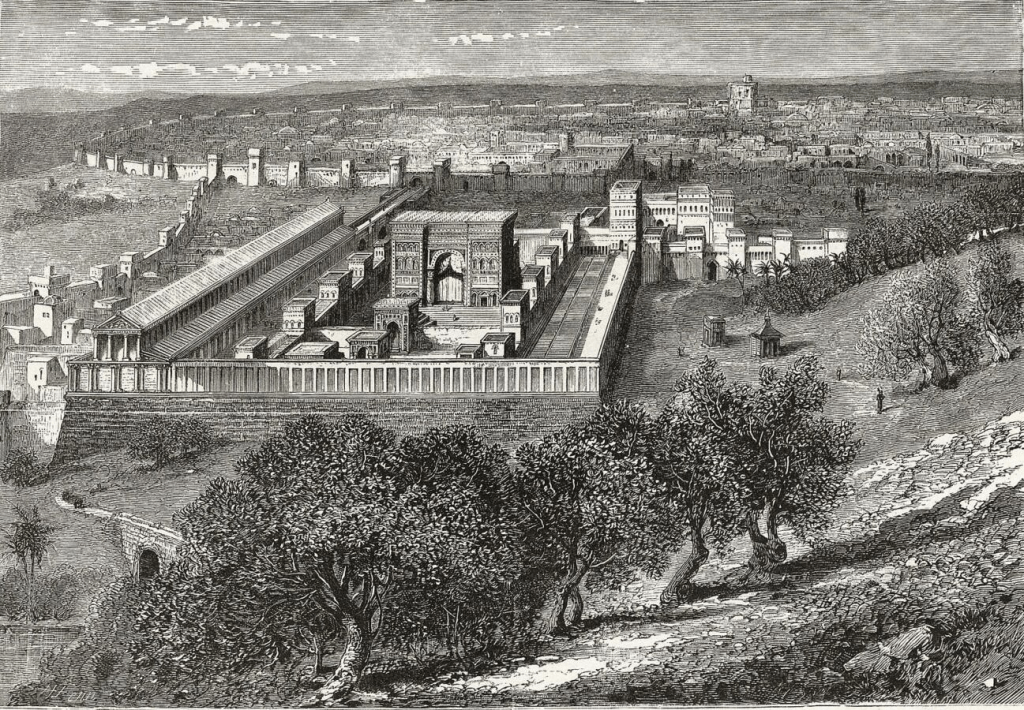
Rebuilding (Ezra 6:1-16)

Rebuilding of the Temple, by Gustave Doré, 1866

Then King Darius made a decree, and they searched the archives where the documents were stored in Babylon. But a scroll was found in Ecbatana, the capital of the province of Media, on which was written the following:

A memorandum— In the first year of his rule, King Cyrus made a decree: Concerning God’s house in Jerusalem: Let the house at the place where they offered sacrifices be rebuilt and let its foundations be retained. Its height will be ninety feet and its width ninety feet, with three layers of dressed stones and one layer of timber. The cost will be paid from the royal treasury. In addition, the gold and silver equipment from God’s house, which Nebuchadnezzar took out of the temple in Jerusalem and brought to Babylon, is to be restored, that is, brought back to Jerusalem and put in their proper place in God’s house.

Now you, Tattenai, governor of the province Beyond the River, Shethar-bozenai, and you, their colleagues, the officials in the province Beyond the River, keep away! Leave the work on this house of God alone. Let the governor of the Jews and the elders of the Jews rebuild this house of God on its original site.

I also issue a decree about what you should do to help these elders of the Jews as they rebuild this house of God: The total cost is to be paid to these people, and without delay, from the royal revenue that is made up of the tribute of the province Beyond the River. And whatever is needed—young bulls, rams, or sheep for entirely burned offerings to the God of heaven, wheat, salt, wine, or oil, as requested by the priests in Jerusalem—let that be given to them day by day without fail so that they may offer pleasing sacrifices to the God of heaven and pray for the lives of the king and his sons.

I also decree that if anyone disobeys this edict, a beam is to be pulled out of the house of the guilty party, and the guilty party will then be impaled upon it. The house will be turned into a trash heap.

May the God who has established his name there overthrow any king or people who try to change this order or to destroy God’s house in Jerusalem. I, Darius, have decreed it; let it be done with all diligence.

Then Tattenai, the governor of the province Beyond the River, Shethar-bozenai, and their colleagues carried out the order of King Darius with all diligence. So the elders of the Jews built and prospered because of the prophesying of the prophet Haggai and Zechariah, Iddo’s son. They finished building by the command of Israel’s God and of Cyrus, Darius, and King Artaxerxes of Persia. This house was completed on the third day of the month of Adar, in the sixth year of the rule of King Darius.

Then the Israelites, the priests and the Levites, and the rest of the returned exiles joyfully celebrated the dedication of this house of God. (Common English Bible)

Throughout the time period of the Babylonian exile, the Jews waited impatiently for the day that Babylonian or Persian kings would allow them to return to their land and rebuild the Temple. When Cyrus was appointed king, their efforts were finally rewarded. Cyrus ordered that they be allowed to return to Israel and rebuild the Temple. He even promised to provide supplies for the project.

Under Persian rule, each subject people was allowed to live by its ancestral laws, which were enforced by the imperial government. Violations of the laws of the group to which one belonged constituted an offense against the state precisely because they led to instability. The maintenance of order in Judea, for example, would ensure the security of traveling to and from Egypt, and therefore the king required, in his own interest, that Jewish law be observed.

But down the road, when rebuilding efforts were questioned by the Persian governor of Judea, Tattenai, he and his associates wrote to King Darius about the legitimacy of the work. A search of the Persian records verified the Jewish claim and authority to rebuild the Temple.

What’s more, King Darius strongly affirmed support of restoration, including the use of tax revenues to help with funding the work. It was important enough for Darius to communicate that severe punishment would happen if anyone hindered rebuilding of the Temple.

The Temple was thus completed (in 516 B.C.E.) and it happened over a long period of time, under consistently adverse circumstances. The success of such a huge endeavor came through a combination of two different Persian kings who authorized the work and supported it fully; the prophets Haggai and Zechariah who encouraged it and provided spiritual support; and the Jewish leaders and workers who did the actual reconstruction and supported the effort with their blood, sweat, and tears.

In other words, a lot of stars in the universe needed to align for the Temple to actually be rebuilt. And it happened. Celebration of God’s sovereignty and divine help was then in order.

Awe and wonder are the basis of any good spirituality. Experiences that defy our imagination stick with us and bolster our faith for future mysteries and conundrums. I’m sure the Jews involved in rebuilding the Temple seriously wondered if it ever would materialize. Yet, it did.

While moments of awe come upon us, and cannot really be planned, there are yet some ways in which we can attune ourselves to experience awe in the everyday, such as:

  • Reading Holy Scripture, or inspiring biographies and novels
  • Attending church worship services and special events
  • Walking out in creation and spending time outside
  • Listening to music and going to live music performances
  • Visiting museums and community events
  • Engaging in spiritual disciplines and practicing them with others

We all go through times of rebuilding and needing to restore something which has been damaged or devastated. In your efforts, may you see the wonder of God’s movements in your life today, as you work and labor for a better tomorrow. Amen.

The Everlasting God (Isaiah 40:21-31)

Don’t you know? Haven’t you heard?
    Wasn’t it announced to you from the beginning?
    Haven’t you understood since the earth was founded?
God inhabits the earth’s horizon—
    its inhabitants are like locusts—
    stretches out the skies like a curtain
    and spreads it out like a tent for dwelling.
    God makes dignitaries useless
    and the earth’s judges into nothing.
Scarcely are they planted, scarcely sown,
    scarcely is their shoot rooted in the earth
    when God breathes on them, and they dry up;
    the windstorm carries them off like straw.
So to whom will you compare me,
    and who is my equal? says the holy one.

Look up at the sky and consider:
    Who created these?
    The one who brings out their attendants one by one,
    summoning each of them by name.
Because of God’s great strength
    and mighty power, not one is missing.
Why do you say, Jacob,
    and declare, Israel,
    “My way is hidden from the Lord,
    my God ignores my predicament”?
Don’t you know? Haven’t you heard?
    The Lord is the everlasting God,
    the creator of the ends of the earth.
    He doesn’t grow tired or weary.
His understanding is beyond human reach,
    giving power to the tired
    and reviving the exhausted.
Youths will become tired and weary,
    young men will certainly stumble;
    but those who hope in the Lord
    will renew their strength;
    they will fly up on wings like eagles;
    they will run and not be tired;
    they will walk and not be weary. (Common English Bible)

Strength, endurance, and perseverance are vital resources which come from the reservoir of spiritual resources.  One does not simply will it into reality, and, poof! It is there! No, these resources must be drawn from a source that is reliable and continual.

Whenever you and I are persuaded to use an unreliable and/or limited resource, like our own, or some slick marketed one, we are not revived or restored to keep going and persevere through a given situation. In such times, we may naively think that God is absent, and cry, “God ignores my predicament.”

But God isn’t sleeping. The Lord hasn’t gone out to lunch or taken a bathroom break. God is not the problem. 

We actually thought we could handle our own junk, independently, without any help, saying, “I’ve got this!”  Maybe, for a while, you did. But then the strength ran out; weariness overwhelmed you. All of sudden, it seems, you have overestimated yourself, and underestimated God. 

With no steady and reliable resource to draw from, your brain’s thinking became distorted, and your heart’s confidence sunk. That’s because the sovereign and majestic God is the One who gives power and life, and there was trust in other things beside the Lord.

Yet, placing our hope in the God who is there, is to plunge into an inexhaustible and gracious pool of strength.  God enables us to fly and soar above our human predicaments and our daily problems. With the power God provides, we can carry-on and follow-through with the demands, duties, and desires of life on this earth which God created for us.

To draw from the deep well of God, it is thus extremely necessary to meet with this God on a regular and consistent basis. If food and drink for the body requires multiple daily attention and time, then filling the soul is just as, and even more, important.

This need for daily spiritual food and drink is why I choose to engage in the Divine Hours, also known as the Daily Office, or Fixed Hour Prayer. At certain set times in the day I break away from what I’m doing to give attention to the soul by drawing from the merciful resources of God. 

Perhaps this might be for you, as well, a fresh way to address your parched and needy soul.

Here is a link to the Divine Hours, based on the book of prayers compiled by Phyllis Tickle:

explorefaith.org/prayer/fixed/hours.php

Yet, no matter the particulars of how we address meeting with God, consistently drawing from the well of grace is vital to our spiritual and emotional health.

Set me free, O God, from the bondage of my sins, and give me the liberty of that abundant life which you have made known to me in your Son our Savior Jesus Christ; who lives and reigns with you and the Holy Spirit, one God, now and forever. Amen

The Steadfast Love of God (Psalm 33:12-22)

Happy is the nation whose God is the Lord,
    the people whom he has chosen as his heritage.

The Lord looks down from heaven;
    he sees all humankind.
From where he sits enthroned he watches
    all the inhabitants of the earth—
he who fashions the hearts of them all
    and observes all their deeds.
A king is not saved by his great army;
    a warrior is not delivered by his great strength.
The war horse is a vain hope for victory,
    and by its great might, it cannot save.

Truly the eye of the Lord is on those who fear him,
    on those who hope in his steadfast love,
to deliver their soul from death
    and to keep them alive in famine.

Our soul waits for the Lord;
    he is our help and shield.
Our heart is glad in him
    because we trust in his holy name.
Let your steadfast love, O Lord, be upon us,
    even as we hope in you. (New Revised Standard Version)

God is in control of the world. I am not. Neither are you.

Although the myth of self-sufficiency and self-reliance completely permeates individualist societies, this in no way lessens the immense transcendence and sovereignty of a hugely big God.

In today’s psalm, the scene of God looking down from heaven portrays the Lord as above all, firmly in control, clearly seeing the big picture of the entire world. And yet, the Lord is also attentive to all that is happening on the earth.

Individual human creatures subscribing to a narrative of personal independence will inevitably run into the Creator God with a story as big as history itself.

Success may give us the illusion that our own strength, intelligence, and/or ingenuity has brought us the good things we possess – not God. “I worked hard for my money and I will do whatever I want with it!” and the even more crass, “It wasn’t God who put food on my table!” are just a few of the power delusions I have heard from others, as if personal accomplishments are unconnected to any other force in the universe.

What’s more, looking at individualism from the converse angle, our lack of success may cause us to pause and wonder if God is really observing all our deeds, or not. Perhaps the Lord is reclining in his La-z-God chair and watching old baseball game replays of the Angels.

More likely, we have become so expectant of satisfactory service and immediate results as consumers in a capitalist culture that we fail to discern the virtue of patience – that God is not slow in keeping divine promises as some would understand it.

The sheer fact of the matter is that we need God. And God feels no compulsion from us to be hurried along with divine purposes for humanity. Since God is the ever-present gravity in this world, the way of realizing the good life on this earth is to conform ourselves to the Lord’s purposes, and not the other way around.

When we learn to exercise the inherent gifts of hope and patience which a gracious God has fashioned in our hearts, then we begin to discover persevering trust, enduring happiness, a settled sense of gladness, and steadfast love. We awaken to the true passion of God for us. Rather than a capricious or indifferent deity, the Lord God looks upon us with endearing faithfulness.

God’s heart is forever drawn to us. Therefore, there’s no need to take every matter into our own hands, as if we are alone in the world. If we can see a vision of God high and lifted-up, observing us with a gaze of delight, then our spirits open to mercy and we find grace to help us in our time of need.

The Lord your God is in your midst—a warrior bringing victory. He will create calm with his love; he will rejoice over you with singing.

Zephaniah 3:17

God labors on our behalf. God has our back. God establishes a safe environment for us. And never forget: God delights in you. And so much so, that, this very minute, the Lord is singing songs of joy over you.

Trust and hope cannot be coerced by another or willed into being by the mind; it can only be generated through the deep conviction of God’s broad love for you and me.

The best self-help program I know of is not self-help at all – it is the self-care of opening to a loving God and allowing God’s joy and delight to fill us. God is watching us, and it is the gaze of adoration, not condemnation.

Dear God, the One who watches all, love comes from you. Anyone who loves is your child and knows you. And anyone who does not love does not know you, for God is love. Thank you for showing me love by sending your one and only Son into the world so that I might have eternal life through him. 

Precious Lord, since you loved me that much, I surely ought to love others. May you live in me and may the love of Jesus be brought to full expression in me through the power of the Spirit. Amen.