Spiritual Support (Ezekiel 29:3-7)

Speak and say, The Lord God proclaims:

I’m against you, Pharaoh, Egypt’s king,
    great crocodile lurking
    in the Nile’s canals,
        who says, “The Nile is all mine;
        I made it for myself!”
I will set hooks in your jaws;
    I will make the fish from the Nile’s canals cling to your scales.
I will drag you out of the Nile’s canals,
    and also all the fish from the Nile’s canals
    clinging to your scales.
        I will fling you out into the desert,
        and also all the fish from the Nile’s canals.
You will fall on the open ground,
    and won’t be gathered or retrieved.

I’ve given you to the beasts of the earth
        and the birds in the sky for food.
Everyone living in Egypt will know that I am the Lord.

Because they were a flimsy crutch for the house of Israel—when they took you in hand, you would splinter and make their shoulders sore; when they leaned on you, you would break, bringing them to their knees. (Common English Bible)

“Relying on God has to begin all over again every day as if nothing yet had been done.”

C.S. Lewis

From where, and to whom, do we look to for support?

The Pharaoh of Egypt could open his mouth as wide as a crocodile, but he had no real strength – only talk and no bite – and talk is cheap, especially in the face of a sovereign God.

The Lord had little tolerance for Pharaoh’s bombast, so God decided to don the divine crocodile hunter hat and pull the old creature out of the Nile River.

The reeds that grow along the Nile in Egypt look something like bamboo. They appear as if they might make a decent staff or crutch, but the reeds are not good for that, and if used so, would shatter and put some significant splinters into your hand.

God was warning the Israelites against sizing up Egypt as a significant means of support, and then putting weight on them for help. The leadership of Jerusalem was trusting in Pharaoh and his Egyptian troops to rescue them from the Babylonian army.

But, as we know from history, the Babylonians soundly defeated the Egyptian soldiers. Pharaoh was no support, at all, and became a shattered crutch to Judah, just as God had warned.

We need to be careful about choosing our sources of support. There are a lot of unreliable means of help out there, that people turn to in life.

When going through tough times, we may believe that popularity and power, or alcohol and drugs, or wealth and position will help support us and get us through the hard situation. Yet, they all prove too weak and inadequate in the end.

God is able to carry a person through a crisis, so that we do not just survive it, but grow and thrive through it. We must continually be vigilant and wise to resist the temptation toward the shiny things in life which may draw us to depend upon unreliable things and people. We need God working through God’s people to help support us in a time of need.

Our help is in the name of the Lord,
    who made heaven and earth. (Psalm 124:8, NRSV)

One of the great Christian theologians of the twentieth century, the Protestant Swiss professor Karl Barth, believed that we are not fully human and fully supporting one another apart from:

  • mutual seeing and being seen
  • reciprocal speaking and listening
  • granting one another mutual assistance
  • doing everything with gratitude and gratefulness

Barth used the German term Mitmenschlichkeit (co-humanity) to communicate that we are human and supported with a trusted other person alongside us. In other words, human flourishing requires mutual giving and receiving. Only in relation to each other, including those in need, do we thrive as people.

Christianity is a dependence upon God and an inter-dependence on one another; it’s not an isolated independent venture. Adversity, hardship, and difficulty can become a symbiotic relationship between the care-seeker and the caregiver, within the foundation of Trinitarian love, expressed with grace and hope given by Jesus in the power of the Holy Spirit.

So, when we talk about spiritual support of another, it includes the following alliterated points:

  • Struggle. Enter another’s spiritual and emotional wrestling along with them, without succumbing to the impetus to change or fix, but to empathize, affirm, and validate emotions and experiences.
  • Share. Seek to be emotionally available and aware – to be present in another’s pain and wonderment, understanding that a person cannot go any deeper with me than I have gone with myself.
  • Story. Listen to the story that a person weaves about their own situation, background, family, support, religious milieu, as well as their personal spiritual and emotional world.
  • Salvation. Allow and give permission to the person to name and resolve their own struggle; because I am neither the Savior nor in the saving business, as if deliverance and freedom depended upon me.

“Do not let your hearts be troubled. Believe in God; believe also in me.”

Jesus to his disciples (John 14:1, NRSV)

Trust of another must be given carefully and wisely, not flippantly or thoughtlessly. And becoming a trusting person involves not only a willingness to do so, but also the presence to listen, the place to care, and the passion and commitment to do what is helpful, not hurtful.

Blessed God of support and strength, you have given me the shield of your salvation, and your right hand has supported me. Your divine help has gotten me through, and given me a wide place for my steps under me, so that my fee do not slip.

Gracious God, you have given me an example through the Lord Jesus that we must support the weak, remembering his words, “It is more blessed to give than to receive.” May it be so, in the strength given by the Holy Spirit, to your glory and honor. Amen.

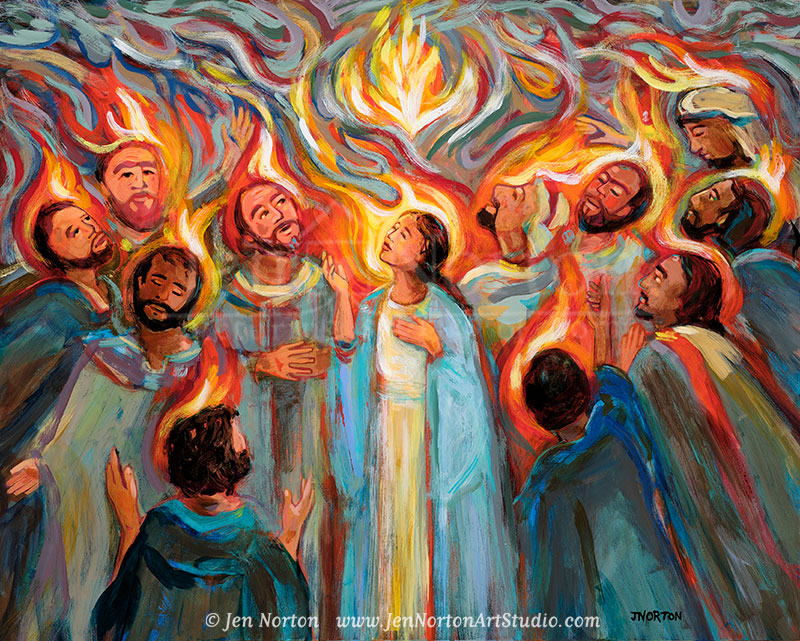
The Spirit’s Ministry (John 14:25-26)

Jesus said:

“I have spoken these things to you while I am with you. The Companion, the Holy Spirit, whom the Father will send in my name, will teach you everything and will remind you of everything I told you.” (Common English Bible)

“These things I have spoken to you while I am still with you. But the Helper, the Holy Spirit, whom the Father will send in my name, he will teach you all things and bring to your remembrance all that I have said to you.” (English Standard Version)

“I’m telling you these things while I’m still living with you. The Friend, the Holy Spirit whom the Father will send at my request, will make everything plain to you. He will remind you of all the things I have told you.” (The Message)

“All this I have spoken while still with you. But the Advocate, the Holy Spirit, whom the Father will send in my name, will teach you all things and will remind you of everything I have said to you.” (New International Version)

“These things have I spoken unto you, while yet abiding with you. But the Comforter, even the Holy Spirit, whom the Father will send in my name, he shall teach you all things, and bring to your remembrance all that I said unto you.” (American Standard Version)

“These things I have spoken to you, while I am still with you. But the Counselor, the Holy Spirit, whom the Father will send in my name, he will teach you all things, and bring to your remembrance all that I have said to you.” (Revised Standard Version)

“The Holy Spirit is the bond by which Christ unites us to himself.”

John Calvin

We are now in the season of “Ordinary Time” or “Proper Time” in the Church Year. It is “ordinary” in the sense that the Holy Spirit has been given to do the “proper” ongoing work of growing believers in Christ and helping them live into his directives.

The Spirit is our Teacher, cultivating and stirring-up within us all that we need for the Christian life.

As you can see from a few of the various English translations of today’s Gospel verses, there is no uniform rendering of the original Greek word, “Paraclete.” That’s because this word for the Spirit is so rich and full that it’s difficult to encompass what it means with a single English word.

A straightforward literal translation of “Paraclete” needs a phrase rather than a word: “Called alongside for encouragement,” fairly-well translates it. All the various words used in the different versions of the New Testament are accurate – yet they merely bring out one dimension to the understanding of the Holy Spirit’s ministry.

Our needs as followers of Jesus are many – thus requiring a multi-faceted mentoring ministry by the Spirit.

The Spirit was sent to be with Christians continually as their Teacher, reminding them of all Jesus has said and done as the ultimate witness to Christ’s life and ministry.

The role of the Holy Spirit is to provide comfort and aid for Christians, especially in difficult situations; the Spirit helps in a time of need.

The force of “Paraclete” is even more than this because there’s also the dimension of the Spirit being our close companion. Indeed, it is a special friend who stands up for us, advocates on our behalf, gives us remedial teaching, and brings comfort.

The Holy Spirit is motivated (just like the Father and the Son) with love for us, to give whatever we need to live a successful, abundant, and full Christian life.

In whatever situation we face, the Holy Spirit is something of a divine concierge in the middle of adversity who is attentive to every need.

The true difficulty in describing the Spirit’s ministry with us is that the Spirit is God – and no amount of description will adequately get our minds around the Spirit. God is much too big for that. All metaphors, images, and words fall short of genuinely expressing the Spirit’s immense work.

Perhaps a story will better illustrate the Spirit’s nature and work. When my girls were small and I was a financially struggling seminarian, we were one evening down to our last bit of food. Although they thought it was a privilege to eat Wheaties for supper, my wife and I knew the cupboard was now bare. So, we prayed.

As we got up from our knees and started off for bed, there was a knock at our patio back door. We looked at each other wondering who in the world it could be at such a late hour. When I drew the shades, one of our neighbors, a little Puerto Rican woman, was outside holding what appeared to be more than her own body weight in overflowing grocery bags.

I ushered her in and before I could say a word, she said, “I went to bed and had just fallen into a deep sleep. But the Holy Spirit woke me up and told me to take as many groceries as I could carry to you. So, here I am.” In that moment, I knew in my head and felt in my heart a ministry of the Spirit which transcends language.

The next morning our girls learned something about God that they would never get from listening to their Dad’s teaching and preaching. This is a story which gets retold often because it reminds us of how God meets us in our need and how much God cares.

Through such encounters with the Spirit (and I have mercifully been granted many of them!) I begin to understand and appreciate the wisdom of the saints throughout the ages:

“When the grace of the Holy Spirit enters a soul and is established there, it gushes forth more powerfully than any other spring; it neither ceases, dries up, nor is exhausted. And the Savior, to signify this inexhaustible gift of grace, calls it a spring and a torrent; He also calls it gushing water, to indicate its force and impetus.”

St. John Chrysostom

“Trying to do the Lord’s work in your own strength is the most confusing, exhausting, and tedious of all work. But when you are filled with the Holy Spirit, then the ministry of Jesus just flows out of you.”

Corrie Ten Boom

May you know the ministry of the Spirit, inside and out, in all ways and in all circumstances.

A Prayer of St. Augustine:

Breathe in me, O Holy Spirit,
That my thoughts may all be holy.
Act in me, O Holy Spirit,
That my work, too, may be holy.
Draw my heart, O Holy Spirit,
That I love only what is holy.
Strengthen me, O Holy Spirit,
To defend all that is holy.
Guard me, then, O Holy Spirit,
That I always may be holy. Amen.

God Will Take Care of You (Ezekiel 34:23-31)

I will give them a king like my servant David to be their one shepherd, and he will take care of them. I, the Lord, will be their God, and a king like my servant David will be their ruler. I have spoken. I will make a covenant with them that guarantees their security. I will get rid of all the dangerous animals in the land, so that my sheep can live safely in the fields and sleep in the forests.

“I will bless them and let them live around my sacred hill. There I will bless them with showers of rain when they need it. The trees will bear fruit, the fields will produce crops, and everyone will live in safety on his own land. When I break my people’s chains and set them free from those who made them slaves, then they will know that I am the Lord. The heathen nations will not plunder them anymore, and the wild animals will not kill and eat them. They will live in safety, and no one will terrify them. I will give them fertile fields and put an end to hunger in the land. The other nations will not sneer at them anymore. Everyone will know that I protect Israel and that they are my people. I, the Sovereign Lord, have spoken.

“You, my sheep, the flock that I feed, are my people, and I am your God,” says the Sovereign Lord. (Good News Translation)

We all need a safe place to live and our needs provided. When protection from harm and provision of needs are realized, we call this “peace.”

So many people long for peace, simply because they aren’t experiencing it. They feel unsafe – either physically, mentally, emotionally, or spiritually – and are separated from the sort of resources which would give them what they need to live well.

God is the expert on security and safety, peace and protection. The Lord has provided what we need.

His divine power has given us everything we need for a godly life through our knowledge of him who called us by his own glory and goodness. Through these he has given us his very great and precious promises, so that through them you may participate in the divine nature, having escaped the corruption in the world caused by evil desires. (2 Peter 1:3-4, NIV)

The Shepherd Ruler

God made a covenant with David that was to last forever. There was the anticipation of a leader, even the Messiah, who would come from the line of King David. Such a ruler will bring unity to the people. This leader shall be a servant of the people, a shepherd, characterized by humility. And, most of all, the hoped for ruler will usher in an unprecedented time of peace.

The flock of sheep – the people – will not have a care in the world. The new divine shepherd will not live off the sheep, but will instead live for the sheep. The shepherd shall be the ultimate non-anxious presence among the sheep, assuaging their fears and keeping them well-fed.

“I am the good shepherd; I know my sheep and my sheep know me—just as the Father knows me and I know the Father—and I lay down my life for the sheep.”

Jesus (John 10:14-15, NIV)

From the standpoint of Christianity, this great restoration project of the Lord finds its fulfillment in the person and work of Jesus. We needed a faithful shepherd, a merciful ruler, and we now have one.

The Settled Rest

Wholeness, integrity, thriving, flourishing, satisfaction, contentment, and a good life are all wrapped up in the biblical concept of peace and rest. And that is what the shepherd does for the sheep.

There is no peace when shepherds view the sheep as merely animals to be fleeced and used. But with a good shepherd, predators are kept away from the flock, plenty of pasture is provided to feed upon, and other shepherds in other fields attempting to steal sheep don’t stand a chance against the Good Shepherd.

A large chunk of humanity lives in a state of fear and anxiety because of violence, lack of basic necessities, disease, or natural disaster. Life can become so overwhelming that the future seems bleak and without hope. People long for peace – personal peace, family peace, world peace. They’re tired, and just want some rest.

“Come to me, all you who are weary and burdened, and I will give you rest.”

Jesus (Matthew 11:28, NIV)

Although the list of stressors may seem endless, divine blessings shall create the conditions in which humanity can live without fear and with hope in the world. No one will make them afraid, ever again.

“Peace I leave with you; my peace I give you. I do not give to you as the world gives. Do not let your hearts be troubled and do not be afraid.” (John 14:27, NIV)

The Sure Restoration

The divine/human relationship, so marred and messed up by the presence and power of sin, will be perfectly restored. The Lord is God; and God is with us. The divine energy is no longer against us, but is for us. And if God is for us, who can be against us?

Who shall separate us from the love of Christ? Shall trouble or hardship or persecution or famine or nakedness or danger or sword? As it is written:

“For your sake we face death all day long;
    we are considered as sheep to be slaughtered.”

No, in all these things we are more than conquerors through him who loved us. For I am convinced that neither death nor life, neither angels nor demons, neither the present nor the future, nor any powers, neither height nor depth, nor anything else in all creation, will be able to separate us from the love of God that is in Christ Jesus our Lord. (Romans 8:35-39, NIV)

God will care for you. Along with you, the Lord will care for your loved ones who need a faithful leader, a place of peace and rest, and a new life.

O God, the source of all holy desires, all good counsels, and all just works: Give to your servants the peace which the world cannot give, so that our hearts may obey your commandments, and that we, being defended from the fear of our enemies, may pass our time in rest and quietness, through the merits of Jesus Christ our Savior. Amen.

The Divine Helper (Psalm 121)

I lift up my eyes to the mountains—
    where does my help come from?
My help comes from the Lord,
    the Maker of heaven and earth.

He will not let your foot slip—
    he who watches over you will not slumber;
indeed, he who watches over Israel
    will neither slumber nor sleep.

The Lord watches over you—
    the Lord is your shade at your right hand;
the sun will not harm you by day,
    nor the moon by night.

The Lord will keep you from all harm—
    he will watch over your life;
the Lord will watch over your coming and going
    both now and forevermore. (New International Version)

Not a one of us gets off this planet without needing help – a lot of help! Even people who are in helping professions or who identify themselves primarily as helpers need help themselves.

There is no such thing as complete, total, and irrevocable independence. We humans are hard-wired by our Creator for community. That means we can only find our greatest fulfillment within interdependent relationships; and, furthermore, discover our highest happiness in a dependent relationship to God.

To need others, and especially to need God, is not a weakness; it’s a sign of strength. To have an awareness that help is needed allows us to make wise and confident choices. Only the fool goes it alone, believing they can pull themselves up by their bootstraps. “God helps those who help themselves,” was originally said by Benjamin Franklin, not Holy Scripture.

So, the question becomes: To whom and to where do we go for help? Who do we consult? With whom do we collaborate?

The most important step any of us can make is to realize that our own personal resources, although important and necessary, are inadequate. Therefore, we must admit, “I need help with this.” The next step is to go to the right source for that help.

The psalmist insists that the Lord is our helper, our keeper. Keeping is a large part of helping. God as our Divine Keeper means that the Lord watches over us, guards our lives, and seeks to preserve us from harm, wrongdoing, injustice, and oppression.

The very identity of God is wrapped up in being a Protector, Guard, and Watchkeeper. The Lord shields and shelters us, much like a mother hen over her chicks. God watches over us, just as a watchman keeps guard over a city at night when the residents are sleeping. And since the Lord is everywhere present, there is a continual divine presence in all of our life journeys. The dangers of both the day and the night are no match for the God who is our Keeper.

The promises of safety in today’s psalm are not meant to suggest that those who walk in the shelter of God will never endure harm or that nothing ill will ever befall them. The Psalter knows all too well that the wicked are everywhere and that they thrive unjustly.

Rather, these divine promises are general promises—they are blessings God does for those who rely on the Lord, call upon God’s name, and seek divine help. We are to have a continual awareness of God’s presence in this world. Although we are not inoculated from pain, God is always with us in our hurt and bewilderment.

It can be hard to ask for help. Our pride, stubbornness, and independence might cause us to experience harm rather than seek assistance. Be specific about the help needed. The following are some “helpful” ways of approaching God by answering some basic newsgathering type questions. The goal isn’t to convince the Lord to help us, but rather to enable us in connecting with what we truly need and being specific about God’s assistance for us or for others:

Who needs help?

Be clear and specific if the help is for yourself, another, or a group of people.

When Jesus had entered Capernaum, a centurion came to him, asking for help. “Lord,” he said, “my servant lies at home paralyzed, suffering terribly.”

Jesus said to him, “Shall I come and heal him?”

The centurion replied, “Lord, I do not deserve to have you come under my roof. But just say the word, and my servant will be healed. (Matthew 8:5-8, NIV)

How will God’s intervention help?

God is an expert listener. Tell the story of what you have tried already and where you fall short.

Jesus asked the boy’s father, “How long has he been like this?”

“From childhood,” he answered. “It has often thrown him into fire or water to kill him. But if you can do anything, take pity on us and help us.”

“‘If you can’?” said Jesus. “Everything is possible for one who believes.”

Immediately the boy’s father exclaimed, “I do believe; help me overcome my unbelief!” (Mark 9:21-24, NIV)

Why are you asking for God’s help?

Explain what’s going on and the reasons why you believe the Lord is the One to help. Mention the divine attributes and actions of God, as well as your own personal connection.

Then Asa called to the Lord his God and said, “Lord, there is no one like you to help the powerless against the mighty. Help us, Lord our God, for we rely on you, and in your name we have come against this vast army. Lord, you are our God; do not let mere mortals prevail against you.” (2 Chronicles 14:11, NIV)

Where is the help needed?

Is it a geographical location, a specific spot in the human body, or a place such as a building or home?

Jesus left the synagogue and went to the home of Simon. Now Simon’s mother-in-law was suffering from a high fever, and they asked Jesus to help her. So, he bent over her and rebuked the fever, and it left her. She got up at once and began to wait on them. (Luke 4:37-39, NIV)

When do you need help?

Immediately? Tomorrow? At a specific time?

O Lord, God of my salvation,

    when, at night, I cry out in your presence,

let my prayer come before you;

    incline your ear to my cry.

For my soul is full of troubles,

    and my life draws near to Sheol. (Psalm 88:1-3, NRSV)

What, exactly, is the need?

Spell out what you want in detail, holding nothing back. Don’t be concerned about the words or saying it right. Speak in your own plain language.

Help, O Lord, for the godly are fast disappearing!

    The faithful have vanished from the earth!

Neighbors lie to each other,

    speaking with flattering lips and deceitful hearts.

May the Lord cut off their flattering lips

    and silence their boastful tongues. (Psalm 12:1-3, NLT)

The help you and I need is in the name of the Lord who made heaven and earth. We only need to ask, and it will be given; seek, and we will find; knock, and the answer will open to us.

I Cannot Do This Alone

A Prayer by Dietrich Bonhoeffer

O God, early in the morning I cry to you.
Help me to pray and to concentrate my thoughts on you;
I cannot do this alone.
In me there is darkness, but with you there is light;
I am lonely, but you do not leave me; I am feeble in heart, but with you there is help;
I am restless, but with you there is peace. In me there is bitterness, but with you there is patience;
I do not understand your ways, but you know the way for me….
Restore me to liberty, and enable me to live now, that I may answer before you and before men.
Lord whatever this day may bring, Your name be praised. Amen.