Proverbs 4:1-9 – Pay Attention to Wisdom

Listen, children, to a father’s instruction,
and pay attention so that you may gain discernment.
Because I hereby give you good instruction,
do not forsake my teaching.

When I was a son to my father,
a tender, only child before my mother,
he taught me, and he said to me:
“Let your heart lay hold of my words;
keep my commands so that you will live.
Acquire wisdom, acquire understanding;
do not forget and do not turn aside from the words I speak.
Do not forsake wisdom, and she will protect you;
love her, and she will guard you.
Wisdom is supreme—so acquire wisdom,
and whatever you acquire, acquire understanding!
Esteem her highly and she will exalt you;
she will honor you if you embrace her.
She will place a fair garland on your head;
she will bestow a beautiful crown on you.” (New English Translation)

Pay Attention to Instruction

Once, when I was a kid growing up on the farm, I was playing hide-and-seek with my brother and got lost in a cornfield. The stalks were taller than me, and I couldn’t jump up and try to see over them. I started to panic.

Then, I got my wits about me and looked straight up into the sky. Even though I was only seven or eight years old, I had looked up at the sky a bajillion times in my short lifetime. My dad had taught me how to read the sky and the weather above us. Fortunately, I had listened well and paid attention to all those times we looked up together.

I knew that the position of the sun in the bright blue sky would give me a fixed point of direction. Once I did that, I walked in the direction I was certain would take me out of the cornfield, trying not to let fear take hold of me. In no time at all, I was out. I lost the game of hide-and-seek. But I didn’t care.

Wisdom is personified in the book of Proverbs as a sage woman and a discerning counselor for whom we must hear and heed her advice. 

In the Old Testament, wisdom is the practical daily application of knowledge and understanding. It’s the ability to take the knowledge of God and use it in everyday life in a way that leads to human peace, contentment, and flourishing. There are two important aspects to wisdom. 

Pay Attention to Knowledge

First, the individual must possess some body of knowledge. If we are ignorant (without knowledge) then we have no ability to exercise wisdom. More than once, I rescued cousins and friends from the cornfield while playing hide-and-seek, because they didn’t have the same understanding of the sky that I did.

So, it’s absolutely imperative for us to actively seek understanding. It’s not going to simply drop into our lap. We must purposely strive to look up and see the Son, to view life from God’s perspective, and to put ourselves in another person’s shoes. 

To gain wisdom, we must become readers, listeners, and devoted learners. Why? Because without books to read, without spiritual directors to consult and listen to, and without adopting the humble posture of learning from others, we will never realize wisdom.

The telltale sign of one who fails to read, listen, and learn, is that they continually opine on everything with no evidence to back up their opinions, no insight into the human condition, and no grace in their language. In the book of Proverbs, such as a person is labeled the “fool.”

Pay Attention to Behavior

The second aspect to wisdom is that the individual must use the acquired knowledge to have good behavior and to live well. 

Knowledge by itself, apart from actual practical use, only produces puffed-up pride (1 Corinthians 8:1). The reason for accumulating understanding is to use it for the welfare of others, for the benefit of the common good. 

We have quite enough preening peacocks in this world who have answers for every earthly problem under the sun. This world needs much less of them, and more of those who seek the humility that comes from biblical wisdom. As the Apostle James in the New Testament once put it, we must be doers of the Word and not hearers only (James 1:22).

Wisdom is realized whenever there is learning that has come through both the head and the hands. Proverbs is a very good place to begin constructing a life of wisdom. Reading one chapter a day, for one month, will get you through the entire book. 

Make a wise plan to carefully go through Proverbs sometime this spring or summer. You’ll be glad you did. And so will those around you.

Pay Attention to Prayer

God of all wisdom, save me from pride and arrogance, and take me to the place where Christ’s humility is center stage, where I’m lifting up clean hands and a pure heart to you.

Spirit of discernment, take me to the place where I’m no longer looking with panic or anxiety at the cornfields and situations I face, but look up to you, where I can see clearly, and my decisions are flooded with your bright light, truth, and justice.

Jesus, teacher of all that is right and good, I submit to your instruction and humbly seek to live into your words and ways. I keep my ears open to receive your counsel, my heart open to receive your eternal wisdom, and my eyes open to see your risen and ascended glory.

Just, right, and wise God – Father, Son, and Spirit, the God whom I serve – know that I love wisdom. I desire it more than money, fame, or power. Help me to use biblical common sense, spiritual savvy, and Scriptural discernment so that I might learn the good and the beautiful. Amen.

Galatians 6:7-10 – You Harvest What You Plant

Photo by Johann Piber on Pexels.com

Do not be deceived; God is not mocked, for you reap whatever you sow. If you sow to your own flesh, you will reap corruption from the flesh; but if you sow to the Spirit, you will reap eternal life from the Spirit. So let us not grow weary in doing what is right, for we will reap at harvest time if we do not give up. So then, whenever we have an opportunity, let us work for the good of all, and especially for those of the family of faith. (New Revised Standard Version)

“You reap what you sow” is one of those famous (or infamous) phrases of the Bible. Some people have a visceral reaction to the statement because it was used in the negative sense to keep kids obedient. 

However. the actual context for the statement, while not excluding the need to avoid disobedience, is aimed much more toward the necessity of doing good works for others. 

In the Church’s and the Christian’s work of burden-bearing on behalf of those with crushing loads to carry, we are not to become weary as the walk goes on and on. Persevering in good works will eventually lead to a bumper crop of righteousness.

We don’t typically use the words “sow” and “reap” much anymore. We really don’t use very many agrarian metaphors anymore since most folks are no longer living on farms and working the soil. We’re likely more familiar with the words “plant” and “harvest.”

We understand that if we plant seeds in our garden, it will take some time for them to germinate, take root, break the ground, grow, and produce what we want from them. The same is true in life. To expect instantaneous results for the spiritual life is unrealistic; it just doesn’t work that way.

The main orientation of today’s New Testament lesson is patience and perseverance in the doing of good works. Although it might not seem, at the moment, that our labors are really making a dent at all, God is taking notice. The Lord sees each act of service.  Eventually, if we will keep up the slow, tedious, and often dull work of persisting in doing what is right, it will all pay-off in a harvest of righteousness.

Perhaps you have been struggling lately – wanting to see something happen that you’ve been working on or praying for. And it hasn’t happened yet. You’re ready for the harvest and are tired of waiting. 

There are times when I grow weary of having the same conversations with people over and over again. I sometimes grow impatient with impenitent people who only seem to think of themselves. Alas, welcome to the human race! 

God cares just as much, or more, about the process of planting and tending as the actual end of the harvest. In other words, the means of how we go about things are as important as the end result. To help us be accountable, we very much need the encouragement of others in our Christian pilgrimage through this life. 

Accountability is a humble willingness to accept the consequences of our choices, our words, and our behaviors. That is, we need to own our part in situations we’ve been in. It’s about taking responsibility (not for others and their behavior) for one’s self and making things right.

Now all discipline seems painful at the time, not joyful. But later it produces the fruit of peace and righteousness for those trained by it. (Hebrews 12:11, NET)

Honesty, integrity, wisdom, courage, forgiveness, and humility don’t simply fall out of the sky for us. A good and abundant harvest which can be shared with many requires patient and tedious work. These virtues, along with the fruit of the Spirit – love, joy, peace, patience, kindness, goodness, gentleness, and self-control – need careful attention. Like a faithful and patient gardener, we must tend to them, keeping ourselves free of weeds, bugs, and critters.

As we daily tend to our personal garden, we pay attention to how we use our time; know and honor our limits; and remain open to change. We cannot control outside forces, such as the weather, but we can take responsibility for our own choices and the consequences which result from them.

We cannot care for others and do good works unless we have done the work of self-care. Doing good flows from being good, first to ourselves, then to others. We can only give what we have. If we have tended to our garden with care, then the bounteous harvest can be shared with many. But if we neglect our own garden, there will be nothing to give when the season of harvest comes around.

“Which of the commands is most important?” Jesus answered, “The most important command is this: ‘Listen, people of Israel! The Lord our God is the only Lord. Love the Lord your God with all your heart, all your soul, all your mind, and all your strength.’The second command is this: ‘Love your neighbor as you love yourself.’ There are no commands more important than these.” (Mark 12:28-31, NCV)

Caring for ourselves isn’t a luxury. We must give ourselves permission to do it. The way in which we talk to ourselves will eventually become the manner in which we talk to others. The care we learn to extend to ourselves will be the care we give to others.

If we sow and plant good things in our own lives, then we will reap a harvest of good works for others. So, let us do good, especially to our sisters and brothers in the faith.

Patient God, you have been waiting for several millennia to complete your work in this world. It is a small thing for me to keep doing your will with perseverance over the span of my own lifetime. I look to my model, Jesus Christ, who for the joy set before him endured the cross and reaped eternal life for all who would believe. Amen.

Ezekiel 11:1-25 – A New Heart

Then the Spirit lifted me up and brought me to the gate of the house of the Lord that faces east. There at the entrance of the gate were twenty-five men, and I saw among them Jaazaniah son of Azzur and Pelatiah son of Benaiah, leaders of the people. The Lord said to me, “Son of man, these are the men who are plotting evil and giving wicked advice in this city. They say, ‘Haven’t our houses been recently rebuilt? This city is a pot, and we are the meat in it.’ Therefore, prophesy against them; prophesy, son of man.”

Then the Spirit of the Lord came on me, and he told me to say: “This is what the Lord says: That is what you are saying, you leaders in Israel, but I know what is going through your mind. You have killed many people in this city and filled its streets with the dead.

“Therefore, this is what the Sovereign Lord says: The bodies you have thrown there are the meat, and this city is the pot, but I will drive you out of it. You fear the sword, and the sword is what I will bring against you, declares the Sovereign Lord. I will drive you out of the city and deliver you into the hands of foreigners and inflict punishment on you. You will fall by the sword, and I will execute judgment on you at the borders of Israel. Then you will know that I am the Lord. This city will not be a pot for you, nor will you be the meat in it; I will execute judgment on you at the borders of Israel. And you will know that I am the Lord, for you have not followed my decrees or kept my laws but have conformed to the standards of the nations around you.”

Now as I was prophesying, Pelatiah son of Benaiah died. Then I fell face down and cried out in a loud voice, “Alas, Sovereign Lord! Will you completely destroy the remnant of Israel?”

The word of the Lord came to me: “Son of man, the people of Jerusalem have said of your fellow exiles and all the other Israelites, ‘They are far away from the Lord; this land was given to us as our possession.’

“Therefore say: ‘This is what the Sovereign Lord says: Although I sent them far away among the nations and scattered them among the countries, yet for a little while I have been a sanctuary for them in the countries where they have gone.’

“Therefore say: ‘This is what the Sovereign Lord says: I will gather you from the nations and bring you back from the countries where you have been scattered, and I will give you back the land of Israel again.’

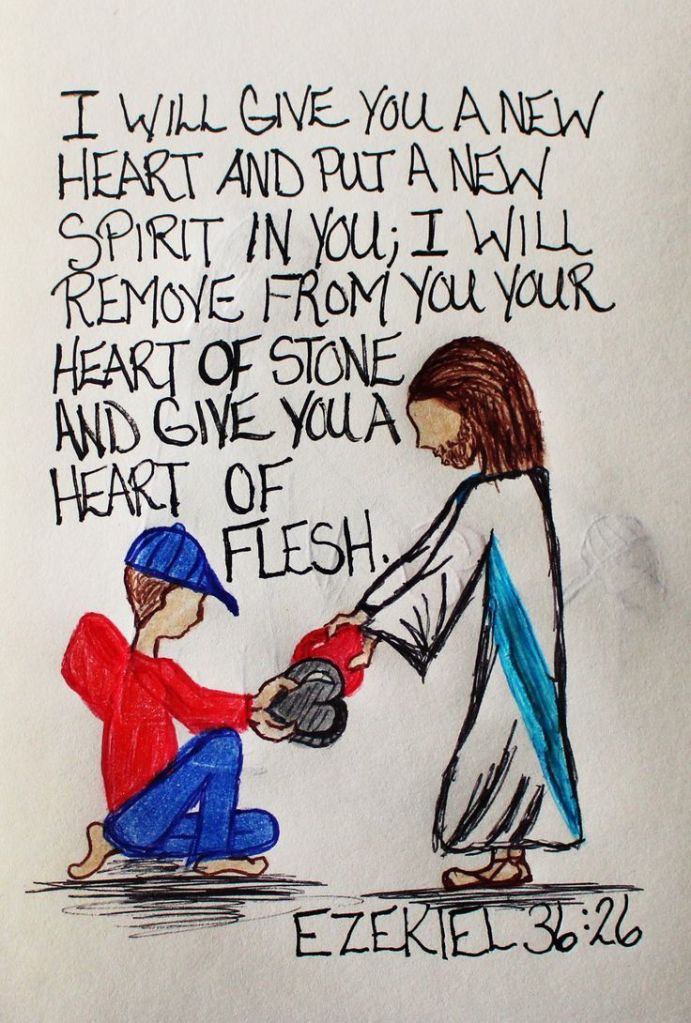
“They will return to it and remove all its vile images and detestable idols. I will give them an undivided heart and put a new spirit in them; I will remove from them their heart of stone and give them a heart of flesh. Then they will follow my decrees and be careful to keep my laws. They will be my people, and I will be their God. But as for those whose hearts are devoted to their vile images and detestable idols, I will bring down on their own heads what they have done, declares the Sovereign Lord.”

Then the cherubim, with the wheels beside them, spread their wings, and the glory of the God of Israel was above them. The glory of the Lord went up from within the city and stopped above the mountain east of it. The Spirit lifted me up and brought me to the exiles in Babylonia in the vision given by the Spirit of God.

Then the vision I had seen went up from me, and I told the exiles everything the Lord had shown me. (New International Version)

God’s heart is a heart of justice. The Lord abhors unrighteousness, injustice, and oppression. Thankfully, God will not sit idle and put up with systemic evil for long.

Ezekiel is one of those Old Testament prophets that thoroughly uncovered the true state things, especially of the human heart. Through a series of visions given to Ezekiel for the Israelite exiles, one of the main messages of the prophet is that God would give them a new heart. 

There is hope for the exile, for the one in captivity because of sin’s destructive, demeaning, and deluding power. Conversely, for those conforming to such ways, for the ones who caused the exile of others, the high Judge of the universe will deal with them according to their errant and rascally ways.

Dark shadows exist within the human heart. Although humanity has a great potential for altruistic good, people also have a large capacity for evil. Arrogant pride, self-centered behavior, and sheer ignorance can take such root within a person’s heart, as well as the heart of an organization or institution, that oppression becomes the norm, with fat cats ruling over an indigent people.

At best, the heart apart from God contains a miniscule vestige of its ancient Creator’s image; at worst, the heart is desperately wicked and on a highway to hell. 

The issue, then, is whether the heart only needs to be modified, or whether there is needed a complete heart transplant. The prophet makes it quite clear which option must be done.

Jesus Christ sacrificed himself on the cross so that we could be transformed into new people. He did not come to tweak a few things in life and improve upon it – he came to bring wholesale change and transform the heart. 

If all we needed was a motivational speaker who would inspire our hearts to live better and reach our personal goals, then we would have not needed an incarnation, a crucifixion, a resurrection and ascension. Jesus is the risen Lord and Savior who replaces our hard stubborn hearts with a soft new heart of flesh. 

We need transformation of life, not life modification.

Awesome God, you have graciously and surgically removed my old heart, which was bound for destruction, and replaced it with a new heart, oriented toward living and loving like the Lord Jesus. May my heart always be inclined to the doing of your will, in the power of your Holy Spirit. Amen.

Psalm 126 – Planting in Tears and Harvesting with Joy

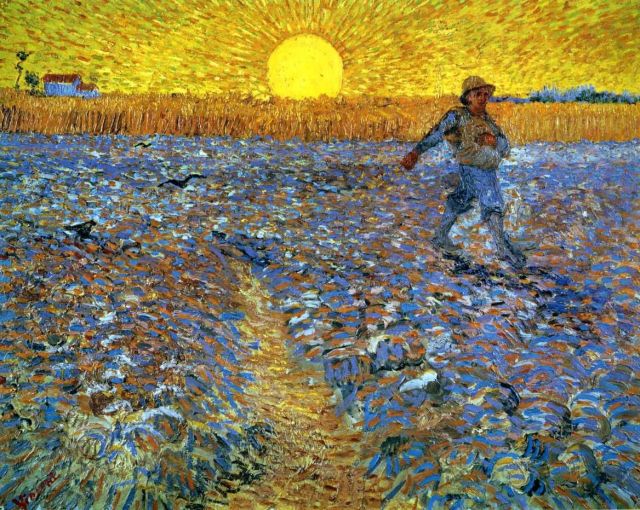
The Sower, by Vincent Van Gogh, 1881

When the Lord brought back his exiles to Jerusalem,
    it was like a dream!
We were filled with laughter,
    and we sang for joy.
And the other nations said,
    “What amazing things the Lord has done for them.”
Yes, the Lord has done amazing things for us!
    What joy!

Restore our fortunes, Lord,
    as streams renew the desert.
Those who plant in tears
    will harvest with shouts of joy.
They weep as they go to plant their seed,
    but they sing as they return with the harvest. (New Living Translation)

Many people are familiar with the phrase, “You reap what you sow.” Although the saying is typically referred to in the context of avoiding poor decisions (Galatians 6:7) the principle is woven throughout Holy Scripture in other scenarios, as well, as it is in today’s psalm.  

Sowing and reaping are, of course, agricultural terms. Farmers and gardeners tend to the soil through tilling, planting, cultivating, weeding, and eventually harvesting. The images of farming and the growth of plants serve as fitting metaphors for the spiritual life. Growth does not occur quickly. Instead, constant and vigilant attention to one’s spirit eventually brings a harvest of good works and godly attitudes. 

Jesus said, “My food is to do what the one who sent me wants me to do. My food is to finish the work that he gave me to do.” (John 4:34, ERV)

In a culture which values immediacy and having things now, the slow growth of the spiritual life can be a difficult principle to grasp. We may think that whenever we sin – with no immediate lightning to zap us – that therefore what we did must not have been so bad. 

Eventually, however, our implanted seeds will sprout and become visible to all. Conversely, we might believe whenever we dedicate ourselves to altruistic service, and then see no immediate results, that we must be doing something wrong. So, we may easily become discouraged and give up.

Sow for yourselves righteousness; reap steadfast love. Break up your fallow ground; for it is time to seek the Lord, that he may come and rain righteousness upon you. (Hosea 10:12, NRSV)

The psalmist reminds us of the need for patience. Just as it takes continual watering to reap a harvest in the field, so the Christian’s life of weeping and tears, of tilling deeply into the things of God, is the necessary work to eventually spot a sprout, see growth, and finally bear fruit. 

The tedious cultivating and weeding of our souls is the task before us. If we are patient and consistent, we will realize a harvest of righteousness. 

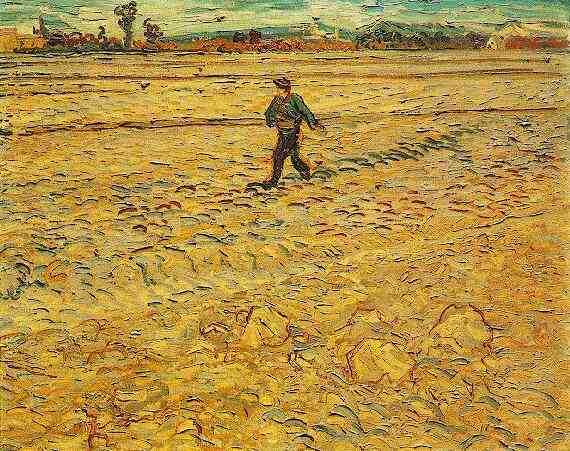
The Sower, by Vincent Van Gogh, 1888

Jesus taught his Beatitudes to help us understand that righteousness, peace, and joy come through connecting with our poverty of spirit; mourning over personal and corporate sin; embracing humility and meekness; hungering and thirsting after righteousness.

Only through the blood, sweat, and tears of spiritual agony will we come through to the deep happiness of seeing the Lord accomplish great things in our lives. In other words, joy is neither cheap nor easy. It is the fruit of many tears.

Spiritual farming involves sound practices of sowing and reaping. There is suffering before glory, tears before joy, lament before healing.

Just as a farmer cannot take short-cuts in the planting and cultivating process if he wants to have a bounteous and delicious harvest, so there is no getting around the painful work of grieving our changes and losses.

Avoiding the hard work of spiritual farming leads to a bogus harvest where we bite into a fresh ear of sweet corn only to discover a mouthful of worms.

Remember this: The person who plants a little will have a small harvest, but the person who plants a lot will have a big harvest.

2 Corinthians 9:6, NCV

The bulk of our lives are played out in the liminal space between sowing and reaping. The farmer plants and waits, attentive to the land and the weather until the time of harvest. We, too, exist in a time of patience. So, we pray, recalling past harvests and anticipate that with God’s good help, we will enjoy abundance.

This in-between time is often characterized by tears.

As she stood behind him at his feet weeping, she began to wet his feet with her tears. Then she wiped them with her hair, kissed them and poured perfume on them. (Luke 7:38, NIV)

I grew up on an Iowa farm. I only saw my father cry twice in my life. The first time, I was just a boy, two days after my eighth birthday – a devastating hailstorm destroyed the crops that had been planted just six weeks before. Despite farm equipment and technological savvy, the farmer is still at the mercy of the weather.

And we will always be at the mercy of God. Because God is good, just, and fair, the Lord does great and benevolent things. To be blessed, we need to embrace the dog days of summer in all its banality and its tears until we reach the time of reaping. There is joy, and it is coming, if we do the work of spiritual farming and wait patiently.

Likely, none of us awake in the morning, sit up on the edge of the bed, and say to ourselves, “Well, let’s see, I think I’ll cry and be sorrowful today.” We might do that with joy, but not with sadness. It can be easier to gravitate toward the fulfillment of dreams, laughter, and happiness than tears and weeping.

Yet, if we want to experience authentic joy, the path to it is through crying because it is our tears which find a better way.

“Normality is a paved road: It’s comfortable to walk, but no flowers grow on it.”

Vincent Van Gogh

Whether it comes from a certain denominational tradition, ethnic background, or family of origin dynamics, there are many Christians who love to emphasize Jesus as Victor and camp in resurrection power – while eschewing Christ as the man of sorrows, acquainted with grief and sadness.

By viewing only one dimension of Christ’s redemptive work, pastoral care often falls far short of true help. Trying to engineer cheerfulness and create solutions to a person’s genuine grief is, at best, not helpful, and at worst, damaging to their soul. It only leads to cheap inauthentic joy.

Sincerely singing spontaneous songs of joy, with a sense of abundant satisfaction, comes through suffering and sorrow. There must be a crucifixion before there is a resurrection. In the agrarian culture of ancient Israel, the metaphor of sowing a reaping connected well to the importance of planting tears and allowing them to flower later into an abundant harvest of joy.

Perhaps in contemporary American culture, a more apt metaphor would be financial investing and cashing out. The investment we put into attending to our grief with expressions of lament through tears, will eventually get a return, and we shall be able to cash out with a rich bounty of joy.

Easter is coming. Resurrection and new life will occur. The journey of Lent, with seeds repentance carefully planted, watered with tears, shall bring an abundant harvest of joy.

Gratias Deo. Thanks be to God.