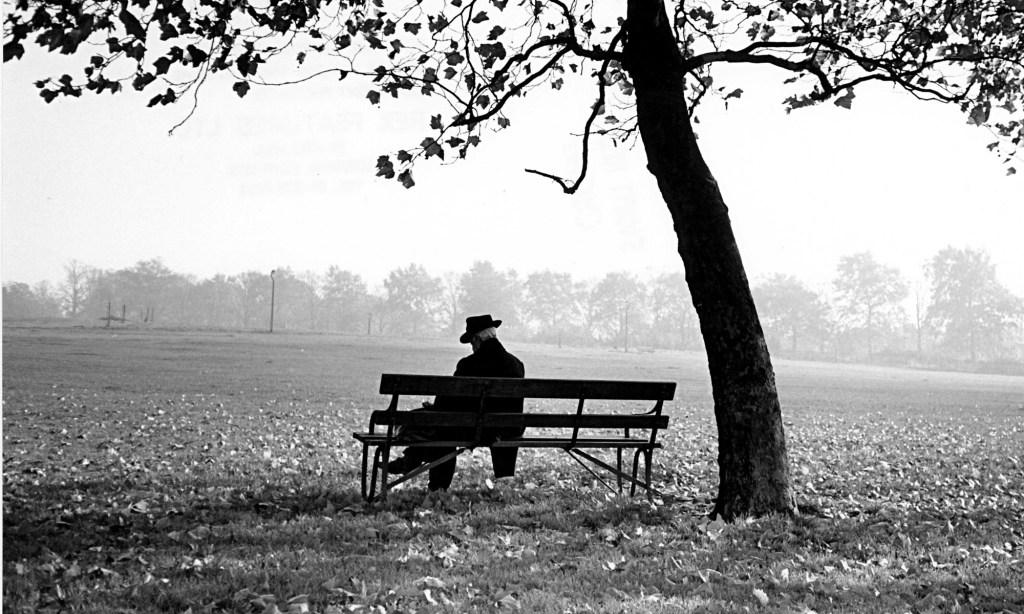
How Can I Move Through My Grief? (Lamentations 1:7-15)

The Lamentations of Jeremiah by Marc Chagall (1887-1985)

Her people recall the good life
    that once was theirs;
now they suffer
    and are scattered.
No one was there to protect them
from their enemies who sneered
    when their city was taken.

Jerusalem’s horrible sins
    have made the city a joke.
Those who once admired her
    now hate her instead—
she has been disgraced;
    she groans and turns away.

Her sins had made her filthy,
but she wasn’t worried
    about what could happen.
And when Jerusalem fell,
    it was so tragic.
No one gave her comfort
    when she cried out,
“Help! I’m in trouble, Lord!
    The enemy has won.”

Zion’s treasures were stolen.
Jerusalem saw foreigners
    enter her place of worship,
though the Lord
had forbidden them
    to belong to his people.

Everyone in the city groans
    while searching for food;
they trade their valuables
for barely enough scraps
    to stay alive.

Jerusalem shouts to the Lord,
“Please look and see
    how miserable I am!”
No passerby even cares.
Why doesn’t someone notice
    my terrible sufferings?
You were fiercely angry, Lord,
and you punished me
    worst of all.
From heaven you sent a fire
    that burned in my bones;
you set a trap for my feet
    and made me turn back.
All day long you leave me
    in shock from constant pain.
You have tied my sins
    around my neck,
and they weigh so heavily
    that my strength is gone.
You have put me in the power
    of enemies too strong for me.

You, Lord, have turned back
my warriors and crushed
    my young heroes.
Judah was a woman untouched,
but you let her be trampled
    like grapes in a wine pit. (Contemporary English Version)

“The darker the night, the brighter the stars. The deeper the grief, the closer is God.”

Fyodor Dostoevsky

The only way to the mountain is through the valley. The only way to make the pain go away is to move through it – not by avoiding it, pretending it’s not there, or trying to move around it. Pain and suffering are inevitable; misery is optional.

The reality is that, when experiencing catastrophic loss, you and I will grieve forever. We shall never “get over” it; we only learn to live with it.

Yes, I do believe there is spiritual and emotional healing. Significant change and grinding loss doesn’t need to define who we are. We can rebuild ourselves around the loss we have suffered.

Yes, you and I will be whole again. However, we shall never ever be the same again. It isn’t possible – nor should it be.

The prophet Jeremiah, the exiles in Babylon, and the remaining people of Jerusalem faced a tremendous and heartbreaking adjustment to a new world full of changes and losses. Expressing that grief was central to not becoming stuck in the past, living in the here and now, and moving into the future.

Grief is the normal mental, emotional, spiritual, and/or physical response to any significant change or loss. Grief is not optional but necessary. It is our personhood’s way of facing the pain and moving through it to a place of finding renewed meaning, support, and purpose in life.

How do people move through the grief?

  • Community: Grief needs a witness. It must be expressed. We must tell our stories of life, love, and loss. Otherwise, the grief just sits unmoved deep within and eventually becomes gangrene of the soul.

Help carry each other’s burdens. In this way you will follow Christ’s teachings.

Galatians 6:2, GW
  • Connection: Grief doesn’t so much go away as it morphs into fond memories of remembrance through ritual behavior.

Then Jesus took a loaf of bread, and when he had given thanks he broke it and gave it to them, saying, “This is my body, which is given for you. Do this in remembrance of me.” (Luke 22:19, NRSV)

  • Character: No one is defined by their grief, their disease, their mental disorder, their disability, or their addiction. In many religious traditions, people are identified as carrying the image and likeness of G-d.

God knew what he was doing from the very beginning. He decided from the outset to shape the lives of those who love him along the same lines as the life of his Son. The Son stands first in the line of humanity he restored. We see the original and intended shape of our lives there in him.

After God made that decision of what his children should be like, he followed it up by calling people by name. After he called them by name, he set them on a solid basis with himself. And then, after getting them established, he stayed with them to the end, gloriously completing what he had begun. (Romans 8:29-30, MSG)

  • Care: Practice caring for yourself. Give yourself the grace and the permission to be happy… or sad… or angry – to feel what you need to feel. Treat yourself like you would treat your best friend.

Jesus said, “Come to me, all you who are struggling hard and carrying heavy loads, and I will give you rest. Put on my yoke and learn from me. I’m gentle and humble. And you will find rest for yourselves. My yoke is easy to bear, and my burden is light.” (Matthew 11:28-30, CEB)

  • Compare not: Please do not compare your grief and loss with anyone else’s. The truth is this: The absolute worst loss is your loss, not somebody else’s.

The Lord is close to the brokenhearted and saves those who are crushed in spirit. (Psalm 34:18, NIV)

  • Count: Count your wins. Count your blessings. Say them out loud. Write them down. Share them with a friend or loved one.

Bless the Lord, O my soul,

    and forget not all his benefits,

who forgives all your iniquity,

    who heals all your diseases,

who redeems your life from the pit,

    who crowns you with steadfast love and mercy. (Psalm 103:2-4, ESV)

Sometimes, prayer is the only possible way forward. Maybe the Lord will once again hear us and respond, as of old:

“I have surely seen the affliction of my people… I have heard their cry… for I know their sorrows.” (Exodus 3:7, NET)

May the presence of the Lord melt your fear and discouragement. May God strengthen and help you. May the Lord lift you and hold you in gracious and compassionate hands. Amen.


Psalms 42 & 43 – Longing for Another World

As a deer gets thirsty
    for streams of water,
I truly am thirsty
    for you, my God.
In my heart, I am thirsty
for you, the living God.
    When will I see your face?
Day and night my tears
    are my only food,
as everyone keeps asking,
    “Where is your God?”

Sorrow floods my heart,
    when I remember
leading the worshipers
    to your house.
I can still hear them shout
    their joyful praises.
Why am I discouraged?
Why am I restless?
    I should trust you, Lord.
I will praise you again
because you help me,
    and you are my God.

I am deeply discouraged,
    and so I think about you
here where the Jordan begins
at Mount Hermon
    and at Mount Mizar.
Your vicious waves
    have swept over me
like an angry ocean
    or a roaring waterfall.

Every day, you are kind,
    and at night
you give me a song
as my prayer to you,
    the God of my life.

You are my mighty rock.
    Why have you forgotten me?
Why must enemies mistreat me
    and make me sad?
Even my bones are in pain,
    while all day long
my enemies sneer and ask,
    “Where is your God?”

Why am I discouraged?
Why am I restless?
    I trust you, Lord!
And I will praise you again
because you help me,
    and you are my God…

Show that I am right, God!
Defend me against everyone
    who doesn’t know you;
rescue me from each
    of those deceitful liars.
I run to you for protection.
Why do you turn me away?
Why must enemies mistreat me
    and make me sad?

Send your light and your truth
    to guide me.
Let them lead me to your house
    on your sacred mountain.
Then I will worship
at your altar because you
    make me joyful.
You are my God,
    and I will praise you.
Yes, I will praise you
    as I play my harp.

Why am I discouraged?
Why am I restless?
    I trust you, Lord!
And I will praise you again
because you help me,
    and you are my God. (Contemporary English Version)

Longing is a universal human experience. It is also an integral part of the human condition.

“If we find ourselves with a desire that nothing in this world can satisfy, the most probable explanation is that we were made for another world.”

C.S. Lewis

Before that statement, Lewis spoke of the nature of longing – how all that we experience in this life is not the ultimate object of our desire, of our longing. The beauty and satisfaction we seek:

“was not in them, it only came through them, and what came through them was longing. These things—the beauty, the memory of our own past—are good images of what we really desire; but if they are mistaken for the thing itself they turn into dumb idols, breaking the hearts of their worshipers. For they are not the thing itself; they are only the scent of a flower we have not found, the echo of a tune we have not heard, news from a country we have never yet visited.”

C.S. Lewis, The Weight of Glory

If we follow the path of any pain, any psychological or emotional wounding, it will lead us to this one primal pain: the pain of separation.

That’s because, having been born into this world, we are banished from Paradise and carry the scars of our Edenic estrangement – the separation from God.

Although it may sound counter-intuitive, if we will but embrace this suffering, if we allow it to lead us deep within ourselves, it will take us deeper than any healing this world can offer.

In other words, longing is itself the cure. It is when our hearts break that they become open for the love to come pouring out of it.

The grief we acknowledge and express draws us toward intimacy with the Divine and with others. It brings union, not separation. The problem itself becomes the cure.

“Do not seek for water. Be thirsty.”

Jalāl al-Dīn Muḥammad Rūmī (1207-1273)

The longing for love, belonging, and connection needs to be deeply felt, because it is really the only way of actually loving another. It is in hungering and thirsting – that is, in longing – which leads us to pray and seek to end our separation.

Prayer is the voice we give to our longings.

Naming our sadness for what it is, even our depression, is most necessary. Since we are emotional creatures, profound sadness even to the point of depression and/or despondency will happen.

Yet, despite the universal nature of discouragement, tears, and the longing for better and beauty, many Christians buck the feelings. Far too many believers focus so exclusively on victory in Jesus through his resurrection, ascension, and glorification that they use religion as their denial when unwanted emotions come banging at the doorstep of their soul.

Depression is not sin. To be discouraged is not the Enemy. And our longings are the evidence that this is so. We must sit with our emotions and feel the breadth and depth of them. Both our spiritual and emotional health come through an awareness and robust engagement with our feelings. Refusing to feel is, in reality, putting the stiff arm to God.

The psalmist does anything but deny his feelings. He brings them before the Lord and spreads them out before the Divine. Why am I discouraged? Why am I restless? Why the sadness? Could it be that God has forgotten me? Where is the Lord? Is God angry with me? Are my troubles the result of divine wrath?

To blandly say we have never uttered or thought such questions is a telltale sign of denying our deep longings. The bottom line for many folks is that they do not want to feel discouraged or cry any tears because it complicates their lives. Besides, it hurts!. “Why feel,” we reason, “when it only brings pain?”

Ah, yes, the avoidance of pain. And there is no pain quite like emotional and spiritual pain of separation and longing for things to be different.

Much like an open wound which needs a liberal application of painful peroxide, so our spiritual wounds must sting with the salve of emotional feeling. Healing is neither cheap, easy, nor painless. It typically hurts like hell.

The psalmist’s own pain revolved around feelings of alienation from God, being cut off from fellow worshipers, and harassed by others around him. Understandably, he experienced despondency and loneliness. The psalmist wondered if anyone, including God, even cared what he was going through. In other words, he is desperate for God to show up. So, he prayed as if his life depended on it.

The psalmist did not get answers to his questions. But that was never the point of the asking.

Hope arises from holding the big picture of the past, present, and future together at the same time. When present circumstances are difficult, and it appears we are about to swallowed up into the now, we must hold the past and future along with it, in careful tension.

While we desperately search for a cure, none will be found in this life – at least not in full. We are occasionally and surprisingly graced with glimpses of our deepest longings whenever we experience the kindness of a stranger, an answer to a prayer we uttered years ago, or the peace of an unexpected rest.

Then, our trust reawakens, and we are encouraged to take another step in the long walk of life – a walk in which God is beside us, even if we cannot discern it.

Gracious God, help us to know wonder in our waiting, patience in our wonderings, and a vision of how life is supposed to be lived. May our deepest longing find its satisfaction in you and in the many ways you mercifully hold the world together, through Jesus Christ our Lord. Amen.

Psalm 71:1-6 – How to Cope with Change and Loss

I run to you, Lord,
for protection.
    Don’t disappoint me.
You do what is right,
    so come to my rescue.
    Listen to my prayer
    and keep me safe.
Be my mighty rock,
    the place
where I can always run
    for protection.
Save me by your command!
    You are my mighty rock
    and my fortress.

Come and save me, Lord God,
    from vicious and cruel
    and brutal enemies!
I depend on you,
    and I have trusted you
    since I was young.
I have relied on you
    from the day I was born.
You brought me safely
through birth,
    and I always praise you. (Contemporary English Version)

No one gets off this planet without experiencing several events of change and loss, resulting in grief and the need to lament. Because of this reality, you would think we all acknowledge this great need of lamenting our significant losses. Yet, we don’t.

Many Christians avoid grief work. The following are just a few of the statements I’ve heard over the decades from parishioners when they experience loss:

  • “Christ is resurrected and alive. There’s victory in Jesus. No need to grieve like unbelievers.”
  • “My loved one is in heaven. No more suffering or pain. It would be selfish of me to be sad.”
  • “It’s a sin to be depressed.”
  • “I can’t let myself cry and fall apart. I need to be strong for my family.”

Those statements are very far from what we find in the biblical psalms and throughout the entirety of Holy Scripture. Consider these realities in the Bible:

  • 62 out of the 150 Psalms in the Old Testament are laments; some are communal, many are individual expressions of grief.
  • God laments. And God grieves with us. (Genesis 6:5-6; Isaiah 53:4; John 11:1-44)
  • An extended time and process of grieving was practiced by biblical characters when loss occurred. It was a normal emotional, spiritual, physical, and relational reaction to that loss. (e.g., Genesis 50:1-3)
  • Lament is an intentional process of letting go of relationships and dreams and discovering how to live into a new identity after the loss or change. There’s even an entire book of the Bible given to lamenting: Lamentations.
  • Everyone’s grief is personal; there is no one size fits all.
  • Avoiding grief, mourning, lament, and loss is totally foreign to the Bible.

Psalms of lament have a characteristic structure, distinct from psalms of praise, trust, or wisdom, like today’s psalm:

  1. Address to God: The address is usually a brief cry for help; and is occasionally expanded to include a statement of praise or a recollection of God’s intervention in the past (Psalm 71:1-3).
  2. Complaint: God is informed about the problem or experience through a range and depth of emotional, relational, and spiritual reactions to change (Psalm 71:4).
  3. Confession of Trust: The psalmist remains confident in God despite the circumstances and begins to see his or her problems differently (Psalm 71:5-8).
  4. Petition: Filled with confidence in God, the psalmist appeals to God for deliverance and intervention.  Petitioning is not bargaining with God or a refusal to accept loss; it is a legitimate seeking of help (Psalm 71:9-13).
  5. Words of Assurance: The psalmist expresses certainty that the petition will be heard by God (Psalm 71:14a).
  6. Vow of Praise: The lament concludes with the psalmist’s vow to testify to what God will do or has done through praise (Psalm 71:14b-24).

The biblical psalms do two wonderful services for us as God’s people: First, a constant stream of reading, quoting, memorizing, and meditating on them actually shapes our faith into a full-orbed, mature, and robust belief. Second, the psalms provide us with a healthy means of expressing the complete range of our human experience. 

So, then, the psalms both reflect our feelings, and, at the same time, form those feelings to know God better, cope with situations, and relate appropriately with others. 

The fourth-century Bishop of Alexandria, Athanasius, had it right about the psalms when he said: 

“Whatever your particular need or trouble, from this same book [the Psalms] you can select a form of words to fit it, so that you not merely hear and pass on, but learn the way to remedy your ill.”

St. Athanasius (297-373 C.E.), Bishop of Alexandria

Today’s psalm of lament is the expression of a person getting along in years and discovering all the limitations and weaknesses that go along with aging. It is a plea for help. Whereas in younger days the psalmist had the vigor to engage problems and enemies, now he has the realization that he must increasingly depend upon God (and others).  

Far too many people hitting the aging process do not deal with it well. The change to their bodies, even their minds, is so unwelcome that they do not cope quickly, or, sometimes, at all. They believe it silly to lament such a natural occurrence, even though those physical changes dog them day after day.

Based upon the psalms, I insist that lament is a powerful and necessary form of coming to grips with change. God has not promised us life-long health and constant energy. Rather, the Lord has promised to be with us as our refuge and help through all the vicissitudes of changing health and altered situations. 

Let praying the psalms, then, be a regimen as familiar and daily as your using your pill planner and taking your meds.

Ever-watchful God, you are a rock of refuge, a never changing reality in a world of constant change. You are my hope, Lord, and my faith has been in you all my life. I lament all the difficult changes I encounter. I can never go back to the way things were. So, please open to me a new reality where fresh hope and life can be found, through Jesus Christ my Savior. Amen.

Galatians 6:1-10 – Fulfill the Law of Christ

Brothers and sisters, if someone is caught in a sin, you who live by the Spirit should restore that person gently. But watch yourselves, or you also may be tempted. Carry each other’s burdens, and in this way you will fulfill the law of Christ. If anyone thinks they are something when they are not, they deceive themselves. Each one should test their own actions. Then they can take pride in themselves alone, without comparing themselves to someone else, for each one should carry their own load. Nevertheless, the one who receives instruction in the word should share all good things with their instructor.

Do not be deceived: God cannot be mocked. A man reaps what he sows. Whoever sows to please their flesh, from the flesh will reap destruction; whoever sows to please the Spirit, from the Spirit will reap eternal life. Let us not become weary in doing good, for at the proper time we will reap a harvest if we do not give up. Therefore, as we have opportunity, let us do good to all people, especially to those who belong to the family of believers. (New International Version)

Its all about grace. God’s grace. In Christ, lived by means of the Holy Spirit. Its not about hard black-and-white lists of rules or principles to live by. The Law of Christ is to help each other in our troubles, no matter what.

Overwhelming physical, mental, emotional, and/or spiritual burdens can become even more heavy through failing to live up to someone’s or some group’s or a church’s unwritten list of rules. “Keep a stiff upper lip.” “Everything is possible for those who love God.” “Stay positive.” “Just have faith and trust God.” Or worse, silence…. These and hundred other phrases communicate to people with crushing loads that they will have to carry them alone.

The letter to the Galatian believers spells out what is to truly characterize Christian interactions, and what it means to walk in the Spirit. Believers in Jesus are to emulate the behavior of Christ, the ultimate burden-bearer, who came to restore sinners, not condemn them.

We have a responsibility to rescue, renew, and revitalize persons who have lost their way. We are our brother’s and our sister’s keeper.

Someone caught in the crosshairs of a bad decision, or ensnared by making a wrong step, who is now in over their heads, needs help. In such a case, we are to restore, not punish. The person’s wound needs spiritual cauterizing. The broken spirit needs to be set back into place to heal properly.

The tone and the attitude which we do this important work of restoring people is through gentleness (meekness). We are to have a mindset and heart stance which understands there is no moral superiority with me. I could easily be the person in need of restoration.

When we have a gentle spirit, then we discern we are not above falling into the same trouble. We, too, are ethically and morally vulnerable. So, the church has a corporate responsibility to bear one another’s burdens.

There are other people who, through no fault of their own, find themselves in over their heads, too. Their health and mental health challenges, the emotional weight of hard circumstances, and their broken spirits require others to help shoulder the load so that the weighted-down person is not crushed.

Nobody in any faith community is above doing this work of burden-bearing. And it isn’t appropriate for an individual to boast about the burden-bearing work of others, as if it were theirs. You and I are to take responsibility for our own actions and attitudes without taking credit for someone else’s efforts.

A mature spiritual community of people are able to distinguish those loads which individuals must bear for themselves, and those burdens where help is sorely needed. We are accountable to carry our own backpack. And we are also accountable before Christ to share our load with others when it becomes too heavy for us.

If we choose not to allow others to assist us when we need it, then we will reap what we sow – we’ll feel the full weight and consequences of our silence. The planting and harvesting metaphor isn’t just for those who have engaged in wrongdoing. It is also for those who don’t put any seeds in the ground to begin with. They shouldn’t expect a harvest, at all.

Grace lived out in real experiences knows when to get under a load and help carry it. And grace also knows when to be kind to self and share the heavy burden with others who can help shoulder it for a bit. This is Christianity which relies on the enablement of the Spirit, made possible by Christ, who carried our crushing weight of guilt and shame for us.

Our Christian freedom in Jesus is to be stewarded wisely through carrying one another’s burdens, and so, fulfilling the Law of Christ.

God of all comfort, our help in time of need: We humbly pray to relieve and restore persons in need, people for whom are tired, sick, weary, or unable to continue as they are. Look upon them with the eyes of your mercy; comfort them with a sense of your goodness; preserve them from the temptations of the enemy; and give them patience under their affliction. In your good time, restore them to holistic health, and enable them to live their lives to your glory; and may they dwell with you in life everlasting; through Jesus Christ our Lord. Amen.