Proverbs 1:1-7 – Right, Just, and Fair

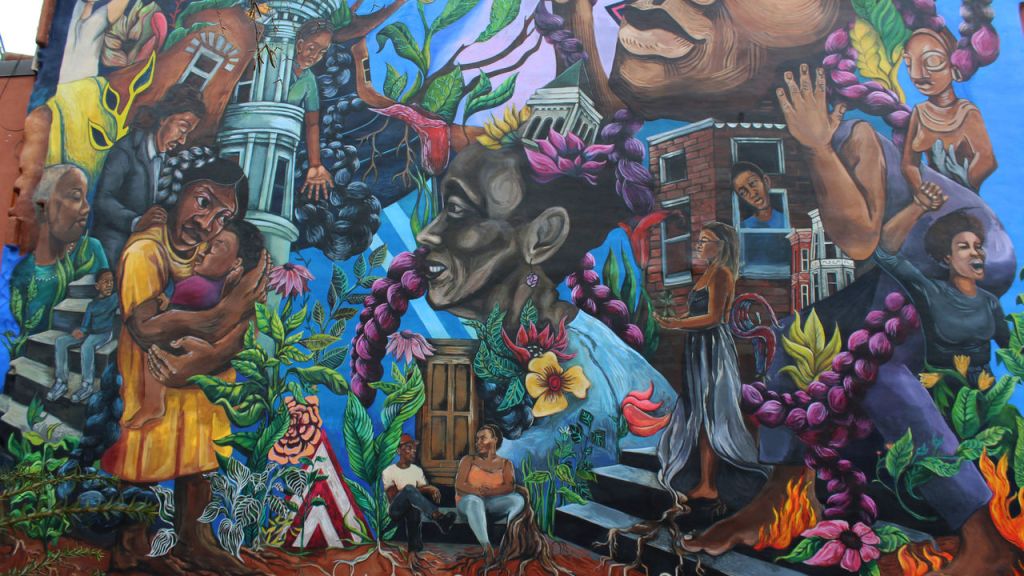
“Passing Wisdom, Planting Seeds,” building art in Brooklyn, New York City by artists Danielle McDonald and Jazmine Hayes

These are the proverbs of Solomon, David’s son, king of Israel.

Their purpose is to teach people wisdom and discipline,
    to help them understand the insights of the wise.
Their purpose is to teach people to live disciplined and successful lives,
    to help them do what is right, just, and fair.
These proverbs will give insight to the simple,
    knowledge and discernment to the young.

Let the wise listen to these proverbs and become even wiser.
    Let those with understanding receive guidance
by exploring the meaning in these proverbs and parables,
    the words of the wise and their riddles.

Fear of the Lord is the foundation of true knowledge,
    but fools despise wisdom and discipline. (NLT)

The pursuit of wisdom is a noble aspiration for the New Year. One of the best places to go in that pursuit is the biblical book of Proverbs because it is all about living wisely and not foolishly.

To acquire and live by wisdom means learning to become right, just, and fair in all our interactions and dealings with others.

“Right” for the ancient King Solomon is a relational term – to be righteous, to have right relationships with God and other people. Righteousness involves experiencing peaceful, harmonious, and fruitful relations. For the Christian, right living is to know the wonderful freedom and joy of an unhindered relationship through Jesus Christ in dependence upon the Holy Spirit. 

When it comes to fellow human relations, a person characterized by righteousness does not, for example, let the sun go down on their anger. It is to know personal peace as well as to be a peacemaker so that relationships do not remain strained but enjoy harmony.

“Just” is closely related to “right.” We might tend toward primarily understanding justice as a punitive act – and that is certainly a part of the term. God punishes the wicked (not us!) with appropriate timing and wisdom; and deals with those who withhold righteousness and love through their uncaring, inattentive, or evil acts. 

Solomon understood justice as mostly concerned with providing a person with the necessities of life. So, for example, if someone is hungry and needs food, or does not have clean water to drink, it is a “just” act for us to provide those critical needs. God is deeply concerned for justice and expects people to act in this same manner.

“Fair” is to be egalitarian. Fairness and equity binds righteousness and peace together by avoiding prejudice toward others and their needs. It means to not show favoritism because there is an unshakable belief in the equality of all people, no matter where they are from, what they do, or who they are.

Therefore, if we exercise righteousness and justice exclusively with individuals and groups we like, but ignore others in need, there is no fairness. To give our love and service to all persons without strings attached, or without being concerned to get paid back, is the practice of being fair in all our affairs.

To live in the way of being right, just, and fair in all things is to be wise. Conversely, the classic fool is one who judges others, creates discord, and ranks persons according to their own personal standard of who deserves help, and who does not. Trying to have a useful and gracious conversation with a fool is like trying to reason with a toddler – you will get nowhere. 

A good place to start in pursuing the wise and biblical virtues of righteousness, justice, and fairness is to ask God to open our eyes to those within our sphere of influence who need both physical and relational needs met. Then, follow through with loving those persons for whom God brings into our lives.

Almighty God, the essence and source of wisdom, you are always right, just, and fair in all things, I praise you for your infinite and abundant wisdom. Whereas you abound in wisdom, I am lacking. Please help me to grow in wisdom as I increase in my knowledge and respect of your divine presence. By means of your Spirit, please increase my depth of insight as I study your Holy Word. Hold me back from leaning on my own understanding and enable me to wholeheartedly embrace the wisdom from above. Righteous God help me to grow in wisdom continually and consistently. Teach me your ways. Since you are a just God who shows no favoritism, lead me into being like you in my dealings with others through the example of Jesus Christ, in the strength of the Holy Spirit. Amen.

Psalm 126 – Sorrow and Joy

When the Lord restored the fortunes of Zion,
    we were like those who dreamed.
Our mouths were filled with laughter,
    our tongues with songs of joy.
Then it was said among the nations,
    “The Lord has done great things for them.”
The Lord has done great things for us,
    and we are filled with joy.

Restore our fortunes, Lord,
    like streams in the Negev.
Those who sow with tears
    will reap with songs of joy.
Those who go out weeping,
    carrying seed to sow,
will return with songs of joy,
    carrying sheaves with them. (NIV)

Likely none of us awake in the morning, sit up on the edge of the bed and say to ourselves, “Well, let’s see, I think I’ll cry and be sorrowful today.” We might do that with joy, not with sadness. It can be easier to gravitate toward the fulfillment of dreams, laughter, and happiness than tears and weeping.

If we want to experience authentic joy, the path is through crying because it is our tears which find a better way.

Whether it comes from a certain denominational tradition, ethnic background, or family of origin dynamics, there are many Christians who love to emphasize Jesus as Victor and camp in resurrection power – while eschewing Christ as the man of sorrows, acquainted with grief and sadness.

It is from this place of continually viewing only one dimension of Christ’s redemptive work that pastoral care often falls far short of true help. Trying to engineer cheerfulness and create solutions to a person’s genuine grief is, at best, not helpful, and at worst, damaging to their soul. Such attempts will only lead to cheap joy.

Coming to the place of sincerely singing spontaneous songs of joy with a sense of abundant satisfaction comes through suffering and sorrow.

There must be a crucifixion before there is a resurrection. In the agrarian culture of ancient Israel, the metaphor of sowing a reaping connected well to the importance of planting tears and allowing them to flower later into an abundant harvest of joy.

Perhaps in American culture, a more apt metaphor would be financial investing and cashing out. The investment we put into attending to our grief with expressions of lament through tears, will eventually get a return, and we shall be able to cash out with a rich bounty of joy.

All good things in life are realized through a lot of blood, sweat, and tears. “Blessed are those who mourn,” said Jesus, “for they shall be comforted” (Matthew 5:4, NIV). Just as it takes both field crops and economic investments time to grow and mature, so the believer’s life is a process of spiritual development which is watered through tears and experiences the up-and-down sorrows of a market economy.

There is coming a day when our joy will be realized in full measure. The season of Advent reminds us that we must wait, and that we must suffer many things before we enter the kingdom of God and enjoy unending fellowship with our beloved Savior and King.

Great God almighty, with expectant hearts we await the coming of Christ. As once he came in humility, so now may he come in glory so that he may make all things perfect in your everlasting kingdom. For Christ is Lord forever and ever. Amen.

Philippians 3:7-11 – The Ultimate Value

A mosaic of the Apostle Paul in St Isaac’s Cathedral, St. Petersburg, Russia

Christ has shown me that what I once thought was valuable is worthless. Nothing is as wonderful as knowing Christ Jesus my Lord. I have given up everything else and count it all as garbage. All I want is Christ and to know that I belong to him. I could not make myself acceptable to God by obeying the Law of Moses. God accepted me simply because of my faith in Christ. All I want is to know Christ and the power that raised him to life. I want to suffer and die as he did, so that somehow, I also may be raised to life. (CEV)

As I looked at today’s date, I realized that it was on this day thirty-six years ago that my now dear wife told me, “I love you.” Two months previous, I had told her, “I love you.” She did not reciprocate. Instead, this lovely girl whom I had come to love (it was not love at first sight for either of us, which is a much longer story for another time) flat out retorted back to me, “Well, I don’t love you. Listen, Mr., I’ve heard every line in the book. What’s your angle? What do you want from me?”

For me, I knew I what I had was genuine love and not infatuation because I found myself responding matter-of-factly, “There’s no angle. I love you. If you choose not to love me back, I’ll just keep loving you.” This threw her into a two-month long sort of existential angst in which she explored the depths of her own spirit to see if her best friend was her love, as well.

So, when the love of my life said to me on that day, “I love you,” I knew it came from a place of soul-searching, prayer, trepidation, deliberate resolve, and genuine sincerity. For my wife, to say those words meant she was committed to me. They were not said lightly. It took a lot for those words to be formed.

On that day thirty-six years ago, the both of us had amazing clarity about the direction of our lives. We were going to be together, and no other person would ever have the primary place we each now enjoyed with one another. To me, every other girl seemed like nothing compared to my beloved. And, I will still admit, my feelings have not changed one iota.

I picture the Apostle Paul going through a similar struggle and process of coming to Christ. And once he did commit, no one was ever going to usurp the place of Jesus in his life.

I honestly believe that the primary reason my dear wife and I have been together all this time and still love each other as if it were December 10, 1984 is because of our shared commitment and ultimate value of knowing Christ. For each of us, Jesus is everything. Our lives center around him. The grace of God in Christ shapes all our worldview and animates every action we take.

Together with the Apostle Paul, we want to know Christ and we will take whatever situation is necessary to realize a continual growth in grace with Jesus at our side. Just as the adversity, hardship, and difficulties we have faced together over the decades has caused to bring us even closer together, so facing all of it with Christ in the middle of it has brought us closer to God.

Although it may seem counter-intuitive, power and suffering go together. For example, weightlifting causes fibers of the muscles to sustain injury. So, the body repairs those damaged fibers by fusing them, which then increases the mass and size of the muscles. It is through suffering, even trauma, that muscles grow bigger and stronger.

Spiritual power results from undergoing suffering. Through hard circumstances, our spirits experience hurt. Yet, through the process of healing we become stronger, more resilient, and our faith grows. A deeper experience of Christ and a greater intimacy with Jesus results from identifying with him in his suffering. Show me a person with vigorous faith and I will show you a person who has been strengthened through suffering.

When Jesus Christ is our surpassing value, everything else is viewed differently – the past, present, and future take on new meaning. We tell ourselves an alternate story, based in the person and work of Christ. In this Christian season of Advent, we look back to the first advent of Christ’s incarnation; look forward to the second advent of Christ coming again; and, this shapes how we live in the present between the two advents accepting suffering as a gift and embracing fresh power as a means to serve others.

Yes, this is a special day for me. Yet, everyday is a special day when I can enjoy fellowship with my Lord together with my wife.

Almighty and eternal God, so draw my heart to Christ, so guide my mind, so fill my imagination, so control my will, that I may be wholly yours, utterly dedicated to you; and then use me, I pray you, as you will, and always to your glory and the welfare of your people; through the sufferings of my Lord and Savior Jesus Christ and in the his great resurrection power I pray. Amen.

Isaiah 11:1-10 – All I Want for Christmas Is a Savior

The Lion and the Lamb by Aaron Spong

A shoot will come up from the stump of Jesse;
    from his roots a Branch will bear fruit.
The Spirit of the Lord will rest on him—
    the Spirit of wisdom and of understanding,
    the Spirit of counsel and of might,
    the Spirit of the knowledge and fear of the Lord—
and he will delight in the fear of the Lord.

He will not judge by what he sees with his eyes,
    or decide by what he hears with his ears;
but with righteousness he will judge the needy,
    with justice he will give decisions for the poor of the earth.
He will strike the earth with the rod of his mouth;
    with the breath of his lips he will slay the wicked.
Righteousness will be his belt
    and faithfulness the sash around his waist.

 The wolf will live with the lamb,
    the leopard will lie down with the goat,
the calf and the lion and the yearling together;
    and a little child will lead them.
The cow will feed with the bear,
    their young will lie down together,
    and the lion will eat straw like the ox.
The infant will play near the cobra’s den,
    and the young child will put its hand into the viper’s nest.
They will neither harm nor destroy
    on all my holy mountain,
for the earth will be filled with the knowledge of the Lord
    as the waters cover the sea.

In that day, the Root of Jesse will stand as a banner for the peoples; the nations will rally to him, and his resting place will be glorious. (Isaiah 11:1-10, NIV)

Christians believe Isaiah’s prophecy to speak of Jesus in whom all these virtues exist in wonderful perfection and practice. Jesus Christ has so clearly identified with us that we are in a vital union with him.  He still exists here on earth in the person of the Holy Spirit.  Jesus was sent by the Father.  With the Father and the Son, the Spirit was sent to press the redemptive events of Jesus into the believer’s heart.  This is basic Trinitarian theology.  Yet these are not abstract ideas.  Prayer, discernment, and listening are the pathways forward to discovering the wisdom, counsel, and knowledge we need to live and serve well as Christians.

In some quarters of Christianity, the church exists as a mere stump of its former existence. For many Christians, daily experience of the Spirit has been supplanted by individual ingenuity, hard work, and getting ahead through accumulation of more and more.  Basic Christian spirituality then becomes a mere shadow of its former influence.  If we desire the Spirit of the Lord to rest upon us, we will seek Christ as our foremost importance.  

Indeed, it is when we are worn down to a stump and have no ability to grow or sustain life anymore that God enters, specializing in giving hope to the hopeless, justice for the poor, wisdom to the confused, and peace to all who desire a harmonious world.

In the awful feelings of helplessness and hopelessness, there is a faint sign of life. A fresh shoot becomes discernible. Could there be possibility amidst such impossible circumstances? Can there be life again? Do I dare hope again? Will things really change, and do so for the better?

The answer is “yes.” For where the Spirit of the Lord blows there is the force of resurrection power, spiritual energy, and fresh courage. Where others see only three-dimensional impossibilities, the believer has the capacity of faith to see multi-dimensional possibilities. The Spirit’s force generates possibility where none existed before. When the breath of God whispers to the sprout in the stump, pessimistic despair turns to optimistic hope, even joy.

Jesus Christ is the Christian’s hope. In Christ, there is security, well-being, and life. With Jesus, there is a vision of justice in which all persons receive what they need to live, thrive, and flourish in God’s world. Christ operates to our advantage and on our behalf without the personal greed and indifference of so many earthly rulers. The weak and vulnerable have a champion in Jesus. Renewal and restoration become very real possibilities.

I have lately taken a liking to a show called “The Repair Shop,” a British television series in which family heirlooms which have sentimental value for their owners are carefully restored by experts. What captivates me about the show is how one person can take an old broken-down item (and by all appearances now a piece of junk) and restore it to its once glorious newness.

There is more to my captivation of the show. I am struck by the sheer pleasure the restorers take in handling the old object, enjoying the process. Just by the looks on their faces, I can tell they consider it a privilege to be restoring such a precious object of the past.

Artisan Steve Fletcher restoring an 18th century French clock

I am sure this is precisely how God feels with us. Rather than envisioning the Lord as some reluctant deity who feels put out with having to rescue a bunch of dumb and wayward people, God is One who has delight in taking this old stump of fallen damaged humanity and restoring us to our original luster and beauty. Transformation is God’s specialty, and the Lord goes about the process of restoration with great care and delight.

The impossible possibility of God’s new creation is poetically described in the peaceful co-existence of animals and creatures who are inconceivably together without fear or violence. There is a time coming when death will be no more, and so, the necessity in this life of hunter and prey shall be forever negated. No more snakes terrorizing women and children. No more big fishes eating little ones. No more human fat cats preying upon and striking poison on the smaller and vulnerable.

The presence of the godly Ruler means the world will be governed rightly, detoxified of its sinful impurities; a place where the poor, the weak, and the little lambs will indeed be safe and secure forever. There will be peace because of the Prince of Peace. All creation will be full of God, and thus, free of all malice.

This beautiful prophecy from Isaiah envisions a deep, radical, limitless transformation in which there will be no more appetite to injure another; no more desire to devour another; no more lust for selfish control of another; and no more destructive passion for domination over others.

It is a thorough renovation of the human heart, human institutions, the animal kingdom, and even every blade of grass in creation. The Apostle Paul had this grand vision of God in mind when he wrote to the Church at Rome:

The creation waits in eager expectation for the children of God to be revealed. For the creation was subjected to frustration, not by its own choice, but by the will of the one who subjected it, in hope thatthe creation itself will be liberated from its bondage to decay and brought into the freedom and glory of the children of God. We know that the whole creation has been groaning as in the pains of childbirth right up to the present time. Not only so, but we ourselves, who have the first fruits of the Spirit, groan inwardly as we wait eagerly for our adoption to sonship, the redemption of our bodies. (Romans 8:19-23, NIV)

The implication for us as humanity was voiced by Paul to the Colossian Church:

Now you must rid yourselves of all such things as these: anger, rage, malice, slander, and filthy language from your lips. Do not lie to each other, since you have taken off your old self with its practices and have put on the new self, which is being renewed in knowledge in the image of its Creator. Here there is no Gentile or Jew, circumcised or uncircumcised, barbarian, Scythian, slave or free, but Christ is all, and is in all. (Colossians 3:8-11, NIV)

The transformation is all-pervasive, impacting everything public while also being intimately personal. It is a gift from God; it is the impossible made possible. And it is this precise thing which we acknowledge, celebrate, and long for in the season of Advent. When the angel came to Mary and communicated that Isaiah’s vision was coming to reality through her womb, Mary astonishingly retorted:

“How will this be, since I am a virgin?”

The angel, with supreme confidence, answered Mary as a matter of fact:

“The Holy Spirit will come on you, and the power of the Most High will overshadow you. So, the holy one to be born will be called the Son of God…. For no word from God will ever fail.”

Mary’s response gives voice to our own desires and longings for the new order of things:

“I am the Lord’s servant. May your word to me be fulfilled.” (Luke 1:34-38, NIV)

This is our confession, too. I am the Lord’s servant. You are the Lord’s servant. May God’s word to us about the coming of Christ be fulfilled, just as Isaiah has said. The hopes and fears of all the years are met in Jesus on a bright starry night.