Have Spiritual Eyes to See (1 Peter 1:8-12)

You love him, although you have not seen him, and you believe in him, although you do not now see him. So you rejoice with a great and glorious joy which words cannot express, because you are receiving the salvation of your souls, which is the purpose of your faith in him.

It was concerning this salvation that the prophets made careful search and investigation, and they prophesied about this gift which God would give you. They tried to find out when the time would be and how it would come. This was the time to which Christ’s Spirit in them was pointing, in predicting the sufferings that Christ would have to endure and the glory that would follow. 

God revealed to these prophets that their work was not for their own benefit, but for yours, as they spoke about those things which you have now heard from the messengers who announced the Good News by the power of the Holy Spirit sent from heaven. These are things which even the angels would like to understand. (Good News Translation)

No less real than our actual physical eyes are our spiritual eyes – which enable us to see things invisible to our physical eyesight. Faith is the glasses that bring those things into focus.

To have faith is to be sure of the things we hope for, to be certain of the things we cannot see. (Hebrews 11:1, GNT)

Our life is a matter of faith, not of sight.

(2 Corinthians 5:7, GNT)

Faith creates the conditions for love. Cold dispassionate ideas and thoughts are just that; but faith gives us sight to see the true nature and meaning of love. Faith enables us to see Jesus Christ, who is Love incarnate.

This spiritual sight, made possible by faith, and bringing Christ into focus, is the basis for joy and the foundation of hope. It is more than joy; it’s joy unspeakable, beyond words, greater than the vocal chords can produce. It’s the sort of joy that takes your breath away.

Joy elevates us and brings us face to face with the glory of heaven. And once we have experienced this, our contentment is solely in Christ, and we have no need for anything the world offers. This is what it means to be saved.

Salvation always involves two equal and important facets: deliverance from something, so that we may attach to something else.

For the believer, with spiritual eyes to see in faith, we are saved from all the snake oil promises and allurements of the world; we are delivered from the weight of guilt and shame we carry; and we are snatched from the flames of hell and the machinations of the devil to ensnare us in evil.

The deliverance comes so that we can then connect with goodness, truth, justice, integrity, wholeness – with the love of God in Jesus Christ. Experiencing this wondrous spiritual fruit leads to a pure confession of faith:

But all those things that I might count as profit I now reckon as loss for Christ’s sake. Not only those things; I reckon everything as complete loss for the sake of what is so much more valuable, the knowledge of Christ Jesus my Lord. For his sake I have thrown everything away; I consider it all as mere garbage, so that I may gain Christ and be completely united with him. (Philippians 3:7-9, GNT)

I am neither a Christian because I was raised in cultural Christianity, nor because it was all I knew at the time. Rather, I am a Christian – a follower of Jesus Christ – because I was given a great gift of faith and saw divine love given for me, even though I deserved none of it.

So, my heart fully and forever belongs to Christ. It is a life worth living, a life of faith, hope, and love. No matter the hardship, adversity, or crud which happens to me on this earth, I am thoroughly surrounded by God’s grace, peace, and love.

And if I have to explain it to you, you probably don’t have it. That’s because it takes a different sort of eyesight, a countercultural set of ears, and a new meaning of touch, smell, and taste.

This sort of deliverance from sin, death, and hell, and into a great inheritance of faith, is so incredible that the ancient prophets, and the even older angels, longed to know what this salvation truly is.

And what they foretold, and believers now know, is that the cross is the way to victory; death is the passage to life; suffering is the road to glory.

Therefore, our present afflictions need not discourage nor debilitate us, as though we were miserable without any hope. Even more, it is through these very troubles that we are blessed.

No matter the evil thrown our way, there is always glory attached to it. If we must suffer, let us do so in the same spirit as Christ suffered:

My dear friends, do not be surprised at the painful test you are suffering, as though something unusual were happening to you. Rather be glad that you are sharing Christ’s sufferings, so that you may be full of joy when his glory is revealed. 

Happy are you if you are insulted because you are Christ’s followers; this means that the glorious Spirit, the Spirit of God, is resting on you. If you suffer, it must not be because you are a murderer or a thief or a criminal or a meddler in other people’s affairs. However, if you suffer because you are a Christian, don’t be ashamed of it, but thank God that you bear Christ’s name. (1 Peter 4:12-16, GNT)

Allow your spiritual eyes to confirm the truth, and to behold the living Christ.

“Why are you alarmed? Why are these doubts coming up in your minds? Look at my hands and my feet, and see that it is I myself.” Jesus (Luke 24:38-39, GNT)

May you know Christ, and him crucified, risen, and coming again. And may you know the hope of glory, indescribable joy, and everlasting love. May you know salvation.

Listen and See (Isaiah 42:14-21)

For a long time, I, the Lord,
    have held my temper;
now I will cry out and groan
    like a woman giving birth.
I will destroy the mountains
    and what grows on them;
I will dry up rivers and ponds.

I will lead the blind on roads
    they have never known;
I will guide them on paths
    they have never traveled.
Their road is dark and rough,
    but I will give light
to keep them from stumbling.
    This is my solemn promise.

Everyone who worships idols
as though they were gods
    will be terribly ashamed.

You people are deaf and blind,
but the Lord commands you
    to listen and to see.
No one is as blind or deaf
as his messenger,
    his chosen servant,
who sees and hears so much,
    but pays no attention.

The Lord always does right,
and so he wanted his Law
    to be greatly praised. (Contemporary English Version)

The Christian season of Lent serves to remind us that we must cultivate awareness by opening our eyes and unstopping our ears. Spiritual blindness and deafness are the result of failing to pay attention, ignoring the moral vision of God, and not listening to God’s voice.

It’s not unusual for people to complain about God being silent and ignoring them. But do we ever consider how the Lord feels about us living our lives as functional atheists? There may be expressions of belief, yet God doesn’t factor into the daily life of many. And the Lord is not okay with this.

At least we have assurances throughout Holy Scripture that the Lord is attentive to us, even when silent or seemingly not there. However, when it comes to us, our silence and lack of being present to the Lord is outright spiritual blindness and deafness on our part.

Today’s Old Testament lesson almost seems as if Yahweh is like the person trying to get your attention in a crowded place – jumping up and down, waving his arms, yelling our name – doing whatever it takes for us to see and hear, listen and look up. Yet, alas, we don’t.

Maybe we need to remember what God’s divine eyes and ears have already seen and heard. The Lord heard the awful groanings of the Israelites in Egypt under their harsh slavery. And God took notice of them and saw what was happening. (Exodus 2:24-25)

Perhaps we must recall all the times the Lord heard the cries of the people and sent a deliverer (Judges 2:16-19); and looked from heaven, saw those in bondage, and freed them. (Psalm 102:18-20)

If we put our fingers in our ears, and cover our eyes for too long, our hearts will become hard, and we shall be unable to turn from unhealthy ways of living. We’ll become so obtuse and clueless that we cannot repent and be healed.

Then I heard the voice of the Lord saying, “Whom shall I send? And who will go for us?” And I said, “Here am I. Send me!” He said, “Go and tell this people:

“‘Be ever hearing, but never understanding;
    be ever seeing, but never perceiving.’
Make the heart of this people calloused;
    make their ears dull
    and close their eyes.
Otherwise they might see with their eyes,
    hear with their ears,
    understand with their hearts,
and turn and be healed.” (Isaiah 6:8-10, NIV)

This might seem rather hard. And yet, none of us can truly know comfort and consolation apart from facing the hard truth in front of us and the hard heart inside us. Everyone wants happiness without pain. However, we cannot have a rainbow without a storm, and a resurrection without a cross.

We can have a different experience of God. It’s not too late. The message of Lent is that we can prepare ourselves for the Lord’s deliverance – and it is likely to come in the form of great sorrow and great joy of which we could not have anticipated.

The wisdom I proclaim is God’s secret wisdom, which is hidden from human beings, but which he had already chosen for our glory even before the world was made. None of the rulers of this world knew this wisdom. If they had known it, they would not have crucified the Lord of glory. However, as the scripture says,

“What no one ever saw or heard,
    what no one ever thought could happen,
    is the very thing God prepared for those who love him.” (1 Corinthians 2:7-9, GNT)

We humans struggle with the hard things of life. Yet, what we don’t always see or hear is how those adversities are shaping and forming us as a people.

For how would we ever know the Lord as our:

  • Deliverer unless we were in bondage?
  • Comforter unless we were in trouble?
  • Helper unless we were weak?
  • Healer unless we were broken?
  • Provider unless we were poor?
  • Protector unless we were in danger?
  • Warrior unless we were under attack?
  • Rock unless we were being tossed about?

Every day is a fresh opportunity to experience the presence, power, provision, and protection of a God who sees and hears us. Believers are to honor and respect the Lord by listening to God’s voice and obeying God’s words.

So, let us use this season to offer prayers of repentance and faith:

O God, whose glory it is always to have mercy: Be gracious to all who have gone astray from your ways,
and bring them again with penitent hearts and steadfast faith to embrace and hold fast the unchangeable truth of your Word, Jesus Christ your Son; who with you and the Holy Spirit lives and reigns, one God, forever and ever. Amen.

Dealing with Spiritual Blindness (John 9:1-41)

Coptic Church depiction of Jesus healing the man born blind

As he went along, he saw a man blind from birth. His disciples asked him, “Rabbi, who sinned, this man or his parents, that he was born blind?”

“Neither this man nor his parents sinned,” said Jesus, “but this happened so that the works of God might be displayed in him. As long as it is day, we must do the works of him who sent me. Night is coming when no one can work. While I am in the world, I am the light of the world.”

After saying this, he spit on the ground, made some mud with the saliva, and put it on the man’s eyes. “Go,” he told him, “wash in the Pool of Siloam” (this word means “Sent”). So the man went and washed, and came home seeing.

His neighbors and those who had formerly seen him begging asked, “Isn’t this the same man who used to sit and beg?” Some claimed that he was.

Others said, “No, he only looks like him.”

But he himself insisted, “I am the man.”

“How then were your eyes opened?” they asked.

He replied, “The man they call Jesus made some mud and put it on my eyes. He told me to go to Siloam and wash. So I went and washed, and then I could see.”

“Where is this man?” they asked him.

“I don’t know,” he said.

They brought to the Pharisees the man who had been blind. Now the day on which Jesus had made the mud and opened the man’s eyes was a Sabbath. Therefore the Pharisees also asked him how he had received his sight. “He put mud on my eyes,” the man replied, “and I washed, and now I see.”

Some of the Pharisees said, “This man is not from God, for he does not keep the Sabbath.”

But others asked, “How can a sinner perform such signs?” So they were divided.

Then they turned again to the blind man, “What have you to say about him? It was your eyes he opened.”

The man replied, “He is a prophet.”

They still did not believe that he had been blind and had received his sight until they sent for the man’s parents. “Is this your son?” they asked. “Is this the one you say was born blind? How is it that now he can see?”

“We know he is our son,” the parents answered, “and we know he was born blind. But how he can see now, or who opened his eyes, we don’t know. Ask him. He is of age; he will speak for himself.” His parents said this because they were afraid of the Jewish leaders, who already had decided that anyone who acknowledged that Jesus was the Messiah would be put out of the synagogue. That was why his parents said, “He is of age; ask him.”

A second time they summoned the man who had been blind. “Give glory to God by telling the truth,” they said. “We know this man is a sinner.”

He replied, “Whether he is a sinner or not, I don’t know. One thing I do know. I was blind but now I see!”

Then they asked him, “What did he do to you? How did he open your eyes?”

He answered, “I have told you already and you did not listen. Why do you want to hear it again? Do you want to become his disciples too?”

Then they hurled insults at him and said, “You are this fellow’s disciple! We are disciples of Moses! We know that God spoke to Moses, but as for this fellow, we don’t even know where he comes from.”

The man answered, “Now that is remarkable! You don’t know where he comes from, yet he opened my eyes. We know that God does not listen to sinners. He listens to the godly person who does his will. Nobody has ever heard of opening the eyes of a man born blind. If this man were not from God, he could do nothing.”

To this they replied, “You were steeped in sin at birth; how dare you lecture us!” And they threw him out.

Jesus heard that they had thrown him out, and when he found him, he said, “Do you believe in the Son of Man?”

“Who is he, sir?” the man asked. “Tell me so that I may believe in him.”

Jesus said, “You have now seen him; in fact, he is the one speaking with you.”

Then the man said, “Lord, I believe,” and he worshiped him.

Jesus said] “For judgment I have come into this world, so that the blind will see and those who see will become blind.”

Some Pharisees, who were with him, heard him say this and asked, “What? Are we blind too?”

Jesus said, “If you were blind, you would not be guilty of sin; but now that you claim you can see, your guilt remains. (New International Version)

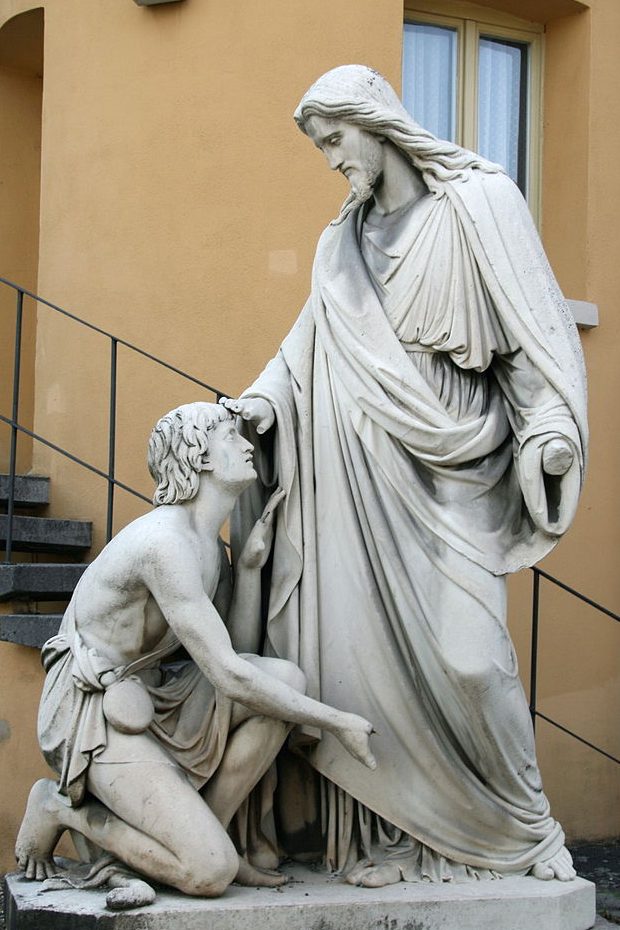
Jesus healing blind Bartimaeus by Johann Heinrich Stöver, 1861. St John’s Church, Hesse, Germany

Assuming Blindness

Behind everything we believe and talk about, there are pre-suppositions or assumptions. The disciples had an assumption about blindness: its sin – not just a result of living in a fallen world, but personal sin. That is, an individual sinner whom we can point the finger to. The disciples demonstrated they were just as blind as the physically blind man.

Jesus had a clear and concise response to that assumption: nobody is at fault here, nobody. Which, to me, begs the question:

Have you considered that your thoughts are subjective, not objective?

Too many people treat their thoughts, ideas, and beliefs as if they were pure gospel truth (which is probably why they feel justified in assuming they are always right and are arbiters of truth!). Reality check: You, nor I, have the corner on truth. Jesus is the truth, not anybody else.

Healing Blindness

Since Jesus is the way, the truth, and the life, he has the power and authority to heal, making the blind to see. Sin wasn’t the issue; the true issue was an opportunity to showcase the gracious work of God. So, Jesus healed the man’s eyes so that he could see again. Healing is not a one-size-fits-all, which is why Jesus did something unique with the blind man, and then gave specific instructions on what to do.

Therefore, we must not assume that we know how a healing is supposed to happen. There’s no codifying a particular process or prayer in order to leverage God into performing one.

Investigating Blindness

The religious leaders always seem to have a problem about something. They, like the disciples, assumed sin was at the core of the man’s blindness. The leaders were befuddled that a sinner like Jesus (who doesn’t keep the Sabbath properly) could ever heal another sinner (a blind man). That’s a conundrum they couldn’t live with, and so, the questions kept getting heaped on the poor guy who was healed.

The religious leaders were trying to make sense out of what they thought was a nonsensical situation. It’s only nonsensical to them because they didn’t have any good sense to begin with. Their interaction with the healed man, and then with Jesus, only demonstrated their profound lack of awareness resulting in spiritual blindness.

Remaining in Blindness 

Many of the religious leaders, heretics in the early church, and spiritual phonies of today are not deliberately trying to deceive or lead others astray; they think they are doing the right thing when they are actually not. 

An eye-opening reality I discovered when I first studied church history is that the early heresies, condemned at church councils, were doctrines promoted by men who were not evil – they were just sincerely misguided. The heretics believed they were helping the church better understand the nature of God and Christ. However, they were unaware and blind to the actual nature of their teachings. 

Back when I wrote my master’s thesis in nineteenth century American Religious History, I read hundreds of sermons from southern preachers before the American Civil War. They had a “biblical” defense of Black chattel slavery. Many of them were influential pastors of large churches who led many people to Christ, that is, white people. Yet, at the same time, they were blind to how they slammed the door of God’s kingdom in the faces of Black folk, were complicit in slaveholder abuse, and fueled antagonisms between North and South.

Churches and Christians may be unaware and blind to how they keep people out of God’s kingdom by saying God’s grace is for all, and then avoid certain people; by having explicit written statements or rules that exclude people from service; or by binding people to human traditions and practices instead of Holy Scripture.

Our Eyes

“The eye is the lamp of the body. If your eyes are healthy, your whole body will be full of light. But if your eyes are unhealthy, your whole body will be full of darkness. If then the light within you is darkness, how great is that darkness! (Matthew 6:22-23, NIV)

In the ancient world, the eye represented what you fixed your gaze on, or what your focus was. In our culture, we could replace the word “eye” with the word “goal.” The word “body” represents the entirety of one’s life.  So, we might interpret Christ’s words in this way: 

A goal is the focus of a life. If your goals are good, your whole life will be full of proper focus. But if your goals are bad, your whole life will be full of blindness. If then, the focus within you is only really blindness, how great is that darkness!

If goals and dreams are toward earthly treasure, one will blindly move in that direction and have misplaced values. Today’s Gospel story portrays the need to be self-aware as individual Christians and as a church. We can choose to:

  1. Be open to new information
  2. Entertain the notion that you might be wrong
  3. Embrace a full range of knowing (head, heart, and gut)
  4. Allow the light of Christ to shine on every person and each situation
  5. Stick to your experience of others and events
  6. Consider how your words and actions affect others
  7. Keep accountable to others and ask for feedback

Monitoring ourselves and our own emotional landscape will help us to become aware of what’s happening inside us. And then, in turn, having our eyes opened enables us to truly see others and be aware of their needs.