
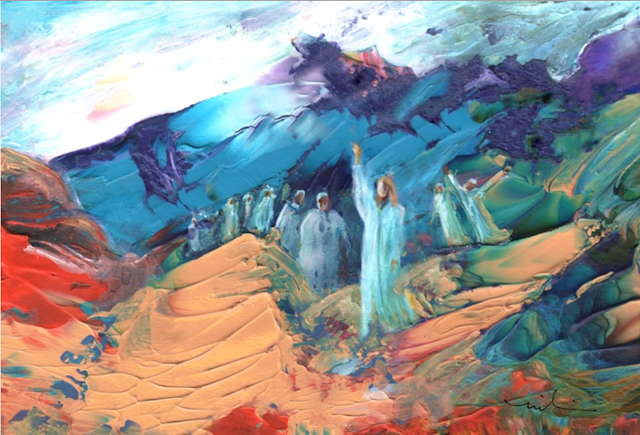
Blessings or Woes?

The Sermon on the Mount, by Miki de Goodaboom

There are many persons who currently feel angry and powerless in the face of recent and contemporary political events. All of this has large implications, especially for workers.

I admit to being one who is frustrated and saddened by the U.S. government’s unwillingness and inability to simply care about all of its citizens (as well as the citizens of the world). Along with their spirit of the age, they are failing to ensure the common good of everyone.

What’s more, there are large swaths of American Christianity who are either complicit or actively involved in establishing and perpetuating a system of governance which is fundamentally out of sync with biblical norms.

The Church and the Christian have a responsibility and a call, based in the words and ways of Jesus, of whom we purport to follow. In some of the first words uttered to his disciples, establishing what is of upmost importance for us to know, Jesus said:

“Blessed are you who are poor,
    for yours is the kingdom of God.
“Blessed are you who are hungry now,
    for you will be filled.
“Blessed are you who weep now,
    for you will laugh…

“But woe to you who are rich,
    for you have received your consolation.
“Woe to you who are full now,
    for you will be hungry.
“Woe to you who are laughing now,
    for you will mourn and weep.” (Luke 6:20-21, 24-25, NRSV)

Jesus was building and upholding an alternative kingdom to the political systems of the time. Christ came to this earth to set things right amidst a corrupt world whose authority was held in the hands of evil.

But change would not come through the typical means of worldly power such as coups, revolutions, or economic exploitation of some persons over others.

For those who feel helpless and without power, Christ brings a liberation which transcends all other powers and authorities. He brings blessing.

What this means for those who are enamored with worldly aspects of power (money, wealth, resources, political authority, etc.) the words and actions of Jesus brings woe.

An evil grip of the world cannot be loosened with practices and responses of hate, class warfare, verbal and physical violence, and economic takeovers. For those with spiritual eyes to see, and ears to hear, the sandy and shifting foundations of this present government administration are being, and will be, washed away. (Luke 6:49)

It’s important that people of faith participate with what is good, right, and just – that they are concerned with the public good of everyone; and are attuned to a social and economic vision for humanity that is concerned for all citizens, and not just some or a few of them.

For the past few hundred years, much of the church has made spiritual deliverance and socio-economic freedom a matter of only the individual. As long as one embraces a personal salvation in Christ, well then, all is well, right!?

Wrong. Holy Scripture is filled with concerns for the whole of humanity because of the exploitive powers of this world. We have stories in the Bible replete with such powers as the Pharaoh who enslaved and exploited workers for his and Egypt’s own wealth, power, and benefit.

Jesus came not to the religious leaders and the kings of the earth, but instead made it his purpose to spend time amongst the least in society, those for whom the rich and powerful had no inclination to pay attention to and help.

“We have for much too long settled for a gospel of private other-worldly possibility.”

Walter Brueggemann

Even amongst God’s own ancient people, King Solomon built an empire on the driving force of both slavery and cheap labor, exploiting a large class of persons in order to feed the behemoth of structural wealth.

Economic systems which exploit workers do it so that they can maintain cheap labor. They seek to keep those persons invisible and outside of any safety net of security which might cost the system money.

Unfortunately, there are extremely rich persons who rely upon workers remaining on the underbelly of their companies and of society. Embracing unrestrained individualism and unbridled capitalistic practices make for a permanent class of exploited workers who remain poor on purpose by those wishing them to remain there.

Such extremely rich individuals become political players only because of their wealth. They know little about statecraft and how a politics concerned for the common good really works. And, frankly, they don’t seem to care.

I bring up these things because many Christians have been complicit in the injustice and exploitation; and because many churches and church leaders try to operate like the super-rich, instead of trying to follow the words and ways of the Lord Jesus, whom they purport to follow.

The Apostle James minced no words in addressing the rich within the church:

Come now, you rich people, weep and wail for the miseries that are coming to you. Your riches have rotted, and your clothes are moth-eaten. Your gold and silver have rusted, and their rust will be evidence against you, and it will eat your flesh like fire. You have laid up treasure during the last days. Listen! The wages of the laborers who mowed your fields, which you kept back by fraud, cry out, and the cries of the harvesters have reached the ears of the Lord of hosts. You have lived on the earth in luxury and in pleasure; you have nourished your hearts in a day of slaughter. You have condemned and murdered the righteous one, who does not resist you. (James 5:1-6, NRSV)

Meanwhile, the poor and exploited are suffering. Christians are not to kiss-up to those in power, nor try to be like them. And, for God’s sake, we are never to get into the game of systemic evil, like those who mistreat us.

Instead, we learn to practice patience and endurance in the face of suffering, while we work toward a better society. We strengthen one another’s hearts through faith. We do not grumble and turn against each other, like a pack of wild dogs, but pray continually and practice forgiveness, so that we can be compassionate and merciful.

Since we are all connected on this planet, any time an individual shows unmitigated kindness toward another, chooses to love the enemy, expresses gratitude, or offers sincere forgiveness to someone who doesn’t deserve it, we shift the balance of the world back toward the axis of grace.

Unless we all work together to embrace our collective poverty of spirit and acknowledge our grinding emotions (and sit with them), we will eventually go the way of the already condemned who spend, eat, and laugh with sinister abandon.

Life is not a 100 meter sprint; life is a marathon. We are in the long haul of life, and do not live for the pleasures of the moment. So then, let us live up to who we are in Christ, created in the image and likeness of God, and possessing divine light and living water which will nourish us through our time of need.

For humanity does not live on bread alone, but by every word that comes from the mouth of God. I, for one, want to be blessed by Jesus, and not experience a woe from him. That means paying attention to the people and the matters of importance to Christ.

Waiting with Hope (Romans 8:22-25)

Art depicting cracked earth, a dry riverbed, white plastic shapes, a lack of life and the red glow of fire. The figures are separated, lacking any real connection. By artist Chris De Hoog

For we know that all creation has been groaning as in the pains of childbirth right up to the present time. And we believers also groan, even though we have the Holy Spirit within us as a foretaste of future glory, for we long for our bodies to be released from sin and suffering.

We, too, wait with eager hope for the day when God will give us our full rights as his adopted children, including the new bodies he has promised us. We were given this hope when we were saved. (If we already have something, we don’t need to hope for it. But if we look forward to something we don’t yet have, we must wait patiently and confidently.) (New Living Translation)

Salvation is not only personal; it’s also cosmic.

That is, freedom from the power of sin, death, and hell is not only for an individual person, but this deliverance is for all of creation, for the entire earth.

So then, all of creation – not just people – long for and groan for the advent of Christ. My oak tree in the backyard longs for it. My dog whines for it. When it rains, the sky is wondering how long it will have to keep up its tears.

Together with the entire cosmos, we look forward to the complete fulfillment of our inheritance as God’s creation, as God’s creatures.

Since that is true, it is Christians who need to see the privilege and responsibility of conducting ourselves with unity, harmony, and non-violence. We are to live this way because we are foreshadowing the end of the world’s story.

There is a day coming when there will be no more malevolent and selfish posturing for power and control. No more oppression and victimization. No more injustice.

And we have the chance to begin living that way now, and not only in a future time. We get to do this because of Christ.

But that doesn’t mean we don’t suffer anymore. Presently, along with all creation, we have pain like that of a woman in childbirth. This is no papercut inconvenient pain; this is “I hurt like hell” pain. That sort of pain has us awaiting the redemption of our bodies.

I work as a hospital chaplain. Every day, I see suffering, some of it unimaginable. I listen to stories of people longing for healing, and grasping at hope. And I hear plenty of groaning (both the actual physical groans, as well as the more quiet internal sighs and groans).

I say to you: The human body is not meant to be destroyed. Our physical selves are not destined for elimination. No, our bodies are meant to be redeemed; they are meant for salvation. It will not always be this way!

So, we hope.

The Christian has the confident expectation that not only is the soul redeemed, but the body, as well. We can enjoy spiritual salvation now. But we must wait for the physical deliverance. There must be patience on our part until Resurrection Day.

The Apostle Paul was calling on believers to hope. Five times he said it in only two verses. Paul was emphasizing the need for spiritual endurance because we have not yet arrived.

In case you haven’t noticed, we aren’t in heaven; this isn’t a renewed earth; people around the globe are not all presently singing kumbaya together.

Therefore, it is imperative that we live with the tension between the “now” and the “not yet.” It’s a weird existence, this Christian life. But, in reality, we exist in the paradox of being saved now, and not yet being saved.

Another way of putting this is that God’s adopted children have not yet received their inheritance.

But that doesn’t mean we’ve been left to ourselves. We have the first fruits of our salvation: the Holy Spirit.

We presently, right now, enjoy a real and significant portion of God’s freedom and deliverance. We have God’s gift of presence. There is the continuing presence of Jesus Christ with us, the blessed Holy Spirit.

And this divine presence is what today helps us to endure and hold onto hope. By holding this future hope, we learn to accept, cope, and transcend our circumstances through love.

Therefore, since we have been made right in God’s sight by faith, we have peace with God because of what Jesus Christ our Lord has done for us. Because of our faith, Christ has brought us into this place of undeserved privilege where we now stand, and we confidently and joyfully look forward to sharing God’s glory.

We can rejoice, too, when we run into problems and trials, for we know that they help us develop endurance. And endurance develops strength of character, and character strengthens our confident hope of salvation. And this hope will not lead to disappointment. For we know how dearly God loves us, because he has given us the Holy Spirit to fill our hearts with his love. (Romans 5:1-5, NLT)

The very suffering which we so often try to avoid and get out of, becomes the means of connecting us with Christ and with others.

The problem becomes the answer.

The Spirit groans with our own spirit, and we all become connected together.

I point out, however, that not everyone wants this sort of connection. There are many people who want nothing to do with solidarity.

Some folks want to remain in their own little huddle or small world; and they take offense at anyone outside of their group who seeks to understand and connect with that group’s suffering.

Although everyone’s pain and suffering is unique – and no one can fully know another’s sorrow – that does not mean solidarity and connection are impossible, or undesirable.

I don’t need to have cancer in order to connect with a cancer patient. I don’t have to become victimized to show genuine empathy and extend competent comfort. Yet, sadly, some persons only want connection and consolation from a certain person or group.

But I say to that: Who are you to tell God whom God can love you through?

To suffer is one thing, because we all must suffer in some way. But to compound your suffering by your own volition is another thing altogether.

You deserve better than harming yourself through cutting off help.

It could be that today is the day you reach out to that person you know will be there for you. Or, perhaps now is the time to quite putting off making space for prayer and reflection.

Whatever it is that you need to do, it’s okay to do it, without putting it off until tomorrow.

Lord Jesus Christ, by your patience in suffering you hallowed earthly pain and gave us the example of obedience to your Father’s will: Be near me in my time of weakness and pain; and sustain me by your grace, so that my strength and courage may not fail. Heal me according to you will; and help me always to believe that whatever happens to me here is of little account if you hold me in eternal life. Amen.

The Righteous and the Wicked (Malachi 3:13-18)

“You have spoken arrogantly against me,” says the Lord.

“Yet you ask, ‘What have we said against you?’

“You have said, ‘It is futile to serve God. What do we gain by carrying out his requirements and going about like mourners before the Lord Almighty? But now we call the arrogant blessed. Certainly evildoers prosper, and even when they put God to the test, they get away with it.’”

Then those who feared the Lord talked with each other, and the Lord listened and heard. A scroll of remembrance was written in his presence concerning those who feared the Lord and honored his name.

“On the day when I act,” says the Lord Almighty, “they will be my treasured possession. I will spare them, just as a father has compassion and spares his son who serves him. And you will again see the distinction between the righteous and the wicked, between those who serve God and those who do not. (New International Version)

The righteous and the wicked. Depending upon what sort of faith tradition you grew up in as a child; or by what belief system you currently adhere to, this may likely determine your understanding of those two words.

The terms “righteous” and “wicked” vary amongst differing groups of people. But however you understand those words, I want us to notice how the prophet Malachi understands them.

To be “righteous” means to have a right relationship with both God and others. It is to be close enough to knowing God to carry out what is important to God.

Righteous folk actually listen and talk to one another. They consult and collaborate with each other. They enjoy good relations because the righteous understand that relationships are a high value. They discern that people are important.

And so, God’s justice is very important to the righteous, because God wants everyone’s basic needs met. The Lord desires people to be treated well, with respect and dignity, in order to make a living and enjoy life.

To be “wicked” means to be arrogant, proud, and boastful. It is to have a string of messed up relationships with both God and others because they insist on their own way.

The wicked are far from God, and do whatever they want to do, regardless of how it may affect others. They view justice and righteousness as dispensable, and unnecessary, unless it can be used as leverage for selfish desires. Even though the wicked might be rich and powerful in this life, they will not be spared from God’s judgment.

Wicked persons – those who carry out injustice and seek to care only for themselves – are called to repent, to change, to amend their evil ways. Their negative statements about God, and their mistreatment of others, has not gone unnoticed.

A typical tactic of wicked persons is to blame others. In Malachi’s day, they were blaming God, and ironically, accusing the Lord of injustice. That’s because the wicked person’s understanding of God is that the Lord exists for their personal benefit.

So, if the wicked person is not receiving some benefit from God, then God isn’t being God, and then is accused and blamed as being the problem to any sort of adverse situation.

But in reality, the righteous are God’s treasured possession, because they consistently serve the Lord, no matter the circumstances. The righteous are faithful, and so, they will be spared on the day of God’s judgment.

So far, I have made this all seem quite black and white. But that was only to make clear the contrast between righteousness and wickedness. The truth is that all of us are a bit of both. We are not always completely right, nor are we always wrong.

We are in the middle of things. Most folks have not rejected God through a lack of belief. Yet, they also have not fully accepted God’s intentions for this world and are not fully living into them.

The prophet Malachi calls such persons (which is perhaps all of us?) to a day when trying circumstances will make the distinction between the wicked and the righteous much more clear.

Then, we will be able to change, fully convinced and knowing the difference between right and wrong, truth and error, faith and fear.

Charlatans will eventually be found out and known. And the consistently faithful people will eventually be noticed and held up by God for others to see and know.

If everything presently appears murky, shadowy, and unclear, please know that it will not always be this way for you.

I am assuming that there very few “wicked” persons actually reading or listening to this. Simply because they see no value in doing so. It doesn’t get them anywhere they want to go.

The wicked may seem to know what they’re doing, but they don’t. Life for them is very nebulous and unclear. They’re only spit-balling through life, trying to look out for number one, that is, themselves.

But you who are reading or listening to this likely want nothing to do with wickedness. You want to stay away from evil.

You are looking to make a difference on this earth, and to improve your little corner of the world. You desire good things for yourself and others. You seek to live as justly and rightly as you can.

Good for you! The Lord is noticing your faith and patience.

So do not throw away your confidence; it will be richly rewarded.

You need to persevere so that when you have done the will of God, you will receive what he has promised. For,

“In just a little while,
    he who is coming will come
    and will not delay.”

And,

“But my righteous one will live by faith.
    And I take no pleasure
    in the one who shrinks back.”

But we do not belong to those who shrink back and are destroyed, but to those who have faith and are saved. (Hebrews 10:35-39, NIV)

Eternal God, in whose perfect kingdom no sword is drawn but the sword of righteousness, no strength known but the strength of love: So mightily spread abroad your Spirit, that all peoples may be gathered under the banner of the Prince of Peace, as children of one Father; to whom be dominion and glory, now and forever. Amen.

The Coming Judgment (Revelation 11:1-14)

Then I was given a measuring stick, and I was told, “Go and measure the Temple of God and the altar, and count the number of worshipers. But do not measure the outer courtyard, for it has been turned over to the nations. They will trample the holy city for 42 months. And I will give power to my two witnesses, and they will be clothed in burlap and will prophesy during those 1,260 days.”

These two prophets are the two olive trees and the two lampstands that stand before the Lord of all the earth. If anyone tries to harm them, fire flashes from their mouths and consumes their enemies. This is how anyone who tries to harm them must die. They have power to shut the sky so that no rain will fall for as long as they prophesy. And they have the power to turn the rivers and oceans into blood, and to strike the earth with every kind of plague as often as they wish.

When they complete their testimony, the beast that comes up out of the bottomless pit will declare war against them, and he will conquer them and kill them. And their bodies will lie in the main street of Jerusalem, the city that is figuratively called “Sodom” and “Egypt,” the city where their Lord was crucified. And for three and a half days, all peoples, tribes, languages, and nations will stare at their bodies. No one will be allowed to bury them. All the people who belong to this world will gloat over them and give presents to each other to celebrate the death of the two prophets who had tormented them.

But after three and a half days, God breathed life into them, and they stood up! Terror struck all who were staring at them. Then a loud voice from heaven called to the two prophets, “Come up here!” And they rose to heaven in a cloud as their enemies watched.

At the same time there was a terrible earthquake that destroyed a tenth of the city. Seven thousand people died in that earthquake, and everyone else was terrified and gave glory to the God of heaven.

The second terror is past, but look, the third terror is coming quickly. (New Living Translation)

There are many people who look upon Christians as oppressors and persecutors in history. And they aren’t wrong. From calls to war for the Crusades, to the Spanish Inquisition, and much more, a great deal of blood has been spilled in the name of Christianity.

The Book of Revelation, however, knows nothing of that history, simply because it pre-dates all of it. Many people forget, in it’s first few hundred years, that Christianity was a persecuted religion by all sorts of people.

Christians were often the scapegoats to many a leader’s problems. From throwing Christians to the lions in the Roman Coliseum, to burning them at the stake because of their faith, many a martyr has faced a bloody death.

The Apostle John’s Apocalypse, which is known to us as the Book of Revelation, was a vision given to John in order to encourage the persecuted Christian Church that God knows their suffering; and that Jesus will return to judge the living and the dead.

John’s vision had a message of judgment on those who were persecuting Christians for their faithful witness of Jesus. The believers in Jesus who were suffering at the hands of oppressors, cried out for vindication and retribution against their persecutors.

Today’s portion of Revelation is situated between the sixth and seventh trumpets of God’s judgment (which are the second and third woes upon the earth). This interlude has to do with two godly witnesses. And the whole world is able to see them.

The space which the two witnesses occupy is in the outer courtyard of the Temple. The two of them symbolize all the faithful people of God in the world. They are attacked and killed, having carried out their witness for 1,260 days (42 months).

This is a time, related to the Old Testament prophecy of Daniel, appointed for the godless to overcome the city. But this time of suffering and woe will not last.

The two witnesses are not named or identified. The point is that whomever they are, these two maintain their prophetic witness to the Lord consistently to their martyrdom.

Like their Lord before them, the two witnesses lay dead for three days. Their bodies visible for all to see. The godless inhabitants of earth gloat over them, and celebrate their demise.

But again, like Jesus, the two are raised from death and ascend to heaven. This evokes a mass of fear throughout the world. The fact that the event causes fear and terror, instead of repentance  and penitence, speaks to how warped the people of earth have become.

Indeed, the Book of Revelation is highly symbolized reading, and John’s vision is not easy to understand. Yet, there are a few things we can reflect upon in light of this passage; and some questions we can ask of ourselves:

  1. It is important to be faithful and persevere to the very end of our lives. How will we respond to this present darkness in the world?
  2. The way in which we live our lives is the legacy we leave for others when we are gone. What will we be remembered for?
  3. Our lives speak to others about who the God of heaven is. Therefore, it is profoundly important how we go about living our current mundane daily existence. How, then, shall you and I live?
  4. Our short lives have eternal ramifications, not only for ourselves, but for future generations. In what ways will you build into the next generation and help them persevere in faith?
  5. Everything you and I see today will change. There is a Judgment Day coming, just as sure as summer will transition to autumn and then into winter. What will you do today that prepares for the final season of the earth as we know it?

Although much of John’s apocalyptic vision deals with wickedness reaching a ripeness which releases the wrath of God’s judgment; it is also simultaneously the church’s entrance into her eternal inheritance. Systemic sin, structural evil, and devilish deeds shall be no more.

Even so, come Lord Jesus. May peace soon come to this world, and within our hearts. Amen.