


From there Jesus set out and went away to the region of Tyre. He entered a house and did not want anyone to know he was there. Yet he could not escape notice, but a woman whose little daughter had an unclean spirit immediately heard about him, and she came and bowed down at his feet. Now the woman was a Gentile, of Syrophoenician origin. She begged him to cast the demon out of her daughter.
Jesus said to her, “Let the children be fed first, for it is not fair to take the children’s food and throw it to the dogs.” But she answered him, “Sir, even the dogs under the table eat the children’s crumbs.” Then he said to her, “For saying that, you may go—the demon has left your daughter.” And when she went home, she found the child lying on the bed and the demon gone.
Then Jesus returned from the region of Tyre and went by way of Sidon toward the Sea of Galilee, in the region of the Decapolis. They brought to him a deaf man who had an impediment in his speech, and they begged him to lay his hand on him.
Jesus took him aside in private, away from the crowd, and put his fingers into his ears, and he spat and touched his tongue. Then looking up to heaven, he sighed and said to him, “Ephphatha,” that is, “Be opened.” And his ears were opened, his tongue was released, and he spoke plainly.
Then Jesus ordered them to tell no one, but the more he ordered them, the more zealously they proclaimed it. They were astounded beyond measure, saying, “He has done everything well; he even makes the deaf to hear and the mute to speak.” (New Revised Standard Version)
Two stories. Two suffering people, because of their infirmities. A mother and a community suffering along with them, not knowing how to help them.
Lo and behold, Jesus, of all people, was the last person they expected to hear was in the area. He a Jew. They Gentiles. Yet, what if….
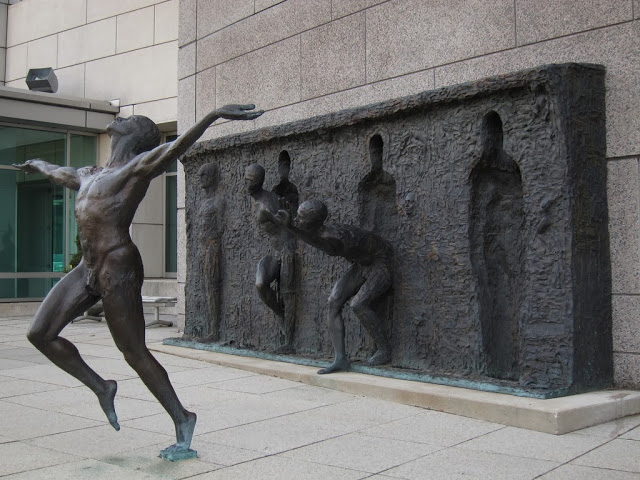
Maybe there is a ray of hope. After all, where there is emptiness, there is potential. And Jesus is the expert on that!
Christ had the rare ability to give the necessary gift of envisioning potential in another’s life, of seeing how the empty space could be filled with life and joy. Indeed, with Jesus there is possibility.
It is important to not only look at what is there, but also on what is not there. Because that’s where we find the quality, opportunity, and potential in another, and in ourselves.
The daughter in the narrative was vexed and incapacitated by an unclean spirit, a demon. The man in the story was deaf and mute, unable to hear and speak, lacking capacity for effective interaction in a society which relied so heavily on the ears and the mouth.
We may imagine their emptiness, feeling bereft of ever experiencing abundant life in their respective circumstances. However, they had those around them who cared, and interceded on their behalf.
Just realizing that Jesus was amongst them seemed to inspire a spark of possibility. Their thinking began to move in a slightly different direction with Christ in the neighborhood.
500 years before Christ’s encounters with these folks, the Chinese philosopher Lao Tzu crafted this poem:
A wheel may have thirty spokes,
but its usefulness lies in the empty hub.
A jar is formed from clay,
but its usefulness lies in the empty center.
A room is made from four walls,
but its usefulness lies in the space between.
Matter is necessary to give form,
but the value of reality lies in its immateriality.
Everything that lives has a physical body,
but the value of a life is measured by the soul.
The immaterial is the real substance. The material is only the form we see around it. It isn’t the material which effects the immaterial; it is the immaterial which has the power to transform the material.
Yet, change is never easy, even the necessary changes we long to see realized. It was not easy for any Gentile living in a Jewish world, and vice versa. Both Jews and Gentiles find out how hard things really can be.

The word got around that Jesus was in town. Nobody knew where he was. But desperate people discover ways to find the people they believe can help. The mother of the daughter with an unclean spirit found where Jesus was staying.
Furthermore, desperate persons are resilient; they rarely give up. The woman was used to tension in the room. She was unfazed by the Jew and Gentile disparity. I happen to think that the response of Jesus was probably expected by the woman. It certainly didn’t discourage her.
The woman asked for help. Jesus rebuffed her. Perhaps this seems incongruent with your understanding of Christ. It may even shock you. It was anything but Midwest nice.
One of the realities, it seems to me, that we need to understand and grapple with, is that Jesus was a real bona fide human being. He was born, grew up, had to learn things and become mature, in every sense of the word.
Christ also needed to develop and live into his own ministry. He had to learn how to establish personal boundaries, apply wisdom to particular situations, and deal with being hungry and tired with a world of human need around him.
I believe that is what we see in this interaction with the woman. And it in no way diminishes Christ’s divinity. We need to be able to hold all of Jesus – both his divinity and his humanity – at the same time, all the time.
Undeterred, the woman bent the words of Jesus to her advantage. That’s what desperate people do. So, Christ, recognizing true desperation and the faith behind her persistence, then immediately exercised his divinity by expelling the unclean spirit from the daughter and bringing her to full capacity.
I’m glad the Gospel writer Mark recorded the narrative as he did. I see a Messiah who deeply desires to do his Father’s will, and has to struggle with how to accomplish it.
I see Jesus in the story as actively growing in his understanding and ability, learning to break into the world with grace and truth; yet at the same time, not conforming to the world’s status quo.
Methinks that not much of this had anything to do with Christ’s sense of ethnicity and gender, but with everyone else’s understanding of the terms. Jesus, along with all of us who desire to follow the ways of God, must struggle with how to bring God’s kingdom values to people.
Jesus, to his credit, is a quick study. Being oriented to love, mercy, and obedience will do that for you. The woman was an outside voice. Christ was willing to listen and banter with her. He was not threatened when she spoke her truth to his power.
I will suggest to you that perhaps the reason for Christ’s willingness and ability to have effective ministry with the woman and her daughter (as well as everyone else) is that he had his own sacred emptiness.
Whenever we are full of ourselves, full of all our thoughts of how things ought to go, and full of all our settled beliefs, then there is no room to see and listen to another person.
Jesus was empty so that the woman could add to him with her own story and struggle. And when that happened, a miracle occurred.
The same sort of sacred emptiness happened with the deaf and mute man who was healed of his infirmity. Jesus was able to receive and be filled with the people who brought the man to him.
They begged Christ to help the man. Jesus saw them and heard them, because he was not so full of himself. And if anyone ever had a right to be full and tell others what to do, it is Jesus.
But he didn’t. In his empty humility, he had room for others. Since Christ emptied himself, he could empty others of all the stuff that gets in the way of living a peaceful life. (Philippians 2:5-8)
That is precisely why I am here. Because Jesus had room for me. Christ has a very large inner space, big enough to accommodate an untold amount of people. He has room for you, too. He sees you, and is able to listen to you.
So, go ahead; speak your own truth to Christ’s power.


 Rev. Tim Ehrhardt