God Is Bigger (Psalm 46)

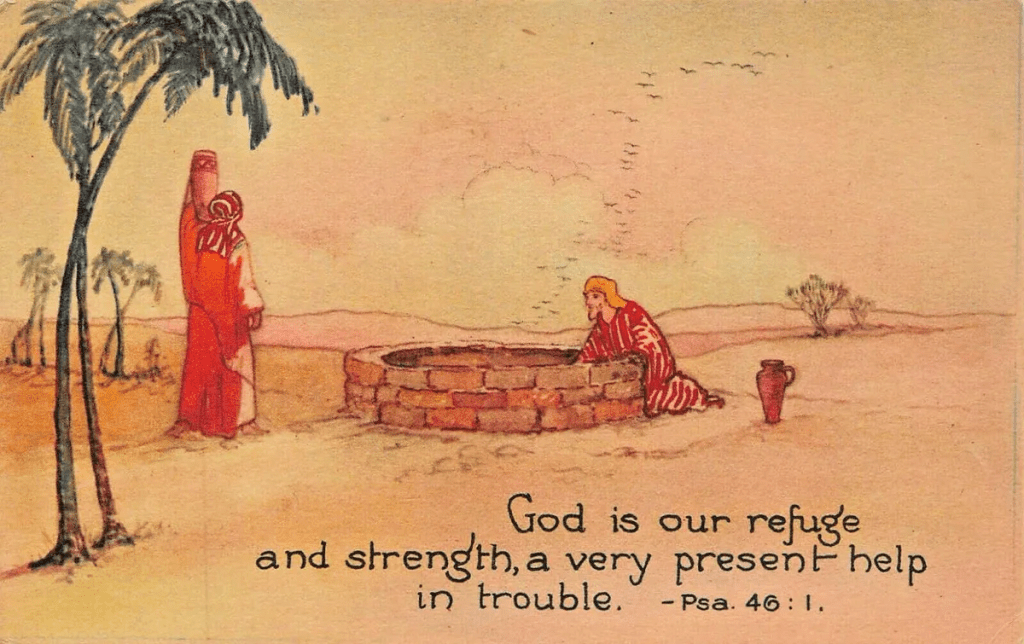
God is our refuge and strength,
    a very present help in trouble.
Therefore we will not fear, though the earth should change,
    though the mountains shake in the heart of the sea,
though its waters roar and foam,
    though the mountains tremble with its tumult.

There is a river whose streams make glad the city of God,
    the holy habitation of the Most High.
God is in the midst of the city; it shall not be moved;
    God will help it when the morning dawns.
The nations are in an uproar; the kingdoms totter;
    he utters his voice; the earth melts.
The Lord of hosts is with us;
    the God of Jacob is our refuge.

Come, behold the works of the Lord;
    see what desolations he has brought on the earth.
He makes wars cease to the end of the earth;
    he breaks the bow and shatters the spear;
    he burns the shields with fire.
“Be still, and know that I am God!
    I am exalted among the nations;
    I am exalted in the earth.”
The Lord of hosts is with us;
    the God of Jacob is our refuge. (New Revised Standard Version)

Fear is one of those things that we don’t get over simply by telling ourselves to not be afraid. In fact, that approach typically makes us even more fearful – namely, because we focus on the fear itself. But to cope and deal with fear, it requires a focus on something bigger than the fear.

God is bigger than the boogie man.
He’s bigger than Godzilla,
or the monsters on TV.
Oh, God is bigger than the boogie man.
And He’s watching out for you and me.

So, when I’m lying in my bed,
and the furniture starts creeping,
I’ll just laugh and say,
“Hey, cut that out!”
And get back to my sleeping.
‘Cause I know that God’s the biggest,
and He’s watching all the while.
So, when I get scared I’ll think of Him,
and close my eyes and smile.

God is bigger than the boogie man.
He’s bigger than Godzilla,
or the monsters on TV.
Oh, God is bigger than the boogie man.
And He’s watching out for you and me. – VeggieTales

Psalms and songs of trust in God help us focus on divine hugeness instead of human puniness.

Changing Circumstances

Even though people may find themselves in the dire straits of natural disasters, they can have confidence smack in the middle of all the crazy chaos. Whereas those who focus on their fear become ever more anxious and feel as if the world is out of control, the believer isn’t threatened when overwhelming circumstances occur.

We will not fear, because God – who created the world and its vast natural systems – stands above it all and is therefore able to establish order out of chaos. Just as we are certain that the sun will again rise in the morning, so too, we have full confidence that God shall rise over the darkness and bring light and warmth to all that is shadowy and cold.

Shaky Politics

The nations and their governments who rule with injustice and care nothing for religion, breathe-out their threats and posture themselves as supreme leaders. They, too, are chaotic forces. But God is far above them, as well as above the flood and the famine. The leader’s bellicose blustering sounds merely like a chattering chipmunk to God.

And like natural disasters, the uproar of the nations does damage; but national leaders cannot topple God. Instead, God will shake up the unjust nations, like a protein shake in a blender. When delusional leaders encounter the voice of God, they cower in fear – but God’s people don’t. The spiritual person’s foundation will not be shaken, whereas the would-be dictator will find himself without anyone to lead.

A Working God

God is always working, albeit most of the time behind the scenes. God’s dominion extends over everything and everyone. God can obliterate any and all threats because God is everywhere present.

Based on this view of God, all we as people need do is be still and know that the Lord is God. Like Jesus rebuking the waves and the sea, resulting in immediate stillness, so God’s word brings us stillness, calmness, and freedom from fear and anxiety.

God is with us. God is in control. God cares for us. There are a lot of things we don’t know – such as why we have to personally endure the natural disasters and the unnatural dictators – but we can know without a shadow of a doubt that the presence of God surrounds us, and the love of God squeezes us.

With a transcendent Being who commands the angelic hosts of heaven, our source of security comes not from within but from without. The Lord is a trustworthy God who is vigilant in watching over us.

Trusting the Lord

Armies, security systems, and protective coverings all have their needed purpose in human life. Yet, when we look to our ultimate protection – the kind that provides security of both body and soul – it is God’s presence that sustains our highest and greatest needs.

Perhaps you understand the psalm’s message, yet still find it difficult or untenable to place faith in such an ancient writing and an even older God. Maybe you much prefer to trust in something that isn’t so ethereal, something you can engage with your five senses.

It could be that you prefer a strong political leader, more and bigger weapons, higher and thicker walls of protection. You work hard to have as much money as possible to keep you safe from harm. You seek to gain as much influence in the form of earthly power and authority as you can.

The problem is, however, that none of this earthly posturing is going to protect you from what you fear the most. All that work is going to prove unreliable in the end.

God is the only sure defense. Ultimate power belongs to the Lord God almighty, creator of heaven and earth. Deliverance of body and soul does not ultimately come through the strength of the military, the economy, or any human ingenuity or hard work; for the Christian, it comes through the suffering, death, and resurrection of Jesus Christ.

Any inclination to place saving trust in personal resources, human institutions, or world might, will result in sure failure. They cannot remedy our fear, for nothing is able to match the power of God. Indeed, God is bigger than anyone and anything. We need the mighty fortress which is our God.

A mighty Fortress is our God
A Bulwark never failing
Our Helper He amid the flood
Of mortal ills prevailing

For still our ancient foe
Doth seek to work us woe
His craft and power are great
And armed with cruel and hate
On earth is not his equal

Did we in our own strength confide
Our striving would be losing
We’re not the right Man on our side
The Man of God’s own choosing
Dost ask who that may be?
Christ Jesus, it is He
Lord Sabaoth His Name
From age to age, the same
And He must win the battle

That word above all earthly powers
No, thanks to them, abideth
The Spirit and the gifts are ours
Through Him who with us sideth
Let goods and kindred go
This mortal life also
The body they may kill
God’s truth abideth still
His Kingdom is forever

Amen

Who Is Jesus? (Luke 2:22-40)

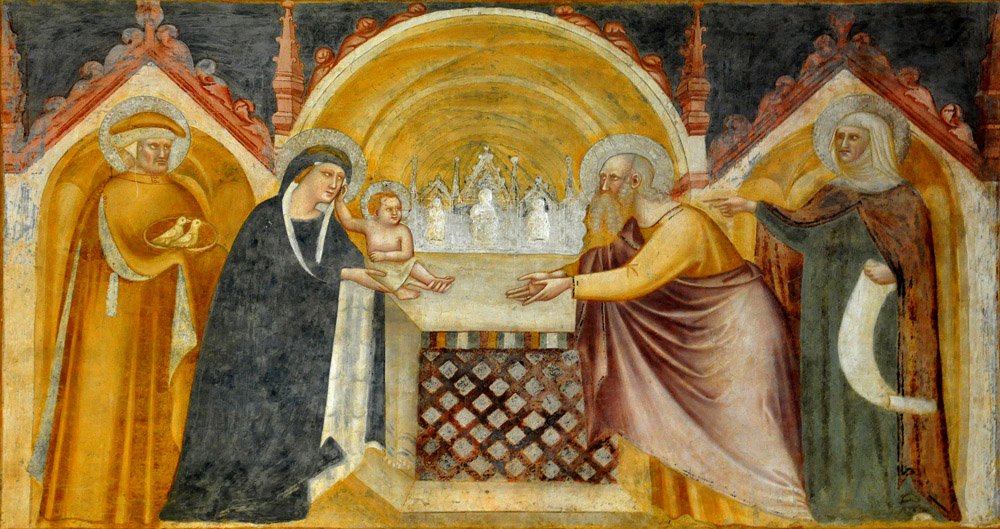
The Presentation in the Temple, 14th century fresco in Pomposa Abbey, Codorigo, Italy

When the time came for the purification rites required by the Law of Moses, Joseph and Mary took him to Jerusalem to present him to the Lord (as it is written in the Law of the Lord, “Every firstborn male is to be consecrated to the Lord”), and to offer a sacrifice in keeping with what is said in the Law of the Lord: “a pair of doves or two young pigeons.”

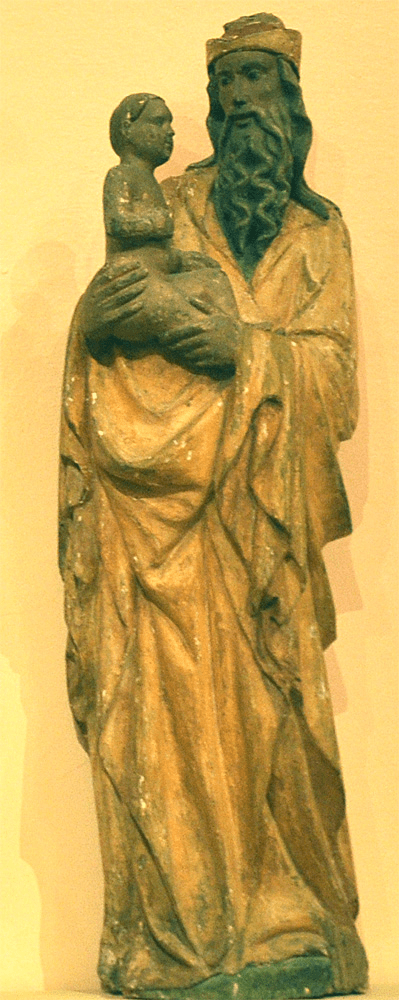
Now there was a man in Jerusalem called Simeon, who was righteous and devout. He was waiting for the consolation of Israel, and the Holy Spirit was on him. It had been revealed to him by the Holy Spirit that he would not die before he had seen the Lord’s Messiah. Moved by the Spirit, he went into the temple courts. When the parents brought in the child Jesus to do for him what the custom of the Law required, Simeon took him in his arms and praised God, saying:

“Sovereign Lord, as you have promised,
    you may now dismiss your servant in peace.
For my eyes have seen your salvation,
    which you have prepared in the sight of all nations:
a light for revelation to the Gentiles,
    and the glory of your people Israel.”

The child’s father and mother marveled at what was said about him. Then Simeon blessed them and said to Mary, his mother: “This child is destined to cause the falling and rising of many in Israel, and to be a sign that will be spoken against, so that the thoughts of many hearts will be revealed. And a sword will pierce your own soul too.”

There was also a prophet, Anna, the daughter of Penuel, of the tribe of Asher. She was very old; she had lived with her husband seven years after her marriage, and then was a widow until she was eighty-four. She never left the temple but worshiped night and day, fasting and praying. Coming up to them at that very moment, she gave thanks to God and spoke about the child to all who were looking forward to the redemption of Jerusalem.

When Joseph and Mary had done everything required by the Law of the Lord, they returned to Galilee to their own town of Nazareth. And the child grew and became strong; he was filled with wisdom, and the grace of God was on him. (New International Version)

The Gospel accounts of Matthew, Mark, Luke, and John actually contain very little information about the childhood of Jesus. That’s because the Gospels are not biographies – in the sense we think of them – but rather they are narratives that seek to answer a fundamental question about faith and life on this earth: Who is this Jesus?

C.S. Lewis went about exploring that very question. He reasons with us in his classis work, Mere Christianity:

“I am trying here to prevent anyone saying the really foolish thing that people often say about Him: I’m ready to accept Jesus as a great moral teacher, but I don’t accept his claim to be God. That is the one thing we must not say. A man who was merely a man and said the sort of things Jesus said would not be a great moral teacher. He would either be a lunatic — on the level with the man who says he is a poached egg — or else he would be the Devil of Hell. You must make your choice. Either this man was, and is, the Son of God, or else a madman or something worse. You can shut him up for a fool, you can spit at him and kill him as a demon or you can fall at his feet and call him Lord and God, but let us not come with any patronizing nonsense about his being a great human teacher. He has not left that open to us. He did not intend to.”

C.S. Lewis, Mere Christianity

St. Luke’s account of Christ’s childhood stories, seeks to make some important theological points about Jesus:

  • born a Jew amongst devout religious Jews in a thoroughly Jewish society, under Roman authority (Luke 2:1-7)
  • born of a woman, born under the law (Galatians 4:4-5)
  • obedient to his heavenly Father (Luke 2:49; Mark 3:35)
The Presentation in the Temple, 14th century marble statue in the National Museum of the Middle Ages, Paris, France

So, as such, the presentation of Jesus in Jerusalem at the temple is motivated by specific requirements of the law of Moses:

The Lord said to Moses, “Say to the Israelites: ‘A woman who becomes pregnant and gives birth to a son will be ceremonially unclean for seven days…. On the eighth day the boy is to be circumcised. Then the woman must wait thirty-three days to be purified from her bleeding. She must not touch anything sacred or go to the sanctuary until the days of her purification are over….

“‘When the days of her purification for a son… are over, she is to bring to the priest at the entrance to the tent of meeting a year-old lamb for a burnt offering and a young pigeon or a dove for a sin offering….

“‘These are the regulations for the woman who gives birth to a boy… But if she cannot afford a lamb, she is to bring two doves or two young pigeons, one for a burnt offering and the other for a sin offering. In this way the priest will make atonement for her, and she will be clean.’” (Leviticus 12:1-8, NIV)

What’s more, every first-born male (as Jesus was) specifically belongs to the Lord, and is set apart.

The Lord said to Moses, “Consecrate to me every firstborn male. The first offspring of every womb among the Israelites belongs to me… you are to give over to the Lord the first offspring of every womb….”

“In days to come, when your son asks you, ‘What does this mean?’ say to him, ‘With a mighty hand the Lord brought us out of Egypt, out of the land of slavery. When Pharaoh stubbornly refused to let us go, the Lord killed the firstborn of both people and animals in Egypt.

This is why I sacrifice to the Lord the first male offspring of every womb and redeem each of my firstborn sons.’ And it will be like a sign on your hand and a symbol on your forehead that the Lord brought us out of Egypt with his mighty hand.” (Exodus 13:1-2, 12, 14-16, NIV)

Luke was making the connection that when Joseph and Mary presented Jesus to the Lord in Jerusalem, they were essentially dedicating his life to God. Jesus will be the means of redemption for all the people.

Mary would have remembered the words the angel Gabriel told her, that her son will not only be holy, but also be called the Son of God. The life of Jesus – conception, birth, and presentation at the temple – is demonstrably dedicated fully and completely to his heavenly Father. Deliverance for both Jews and Gentiles is focused in the person of Jesus.

Simeon and the Child Jesus, 16th century statue in Zadar, Croatia

Simeon and Anna show up at the presentation of Jesus as devout Jews who are awaiting the fulfillment of God’s promises of consolation and redemption for Israel.

“I, the Lord, have called you in righteousness;
    I will take hold of your hand.
I will keep you and will make you
    to be a covenant for the people
    and a light for the Gentiles.” (Isaiah 42:6, NIV)

Break forth; shout together for joy,
    you ruins of Jerusalem,
for the Lord has comforted his people;
    he has redeemed Jerusalem.
The Lord has bared his holy arm
    before the eyes of all the nations,
and all the ends of the earth shall see
    the salvation of our God. (Isaiah 52:9-10, NRSV)

Simeon and Anna became the spokespersons for the redemption that is to come through Jesus. They both got a glimpse of the salvation that would, one day, reveal itself to the whole world. Forgiveness of sins, deliverance from death and hell, and freedom from guilt and shame all become laser focused on the suffering servant of God.

Who is Jesus? He is the ultimate meaning of Christmas, the incarnation of the Son of God, the Savior of the world. Amen.

Born to Die (Judges 13:2-24)

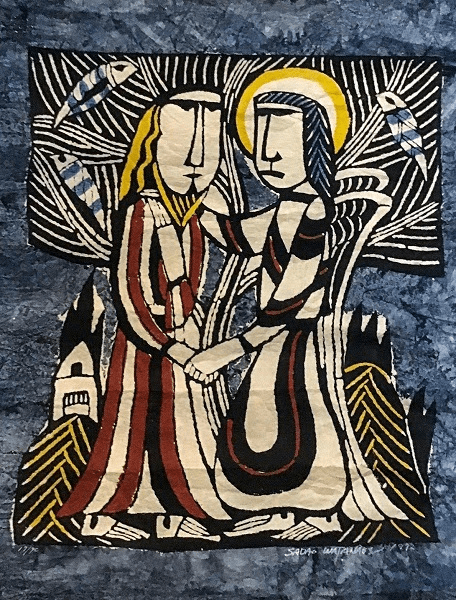
The angel and Manoah, by Sadao Watanabe, 1972

There was a man from Zorah named Manoah. Manoah was from the family of Dan. His wife was not able to have children. The Messenger of the Lord appeared to her and said, “You’ve never been able to have a child, but now you will become pregnant and have a son. Now you must be careful. Don’t drink any wine or liquor or eat any unclean  food. You’re going to become pregnant and have a son. You must never cut his hair because the boy will be a Nazirite dedicated to God from birth. He will begin to rescue Israel from the power of the Philistines.”

The woman went to tell her husband. She said, “A man of God came to me. He had a very frightening appearance like the Messenger of God. So I didn’t ask him where he came from, and he didn’t tell me his name. He told me, ‘You’re going to become pregnant and have a son. So don’t drink any wine or liquor or eat any unclean food because the boy will be a Nazirite dedicated to God from the time he is born until he dies.’ ”

Then Manoah pleaded with the Lord, “Please, Lord, let the man of God you sent come back to us. Let him teach us what we must do for the boy who will be born.”

God did what Manoah asked. The Messenger of God came back to his wife while she was sitting out in the fields. But her husband Manoah was not with her. The woman ran quickly to tell her husband. She said, “The man who came to me the other day has just appeared to me again.”

Manoah immediately followed his wife. When he came to the man, he asked him, “Are you the man who spoke to my wife?”

“Yes,” he answered.

Then Manoah asked, “When your words come true, how should the boy live and what should he do?”

The Messenger of the Lord answered Manoah, “Your wife must be careful to do everything I told her to do. She must not eat anything that comes from the grapevines, drink any wine or liquor, or eat any unclean food. She must be careful to do everything I commanded.”

Manoah said to the Messenger of the Lord, “Please stay while we prepare a young goat for you to eat.”

But the Messenger of the Lord responded, “If I stay here, I will not eat any of your food. But if you make a burnt offering, sacrifice it to the Lord.” (Manoah did not realize that it was the Messenger of the Lord.)

Then Manoah asked the Messenger of the Lord, “What is your name? When your words come true, we will honor you.”

The Messenger of the Lord asked him, “Why do you ask for my name? It’s a name that works miracles.”

So Manoah took a young goat and a grain offering and sacrificed them to the Lord on a rock he used as an altar. While Manoah and his wife watched, the Lord did something miraculous. As the flame went up toward heaven from the altar, the Messenger of the Lord went up in the flame. When Manoah and his wife saw this, they immediately bowed down with their faces touching the ground.

The Messenger of the Lord didn’t appear again to Manoah and his wife. Then Manoah knew that this had been the Messenger of the Lord. So Manoah said to his wife, “We will certainly die because we have seen God.”

But Manoah’s wife replied, “If the Lord wanted to kill us, he would not have accepted our burnt offering and grain offering. He would not have let us see or hear all these things just now.”

So the woman had a son and named him Samson. The boy grew up, and the Lord blessed him. (God’s Word Translation)

The Sacrifice of Manoah, by Charles Blanc (1813-1882)

In the anticipation of Christ’s birth, we are reminded today that there have been extraordinary births in history – a sign that the delivery of a baby will lead to a deliverance of the people.

The ancient Israelites were yet again in one of their downward spirals into apostasy. As a result, their arch-nemesis, the Philistines, had domination over them. The tribe of Dan – from which Samson was born into – was geographically situated in such a way that they would have borne the brunt of Philistine oppression.

In the case of miraculous births in Holy Scripture, an angel comes to announce the coming child. These sorts of situations always have an infertile woman who was not planning on becoming a mother. And in many cultures, including Israel, a son born to a woman who was childless for a long time is recognized as a particularly special gift from God.

There are typically, therefore, high expectations that such a special child is destined for great things in this life. Indeed, Samson would become an extraordinary person by initiating the deliverance of Israel from the Philistines.

Samson, according to the angel, was not only to make sure he never eats any unclean food, but also was to be set apart from his very conception as a Nazirite – one who has the special rules of abstinence from alcohol, cutting the hair, and touching corpses. (Numbers 6:1-8)

From the very beginning of Samson’s existence in the womb of his mother, the Spirit of God was with him and began empowering him for his destiny of deliverance.

Since we know the rest of the story, as contained in the Bible, we understand that the way the deliverance of Israel came was not by any sort of conventional means. It was a rather circuitous and complicated set of circumstances and decisions which brought about Israel’s freedom from oppression.

In a similar way, the deliverance which Jesus secured – not only for Israel, but according to Christianity, for all nations – came about through unexpected and tragic circumstances. This is why many Christians will state that Jesus was born to die – because his death, like Samson’s, brought about a great saving event that vastly outdid anything done during life.

Perhaps you existentially know something in this season about such bittersweet circumstances and events. It could be that you are experiencing a situation that is both very sad and quite joyous at the same time.

So, may you, especially, in this time of year, find satisfaction in your grief, and contentment in your lament. May the angel’s announcement stir in your soul the peace that passes all understanding. May the Lord be with you, my friend.

Soli Deo Gloria

A Real Change of Life (Matthew 12:43-45)

“When an evil spirit leaves a person, it goes into the desert, seeking rest but finding none. Then it says, ‘I will return to the person I came from.’ So it returns and finds its former home empty, swept, and in order. Then the spirit finds seven other spirits more evil than itself, and they all enter the person and live there. And so that person is worse off than before. That will be the experience of this evil generation.” (New Living Translation)

Nature abhors a vacuum. A tilled plot of soil will be overtaken with weeds if nothing is planted and nurtured in the turned-over dirt. 

The pecking order of a brood of chickens cannot handle the death of the top hen without filling the position almost immediately. 

In the spiritual realm, the exorcising of a demon will not simply leave a person empty of evil – their life will be filled with something in its place.

Jesus told a story about a man who was delivered from an unclean (evil) spirit. It’s a powerful and simple narrative on the necessity of true repentance, that is, on what a real change of life is like. 

Genuine freedom is more than getting rid of something bad and destructive; the evil must be replaced with something good and useful. In other words, biblical repentance, a true transformation of a person, is both a turning away from ungodliness and an embrace of righteousness.

We are delivered from evil so that we can start living into right and peaceful relationships, as God intends for us.

For example, the Apostle Paul exhorted the Ephesian believers to not only stop stealing but also to get a job and start sharing with others. They were not only to stop lying and using their tongues for gossip and slander and start using their words to speak truth that builds up others. (Ephesians 4:25-32)

The spiritual principle is the same as the nature principle: A empty vacuum will always be filled. The man who did not fill his life with God ended up having a problem with evil seven times greater than when he started. If anything, or anyone, is emptied of its unhealthy elements and practices, it is imperative that the hole be immediately filled with healthy disciplines for life.

Whether dealing with addictions, bad habits, or any kind of evil influence, a two-pronged approach is needed for its eradication. We expel the evil by replacing it with godliness. 

For example, the man struggling with pornography or adultery must not only stop the behavior but take up the mantle of being a champion for women’s issues; or the woman who has no healthy boundaries and allows herself to be used and abused must not only separate from the problem or person but adopt her identity in Christ as a precious child of God and enforce righteous limitations. 

These examples are not meant to be simplistic answers to complex situations. Rather, they illustrate why so many people do not experience freedom and continue to have even greater enslavement to their passions and sufferings. Freedom is realized through replacing old practices with new disciplines that directly attack the old.

We all have needs. How we get those needs met is often a mixed bag of both legitimate and illegitimate ways. In a perfect world, everyone would be aware of their needs and be able to express them to one another without shame, anxiety, or anger. Since we live on a blemished fallen planet, we end up trying to meet our needs indirectly through hustling for love, hoarding resources, and controlling others – all harmful ways which destroys souls and relationships.

In order to focus on meeting our needs in a wise and healthy manner, we must take a step beyond ending a toxic relationship, cutting up a credit card, or saying “no” to another responsibility. We often get into our mess to begin with because we are out of touch with ourselves and our needs. We need affection and encouragement, and there is no shame in needing this. We need security and safety, and there is no problem in acquiring this. There are some things we need to control, and that is okay.

If we fail to address our needs, we might do the necessary work of deliverance, then turn right around and become worse off than before by filling the empty place of our lives with:

  • Being all things to all people, as if we were the Messiah.
  • Being successful so that we stay ahead of being needy.
  • Pulling inside ourselves and trusting nobody.
  • Distancing from our needs and pretending they are not there.
  • Being continually vigilant so that we are never hurt that way again.
  • Keeping a positive spin on everything, as if there is no negative stuff in the world.
  • Challenging other’s opinions and behaviors to keep the focus off our needs.
  • Becoming a wallflower so that we can never be the brunt of someone else’s vitriol or evil.

Instead, we can let Jesus fill the emptiness with love, purpose, peace, joy, attention, and grace. Christ is the Savior who delivers us from evil, and the Holy Spirit is the Sanctifier who carefully applies the work of salvation to our lives. When our hearts and minds are full of God, there is no place for the demons to get in.

True change and transformation equally forsakes evil and embraces righteousness; replaces the unhealthy with the healthy; jettisons the illegitimate and seeks the legitimate; and puts away unnecessary suffering and pursues peace and joy in the Spirit.

O God, I no longer want to live with saying I’m sorry and going right back to the old pig slop of sin. I cannot change on my own. I need Jesus to both take away the sin and give me a new life of living for him. Help me to make choices that put to death the old way of life, and the courage to live into my forgiveness in the power of the Holy Spirit. Amen.