Hebrews 10:32-39 – Don’t Throw Away Your Confidence

Remember those earlier days after you had received the light, when you endured in a great conflict full of suffering. Sometimes you were publicly exposed to insult and persecution; at other times you stood side by side with those who were so treated. You suffered along with those in prison and joyfully accepted the confiscation of your property, because you knew that you yourselves had better and lasting possessions. So, do not throw away your confidence; it will be richly rewarded.

You need to persevere so that when you have done the will of God, you will receive what he has promised. For,

“In just a little while,
    he who is coming will come
    and will not delay.”

And,

“But my righteous one will live by faith.
    And I take no pleasure
    in the one who shrinks back.”

But we do not belong to those who shrink back and are destroyed, but to those who have faith and are saved. (New International Version)

Confidence is necessary for the Christian life. It’s not optional. One can only persevere through trouble with some confident hope.

It’s one thing to bear up under a hard circumstance for a few days or weeks. It’s altogether another thing for that same hardship to continue for months, even years.

Living with such adversity everyday makes one tired… really tired. Feelings of hopelessness slowly creep within. And, after a while, the person or group of people just want the madness to end. So, they simply give up, being lost in their troubles, feeling alone and bereft of options.

Without the confident expectation of better days ahead, while in the throes of difficulty, a failure of faith can too easily happen.

To realize better days, it’s important to remember the earlier days. I’m not talking about living in the past and wishing it were the 1950s again with Beaver Cleaver across the street. This is not about believing that the past was the good old days, and that the present is bad.

Instead, we can recall and remember the ways we endured and persevered with joy in past experiences.

The original Christian recipients of the message of Hebrews needed to recall the various ways they stood firm and tall in their faith, despite the adversity.

In earlier times, they were insulted and persecuted. Yet, they showed solidarity with others in similar situations. The believers were attentive to prisoners and sought to meet their needs. And they responded to the confiscation of their property with joy because they knew there was so much more than this present life and it’s possessions.

But the persecution and the insults continued… day after day… with no apparent end….

The Christians began to lose their grip on faith. They needed to reconnect with their purpose, with why they were Christians to begin with.

Originally, the reason they had such incredible attitudes while enduring hard things is because they were pursuing heavenly treasure. Their earthly possessions were merely temporary things, not of eternal value. They understood that people have eternal value, not stuff, so the believers willingly focused their efforts in helping others.

However, over time, the band of believers lost their focus. All they could see was the pain and the difficulty. They became disconnected with their purpose. And so, they were in danger of losing their faith and becoming utterly hopeless.

What to do? Give up? Renege on faith? Adopt a “whatever will be, will be,” sort of philosophy?

No. Instead,

Remember what God has done for you.

Affirm what is right, just, and true.

Embrace faith and patience.

That’s what the prophet Habakkuk did. And his resilience helped to bring proper perspective to present troubles.

“Nothing that is worth doing can be achieved in a lifetime; therefore, we must be saved by hope.”

Reinhold Niebuhr (1892-1971)

Habakkuk was distressed over the corruption of his fellow Israelites. Things were askew and not right. So, he complained to God about it. 

God responded by informing Habakkuk that judgment was coming to Israel through the Babylonians. This was neither what Habakkuk expected nor wanted. The prophet grumbled even more because the Babylonians were more corrupt than the Israelites. 

The prophet was having a hard time, and it seemed God was only making things worse, not better.

Habakkuk struggled to come to terms with what God was doing, and not doing. Finally, he concluded the matter by reconnecting with his faith: 

Even though the fig trees have no blossoms,
    and there are no grapes on the vines;
even though the olive crop fails,
    and the fields lie empty and barren;
even though the flocks die in the fields,
    and the cattle barns are empty,
yet I will rejoice in the Lord!
    I will be joyful in the God of my salvation!
The Sovereign Lord is my strength!
    He makes me as surefooted as a deer,
    able to tread upon the heights. (Habakkuk 3:17-19, NLT)

Perhaps the most significant faith experience we can have, is to come to the point of complete trust in God so that our happiness is not dependent upon good circumstances. 

The truth we all must eventually come around to is that joy and security is independent of what’s going on around us. 

Even though we face difficulty, and even evil, confidence can still exist and thrive within us. We can still rejoice because we don’t need everything to go our way in order to be happy.

Faith, patience, and joy are neither cheap, nor easy. For them to remain rooted within us, we must affirm our commitment to Christ daily. And that requires remembering.

What’s more, there is a reward ahead if we persevere to the end.

We can remain patient, express faith, kindle hope, and remember necessary things whenever we stop doing unimportant things which do not add value to our ultimate goals.

So, be mindful of the things which are most important to you; and move through life at a pace of hope, not anxiety. Don’t throw away your spiritual confidence, just because things are continually hard.

God, give us grace to accept with serenity
the things that cannot be changed,
Courage to change the things
which should be changed,
and the Wisdom to distinguish
the one from the other.

Living one day at a time,
Enjoying one moment at a time,
Accepting hardship as a pathway to peace,
Taking, as Jesus did,
This sinful world as it is,
Not as I would have it,
Trusting that You will make all things right,
If I surrender to Your will,
So that I may be reasonably happy in this life,
And supremely happy with You forever in the next.

Amen. – The Serenity Prayer by Reinhold Niebuhr

Isaiah 43:8-15 – The Supremacy of God Matters

Bring out the people who have eyes but are blind,
    who have ears but are deaf.
Gather the nations together!
    Assemble the peoples of the world!
Which of their idols has ever foretold such things?
    Which can predict what will happen tomorrow?
Where are the witnesses of such predictions?
    Who can verify that they spoke the truth?

“But you are my witnesses, O Israel!” says the Lord.
    “You are my servant.
You have been chosen to know me, believe in me,
    and understand that I alone am God.
There is no other God—
    there never has been, and there never will be.
I, yes I, am the Lord,
    and there is no other Savior.
First I predicted your rescue,
    then I saved you and proclaimed it to the world.
No foreign god has ever done this.
    You are witnesses that I am the only God,”
    says the Lord.
“From eternity to eternity I am God.
    No one can snatch anyone out of my hand.
    No one can undo what I have done.”

This is what the Lord says—your Redeemer, the Holy One of Israel:

“For your sakes I will send an army against Babylon,
    forcing the Babylonians to flee in those ships they are so proud of.
I am the Lord, your Holy One,
    Israel’s Creator and King. (New Living Translation)

I am an ordained Minister in a smallish denomination, the Reformed Church in America. This particular Christian tradition has its roots in the magisterial reformer, John Calvin (1509-1564). Calvin placed a strong emphasis on the sovereignty of God. In other words, all things hinge on God as the supreme Being of the universe. As Creator of all things, God’s actions and inactions are in no way dependent upon us creatures.

I believe in God’s unconditional election of persons to salvation and new life. Maybe that means nothing to you, and to others it means everything. For many folks, it’s just some churchy mumbo-jumbo which is rather irrelevant to the real stuff of the Christian life. 

I do not agree. It seems to me to be quite important. The heart of Reformation faith is a focus on God’s sovereignty, majesty, power, and grace. It is God who justifies, and not any human. That means there are no conditions to which God is beholden to act. That is, God works in the world according to divine free will and is not reliant upon anyone or anything to accomplish good purposes and fulfill good promises.

“We should therefore learn that the only good we have is what the Lord has given us gratuitously; that the only good we do is what He does in us; that it is not that we do nothing ourselves, but that we act only when we have been acted upon, in other words under the direction and influence of the Holy Spirit.”

John Calvin

Today’s Old Testament lesson is a soaring view of God’s grace and powerful control. Throughout all eternity God is God. There is none who can thwart the Lord’s plans. God acts freely and mercifully and nothing can cancel out those actions. Nothing can separate us from the love of God. We might jump from finger to finger in our puny attempts at autonomy, but we are not getting out of God’s hand! 

For me, this is a balm and a comfort to my soul. Not everything is up to me, as if my action or inaction has cosmic repercussions. As a guy who easily tends toward carrying the world on his shoulders, it is good for me to know that the earth spinning on it’s axis isn’t my job.

It seems to me, the assurance of God’s sovereignty in the world really ought to be a comfort to every believer. God’s decrees will be fulfilled, and there is not one thing any wicked person can do to subvert divine initiatives.

Furthermore, there is absolutely no way we can screw-up God’s purposes. We simply do not have such power. Our great task as believers is to rest secure in God’s will and to therefore place our trust in the One who knows exactly what he is doing in the world.

So, take a few minutes, draw in a few deep breaths, and think on the wonderful truth that God is sovereign. To help you, here is the great opening to the Reformed confession, The Heidelberg Catechism, giving us a glimpse into the majesty of God:

Q: What is your only comfort in life and in death?

A: That I am not my own,

but belong with body and soul,

both in life and in death,

to my faithful Savior Jesus Christ.

He has fully paid for all my sins

with his precious blood,

and has set me free

from all the power of the devil.

He also preserves me in such a way

that without the will of my heavenly Father

not a hair can fall from my head;

indeed, all things must work together

for my salvation.

Therefore, by his Holy Spirit

he also assures me

of eternal life

and makes me wholeheartedly willing and ready

from now on to live for him. Amen.

2 Samuel 7:18-29 – A Model Prayer

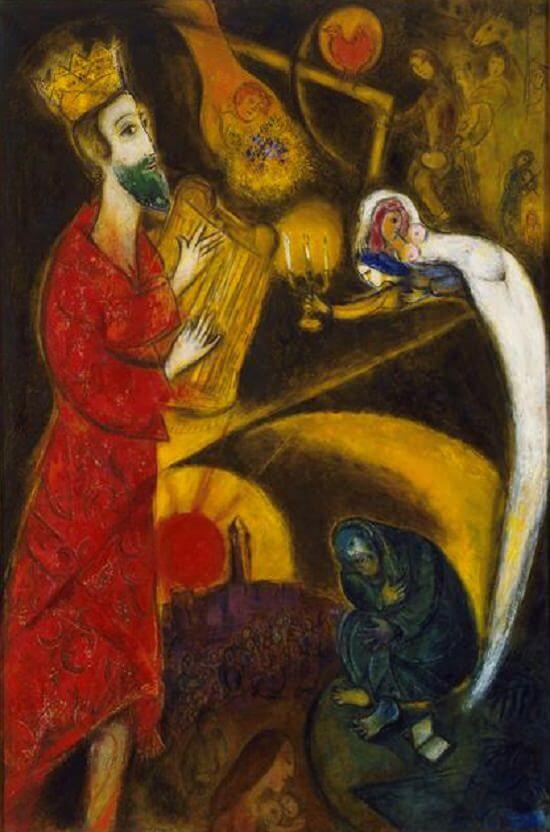
King David by Marc Chagall, 1962

Then King David went in and sat before the Lord, and he said:

“Who am I, Sovereign Lord, and what is my family, that you have brought me this far? And as if this were not enough in your sight, Sovereign Lord, you have also spoken about the future of the house of your servant—and this decree, Sovereign Lord, is for a mere human!

“What more can David say to you? For you know your servant, Sovereign Lord. For the sake of your word and according to your will, you have done this great thing and made it known to your servant.

“How great you are, Sovereign Lord! There is no one like you, and there is no God but you, as we have heard with our own ears. And who is like your people Israel—the one nation on earth that God went out to redeem as a people for himself, and to make a name for himself, and to perform great and awesome wonders by driving out nations and their gods from before your people, whom you redeemed from Egypt? You have established your people Israel as your very own forever, and you, Lord, have become their God.

“And now, Lord God, keep forever the promise you have made concerning your servant and his house. Do as you promised, so that your name will be great forever. Then people will say, ‘The Lord Almighty is God over Israel!’ And the house of your servant David will be established in your sight.

“Lord Almighty, God of Israel, you have revealed this to your servant, saying, ‘I will build a house for you.’ So, your servant has found courage to pray this prayer to you. Sovereign Lord, you are God! Your covenant is trustworthy, and you have promised these good things to your servant. Now be pleased to bless the house of your servant, that it may continue forever in your sight; for you, Sovereign Lord, have spoken, and with your blessing the house of your servant will be blessed forever.” (New International Version)

“The whole reason why we pray is to be united into the vision and contemplation of God to whom we pray.”

Julian of Norwich (1343-1416)

Perhaps you wish you had a better prayer life. To pray, as with most things in life, requires both motivation and how to do it. So, it’s appropriate to find answers about prayer by observing the biblical models of prayer contained in Holy Scripture.

Today’s Old Testament lesson is King David’s prayer in response to God’s revelation to him about fulfilling covenant promises. Looking at David’s prayer, there is a three-fold division which models for us a good way to approach God.

The Present: Gratitude for God’s Grace

David began his prayer with an attitude, posture, and words of humility, recognizing and affirming the relationship between himself and God. Although David is the king over all Israel and Judah, he repeatedly refers to himself as a servant (10 times).

God didn’t have to communicate anything to David about the future. Yet, the Lord graciously made known that it would be through David’s descendants that all of God’s good promises will be fulfilled. And David is overwhelmed with such gracious words. It comes tumbling out of him in a heartfelt prayer of gratitude and thanksgiving.

It is good for us to think about the spiritual blessings we have received from God. Not only can prayers of thanksgiving be uttered at any time to the Lord, but we can also write our gratitude in a journal as a prayer offering to God.

It’s also good to be specific about the circumstances and the praises. In the future, whenever there are discouraging situations, we can look back to what we wrote and remember the ways in which God showed up and encouraged us with very great and precious promises.

The Past: Praise for God’s Actions

David affirms there is no one and no god which can compare to Yahweh, the great I Am. It is the Lord God almighty who displayed divine power and presence in redeeming the Israelites out of Egyptian slavery and into the Promised Land.

Any greatness which arises from humans is the direct result of God’s greatness. Apart from God, there is no distinctive way of living. God’s presence makes all the difference:

Then Moses said to him [Yahweh], “If your Presence does not go with us, do not send us up from here. How will anyone know that you are pleased with me and with your people unless you go with us? What else will distinguish me and your people from all the other people on the face of the earth?” (Exodus 33:15-16, NIV)

The Lord specializes in bending hopeless situations to divine purposes, transforming people to new life, and turning systemic evil on its head so that the humble, meek, and penitent will be first, not last.

The Future: Prayer for God to Fulfill Divine Promises

King David already knew God’s promises to the Israelites. Now, however, David understands how he personally fits into the Lord’s plan.

Courage arises whenever God’s people know God’s promises and then discern how to fit into God’s plan. Confident assurance and settled peace cannot simply be ginned-up through positive thinking; bold faith needs a foundation of truth – a rock solid base which cannot be moved and is always there.

King David found his ultimate motivation in life in God’s revelation. His basis of prayer was God’s Word. Biblical prayers, like David’s, are there for us to model our own prayers.

Accept, O Lord, our thanks and praise for all that you have done for us. We thank you for the splendor of the whole creation, for the beauty of this world, for the wonder of life, and for the mystery of love. We thank you for the blessing of family and friends, and for the loving care which surrounds us on every side. We thank you for setting us at tasks that demand our best efforts, and for leading us to accomplishments that satisfy and delight us. We thank you also for those disappointments and failures that lead us to acknowledge our dependence on you alone.

Above all, we thank you for your Son Jesus Christ; for the truth of his Word and the example of his life; for his steadfast obedience, by which he overcame temptation; for his dying, through which he conquered death; and for his rising to life again, in which we are raised to the life of your kingdom. Grant us the gift of your Spirit, that we may know Christ and make him known; and through him, at all times and in all places, may give thanks to you in all things. Amen.

Hebrews 10:11-25 – Don’t Give Up!

Day after day every priest stands and performs his religious duties; again, and again he offers the same sacrifices, which can never take away sins. But when this priest had offered for all time one sacrifice for sins, he sat down at the right hand of God, and since that time he waits for his enemies to be made his footstool. For by one sacrifice, he has made perfect forever those who are being made holy.

The Holy Spirit also testifies to us about this. First he says:

“This is the covenant I will make with them
    after that time, says the Lord.
I will put my laws in their hearts,
    and I will write them on their minds.”

Then he adds:

“Their sins and lawless acts
    I will remember no more.”

And where these have been forgiven, sacrifice for sin is no longer necessary.

Therefore, brothers and sisters, since we have confidence to enter the Most Holy Place by the blood of Jesus, by a new and living way opened for us through the curtain, that is, his body, and since we have a great priest over the house of God, let us draw near to God with a sincere heart and with the full assurance that faith brings, having our hearts sprinkled to cleanse us from a guilty conscience and having our bodies washed with pure water. Let us hold unswervingly to the hope we profess, for he who promised is faithful. And let us consider how we may spur one another on toward love and good deeds, not giving up meeting together, as some are in the habit of doing, but encouraging one another—and all the more as you see the Day approaching. (New International Version)

The book of Hebrews was originally a sermon preached to a group of struggling Jewish Christians who were discouraged. They were a congregation in decline. The preacher’s approach throughout is to demonstrate that Jesus is better and superior to anything or anyone ever.

With this high view of the person and work of Christ, the preacher comes to the punch line of his sermon. He insists that what the believers need is perseverance to keep going – no matter what adversity they face. For without the ability to endure hardship, the sagging congregation would continue to decline and eventually give up.

Yet, giving up is not an option when it comes to the Christian life. The Christians may not have been going through a Job-like experience, but they needed to get some spiritual spine to them so that they could stand up for Jesus. 

Sometimes, because most of life is lived in the mundane, we can slowly drift from our spiritual moorings and just go through the motions of Christianity without really living for Jesus. Boring and repetitive work; the monotony of caregiving; the tedium of busywork; and the continual grind of it all can be an effective tool in the devil’s workshop. 

When we begin sleepwalking through life, we are in danger of wandering from faith. We then need some stout spiritual stamina. “I didn’t sign up for this!” can be the cry of both the person who is downtrodden with hard circumstances, as well as the person who is simply living a dull life. 

We all have our quitting point – that point where we say, “enough is enough” and we give up and cry uncle. Those times usually come when the pain or inconvenience of what is happening overcomes the resolve to persevere. The devil keeps detailed notes on everyone’s quitting points, and he tries to get us to that point of being ineffective and giving up on the Christian life. 

It easily begins with some minor irritation or complaint against from another. Then moves further along by the loss of someone close. Frustration mounts if financial hardship happens. After a while, if things do not markedly improve, living day in and day out with missed expectations and disappointing situations may lead to bailing out, blowing up, or binging on a sinful desire.

At the quitting point, we throw up our hands, wrongheadedly believing others don’t care and that God is indifferent to our situation.

The preacher of Hebrews knows that the one real measure of a person is the learned ability to push through the quitting points of life. We need endurance and perseverance. But how will we get it?  How can we endure, living for Jesus for the rest of our lives?

There are three indispensable elements of the Christian life, necessary to persevering. Perseverance is a privilege, and not some drudging duty to slog through. Following Jesus for a lifetime comes as we embrace our spiritual privileges.

Faith is the privilege of continually approaching the Lord with confidence

We possess the incredible privilege of approaching the throne of grace with confidence because Jesus has opened the way to God. No longer do we need the elaborate Old Testament sacrificial system in order to approach God. So, let us draw near to God with a sincere heart in full assurance of faith.

We need faith to keep going in the Christian life. Faith is more than doctrinal confession; it is something we experientially live by every day. By faith, we come to God through Jesus – not only soaking in more information but also drawing near to Christ.

Jesus, when on this earth, drew near to the Father. We are to follow Christ in his example. Jesus practiced solitude, silence, and extended times of prayer. Our Lord oriented his teaching and healing ministry around his relationship with the Father by engaging in basic spiritual disciplines that put him in a position to hear and listen so that he could then do the will of God. 

“We can all see God in exceptional things, but it requires the culture of spiritual discipline to see God in every detail.”

Oswald Chambers

A successful student orients her life around certain study disciplines in order to learn and reach graduation day. A winning athlete orients his life around certain daily practices in order to develop the skills needed to face the upcoming competition. Likewise, if we want to follow Christ and draw near to God, we need to reorient our time and commitment in order to take advantage of the privilege of growing and maturing in Jesus. 

The perspective of Hebrews is that we must orient our lives around basic disciplines of faith and put our hands out in order to receive the gift of faith God wants to give us.  Faith is a muscle that must be exercised, or it will atrophy and become useless. And with puny weak faith muscles, it is easy to give up because we have no “umpff” for the Christian life.

Hope is the privilege of living for Jesus with a confident expectation that God keeps divine promises

Perseverance requires hope. Hopelessness happens without the continuing practice of faith expressed in drawing near to God. Hope in Scripture is not wishful thinking; it is a confident expectation that God is good for his promises. 

Hope enables us to bank on the words and ways of Jesus. In those times when we feel hopeless; when there is negativity in the air that brings us to the quitting point; when we sense a season of blessing is not going to come; it is in those very times the preacher of Hebrews says to hold unswervingly to your profession.

We will not always squint our spiritual eyes, looking for the least little hope. Just as young mothers must remember that constant lack of sleep and caring for a needy infant is not always going to be the status quo; just as kids must remember that they will not be in school for the rest of their lives; in the same way, we must remember that God will accomplish everything he sets out to do; that there is an end and a goal to Christianity; and we will be richly rewarded if we keep going and do not give up.

Love is the privilege of encouraging fellow believers

We are to pay thoughtful attention to one another. Believers are to take an interest in each other’s welfare, and put some significant thought into how to spur, incite, cajole, and provoke others into keeping up with Jesus. 

A major opportunity for encouragement is corporate gatherings. Attendance is not an end in itself. Worship services, small group Bible studies, and other ministries of the Church are important because they are moments for us to encourage other people.

Let’s play good response/bad response to this. Bad response: “I feel guilty about what you just said, so I will try harder to love and encourage others.” That’s a prescription for frustration and failure. It ends in reaching the quitting point because we are focusing too much on the strength of our own will, or lack thereof.

Good response: “Wow!  God wants to use me to love other people! I’ll seek to know Jesus better so that I can learn to live and love, just like him. I can’t wait to encourage someone and build them up in the faith.”

Church is not optional equipment for the Christian life. We need each other. We need the Church.

“Love cannot exist in isolation: away from others, love bloats into pride. Grace cannot be received privately: cut off from others, it is perverted into greed. Hope cannot develop in solitude: separated from the community, it goes to seed in the form of fantasies. No gift, no virtue can develop and remain healthy apart from the community of faith. ‘Outside the church there is no salvation’ is not ecclesiastical arrogance but spiritual common sense, confirmed in everyday experience.”

Eugene Peterson

“No one can have God as his Father who does not have the Church as his Mother.”

Cyprian (210-258 C.E.) Bishop of Carthage

“May Christians be guided by the Church’s maternal care until they grow up to maturity and attain the perfection of faith…. To those whom God is a Father, the Church must also be a Mother.”

John Calvin

The Church:

  • Creates a unique presence with God. (Matthew 18:20)
  • Provides the nurture, guidance, and encouragement necessary for spiritual development. (Romans 12:4-5)
  • Helps form our identity as Christians. (Ephesians 2:19-20)
  • Enables endurance through suffering and brings comfort and encouragement in difficult times. (James 5:14-15)
  • Nourishes with the Word in preaching and sacrament. (Acts 2:46-47)
  • Lifts up godly examples to imitate. (1 Corinthians 4:16)
  • Intervenes when sheep go astray. (Colossians 3:16)
  • Fosters spiritual transformation. (Philippians 2:12)
  • Brings maternal care and help. (1 Thessalonians 2:7)

Conclusion

Let’s be encouragers – loving others with the grace of Jesus. The following are six types of encouragers displayed in the book of Hebrews for us to emulate:

  1. The Promoter. Cheering others on to endurance. We are surrounded by a great cloud of witnesses cheering us on and promoting us to push through the quitting points. They did it, and so can we (12:1).
  2. The Professor. Affirming others’ work as valuable and important. God will not forget your work and the love you have shown God’s people and how you continue to help them (6:9-10).
  3. The Preacher. Rebuking and admonishing in love (Proverbs 27:5). We must pay more careful attention to what we have heard, so that we do not drift away.  How shall we escape punishment if we ignore such a great salvation? (2:1-3).
  4. The Prayer Warrior.  Approaching the throne of grace with confidence, so that we may receive mercy and find grace to help us in our time of need (4:16).
  5. The Partner. Coming alongside one another daily so that no one may be hardened by sin’s deceitfulness” (3:13).
  6. The Pastor. Shepherding others through the confusing situations of life. Jesus suffered outside the city gate to make the people holy through his own blood. Together, let’s go to him outside the camp, bearing the disgrace he bore, as we look forward to the heavenly city to come (13:12-14).

It’s our privilege to persevere through the spiritual gifts of faith, hope, and love. Use them for building up one another so that together we can endure for a lifetime.