People Are a Bundle of Contradictions (Romans 7:7-20)

“Contradictions” by Michael Lang, 2015

But I can hear you say, “If the law code was as bad as all that, it’s no better than sin itself.” That’s certainly not true. The law code had a perfectly legitimate function. Without its clear guidelines for right and wrong, moral behavior would be mostly guesswork. Apart from the succinct, surgical command, “You shall not covet,” I could have dressed covetousness up to look like a virtue and ruined my life with it.

Don’t you remember how it was? I do, perfectly well. The law code started out as an excellent piece of work. What happened, though, was that sin found a way to pervert the command into a temptation, making a piece of “forbidden fruit” out of it. The law code, instead of being used to guide me, was used to seduce me. Without all the paraphernalia of the law code, sin looked pretty dull and lifeless, and I went along without paying much attention to it. But once sin got its hands on the law code and decked itself out in all that finery, I was fooled, and fell for it. The very command that was supposed to guide me into life was cleverly used to trip me up, throwing me headlong. So sin was plenty alive, and I was stone dead. But the law code itself is God’s good and common sense, each command sane and holy counsel.

I can already hear your next question: “Does that mean I can’t even trust what is good [that is, the law]? Is good just as dangerous as evil?” No again! Sin simply did what sin is so famous for doing: using the good as a cover to tempt me to do what would finally destroy me. By hiding within God’s good commandment, sin did far more mischief than it could ever have accomplished on its own.

I can anticipate the response that is coming: “I know that all God’s commands are spiritual, but I’m not. Isn’t this also your experience?” Yes. I’m full of myself—after all, I’ve spent a long time in sin’s prison. What I don’t understand about myself is that I decide one way, but then I act another, doing things I absolutely despise. So if I can’t be trusted to figure out what is best for myself and then do it, it becomes obvious that God’s command is necessary.

But I need something more! For if I know the law but still can’t keep it, and if the power of sin within me keeps sabotaging my best intentions, I obviously need help! I realize that I don’t have what it takes. I can will it, but I can’t do it. I decide to do good, but I don’t really do it; I decide not to do bad, but then I do it anyway. My decisions, such as they are, don’t result in actions. Something has gone wrong deep within me and gets the better of me every time. (The Message)

“Contradictions in human character are one of its most consistent notes.”

Muriel Sparks, “Loitering with Intent”

The Apostle Paul’s vulnerable expression of his dilemma resonates deeply with many people. There are times when we say things to ourselves such as:

“I told myself I wasn’t going to be like my mother, and here I am responding just like she would.”

“I know better than to drive by the liquor store on my way home and pick up a pint of vodka, yet, I still did it.”

“I don’t want to die, but my thoughts keep racing about a plan for suicide.”

There are many situations in which we are both frustrated and befuddled by doing the things we do not want to do, and not doing the things we want to do.

Yes, indeed, Paul’s existential angst is a timeless description of our common human condition. We all can relate to the seeming inability to do what is right in so many situations. It can drive us nuts, even to a constant and never-ending low-level discouragement that underlies almost everything we do.

Paul’s prescription for dealing with this does not rely on law. He understood that putting our willpower and effort into obeying commands gets us nowhere, because we will eventually fail. Neither our brains nor our spirits work that way. Our willpower was never designed to be the driver of what we do and do not do. If anything, willpower, and the lack thereof, demonstrates just how much we are climbing the ladder on the wrong wall.

People are a bundle of contradictions, doing good, then bad, and flip-flopping back and forth with great frustration.

God’s law was not crafted to transform us from the inside-out. The law has three solid purposes, none of which are meant to bring deep personal transformation:

  1. Attention to the law works to restrain sin in the world
  2. Use of the law provides us with a helpful guide for grateful living in response to divine grace
  3. Reflection on the laws show us how bad off we really are in this world, and how much we are in need of forgiveness

We need a change of habits, and this is different than adopting a list of laws.

Habits are developed from our desires, our affections. In other words, we do what we love – more specifically, our ultimate love(s) drive us to do what we want. To put it in a more straightforward way:

We sin because we like it. And the path to overcoming any besetting sin is to have an ultimate love surpass the lesser sin which we like.

For example, I have developed daily habits or rituals of faith which enable me to commune with God. I love God with all my heart, soul, mind, and strength, and this ultimate love enables me to push out all competing gods who want my devotion. I also love my wife with all my heart. We work on developing habits of a marital relationship which reinforce our love for each other. Love is what drives me to do right and good by her.

So, what do we do when we mess up? For the Christian, no matter what the question is, the answer is always grace.

God’s grace in the finished work of Jesus Christ applied to us by the Holy Spirit is the operative power that changes lives. The law has no power to do that kind of work. Freedom from the tyranny of our misplaced desires and disordered loves comes from Christ’s forgiveness through the cross. Like a lover enamored with his beloved, our desires become oriented toward Jesus for his indescribable gift to us. That is the strength of grace.

Saving God, I thank you for delivering me from sin, death, and hell through your Son, the Lord Jesus. May your Holy Spirit apply the work of grace to my life every day so that I can realize spiritual healing and practical freedom from all that is damaging and destructive in my soul. Amen.

Living Into a New Story (Deuteronomy 5:22-33)

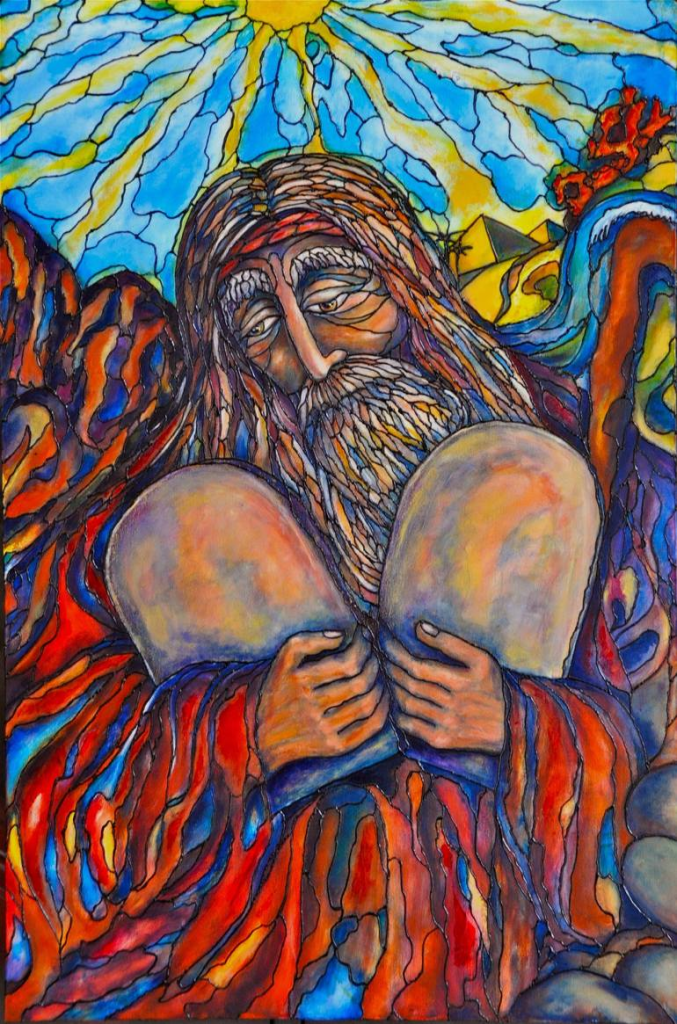
Moses, by Rae Chichilnitsky

“These are the commandments the Lord gave to all of you when you were gathered at the mountain. When he spoke with a mighty voice from the fire and from the thick clouds, he gave these commandments and no others. Then he wrote them on two stone tablets and gave them to me.

“When the whole mountain was on fire and you heard the voice from the darkness, your leaders and the chiefs of your tribes came to me and said, ‘The Lord our God showed us his greatness and his glory when we heard him speak from the fire! Today we have seen that it is possible for people to continue to live, even though God has spoken to them. But why should we risk death again? That terrible fire will destroy us. We are sure to die if we hear the Lord our God speak again. Has any human being ever lived after hearing the living God speak from a fire? Go back, Moses, and listen to everything that the Lord our God says. Then return and tell us what he said to you. We will listen and obey.’

“When the Lord heard this, he said to me, ‘I have heard what these people said, and they are right. If only they would always feel this way! If only they would always honor me and obey all my commands, so that everything would go well with them and their descendants forever. Go and tell them to return to their tents. But you, Moses, stay here with me, and I will give you all my laws and commands. Teach them to the people, so that they will obey them in the land that I am giving them.’

“People of Israel, be sure that you do everything that the Lord your God has commanded you. Do not disobey any of his laws. Obey them all, so that everything will go well with you and so that you will continue to live in the land that you are going to occupy. (Good News Translation)

The people were at the cusp of entering the Promised Land. They had experienced four hundred years of slavery; deliverance from Egyptian bondage; and forty years of wandering around the desert with no permanent home. Now, Moses gathers everyone together and restates God’s Law for a new generation about to realize God’s promise.

In today’s Old Testament lesson, Moses recalls his experience of receiving the two stone tablets, known to many as the Ten Commandments. Moses does this because he does not want this new generation of Israelites to be like their parents and grandparents – who experienced a failure of faith, resulting in their sojourn in the wilderness.

Obedience to God and all of God’s commands is central to a life of faith.

For that obedience to happen, all obstacles must be removed so that we can have an unhindered path in living the way we want to live. The Israelites were in slavery four hundred years. They needed a new story, which meant changing the old one. The people could participate with God by doing the following:

  1. Accept their wounded past of slavery. We cannot let something go and die without acknowledging it and having full acceptance that it happened.
  2. Don’t accept the limitations others put on us. The Israelites were slaves for so long that the Egyptians would have liked them to believe that’s all they could ever be. But the reality is that they are the people of God, meant for infinitely more than bondage.
  3. Trust the process of moving out of one story and into another. And it will take time. Forty years of wandering the desert helped the people wrap their minds and hearts around new possibilities.
  4. Take charge of your life by being a full participant in what the Lord is doing. Acting apart from God is pride. Failing to act is a lack of faith. But a divine/human participation knows what God does and what human responsibility is.
  5. Embrace all the emotions that go with what’s happening. Old ways often die hard. It didn’t take long after leaving Egypt for the people to long for the garlic and leeks of their former life. Holding and sitting with our feelings is an important piece of embracing a new story.
  6. Pay attention to constructing a soul which can serve you for a lifetime by taking initiative and action, reflecting on experiences, and living the insights gained.
  7. Discover new sources of growth and development for your new story and the next chapter of life. The same sources and resources which got you to this point may not be the same ones that will carry you on.

Moving through this liminal space enables us to obey God in new and fresh ways for the future. Obedience itself is not the hard thing; its ensuring a solid theological ground to stand on that is free of spiritual impediments that can hinder our faith.

Spiritual growth implies movement and change. This is necessary in order for the strengthening of faith. In allowing God’s commands and God’s sovereignty to have their way within us, we purposely engraft what’s needed for a lifetime of faith, hope, and love.

Glorious and sovereign God, give us your Spirit, so that we will be wise in how we live our lives. Help us to know you better through all of the experiences and learning we acquire in this life.

May our minds be opened to see your light, so that you will know the hope to which you have called us; and how rich are the wonderful blessings you promise us.

Grant us your strength so that we might remove every obstacle to faith. That spiritual power working in us is the same as the mighty strength which you used when raising Christ from death and exalting him above all things. Amen.

Change and Stress (Acts 27:1-12)

When it was decided that we would sail for Italy, Paul and some other prisoners were handed over to a centurion named Julius, who belonged to the Imperial Regiment. We boarded a ship from Adramyttium about to sail for ports along the coast of the province of Asia, and we put out to sea. Aristarchus, a Macedonian from Thessalonica, was with us.

The next day we landed at Sidon; and Julius, in kindness to Paul, allowed him to go to his friends so they might provide for his needs. From there we put out to sea again and passed to the lee of Cyprus because the winds were against us. When we had sailed across the open sea off the coast of Cilicia and Pamphylia, we landed at Myra in Lycia. There the centurion found an Alexandrian ship sailing for Italy and put us on board. We made slow headway for many days and had difficulty arriving off Cnidus. When the wind did not allow us to hold our course, we sailed to the lee of Crete, opposite Salmone. We moved along the coast with difficulty and came to a place called Fair Havens, near the town of Lasea.

Much time had been lost, and sailing had already become dangerous because by now it was after the Day of Atonement. So Paul warned them, “Men, I can see that our voyage is going to be disastrous and bring great loss to ship and cargo, and to our own lives also.” But the centurion, instead of listening to what Paul said, followed the advice of the pilot and of the owner of the ship. Since the harbor was unsuitable to winter in, the majority decided that we should sail on, hoping to reach Phoenix and winter there. This was a harbor in Crete, facing both southwest and northwest. (New International Version)

Change is an emotionally charged word. For some, change is longed for. Those with adverse circumstances and difficult situations may look for change, and even for a miracle to turn their life around. Others want nothing to do with change; they’ve had a bad experience with it. Their fortunes were good, until something changed. And now they’re stressed out.

The majority of us have some sort of love/hate relationship with change – which is why there are people who look askance on Christianity and raise their eyebrow in skepticism toward Christians or religious folk in general. At the heart of Christianity is change, and change can be quite threatening toward a lot of people.

The Apostle Paul perhaps knew about change better than any Christian in history. He went from resisting change with violence, to embracing change so wholeheartedly that he became a victim of other’s violence. We meet him in today’s New Testament lesson as a prisoner being shipped from Palestine to Rome.

Paul’s message, at its core, is the good news of transformation because of Christ’ crucifixion and resurrection. It’s a message of radical and joyous change, of new life. And it’s also a scandalous message which impacts the surrounding culture.

Wherever the gospel of Jesus Christ went, people responded, and it influenced society to a significant degree. Throughout the Acts of the Apostles, political authorities, religious leaders, and cultural elites felt powerful shifts in their societies. Yes, a few became Christians themselves, but most resisted the change, and in some cases, in their irritated stress response, retaliated against believers.

The message of Christianity doesn’t yield to political forces that attempt to domesticate God; and that reality put many believers in the crosshairs of those forces.

Paul’s ability to keep up his witness to Christ, even while held prisoner under powerful Roman authority, comes from a theology that God is above all earthly rule and can make a way where there seems to be no way. In other words, no matter whether human institutions, empires, and structures either acquiesce or oppose the gospel makes no difference; God is able to bend any system and authority for divine purposes.

And this is precisely why the Apostle Paul appears calm, non-anxious, and able to encourage others in the center of a storm in which everyone might lose their lives. Put simply: Paul trusted God.

Yes, we have unwanted circumstances. Yet, if we are able to entrust ourselves to a good God (which may sound trite and easy, yet is anything but that) then we find that we’re also able to have a radical acceptance of the situation we’re presently in.

Faith and trust help us to accept difficult changes and respond to stress with resilience because faith is attentive to the following:

  • Knowing change is coming. Throughout the New Testament we are told that adversity and suffering are an integral part of the Christian life. Paul wasn’t caught by surprise with a storm. In his life, he expected the difficulties to come.

You have seen me experience physical abuse and ordeals in places such as Antioch, Iconium, and Lystra. I put up with all sorts of abuse, and the Lord rescued me from it all! In fact, anyone who wants to live a holy life in Christ Jesus will be harassed. (2 Timothy 3:11-12, CEB)

  • Paying attention to the feelings of self and others. Emotions are not a necessary evil. They play a very important role in helping us come to grips with what’s happening. Paul acknowledged the emotions of everyone on the ship, as well as his own. And this became the pathway to both acceptance and encouragement.

There’s a season for everything
    and a time for every matter under the heavens

a time for crying and a time for laughing,
    a time for mourning and a time for dancing. (Ecclesiastes 3:1, 4, CEB)

  • Becoming resilient. The ability to adapt, to find ways of surviving and thriving, is buoyed by a robust faith which can see with spiritual eyes and make decisions of faith, hope, and love.

“When I was born into this world,
    I was naked and had nothing.
When I die and leave this world,
    I will be naked and have nothing.
The Lord gives,
    and the Lord takes away.
Praise the name of the Lord!” (Job 1:21, ERV)

Stress and change can be hard and overwhelming. Yet, at the same time, it can be an opportunity to put faith into practice and be a blessing to the world.

Assist us, Lord, in living hopefully into the future. In the face of change, help us to set unnecessary fears aside and to recognize our potential for creative response. Help us to develop a reasonable optimism and to guard against our own defensiveness. Be with us as we remember and celebrate former times, and keep us from unreasonable yearning for them, which takes us from the work you have set before us in our time. All this we ask in the name of your Son, our Savior, Jesus Christ. Amen.

Anyone Can Change (Jonah 3:1-10)

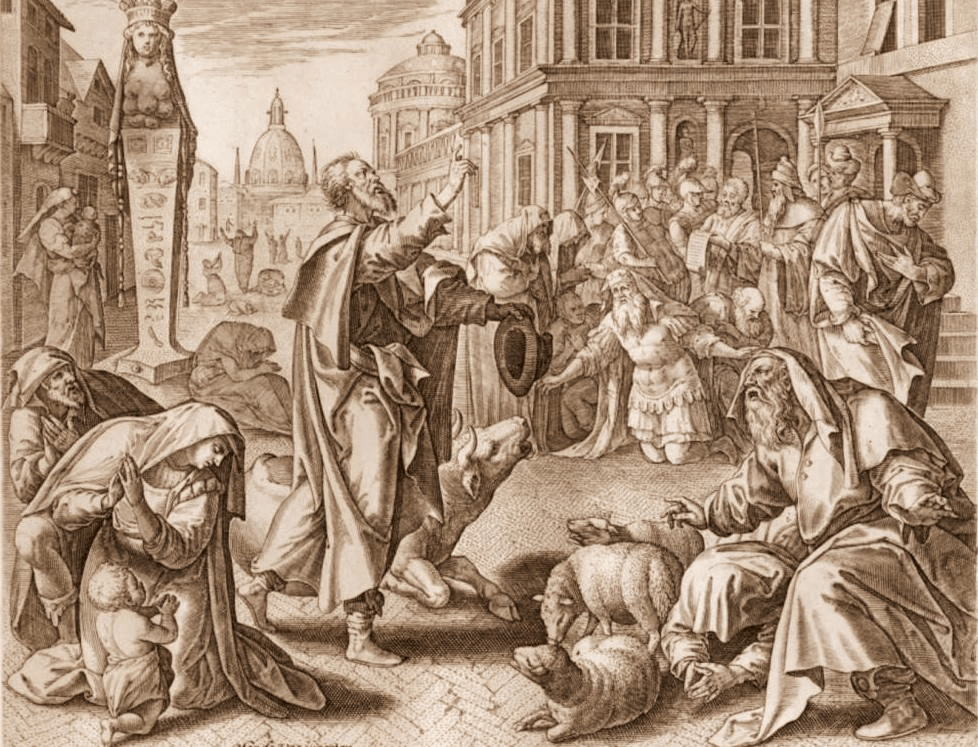
Print of Jonah preaching to the Ninevites and their repenting, by Philip Galle 1547–1612 

The Lord’s word came to Jonah a second time: “Get up and go to Nineveh, that great city, and declare against it the proclamation that I am commanding you.” And Jonah got up and went to Nineveh, according to the Lord’s word. (Now Nineveh was indeed an enormous city, a three days’ walk across.)

Jonah started into the city, walking one day, and he cried out, “Just forty days more and Nineveh will be overthrown!” And the people of Nineveh believed God. They proclaimed a fast and put on mourning clothes, from the greatest of them to the least significant.

When word of it reached the king of Nineveh, he got up from his throne, stripped himself of his robe, covered himself with mourning clothes, and sat in ashes. Then he announced, “In Nineveh, by decree of the king and his officials: Neither human nor animal, cattle nor flock, will taste anything! No grazing and no drinking water! Let humans and animals alike put on mourning clothes, and let them call upon God forcefully! And let all persons stop their evil behavior and the violence that’s under their control!” He thought, Who knows? God may see this and turn from his wrath, so that we might not perish.

God saw what they were doing—that they had ceased their evil behavior. So God stopped planning to destroy them, and he didn’t do it. (Common English Bible)

Anyone can turn around, even the nastiest of people.

Lent (the Christian season lasting six weeks from Ash Wednesday to Easter Sunday) is the ideal time of year to change, to turn around, to repent — to return to God and re-focus our lives.

The season of Lent is something like a forty-day trial run in changing your lifestyle and letting God change your heart. Repentance is the key that unlocks the soul’s ability to connect with God. To repent means to stop going in one direction and start going in another one. It makes all the difference in the orientation of our souls. 

Repentance leads to a real change of direction, a complete re-orientation of life. The evidence of such a change is this:

  • Owning up to the problem and confronting it
  • An eagerness to make things right
  • Indignation over what has been done or said
  • A desire and energy to do what is best for those we have wronged
  • A willingness to accept whatever consequences that might result from the offense

There’s nothing romantic about repentance; it’s typically messy, usually ugly, and often painful. Yet, there must be suffering before glory. Trying to take repentance out of the equation is to eviscerate life and leave our souls vacuous and empty.

Sometimes, we may not even realize we need to repent because we get caught up in the drama of whatever we’re doing – school, relationships, family, church, or work. Our lives can become filled with distractions that take us away from the spiritual life and the need to change.

But our soul knows it’s empty. And so, often unaware, we try to fill the vacuum with meaningless stuff, busywork, and mindless activities. What we’re really doing is running from real life and from God. 

We need to connect with the Divine; we need repentance. The Ninevites instinctively knew what to do; they fasted, prayed, and changed their ways. If a group of people who were experts at human torture and abuse could know this and intentionally pay attention to God, then how much more ought we to connect with what is most important?

Godly sorrow brings repentance that leads to salvation and leaves no regret.

2 Corinthians 7:10, NIV

Throughout Holy Scripture, whenever people were confronted with divine realities, they were completely undone; they began to see their own sin for what it truly is. 

When the Apostle Peter saw the Lord Jesus in his immensity and power through a miraculous catch of fish he fell at Jesus’ knees and said, “Go away from me, Lord; I am a sinful man.” (Luke 5:8) 

When the Apostle John had a vision of Jesus Christ in all his glory, and heard his voice, he fell at the Lord’s feet as though dead. (Revelation 1:12-17)

When the prophet Ezekiel had a vision of God and saw the appearance of God’s glory, he fell facedown. (Ezekiel 1:25-28) 

Even Daniel, perhaps the most righteous prophet and person of all time, saw a vision of God in all his glory, he fell prostrate with his face to the ground, totally overwhelmed with God’s holiness and human sinfulness. (Daniel 8:15-18)

We must put ourselves in a position to hear God so that we can turn from all the obstacles that prevents us from experiencing life as it is meant to be lived. And the all the things which hinder us from repenting are legion:

  • inattention to God’s words and God’s creation
  • constant and prolonged preoccupations and daydreams that prevents availability to God
  • lack of sleep and good health habits that dulls the spiritual senses and prevents awareness of God
  • a paucity of spiritual practices and disciplines that would put us in a position to experience God

Let us, then, take a lesson from the repenting Ninevites and pay attention to God. For God is calling, yet we do not hear him. So, let’s put ourselves in a position to hear the message of God; identify the things that grieve God’s heart; and repent.

God has gone out of the way to reach us so that we can change for the better. And anyone, no matter who they are, can experience it – even a terribly sinful nation of people.

What will you do with this grace?

Almighty and everlasting God, the One who freely pardons all who repent: Redeem and renew every penitent heart with your infinite mercy and grace, forgiving all our sins, and cleansing us from an evil conscience. Amen.