
1 Peter 4:7-11 – Be Hospitable

One of the Family, Frederick George Cotman, 1880

The end of all things is near; therefore, be serious and discipline yourselves for the sake of your prayers. Above all, maintain constant love for one another, for love covers a multitude of sins. Be hospitable to one another without complaining. 

Like good stewards of the manifold grace of God, serve one another with whatever gift each of you has received. Whoever speaks must do so as one speaking the very words of God; whoever serves must do so with the strength that God supplies, so that God may be glorified in all things through Jesus Christ. To him belong the glory and the power forever and ever. Amen. (New Revised Standard Version)

One of the most practical and biblical ways of demonstrating love is through hospitality.

Hospitality, at its heart, is an invitation to come into my home and into my life. It is a ministry of acceptance, encouragement, restoration, and healing. 

The loving work of hospitality “covers a multitude of sins” through the power of influence. When we have face-to-face conversations around the table, it prevents us from engaging in sins that would otherwise be committed if left to ourselves.

Because the end of all things is near, we need our wits about us through a determined focus on prayer, love, and hospitality.

The word “hospitality” literally means, “love of the stranger.” I invite someone whom I do not know very well into my home and befriend them. This is what Jesus did for us. Although we were all estranged from God and on the outside, Jesus came to eat with us.

“Listen! I stand at the door and knock; if any hear my voice and open the door, I will come into their house and eat with them, and they will eat with me.” (Revelation 3:20, GNT)

Jesus invites us into the life of God; and so, we are to invite others into our lives. Jesus has so closely identified with his people that when we practice hospitality, we are inviting Jesus in. In fact, we may not realize that some people we host are angels: 

Do not forget to show hospitality to strangers, for by so doing some people have shown hospitality to angels without knowing it. (Hebrews 13:2, NIV)

Inviting another person into my home and my heart takes time and effort. Doing it without grumbling is a necessity.
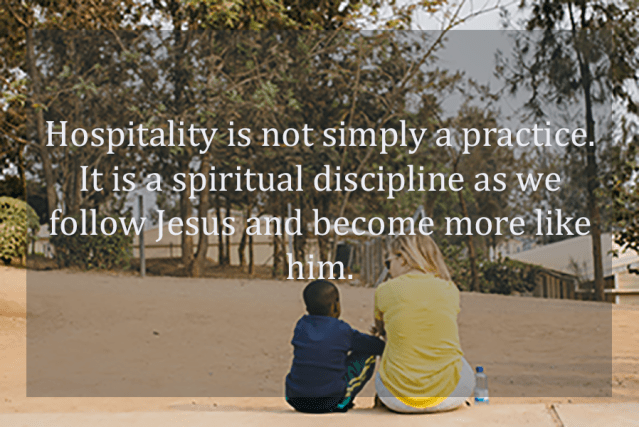
In an ideal world, we always receive something back for our work of hospitality – an invitation from the other person, or, at least, a simple thank you. That does not always happen; it must not be the driving reason why we are generous.

Hospitality is a work of love which originates from a heart that has been touched by the hospitality of God. Our earthly hospitality is a form of saying “thank you” to God for the grace given to us.

Complaints break into the house like unwanted burglars when we expect to receive, and do not. If you receive another person as though they were Christ himself, grumbling will likely be far from you. Instead, there will be rejoicing over the opportunity to serve Jesus.

Jesus said, “Anyone who welcomes you welcomes me. And anyone who welcomes me also welcomes the one who sent me.”

Matthew 10:40, CEV

In the New Testament world, a concrete expression of love to other believers in Jesus was providing food and shelter for Christians traveling throughout the Roman Empire. Often, the traveling strangers were itinerant evangelists spreading the message of the gospel from place to place. 

Dear friend, you are faithful in what you are doing for the brothers and sisters, even though they are strangers to you. They have told the church about your love. Please send them on their way in a manner that honors God. It was for the sake of the Name that they went out, receiving no help from the pagans. We ought therefore to show hospitality to such people so that we may work together for the truth. (3 John 5-8, NIV)

At times, believers were deprived of necessities due to occasional waves of persecution. The people Peter addressed were mostly Jewish Christians. As they faced persecution in Jerusalem, they fled to geographical places dominated by pagan Gentiles.

As refugees, they were often poor and needy; and the townspeople where they went were not hospitable. So, they had to rely on the love and hospitality of those believers they could connect with who had the means to help.

Contribute to the needs of God’s people, and welcome strangers into your home.

Romans 12:13, CEB

There is a great need for hospitality in our world. 

Many American’s circle of friends is shrinking. According to one study, the number of people who said they had no one to talk to about important matters has more than doubled in the past 10 years. Over 35 million Americans now live alone (28% of all households). 

Hospitality cuts both ways for us. We are to invite the lonely into our hearts and homes; and the lonely are to invite others into their hearts and homes, instead of waiting for somebody to just show up.

Food is to hospitality what weightlifting is to bodybuilders; you really need food, meals, and the sharing that goes with it to make a difference in another’s life.

In biblical times, eating a meal together was a sacred affair.  To have another person in your house, sitting around your table, was a way of communicating acceptance, care, and friendship. That’s why the religious leaders had such difficulty seeing Jesus eat with “sinners.” Jesus was unequivocally loving and accepting of such persons.

Looking at our world, it can often be a sad place. We may wonder:

  • Can people of different races live in peace? 
  • Can Democrats find common ground with Republicans? 
  • Can a Christian family carry on a civil friendship with neighbors down the street far from Christianity? 
  • Can people worlds apart from each other get along? 

The early church did. And they did it without all the stuff we have – through the simplest tool of the home.

No matter our gifts and abilities, each one of us can be hospitable. Something mystical happens at a dinner table that does not happen anywhere else – it opens the door to true community.

“Table of Hope” by Joey Velasco

While they were eating, Jesus took a loaf of bread, and after blessing it he broke it, gave it to the disciples, and said, “Take, eat; this is my body.” Then he took a cup, and after giving thanks he gave it to them, saying, “Drink from it, all of you; for this is my blood of the covenant, which is poured out for many for the forgiveness of sins. (Matthew 26:26-28, NRSV)

For the Christian, eating and ingesting bread and wine serves as a tangible way of understanding what life is to be like. We take Jesus into the depths of our lives. We ingest him, that is, we engage in an intimate relationship whereby the two of us can never be separated.

We are meant for life together, to enjoy eating and drinking together. True life is sharing both our resources and our hearts with one another. 

Loving God, thank you for your generosity. I am a stranger in this world, yet you invite me to be your guest. You lavishly offer me your hospitality and welcome me into your family. You invite me to share in the abundance of your kingdom. Help me remember that when I offer hospitality to others, I am receiving Christ into my home.

Gracious God, I open my heart to those who are wounded; those who have wounded me; those who are outcasts; and to all who are searching. I want my everyday ordinary life to please you. I am grateful that there is always room at your Table; through Jesus, my Lord. Amen.

Everyone Can Juggle

“Say, what?” you may protest. “I can’t juggle. I can’t learn that. I’m not coordinated, not rhythmic, not graceful, not _____.” (fill in the blank with your own negative)

I’m not buying it. I insist everyone can juggle, without exception. Yes, even the elderly, the young, those with severely arthritic hands and no hands, at all, can juggle. This is no mind game. It’s not playing with words.

Everyone can juggle because there is a juggler inside of every person.

God is Creator. People are creatures, created in the image and likeness of God. God is a juggler. And so are you and me.

It comes down to what kind of story we are telling ourselves.

For example, if there is a narrative rolling around in your head that you are stupid, even though you may be very intelligent, you will live up to the story of being unintelligent. The life you live will be as an incompetent nincompoop.

So, what is the story you are telling yourself about yourself?

Juggling takes practice. I can teach anyone to juggle in three minutes, or less. After that, it’s all about doing it – lots and lots of repetition and practice. It takes time, patience, and tenacity – the very qualities required to do just about anything.

Which you have done multiple times in your life, already. Sometimes we all need to remember when we did something well, when we committed to the time and effort of accomplishing an important task or project.

There is nothing glamorous about learning to juggle, and certainly not about becoming proficient at it. It is tedious, pedantic, and at times, frustrating work. It takes an overarching, “Why?”

If I want to juggle because it looks cool, and I’d like to impress friends, then I likely will not stick with it. If I believe it can be done in a relatively short amount of time, then I’ll probably become discouraged and drop out.

Yet, if I discover I really like to juggle, and I want to do it, that in the doing of this new thing I am finding out some things about myself I didn’t know before – or even that when I juggle, even imperfectly, I learn something about God – well, then, this is a “why” which has sustaining power.

Yes, indeed, everyone can juggle. There is a juggler inside each and every one of us. The real issue is whether we actually believe that is true, and whether we really have a solid internal reason for doing so.

So, let’s come back to that weird part about what I said above – that even people without an ability to lift their arms (or with no arms, at all) can juggle. It has to do with our definition of juggling. Here is the straight up dictionary definition of the words, “juggle,” “juggling,” and “juggler:”

To keep (several objects, as balls, plates, tenpins, or knives, etc.) in continuous motion in the air simultaneously by tossing and catching.

To perform feats of manual or bodily dexterity, as tossing up and keeping in continuous motion a number of balls, plates, knives, etc.

A person who performs juggling feats, as with balls or knives, etc.

One little word makes the difference here: etcetera. (etc.)

I’m actually not going to answer my own question or make explicit my point. I’ll let you fill it in yourself because I am confident you can do so. You are creative.

You’ll figure it out.

What we all really need is just enough direction to get our creative abilities going, without so much instruction that it becomes controlling (like a boss looking over your shoulder and just barking orders when you screw up).

Developing a skill or a craft is different than becoming a professional or doing a job. The real work is both internal and most often out of the limelight. It’s a commitment to a process, more than it is a means to an end goal. A process cannot be rushed; there must not be shortcuts. And, unless we learn to enjoy the process, we end up doing shoddy work.

The construction of a person’s soul is a lifelong project.

It requires becoming aware of one’s deep inward spirituality. Solitude, silence, and stillness are imperative to forming the soul.

I am a Christian. As such, I want to know Christ better. For that to happen, I need to pay attention to and care for my soul.

Throughout the history of Christianity, much attention has been given to the care of souls. Early church fathers (and mothers) such as Gregory the Great (540-604, C.E.) took great pains to describe ministerial work as offering moral and spiritual guidance to both the churched and unchurched, both Christian and non-Christian.

In 1656, Puritan preacher Richard Baxter wrote a book, The Reformed Pastor, which set the standard of pastoral care for generations. Baxter elaborated on seven functions of crafting souls (stated in my own words):

  1. Helping others connect with their spiritual selves;
  2. Giving sage spiritual direction;
  3. Building up people with careful and encouraging words;
  4. Attending to church, family, and group dynamics;
  5. Providing special focus to the needy, the sick, and the dying;
  6. Holding people accountable for their words and actions;
  7. Setting proper spiritual boundaries to keep harmful words and actions at bay within the community.

There is nothing sexy about any of these functions. It is humble nitty-gritty work which typically goes unnoticed by many because it is a slow process over time.

As a Christian who is concerned for the construction of souls, I take my cues from the Christian Bible. There are many references to “one another” in the New Testament which highlight the spiritual dynamics and proper environment needed for souls to thrive. Just a few of the most mentioned are: 

  • Encouragement
  • Mutual edification
  • Love
  • Forgiveness
  • Hospitality

Within the New Testament Gospels of Jesus, Christ modeled a life of spiritual practice which include healing, teaching, guiding, and mending damaged and broken souls. These were all a part of his mission to bring God’s benevolent kingdom to earth.

Like a proper garden, we need to continually tend to our soul, which requires the consistent spiritual farming of daily Scripture reading and prayer, practicing Sabbath rests, silence and solitude, fasting, and giving.

Our souls need careful shepherding. We are to be vigilant toward attending to our spiritual selves, as well as the souls of others – not because we must, but because we are willing.

You can do this. After all, you are a juggler!

Isaiah 43:8-15 – The Supremacy of God Matters

Bring out the people who have eyes but are blind,
    who have ears but are deaf.
Gather the nations together!
    Assemble the peoples of the world!
Which of their idols has ever foretold such things?
    Which can predict what will happen tomorrow?
Where are the witnesses of such predictions?
    Who can verify that they spoke the truth?

“But you are my witnesses, O Israel!” says the Lord.
    “You are my servant.
You have been chosen to know me, believe in me,
    and understand that I alone am God.
There is no other God—
    there never has been, and there never will be.
I, yes I, am the Lord,
    and there is no other Savior.
First I predicted your rescue,
    then I saved you and proclaimed it to the world.
No foreign god has ever done this.
    You are witnesses that I am the only God,”
    says the Lord.
“From eternity to eternity I am God.
    No one can snatch anyone out of my hand.
    No one can undo what I have done.”

This is what the Lord says—your Redeemer, the Holy One of Israel:

“For your sakes I will send an army against Babylon,
    forcing the Babylonians to flee in those ships they are so proud of.
I am the Lord, your Holy One,
    Israel’s Creator and King. (New Living Translation)

I am an ordained Minister in a smallish denomination, the Reformed Church in America. This particular Christian tradition has its roots in the magisterial reformer, John Calvin (1509-1564). Calvin placed a strong emphasis on the sovereignty of God. In other words, all things hinge on God as the supreme Being of the universe. As Creator of all things, God’s actions and inactions are in no way dependent upon us creatures.

I believe in God’s unconditional election of persons to salvation and new life. Maybe that means nothing to you, and to others it means everything. For many folks, it’s just some churchy mumbo-jumbo which is rather irrelevant to the real stuff of the Christian life. 

I do not agree. It seems to me to be quite important. The heart of Reformation faith is a focus on God’s sovereignty, majesty, power, and grace. It is God who justifies, and not any human. That means there are no conditions to which God is beholden to act. That is, God works in the world according to divine free will and is not reliant upon anyone or anything to accomplish good purposes and fulfill good promises.

“We should therefore learn that the only good we have is what the Lord has given us gratuitously; that the only good we do is what He does in us; that it is not that we do nothing ourselves, but that we act only when we have been acted upon, in other words under the direction and influence of the Holy Spirit.”

John Calvin

Today’s Old Testament lesson is a soaring view of God’s grace and powerful control. Throughout all eternity God is God. There is none who can thwart the Lord’s plans. God acts freely and mercifully and nothing can cancel out those actions. Nothing can separate us from the love of God. We might jump from finger to finger in our puny attempts at autonomy, but we are not getting out of God’s hand! 

For me, this is a balm and a comfort to my soul. Not everything is up to me, as if my action or inaction has cosmic repercussions. As a guy who easily tends toward carrying the world on his shoulders, it is good for me to know that the earth spinning on it’s axis isn’t my job.

It seems to me, the assurance of God’s sovereignty in the world really ought to be a comfort to every believer. God’s decrees will be fulfilled, and there is not one thing any wicked person can do to subvert divine initiatives.

Furthermore, there is absolutely no way we can screw-up God’s purposes. We simply do not have such power. Our great task as believers is to rest secure in God’s will and to therefore place our trust in the One who knows exactly what he is doing in the world.

So, take a few minutes, draw in a few deep breaths, and think on the wonderful truth that God is sovereign. To help you, here is the great opening to the Reformed confession, The Heidelberg Catechism, giving us a glimpse into the majesty of God:

Q: What is your only comfort in life and in death?

A: That I am not my own,

but belong with body and soul,

both in life and in death,

to my faithful Savior Jesus Christ.

He has fully paid for all my sins

with his precious blood,

and has set me free

from all the power of the devil.

He also preserves me in such a way

that without the will of my heavenly Father

not a hair can fall from my head;

indeed, all things must work together

for my salvation.

Therefore, by his Holy Spirit

he also assures me

of eternal life

and makes me wholeheartedly willing and ready

from now on to live for him. Amen.

Who Do We Minister To?

Welcome, friends! Matthew 22:36-40 are the words of Jesus to love God and love our neighbor. The ability to extend that love is grounded in God because God is Love. Click the videos below and let us consider the great love of God toward us and all humanity….

Pastor Tim Ehrhardt, Matthew 22:36-40

May Christ the Son be manifest to you, that your love and your life may be a light to the world. And may the blessing of God our Creator, Redeemer and Giver of life be with you always. Amen.