

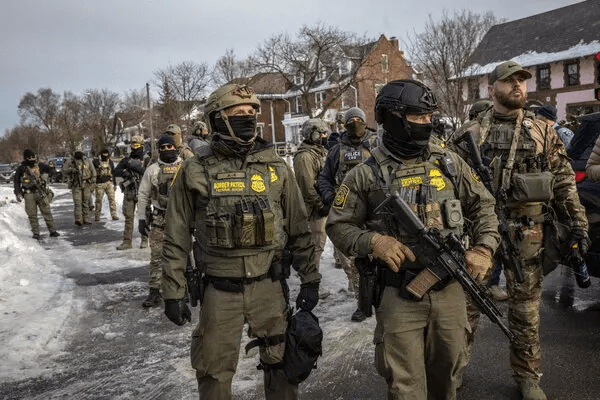
I am, like you, a resident of Minnesota, specifically of the greater Twin Cities area. I have children, grandchildren, and relatives in the city of Minneapolis. So, I am regularly and often in the city’s neighborhoods. I am existentially involved in what is presently happening to the city with the presence of thousands of Immigrant and Customs Enforcement (I.C.E.) agents.
I am not someone who is observing from afar. I see you, up close and personal. And I want you to know that I understand and feel your abject fear, but most of all, your incredibly deep sadness at what is happening to you and your neighbors.
Yesterday, when at a healthcare appointment, with tears in my eyes, I bemoaned that, because of my health, I am unable to be with the protesters, providing spiritual care and emotional encouragement as a retired hospital chaplain and church pastor.
Hence, the writing of this letter. It’s my way of doing something, anything, to help in a time of trouble, in which there seems to be no law but the law of forced power and the might of militarized against the un-militarized.
Yet, my most potent form of help, I believe, are my abiding prayers lifted to God on your behalf and for your wellbeing. I know you are suffering, and I suffer with you. Please think of me as someone who is helping to carry your ridiculously heavy load of grief, confusion, and wondering.
I am with you in feeling like your neighborhoods are back in some COVID-style isolation. Communities have become ghost towns with people afraid to go outside for fear of being treated like “garbage” from a “garbage country,” even though many of you are United States citizens born and raised in Minnesota.
I see what the rest of the country and the world may not see: In the face of real oppression and abuse – designed to break your spirits – so many of you have risen to love your neighbors as yourselves.
Churches, faith communities, non-profit organizations, and individuals are providing meals and running errands for those fearful of going outside to likely face people dressed more like terrorists than fellow citizens.
Even you who help are getting stopped by I.C.E. agents and, in many cases, are detained for hours at a time. But you keep going out, nonetheless, because you are determined to do what is needed to achieve justice and mercy.
I see and applaud your efforts at helping each other. I know that you, including me, are a traumatized people, and for good reason. Please keep up your resilience and maintain your perseverance. It shall be rewarded.
Moreover, I also applaud those concerned citizens from neighboring states who have come with their fresh anger, righteous zeal, and words of encouragement, in order to protest with peace and non-violence. My thanks and gratitude to them for interrupting their own lives to be with us.
My friends, don’t give in to the massive gaslighting project that is directed toward you by the current federal government administration. They, along with their militarized lackeys, are trying their best for you to adopt their twisted view of reality.
No matter which way the Director of Homeland Security wants to spin it, a water balloon and a sub sandwich are not threats to body armor and helmets. But the clubs, tear gas, lack of respect, and very real bullets of I.C.E. agents are vital threats against us.
They may be armed with things which can harm the body, but you have spiritual weapons that they neither understand nor can see because of their spiritual blindness.
They’re trying to make you think that there’s something wrong with you when there isn’t. They want to force the view that sheer power is what’s important. But all along you remember, know, and are practicing that the way of love and compassion has more power than any sort of hate and lack of mercy.
In the future, you will be remembered for your steadfastness in showing grace to the weak and powerless, the immigrant and the alien among you.
No matter who you are – whether white, black, brown, citizen or immigrant, rich or poor – you are all, in my Christian belief, created in the image and likeness of God. Therefore each one of you has inherent worth, and ought to be treated with respect and dignity befitting your status as human beings.
Please also know that I am on my knees in prayer for you each day. I often intercede for you with many of the biblical psalms, because they are prayers meant for us to use as our own. Today I offer Psalm 140. As I pray, I use nouns and pronouns which refer to you and me, as I believe the original psalmist wanted us to do…
Psalm 140
For the director of music. A psalm of David.
Rescue Minneapolis, Lord, from evildoers;
protect them from the violent,
who devise evil plans in their hearts
and stir up war every day.
They make their tongues as sharp as a serpent’s;
the poison of vipers is on their lips.
Keep the residents of Minneapolis, St. Paul, and all of Minnesota safe, Lord, from the hands of the wicked;
protect us from the violent,
who devise ways to trip our feet.
The arrogant have hidden a snare for us;
they have spread out the cords of their net
and have set traps for us along our path.
I say to the Lord, “You are my God.”
Hear, Lord, my cry for mercy.
Sovereign Lord, my strong deliverer,
you shield our heads in the day of battle.
Do not grant the wicked their desires, Lord;
do not let their plans succeed.
Those who surround us proudly rear their heads;
may the mischief of their lips engulf them.
May burning coals fall on them;
may they be thrown into the fire,
into miry pits, never to rise.
May slanderers not be established in the land;
may disaster hunt down the violent.
I know that the Lord secures justice for the poor
and upholds the cause of the needy.
Surely the righteous will praise your name,
and the upright will live in your presence.
May the grace of God, the love of Jesus, and the encouragement of the Spirit be with you all, now and forever. Amen.
Rev. Tim Ehrhardt, MDiv, MA, BCC






 Rev. Tim Ehrhardt