“I Choose You!” (Ephesians 1:3-6)

Blessed is the God and Father of our Lord Jesus Christ, who has blessed us with every spiritual blessing in the heavenly realms in Christ. For he chose us in Christ before the foundation of the world that we should be holy and blameless before him in love. He did this by predestining us to adoption as his legal heirs through Jesus Christ, according to the pleasure of his will—to the praise of the glory of his grace that he has freely bestowed on us in his dearly loved Son. (New English Translation)

There is perhaps no greater sense of worth, security, and love, than stating with sincerity and conviction to another, “I choose you!”

That is exactly what God has done for us. In fact, the Lord chose us and included us before we were even born into this world. Our identity is secure in belonging to God because it isn’t based in any of the screw-ups I did yesterday or the bad decisions I made years ago. Christian identity is based solely and completely by the choice and action of God, in Christ, through the Spirit.

People tend to live up to how they view themselves, to how they self-identify. So, it is critical to our well-being how we truly understand self, others, and God.

If we see ourselves as never getting ahead and needing to lie, cheat, and steal to obtain anything in this life, then we will view ourselves as common thieves.

If we think the only way to have love and security in this life is to hustle for it – to make ourselves as presentable as we possibly can, then we will view ourselves as basically unlovely and search for love in all the wrong places by trying to keep up appearances.

If we look at ourselves as stupid, then we will tend to make poor decisions even when it’s in our ability to make good choices because we see ourselves as unable to compete with those smarter than us. 

The common theme in all these scenarios are people living apart from God. Without the Lord Jesus, we are like lost street children trying to survive from day to day. What we need, what we search for and long for, is to have a good, blessed life in a loving home, a place to belong in a world of disconnection.

To be “blessed,” to have “blessing” in the Holy Scriptures, is to have God’s stamp of approval on your life. It is to know, experience, and feel Divine favor resting upon you.

The picture being painted at the very beginning of Paul’s letter to the church at Ephesus is of wayward children roaming the streets as orphans. The Ephesians were ensconced in their idol worship of Artemis, the fertility cult goddess. They were going about life without a whim about the true and living God.

Out of sheer grace, God plucked them from their worthless condition and adopted them. God placed blessing upon them because of love and gave them a reason to rejoice and praise.

What’s more, the Ephesians were chosen and predestined for holiness and purity. God set them apart for divine blessing. It’s as if God brought them into the kingly palace, provided lavishly for them, and let them have the run of the place. They get to enjoy every privilege that comes with being children of the king.

The focus and orientation of today’s New Testament lesson is about how tremendously special the believer in Jesus really is. And it has nothing to do with how presentable we are to a holy God. Instead, out of the vast storehouse of blessed grace, God chose and adopted. The Lord looked upon you and me with googly divine eyes and said, “I choose you!”

God chooses from a place of divine pleasure. Yes, that’s right. God chooses, predestines, and adopts with a willing heart because it brings great pleasure and divine joy to do so!

There was no arm-twisting from the Father to the Son in securing redemption for lost humanity. And there was no persuasion necessary for the Father and Son to send the Spirit for our ongoing benefit and help in this life. Each redemptive event of Jesus was done out of the grace and love of God in Christ through the Spirit.

Do you see how God views you? Do you know how special you truly are?  Have you an understanding of the incredible position and majesty you have as a human being in God’s image and likeness?

As a child of the king, you live up to the position you know you possess. Freedom from worry and anxiety don’t come from willpower, but from an understanding that God owns all things, and we will never be in need. 

Deliverance from the power of darkness doesn’t come by trying to do better; it comes through the knowledge that God has redeemed us and chosen us to live in the gracious realm of divine love forever. There is no need to hustle for love with God because you and I already have it.

The believer has every spiritual blessing in Christ. God has your back. We belong to God. And to belong to Jesus Christ is to be blessed. It makes all the difference in the world. It is our reason for gratitude and praise, and for settled peace and glorious rest.

Gracious God, your loving activity has snatched me from the barren streets of sin and brought me into a realm of incredible blessing. Thank you for blessing me and giving me a place to belong forever; through Jesus Christ, my Lord and Savior, who with you and the Holy Spirit reign forever and ever in a celebration of redeeming love.  Amen.

The Restorative Powers of Grace (Jeremiah 31:10-14)

Listen to the Lord’s word, you nations,
    and announce it to the distant islands:
The one who scattered Israel will gather them
    and keep them safe, as a shepherd his flock.
The Lord will rescue the people of Jacob
    and deliver them from the power of those stronger than they are.
They will come shouting for joy on the hills of Zion,
    jubilant over the Lord’s gifts:
        grain, wine, oil, flocks, and herds.
Their lives will be like a lush garden;
    they will grieve no more.
Then the young women will dance for joy;
    the young and old men will join in.
I will turn their mourning into laughter
    and their sadness into joy;
        I will comfort them.
I will lavish the priests with abundance
    and shower my people with my gifts,
        declares the Lord. (Common English Bible)

In the seasons of our lives, when we go through those times of difficulty, it feels like a hard slog uphill that never seems to end. But it will not always be this way. Suffering will eventually give way to rejoicing; sickness will turn to health; estranged relationships will reconcile; and broken spirits will be made whole again.

God is the expert in restoration. Dilapidated communities, broken individuals, and peoples in diaspora can find fresh hope amid challenging circumstances. The initiative, interventions, and actions of God are what make the difference in turning sorrow to joy.

The Lord gathers scattered people together, as well as making the disparate parts of people into a unified whole again. And in this gathering action of God, no one is left behind. Attention is given to the stragglers, to those unable on their own strength or ability to journey on the road back to the Lord.

With the Lord’s movements of mercy, those with unfortunate circumstances are turned into the fortunate ones. The underprivileged become privileged. Grief, lament, and mourning give way to joy and a new lease on life. A great reversal occurs with God’s intervention. Sorrow is transformed into praise. Goodness is found in abundance because the Lord is a good God.

God calls people to action, to a response of experiencing the restorative powers of grace. The Lord encourages such behavior because it helps us never forget that no one and no circumstance is ever beyond the renewing grace of God. The effect of God’s merciful activity in the lives of people is singing, shouting, listening, and proclaiming.

With spiritual renewal, there is no mumbling of words, no timidity about being off tune when lifting a song of praise and thanksgiving. The lonely person, fragmented group, depressed community, polarized neighborhood, or scattered nation who becomes restored by God’s merciful grace is a newly minted exuberant people. Singing organically arises from them.

God’s restorative work causes shouts of joy to emanate deep within the soul. In fact, the Lord’s activity is so wonderful that even the rocks will cry out if the people don’t. A last second win in the sports stadium amongst thousands of fans doesn’t even hold a candle to the celebrative shouts of believers gathered and restored.

Whenever a people hear God’s voice and respond, it results in restoration. The desire to listen is then heightened, and obedience to God’s will becomes the norm, instead of the exception. Increased proclamation of good news happens, as a joyous and privileged response to God’s amazing grace. More and more people are included within the community, and hope rises beyond what anyone thought was possible.

Rescue and redemption are at the heart of God toward lost and wayward humanity. Divine intervention leads to restoration of individuals, neighborhoods, faith communities, even nations. Like a faithful shepherd over a flock of sheep, the Lord actively seeks the lost, brings them home, and continues to stand watch over them as a compassionate guardian.

And just as God redeemed the people out of Egyptian slavery and took them to a good land of abundance, so the Lord shall return those persons exiled from that abundant place and restore them to the peace of settled rest. The restoring action of God gathers the scattered. The lost are found. That which is fragmented is made whole. Those previously disabled become able. The weak become strong, the sick healed, the hungry fed, and the prisoner freed.

In times of famine, disease, poverty, hardship, confusion, and scant resources, there is hope. The Lord knows how to restore fortunes and bring untold abundance amid the most difficult of situations.

True joy comes through hard suffering. The pains of childbirth give way to unspeakable joy.

Christians are about to enter the season of Advent, after the long months of ordinary time. God, in Jesus Christ, is about to enter the world through a woman, in the flesh. The gracious work is about to begin, of ransoming, redeeming, and restoring a sinful world that had exiled itself from peace and abundance. In Christ, our lives are about to become full of blessing.

Praise the God and Father of our Lord Jesus Christ for the spiritual blessings that Christ has brought us from heaven! (Ephesians 1:3, CEV)

“I am the gate. Those who come in by me will be saved; they will come in and go out and find pasture. The thief comes only in order to steal, kill, and destroy. I have come in order that you might have life—life in all its fullness. I am the good shepherd, who is willing to die for the sheep.” (John 10:9-11, GNT)

May you know and experience the restorative grace of God in Christ today and every day. And may this upcoming season bring you fresh hope and a renewed faith. Amen.

The Power of a Blessing (Genesis 27:30-46)

Isaac Blesses Jacob, by Yoram Raanan

After Isaac had finished blessing Jacob, and just as Jacob left his father Isaac, his brother Esau came back from his hunt. He too made some delicious food, brought it to his father, and said, “Let my father sit up and eat from his son’s game so that you may bless me.”

His father Isaac said to him, “Who are you?”

And he said, “I’m your son, your oldest son, Esau.”

Isaac was so shocked that he trembled violently. He said, “Who was the hunter just here with game? He brought me food, and I ate all of it before you came. I blessed him, and he will stay blessed!”

When Esau heard what his father said, he let out a loud agonizing cry and wept bitterly. He said to his father, “Bless me! Me too, my father!”

Isaac said, “Your brother has already come deceitfully and has taken your blessing.”

Esau said, “Isn’t this why he’s called Jacob? He’s taken me twice now: he took my birthright, and now he’s taken my blessing.” He continued, “Haven’t you saved a blessing for me?”

Isaac replied to Esau, “I’ve already made him more powerful than you, and I’ve made all of his brothers his servants. I’ve made him strong with grain and wine. What can I do for you, my son?”

Esau said to his father, “Do you really have only one blessing, Father? Bless me too, my father!” And Esau wept loudly.

His father Isaac responded and said to him,

“Now, you will make a home
    far away from the olive groves of the earth,
        far away from the showers of the sky above.
You will live by your sword;
        you will serve your brother.
But when you grow restless,
        you will tear away his harness
        from your neck.”

Esau was furious at Jacob because his father had blessed him, and Esau said to himself, When the period of mourning for the death of my father is over, I will kill my brother.

Rebekah was told what her older son Esau was planning, so she summoned her younger son Jacob and said to him, “Esau your brother is planning revenge. He plans to kill you. So now, my son, listen to me: Get up and escape to my brother Laban in Haran. Live with him for a short while until your brother’s rage subsides, until your brother’s anger at you goes away and he forgets what you did to him. Then I will send for you and bring you back from there. Why should I suffer the loss of both of you on one day?”

Rebekah then said to Isaac, “I really loathe these Hittite women. If Jacob marries one of the Hittite women, like the women of this land, why should I go on living?” (Common English Bible)

Jacob and Esau

The twins Esau and Jacob are the very definition of sibling rivalry. Even at their birth, they jostled and positioned for their entry into the world. Although brothers, they were different from one another in every way. As their aged father, Isaac, was near the end of his days, he was looking to pass on a family blessing to Esau, the firstborn. And that’s where things got dicey.

Jacob, always the trickster, was still playing out the rivalry. When his brother Esau was out hunting and preparing to receive his father’s blessing, Jacob posed as his brother and deceitfully gained the blessing of Isaac.

Both Isaac and Esau were shocked to discover what happened. Esau’s response was one of grief, disappointment, bitterness, with tears and weeping. Despite Esau not being known for his sensitivity to God or family before this event, we can certainly feel his cry: “Do you have only one blessing, my father? Bless me too, my father!”

The Blessing

As a Pastor and a Chaplain who works with a variety of people, I have heard many times over the lament of individuals without a blessing from their father. As people created in the image and likeness of God, we were meant to be blessed – to have a loving and enduring stamp of approval from both our heavenly Father and our earthly fathers.

And when an earthly father, or father figure, either cannot or will not extend a vital blessing to children, it is a terrible wound – like an invisible open putrid abscess which continually leaves the person emotionally and spiritually sick.

Blessing is needed. Without blessing we flounder in the world, struggling to see hope, wondering if we are loved, and lacking confidence in our faith. To be blessed is to receive a beautiful gift.

The term “blessing” in Scripture is a powerful communication of God’s presence and approval.

So, when humans bless one another, we offer commitments of love and connection. We provide powerful words of encouragement and picture a special future for those we are close to.

None of this is optional. To bless others is the way of building up one another and fortifying each other for the rigors of this world. When blessing is withheld, and even worse, when it is replaced with cursing, then individuals are left untethered, bereft of support to face stressful situations. Like a ship adrift without any power or wind, so the person trying to live in this world without blessing is dead in the water.

Jesus Blesses

Where there is no blessing, like Esau, revenge fills our hearts. But Jesus clearly understood the need and the power of blessing, and he was not deterred in deliberately offering it:

People were bringing little children to Jesus for him to place his hands on them, but the disciples rebuked them. When Jesus saw this, he was indignant. He said to them, “Let the little children come to me, and do not hinder them, for the kingdom of God belongs to such as these. Truly I tell you, anyone who will not receive the kingdom of God like a little child will never enter it.” And he took the children in his arms, placed his hands on them and blessed them. (Mark 10:13-16, NIV)

I wonder how this simple encounter affected the lives of those children on that day in which Jesus blessed them. I am curious in what ways they grew-up and how Christ’s blessing shaped their lives. Because that is what blessing does: it forms us into the kind of people we were meant to be.

So, receive today this blessing from Holy Scripture:

The Lord bless you and keep you;
the Lord make his face to shine upon you, and be gracious to you;
the Lord lift up his countenance upon you, and give you peace. Amen. (Numbers 6:24-26)

The Age of the Spirit (Joel 2:18-29)

“Come, Holy Spirit,” by Mary Anne Durnin

The Lord was deeply concerned
about his land
    and had pity on his people.
In answer to their prayers
    he said,
“I will give you enough grain,
wine, and olive oil
    to satisfy your needs.
No longer will I let you
    be insulted by the nations.
An army attacked from the north,
but I will chase it
    into a scorching desert.
There it will rot and stink
from the Dead Sea
    to the Mediterranean.”

The Lord works wonders
    and does great things.
So tell the soil to celebrate
and wild animals
    to stop being afraid.
Grasslands are green again;
fruit trees and fig trees
    are loaded with fruit.
Grapevines are covered
    with grapes.

People of Zion,
celebrate in honor
    of the Lord your God!
He is generous and has sent
the autumn and spring rains
    in the proper seasons.
Grain will cover
    your threshing places;
jars will overflow
    with wine and olive oil.

I, the Lord your God,
will make up for the losses
    caused by those swarms
and swarms of locusts
    I sent to attack you.
My people, you will eat
    until you are satisfied.
Then you will praise me
for the wonderful things
    I have done.
Never again will you
    be put to shame.

Israel, you will know
    that I stand at your side.
I am the Lord your God—
    there are no other gods.
Never again will you
    be put to shame.

Later, I will give my Spirit
    to everyone.
Your sons and daughters
    will prophesy.
Your old men
    will have dreams,
and your young men
    will see visions.
In those days I will even give
my Spirit to my servants,
    both men and women. (Contemporary English Version)

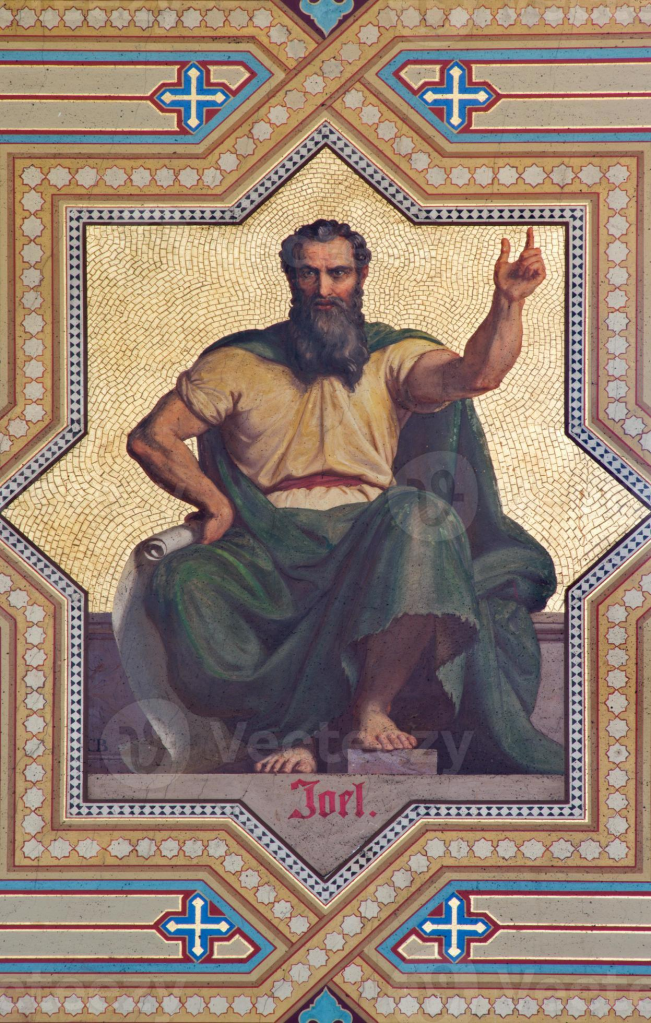
Fresco of the prophet Joel in the Altlerchenfelder Church, Vienna, Austria

We are in the wake of Pentecost Day. But it ought not to have come as a surprise. There were prophetic rumblings of the Spirit’s future tornadic activity, long before the time of Jesus.

The prophet Joel, along with all the Old Testament prophets, had both a message of grace and of judgment. And so, this prophetic book falls naturally into those two parts.

Within the first part of the prophecy, Joel speaks of a terrible locust plague that came over Israel as a judgment from God. The people had strayed from their spiritual and religious ways of covenant with God. The locusts, destroying every plant in their path, reflected the people’s lack of spiritually thriving and growing in grace. They, too, were vulnerable to destruction. They needed to repent and to return to their God.

Yet, the Lord’s anger lasts only a moment, but God’s mercy and blessing endure forever. So, words of grace were offered to the people. There is a time coming, Joel insisted, when God will pour out the divine Spirit far and wide to bless the people and contend with the nations who oppose the covenant community.

Put another way, the first part of the prophecy describes how God fought against God’s own people, to bring them back to their spiritual senses. And the second part of the prophecy describes how the Lord will fight against the nations who fight against God and God’s people.

The people’s affections and allegiance became attached to other things rather than God. So, the Lord sent an army of locusts to oppose them, to challenge their milquetoast and half-hearted attempts at following divine instructions.

Joel foresaw two things coming as the great Day of the Lord approaches: a great outpouring of the Holy Spirit; and a terrible time of divine judgment. 

Let’s take a few things to heart as a response to Joel’s prophecy:

Be aware of God’s purpose in history

From grasshopper swarms to world-wide judgment, to the dissolving of sun and moon—God’s purpose is to reveal divine glory to all the world.

“You will know that I am in the midst of Israel,
        and that I am the Lord your God—no other exists;
        never again will my people be put to shame.” (Joel 2:27, CEB)

“Father, the hour has come; glorify your Son so that the Son may glorify you.” Jesus (John 17:1, NRSV)

Stay close to the Lord

Don’t wander from God. But, if you do, the Lord will spend all kinds of energy in bringing us back and restoring us.

“But even now,” declares the Lord,
“return to me with all your heart—
with fasting, crying, and mourning.” (Joel 2:12, GW)

And the God of all grace, who called you to his eternal glory in Christ, after you have suffered a little while, will himself restore you and make you strong, firm and steadfast. (1 Peter 5:10, NIV)

Change the inside, not the outside

Repentance and faith are to be a way of life, and not simply a one time event. The way we present ourselves on the outside is a projection of what we want others to see. But God sees the heart, so we must go there and focus on the inner person.

Don’t rip your clothes
    to show your sorrow.
Instead, turn back to me
    with broken hearts.
I am merciful, kind, and caring.
I don’t easily lose my temper,
    and I don’t like to punish. (Joel 2:13, CEV)

Endure what you suffer as being a father’s punishment; your suffering shows that God is treating you as his children. Was there ever a child who was not punished by his father? If you are not punished, as all his children are, it means you are not real children, but bastards. In the case of our human fathers, they punished us and we respected them.

How much more, then, should we submit to our spiritual Father and live! Our human fathers punished us for a short time, as it seemed right to them; but God does it for our own good, so that we may share his holiness. When we are punished, it seems to us at the time something to make us sad, not glad. Later, however, those who have been disciplined by such punishment reap the peaceful reward of a righteous life. (Hebrews 12:7-11, GNT)

Earnestly seek the outpouring of the Holy Spirit

On the Day of Pentecost, the Apostle Peter said that the coming of the Holy Spirit was a fulfillment of Joel’s prophecy (Acts 2:16). That was just the beginning of the blessing. The Holy Spirit is still operative and active in the church and the world. The prophecy is far from complete.

In reply to those who were concerned about others prophesying and thereby possibly challenging authority, Moses said:

“Are you concerned what this might do to me? I wish the Lord would give his Spirit to all his people so everyone could be a prophet.” (Numbers 11:29, CEV)

And those who observed and heard the Spirit being poured out, exclaimed with slack jawed amazement:

“Aren’t these all Galileans? How come we’re hearing them talk in our various mother tongues?

Parthians, Medes, and Elamites;
Visitors from Mesopotamia, Judea, and Cappadocia,
    Pontus and Asia, Phrygia and Pamphylia,
    Egypt and the parts of Libya belonging to Cyrene;
Immigrants from Rome, both Jews and proselytes;
Even Cretans and Arabs!

“They’re speaking our languages, describing God’s mighty works!” (Acts 2:7-11, MSG)

The age of the Spirit is here. It hasn’t gone away. So, let’s pursue the spiritual life with all the energy given us, to the glory and praise of God. Amen.