Mark 8:14-21 – Adventures in Missing the Point

The disciples had forgotten to bring bread, except for one loaf they had with them in the boat.“Be careful,” Jesus warned them. “Watch out for the yeast of the Pharisees and that of Herod.”

They discussed this with one another and said, “It is because we have no bread.”

Aware of their discussion, Jesus asked them: “Why are you talking about having no bread? Do you still not see or understand? Are your hearts hardened? Do you have eyes but fail to see, and ears but fail to hear? And don’t you remember? When I broke the five loaves for the five thousand, how many basketfuls of pieces did you pick up?”

“Twelve,” they replied.

“And when I broke the seven loaves for the four thousand, how many basketfuls of pieces did you pick up?”

They answered, “Seven.”

He said to them, “Do you still not understand?” (New International Version)

In today’s Gospel lesson, Jesus uses yeast as a metaphor for corrupting influences. It only takes a little bit of yeast to work through the whole batch of dough. Christ, upholding the teachings of Old Testament law, didn’t just want people to avoid eating actual unleavened bread. He desired his disciples to be unleavened themselves, a holy people, free of all crookedness and malevolent motives.

Christ’s disciples, bless their pea-pickin’ literal interpreting hearts, were too dense to pick up on the metaphor. They began anxiously chattering about how Jesus might be disappointed with them in having no actual bread to eat. Although they had just witnessed an amazing miracle of literally feeding thousands of people, the disciples did not discern what that miracle meant beyond just filling bodily stomachs.

Had Christ’s disciples been able to see beyond the literal to the metaphorical, they would have likely understood several lessons Rabbi Jesus was teaching them:

  • The provision of bread pointed to who Jesus truly is: Living Bread from heaven. Just like the miraculous provision of manna in the desert to the ancient Israelites, so God was graciously meeting the total needs of people through Jesus. Conversely, the yeast of corruption saps the life out of people.
  • The presence of bread doesn’t necessarily mean it’s all good. There’s leavened bread and unleavened bread. That is, there is the healthy bread of God’s Word to eat, and there are other words to eat which is unhealthy bread. A life set apart for goodness and mercy in the world brings life to others. A person with mixed motives and personal agendas of power and privilege brings no nourishment to others – only inedible bread.
  • The puny amount of bread became a huge feast. A little bit of Jesus is enough to feed thousands and satisfy empty stomachs. A little bit of false teaching and hypocrisy is enough to corrupt thousands of people and make them sick.
  • The prosperity of bread multiplied by Jesus was so much that there were leftovers. In the kingdom of God, there is abundance. The disciples served the bread to the throng of people, and they received bread for themselves with twelve basketfuls of bread pieces – enough bread to feed their families, as well. The leavened bread of corruption doesn’t satisfy; it only decreases health.

But the disciples didn’t get it. So, Jesus chided them for their profound lack of spiritual awareness. By this time, the disciples had been following Jesus for a while – watching him do miraculous works of healing and meeting people’s needs, as well as being on the inside track of receiving his gracious teaching. If anyone ought to get what’s going on, it was them.

If we continually possess only a one-dimensional interpretation of Holy Scripture, a literal one, we are most certainly going to miss most of what’s really happening with Jesus. Rigid and narrow hermeneutical approaches aren’t just inadequate; they’re a corrupting influence. It is an adventure in missing the point because there is only a dim awareness of self, others, God, and God’s Word. It doesn’t nourish anybody. In fact, it makes people sick.

That sad situation makes such people, along with disciples at the time, no better than those on the outside of God’s kingdom.

“You will listen and listen,
    but never understand.
You will look and look,
    but never see.” (Isaiah 6:9, CEV)

Spiritual blindness and deafness are the symptoms of an unexamined and unaware life. And the lack of awareness is a malady from the bread of corruption.

Jesus Christ has a mission, along with the authority to make it happen. He was hoping for a more adequate understanding of this from his disciples, instead of getting the obtuse deer-in-the-headlights response.

Although, in some ways, today’s Gospel story is downer, it is also hopeful. The disciples ultimately do not remain stuck. They illustrate for us the nature of faith. Faith is not a one and done event of praying a sinner’s prayer or accepting Jesus. Rather, faith is an unfolding drama of redemption.

We grow in and into faith. Faith is much more a gradual awareness of God’s character and working in the world, with maybe a few dramatic epiphanies along the way. It is piecemeal, rather than wholesale. It’s more like taking small bites of delicious bread and savoring it with friends, instead of ravenously devouring an entire loaf alone.

“I am the living bread which came down from heaven. If anyone eats of this bread, he will live forever; and the bread that I shall give is My flesh, which I shall give for the life of the world.” (John 6:51, NKJV)

Lord Jesus, as you came to serve us living bread, fill us with the compassion and insight to respond to human need by loving service. Let the fire of your goodness and justice burn into us and through us, that we may seek to transform the unjust structures of society. As you come into our lives to redeem all that is good, guide to renew and sustain the life of your creation. Let your glory fill our lives. Let your glory fill this world. Amen.

Mark 16:1-8 – On Big Rocks and Even Bigger Questions

Deposition, Burial and Resurrection of Christ by Guy Roddon (1919-2006)

When the Sabbath was over, Mary Magdalene, Mary the mother of James, and Salome bought spices so that they might go to anoint Jesus’ body. Early on the first day of the week, just after sunrise, they were on their way to the tomband they asked each other, “Who will roll the stone away from the entrance of the tomb?”

But when they looked up, they saw that the stone, which was exceptionally large, had been rolled away. As they entered the tomb, they saw a young man dressed in a white robe sitting on the right side, and they were alarmed.

“Don’t be alarmed,” he said. “You are looking for Jesus the Nazarene, who was crucified. He has risen! He is not here. See the place where they laid him. But go, tell his disciples and Peter, ‘He is going ahead of you into Galilee. There you will see him, just as he told you.’”

Trembling and bewildered, the women went out and fled from the tomb. They said nothing to anyone because they were afraid. (NIV)

“Who will roll away the stone for us from the entrance of the tomb?” So asked the three women on Resurrection Sunday when they came to anoint the dead body of Jesus. Turns out they didn’t need to find the security officers, so to speak, to come and unlock the door. The tomb was already open. What is more, lo and behold, the women did not find a dead body. Jesus was not there – he is risen!

I sometimes find myself asking the same kind of question the women were asking each other: 

Who will move this huge object (or objection!) to what I want to do? 

How can I get to Jesus so that I can do something for him? 

Who will take care of the immovable obstacles that stand in my way? 

I must admit, these are questions born more of a small faith and a limited understanding than of knowing the power of God.

It also turns out the plan the women had for taking care of Christ’s lifeless body was completely irrelevant. Which causes me to ask even more questions of myself:

Are my questions completely off the mark?

Do I have my ladder up against the wrong wall?

Is my plan of caring for Jesus an adventure in missing the point?

Is it Jesus who plans on showing up and caring for me?

Perhaps it all comes down to our expectations. The women were most certainly not expecting a risen Lord! They had absolutely zero expectation of encountering an angel who would tell them Jesus is alive. They did not anticipate their question would end up being completely unnecessary. 

Maybe believers and lovers of Jesus are asking a set of misguided questions based in our puny creature perspective on life, church, and world. Perhaps we are not grasping what God’s power has already accomplished and/or what God already has up his sleeve. 

It could be that all we really need to realize is that God has gone before us, clearing all impediments so that people can see and experience the risen Christ. Methinks our expectations are far too low for a God who has the power and will to raise people from death…. 

Because the way has been opened to a new and vital relationship with the Lord Christ. That massive immovable boulder has already been moved. Whereas we thought it was some big issue to deal with, just by showing up at the tomb we clearly see that isn’t the issue, at all.

“It means,” said Aslan, “that though the Witch knew the Deep Magic, there is a magic deeper still which she did not know. Her knowledge goes back only to the dawn of time. But if she could have looked a little further back, into the stillness and the darkness before Time dawned, she would have read there a different incantation. She would have known that when a willing victim who had committed no treachery was killed in a traitor’s stead, the Table would crack and Death itself would start working backward.”

C.S. Lewis, The Lion, the Witch, and the Wardrobe

So, here I go again with another set of questions:

How many times have we gotten things all discombobulated in our heads and misinterpreted what’s going on just because we didn’t show up and find Jesus is not dead but alive?

When have we severely underestimated the power of God by believing we must operate in our own power and do things for God because Christ is as good as dead to us?

Are we still expecting Jesus to care about buildings, budgets, and butts in the pew because those things (we think) are within our power and control?

Do we even bother to ask Jesus what he cares about, or do we simply superimpose our wishes upon him as if they are his?

Are you yet sick and tired of me asking questions and offering no answers?

That’s because the answer is already there. Jesus is not where you are expecting him. There is power at work for which you are unaware.

The truth is that we can now encounter and explore a fresh reality with Jesus as the Author and Pioneer of our faith. We need only listen, follow, and leave the moving of big rocks to God.

When our faith stands at the grave, grieving for a stone that’s rolled away, forgive us, Lord. When our faith is short of understanding though the truth is there to see, forgive us, Lord. When our faith, beset by doubt, sees no further than an empty tomb today, forgive us, Lord. Bring to our minds the cry of Mary, “I have seen the Lord!” and grant us faith to believe! Amen.

Luke 10:21-24 – Freedom and Blessing

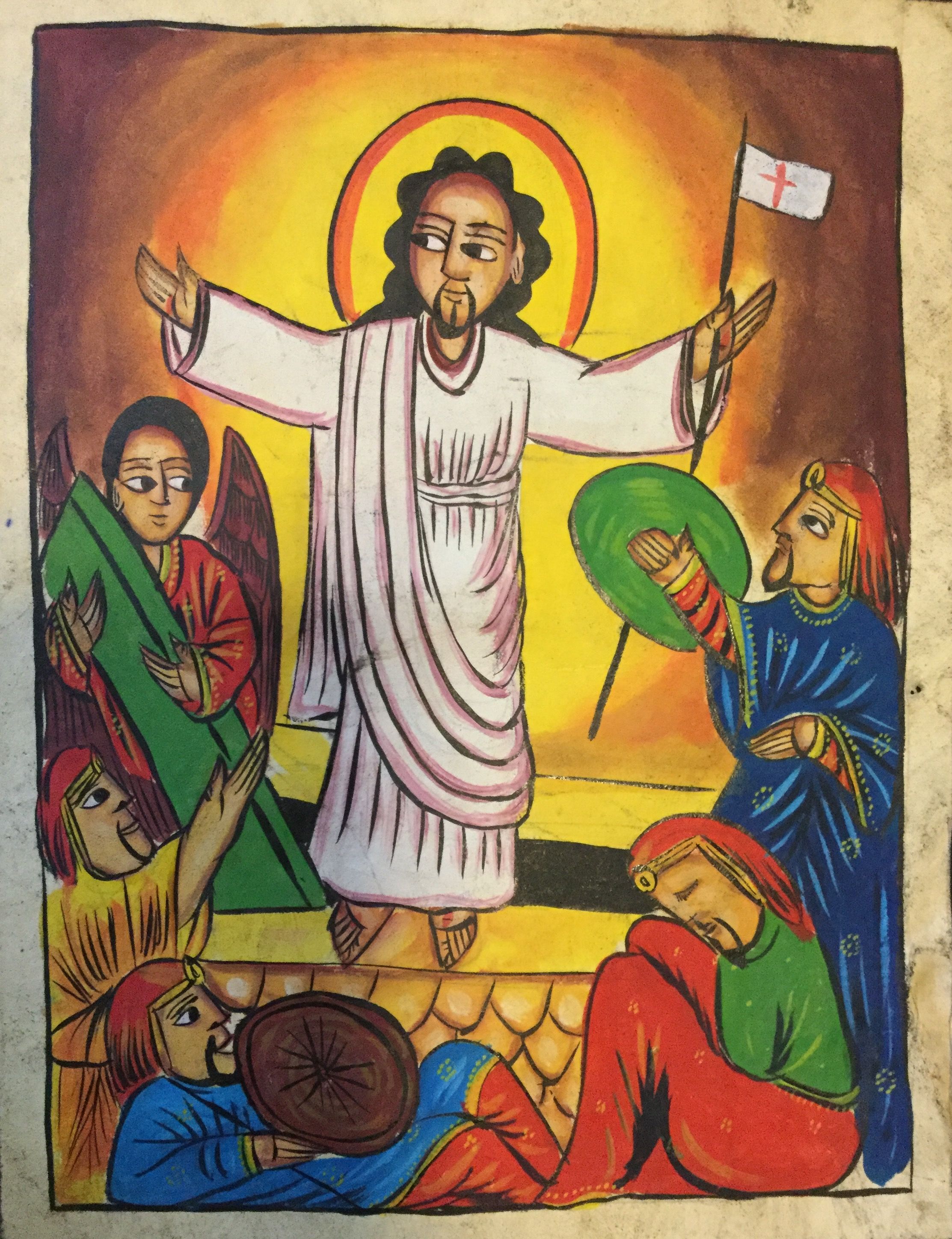
Ethiopian Jesus 2
Ethiopian Orthodox depiction of Jesus teaching

Then Jesus rejoiced in the Holy Spirit and said, “I praise you, Father, Lord of heaven and earth, because you have hidden these things from the people who are wise and smart. But you have shown them to those who are like little children. Yes, Father, this is what you really wanted.

“My Father has given me all things. No one knows who the Son is, except the Father. And no one knows who the Father is, except the Son and those whom the Son chooses to tell.”

Then Jesus turned to his followers and said privately, “You are blessed to see what you now see. I tell you, many prophets and kings wanted to see what you now see, but they did not, and they wanted to hear what you now hear, but they did not.” (NCV)

A healthy view of Holy Scripture is to look at it as an unfolding drama of redemption. Ever since the fall of humanity, God has been on a rescue mission to reclaim, redeem, and restore people. This human project has obviously taken several millennia; and, it still has not reached its fulfillment.

The Christian tradition understands that the climax of victory and final restoration to our true state as humans will occur when Christ returns. By warning us that divine mysteries are hidden to some and revealed to others is Jesus’ way of cautioning us toward triumphalism and self-congratulation. Yes, redemption is a reality; and, it is also not a reality. It is both here and is coming. We are delivered from sin, death, and hell – and, we still labor against the evil machinations of systemic world problems, our own sinful nature, and a demonic realm which is looking for every opportunity to exploit sin’s residue upon the earth.

What this all means on a practical basis is that the good old days for some were the bad old days for others. History is always written by the winners and those in power. The hidden voices are typically squelched. The vision of Jesus is that all kinds of people, not just a certain segment of winners, should enjoy God’s favor.

There were ancient people who longed for spiritual and physical freedom. They looked forward into history and had the hope of Messiah and God’s promises being fulfilled. History is still unfolding. People yet remain locked in personal bondage and large swaths of humanity still experience oppression and a longing to enjoy blessings which others possess and take for granted.

On this Independence Day in the United States it is important that we recognize and hold together both the blessings of realized freedom along with the limits of others’ freedom. And, with this realization, we continue to actively work for all people and keep praying that God’s kingdom come and God’s will be done, here on earth, as it is always done in heaven.

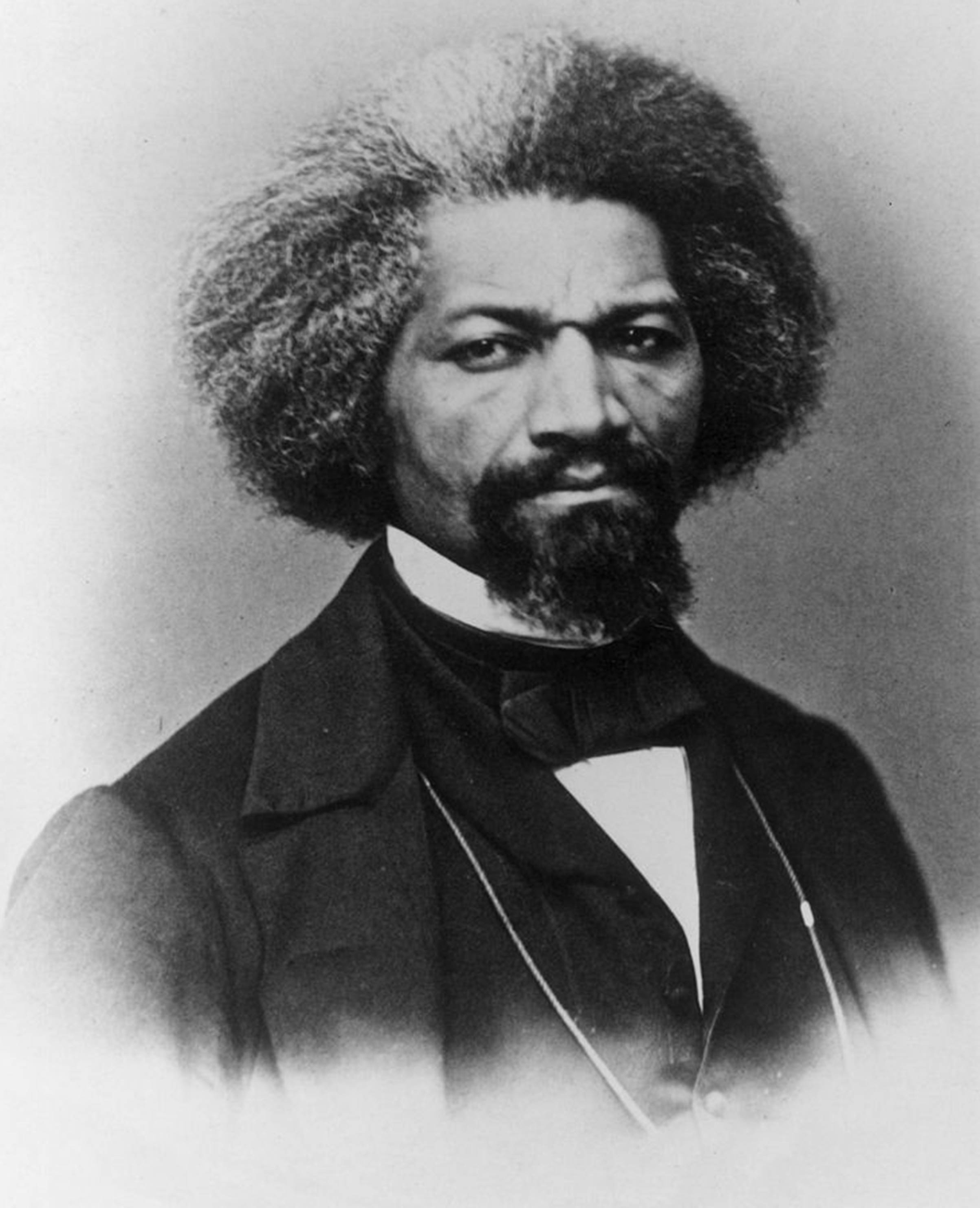
Frederick Douglass
Frederick Douglass, circa 1852

So, today, I am lifting a voice from history which exemplifies the struggle of the black experience in America. The following is a small portion from a speech by the ex-slave Frederick Douglass orated on July 4, 1852, nine years before civil war, with President Millard Fillmore and many congressional politicians in attendance:

“The feeling of the nation must be quickened; the conscience of the nation must be roused; the propriety of the nation must be startled; the hypocrisy of the nation must be exposed; and its crimes against God and man must be proclaimed and denounced. What, to the American slave, is your 4th of July? I answer: a day that reveals to him, more than all other days in the year, the gross injustice and cruelty to which he is the constant victim. To him, your celebration is a sham; your boasted liberty, an unholy license; your national greatness, swelling vanity; your sounds of rejoicing are empty and heartless; your denunciations of tyrants, brass fronted impudence; your shouts of liberty and equality, hollow mockery; your prayers and hymns, your sermons and thanksgivings, with all your religious parade, and solemnity, are, to him, mere bombast, fraud, deception, impiety, and hypocrisy — a thin veil to cover up crimes which would disgrace a nation of savages. There is not a nation on the earth guilty of practices more shocking and bloodier than are the people of these United States, at this very hour.”

Because history is forever unfolding, freedom and blessing develop over time and come more powerfully to some than others. True spiritual discernment, with the awareness to labor on behalf of the common good, does not ultimately come through astute observation and superior intellect; it comes by divine revelation. God will both conceal and reveal according to divine purposes and not human agendas.

Christian spirituality cannot be reduced to praying a sinner’s prayer and then maintaining a holding pattern on earth until heaven. Rather, Jesus remains present in this world through the person of the Holy Spirit and is continually interceding on behalf of those who need freedom and blessing. As Christ’s Body, Christians are to be the hands and feet of Jesus, animated by the Spirit to bring God’s ethical and benevolent regime to those who need it most.

If we are blessed, we are to pass blessing on without prejudice. For the kingdom of God belongs to the poor in spirit.

Dear God, Creator of the universe and all that inhabit it, we come as your Church, and as individuals, in humble submission to your word and your way. God, you are the Alpha and Omega, The Almighty Judge and The Forgiver of All Sins, so we come with humility and contrition on behalf of generations past, present and those yet unborn. We ask that you forgive us and create in us a new spirit. Bind our hearts and send forth the healing power that you and you alone can give to us and this sin-sick world. Bring us into reconciliation with one another and restore us to your righteous and holy path. Amen.