Depression Is Our Teacher (Psalm 102:1-17)

Lord, hear my prayer!
    Let my cry reach you!

Don’t hide your face from me
    in my time of trouble!
Listen to me!
    Answer me quickly as I cry out!

Because my days disappear like smoke,
    my bones are burned up as if in an oven;
    my heart is smashed like dried-up grass.
    I even forget to eat my food
    because of my intense groans.
    My bones are protruding from my skin.

I’m like some wild owl—
    like some screech owl in the desert.
I lie awake all night.
    I’m all alone like a bird on a roof.

All day long my enemies make fun of me;
    those who mock me curse using my name!

I’ve been eating ashes instead of bread.
    I’ve been mixing tears into my drinks
        because of your anger and wrath,
        because you picked me up and threw me away.

My days are like a shadow soon gone.
    I’m dried up like dead grass.

But you, Lord, rule forever!
    Your fame lasts from one generation to the next!

You will stand up—
        you’ll have compassion on Zion
        because it is time to have mercy on her—
    the time set for that has now come!

Your servants cherish Zion’s stones;
    they show mercy even to her dirt.

The nations will honor the Lord’s name;
    all the earth’s rulers will honor your glory
    because the Lord will rebuild Zion;
    he will be seen there in his glory.

God will turn to the prayer of the impoverished;
    he won’t despise their prayers. (Common English Bible)

Author Marianne Williamson tells the story concerning a study of a group of chimpanzees. Supposedly, researchers observed primate behavior which correlates to human depression, such as eating at odd times, spending lots of time alone, and staying on the outskirts of the group. This behavior was observed in about 10% of the chimps, which is about the same percentage of Americans who show symptoms of depression. 

The scientists removed the depressed chimps for six months, to see how this would affect the behavior of the other 90%. You might think that in the absence of the depressed individuals, the remaining majority would produce another 10% of depressed chimps. Instead, when scientists returned six months later, all the non-depressed chimps were dead.

The interpretation and conclusion of the study is that the depressed chimps had functioned as a kind of early warning system, continually looking out for predators, tropical storms, and other threats to the group. Without that system in place, the group was doomed.

Whether the study can be substantiated, or is a fabrication, for those who pay careful attention to the inner person, knowing there is much more to us than physical pathology, this account of chimpanzees resonates deeply.

More than a mere problem to be fixed, depression can also serve as an asset to society. Depressed persons can serve an important role, providing a critical mass of individuals uniquely suited to guarding against danger.

I am not trying to put a positive spin on a terrible malady of mind and spirit. Instead, I’m simply pointing out that there is a lot going on beyond an individual’s inner sadness and struggle; it is also a community’s struggle.

Reading today’s psalm, especially if you read it aloud, you can feel the expression of deep lament borne from a person going through a major depression. Although there are persons in the church and society who, unfortunately, believe depression to be a sin, we get no such judgment from Holy Scripture. Depression just is.

Consider the following biblical characters:

  • Elijah became depressed. The prophet’s depression served as a sign and warning that there was something horribly awry in ancient Israel. Jezebel was the wicked queen, pulling the strings in a nation connected in a web of evil which permeated the land.
  • Moses became despondent time and again. The leader’s depressed spirit pointed to the faithless network of apostasy that kept rearing its golden calf in the life of the Israelite people.

Whenever we, as contemporary persons, become depressed it can and should serve as a billboard to others that something is terribly askew among us, and not just within the individual.

Please know that I fully believe depression ought to be addressed and treated so that the depressed person can come around again to a sense of happiness and hopefulness. Yet, there are also emotionally “healthy” people who try to push pills, hurry along therapy, and pronounce exhortations to the despondent people around them. It’s almost as if depressed folk make others uncomfortable and uneasy.

If depression points to societal ills, not just personal sickness, then it makes sense that non-depressed people want depressed people to get healthy now, because then they don’t have to take a good hard look at the systemic problems of our society and culture. 

Whenever we rush to make someone feel better, typically the person we really want to help is ourselves.

Depression and emotional struggles must be deeply felt, examined, and carefully dealt with. Thus, enter the psalmist. The sheer volume of laments in the psalter ought to clue us in that this is important work. Sadness and grief can get trapped in us like monkeys in a cage. Reciting psalms of lament can help express what is within us and serve as the pick which unlocks us to freedom.

Dealing with depression is a process. It takes time and therapy, perseverance and patience, to heal. Learning new ways to accept, cope, and transcend are difficult – they take time. Cheap hope is a switch which can be easily flipped; genuine hope is a large heavy gate that needs effort to open.

While the depressed among us learn to hope again, the majority who are free of depression ought to pay attention.

We who are depression-proofed persons ought also to examine ourselves, our families, our organizations, our workplaces, and our faith communities to determine what is awry and create new systems and new ways of living together on planet earth.

Depression helps us all become more aware of ourselves and our society. And it drives us to the One who can truly heal all of our ills, both personal and societal. In this way, depression can be our teacher, and not just an unwanted interloper.

After all, who wants to make a monkey of themselves?

Holy God, please observe all who live with depression and hold them in your good strong hands. Send them your love through therapists, pastors, friends, and family. Grant them assurance of your love in their dark hours.

In your mercy, hear my prayer concerning the depressed persons in my life. I feel powerless and inadequate to help. I am frustrated because depression can be so unpredictable. Help me find the resilience and resources I need to be with them during their time of pain. And teach me what I need to learn in their darkness, as well, through Jesus Christ, our Savior. Amen.

Psalm 2 – God

Why are the nations so angry?
    Why do they waste their time with futile plans?
The kings of the earth prepare for battle;
    the rulers plot together
against the Lord
    and against his anointed one.
“Let us break their chains,” they cry,
    “and free ourselves from slavery to God.”

But the one who rules in heaven laughs.
    The Lord scoffs at them.
Then in anger he rebukes them,
    terrifying them with his fierce fury.
For the Lord declares, “I have placed my chosen king on the throne
    in Jerusalem, on my holy mountain.”

The king proclaims the Lord’s decree:
“The Lord said to me, ‘You are my son.
    Today I have become your Father.
Only ask, and I will give you the nations as your inheritance,
    the whole earth as your possession.
You will break them with an iron rod
    and smash them like clay pots.’”

Now then, you kings, act wisely!
    Be warned, you rulers of the earth!
Serve the Lord with reverent fear,
    and rejoice with trembling.
Submit to God’s royal son, or he will become angry,
    and you will be destroyed in the midst of all your activities—
for his anger flares up in an instant.
    But what joy for all who take refuge in him! (New Living Translation)

Our view of God determines how we live. If our perception of God is a being who is small and ineffective or does not really see or care about everything that happens on earth, then the response of the nations in Psalm 2 is likely.

Demagogues and delegates meet for summit talks; God-deniers, the Messiah-defiers get together and say, “Let’s get free of God! Cast loose from Messiah!” (The Message)

However, if we discern that God is far larger than we can ever imagine and sees all, then we know that in heaven the Lord breaks out in laughter as he sits on the sovereign throne, as if amused by such insolence. 

People who think they can distance themselves from the God of the universe are, at best, delusional, and, at worst, in danger of being swept away like an ant hill.

In the past, God spoke through the prophets to our ancestors in many times and many ways. In these final days, though, he spoke to us through a Son. God made his Son the heir of everything and created the world through him. 

The Son is the light of God’s glory and the imprint of God’s being. He maintains everything with his powerful message. After he carried out the cleansing of people from their sins, he sat down at the right side of the highest majesty. And the Son became so much greater than the other messengers, such as angels, that he received a more important title than theirs.

After all, when did God ever say to any of the angels:

You are my Son.
        Today I have become your Father? (Hebrews 1:1-5, NIV)

The sovereign Lord blesses and protects all who seek what is right, fair, just, and true. So, we are to be smart and show respect. Because the fact of the matter is that God is bigger than anyone or anything. That’s good news for those who serve God and bad news for those who don’t. 

For the faithful, nothing can separate us from God’s steadfast love; and for the unfaithful, no nation has more power than God; and no organization, institution, or government can continue unabated in their unethical ways. 

So, when we face adversity, hardship, and difficulty we have a very large God who has our back. It may seem, in the short term, that evil is winning, and arrogant people are having their day, but ultimately God will deal with it. Jesus is king, and we are not.

The presence of God is everywhere. Whenever nations or institutions or governments or communities or individual people fail to discern this, then all hell breaks loose.

Sensing the Lord’s presence, knowing the love of God in Christ, is of upmost importance.

Parishioners must desire the presence of God in a church building more than the building itself. 

Christians must desire the presence of God in their liturgies, spiritual practices, and ministries, more than the programs themselves. 

Clergy must desire the presence of God with them at all times more than the presence of budgets, books, and butts in the pew. 

Spiritual parents and grandparents must desire the presence of God in their families more than the presence of kids, or order in the house, or wanting everything to be up to our standards.

God wants our hearts where they belong: desiring the divine love and presence of the Lord more than anything. Many religious folk in biblical times lost their true sense of purpose as God’s people. They neither perceived nor focused on God’s presence but cared more about the presence of animals and sacrifices, making money, and keeping their social positions secure. 

Failing to seek God’s presence, we are then likely not to see it, even when it stares us in the face. 

A few years ago, the Washington Post orchestrated an interesting experiment. They had arguably the best violinist in the world, Joshua Bell, play in the train station as a regular looking street musician complete with open violin case to catch monetary offerings. 

Not only did Bell play some of the most difficult pieces of music for the violin, but he also played them on a Stradivarius worth $3.5 million dollars. 

His earnings for a few hours of work were exactly $32.17, which is less than just one $100 ticket at a Boston concert hall he played three weeks before. No one noticed the extreme talent right in front of their faces, much like those who merely discern God as a pathetically ineffective deity, or those who only see Jesus as a regular guy.

“The Christian ideal has not been tried and found wanting. It has been found difficult; and left untried.”

G.K. Chesterton

Immense God, you are sovereign above all creation and everything in the earth. I choose this day to submit to the words and ways of Jesus, who is the true ruler of all. May all the nations come to see you for who you really are, the great and wondrous king. Amen.

Ezekiel 1:1-2:1 – A Vision of Glory

In the thirtieth year, in the fourth month, on the fifth day of the month, as I was among the exiles by the river Chebar, the heavens were opened, and I saw visions of God. On the fifth day of the month (it was the fifth year of the exile of King Jehoiachin), the word of the Lord came to the priest Ezekiel son of Buzi, in the land of the Chaldeans by the river Chebar; and the hand of the Lord was on him there.

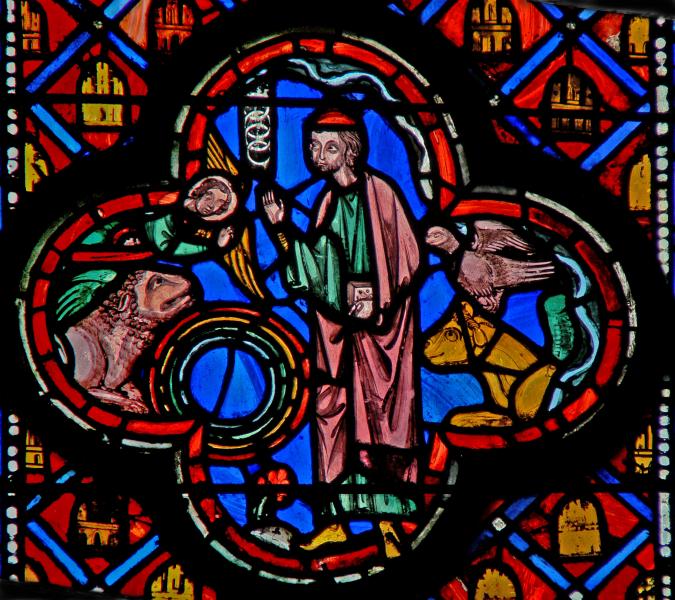
As I looked, a stormy wind came out of the north: a great cloud with brightness around it and fire flashing forth continually, and in the middle of the fire, something like gleaming amber. In the middle of it was something like four living creatures. This was their appearance: they were of human form. Each had four faces, and each of them had four wings. Their legs were straight, and the soles of their feet were like the sole of a calf’s foot; and they sparkled like burnished bronze. Under their wings, on their four sides, they had human hands. And the four had their faces and their wings thus: their wings touched one another; each of them moved straight ahead, without turning as they moved. As for the appearance of their faces: the four had the face of a human being, the face of a lion on the right side, the face of an ox on the left side, and the face of an eagle;such were their faces. Their wings were spread out above; each creature had two wings, each of which touched the wing of another, while two covered their bodies. Each moved straight ahead; wherever the spirit would go, they went, without turning as they went. In the middle of the living creatures there was something that looked like burning coals of fire, like torches moving to and fro among the living creatures; the fire was bright, and lightning issued from the fire. The living creatures darted to and fro, like a flash of lightning.

As I looked at the living creatures, I saw a wheel on the earth beside the living creatures, one for each of the four of them. As for the appearance of the wheels and their construction: their appearance was like the gleaming of beryl; and the four had the same form, their construction being something like a wheel within a wheel.When they moved, they moved in any of the four directions without veering as they moved. Their rims were tall and awesome, for the rims of all four were full of eyes all around. When the living creatures moved, the wheels moved beside them; and when the living creatures rose from the earth, the wheels rose. Wherever the spirit would go, they went, and the wheels rose along with them; for the spirit of the living creatures was in the wheels. When they moved, the others moved; when they stopped, the others stopped; and when they rose from the earth, the wheels rose along with them; for the spirit of the living creatures was in the wheels.

Over the heads of the living creatures there was something like a dome, shining like crystal, spread out above their heads. Under the dome their wings were stretched out straight, one toward another; and each of the creatures had two wings covering its body. When they moved, I heard the sound of their wings like the sound of mighty waters, like the thunder of the Almighty, a sound of tumult like the sound of an army; when they stopped, they let down their wings. And there came a voice from above the dome over their heads; when they stopped, they let down their wings.

And above the dome over their heads there was something like a throne, in appearance like sapphire; and seated above the likeness of a throne was something that seemed like a human form. Upward from what appeared like the loins I saw something like gleaming amber, something that looked like fire enclosed all around; and downward from what looked like the loins I saw something that looked like fire, and there was a splendor all around. Like the bow in a cloud on a rainy day, such was the appearance of the splendor all around. This was the appearance of the likeness of the glory of the Lord.

When I saw it, I fell on my face, and I heard the voice of someone speaking.

He said to me: O mortal, stand up on your feet, and I will speak with you. (New Revised Standard Version)

Stained glass window of Ezekiel’s vision, c.1246–48, Sainte-Chapelle, Paris (Bridgeman Images)

If anyone ever spouted these words on the behavioral health unit on which I work, they’d likely get diagnosed with psychosis. But the prophet Ezekiel was far from psychotic. Patients experiencing a psychotic break rarely talk about visions resembling Ezekiel’s. They’re more inclined to speak about their past trauma in very detached ways, or say things like, “Please pass the ketchup. I’d like to fly a kite and catch some of those butterflies.”

Ezekiel’s vision is also not some contrived experience due to imbibing hallucinogenic substances. The entire prophecy of Ezekiel, spanning a hefty forty-eight chapters, certainly evidences a unique person – yet one that is in control of his full faculties and has keen self-awareness.

If anyone ever tells you they are certain about everything in the book of Ezekiel, don’t believe them. Today’s Old Testament lesson of Ezekiel’s vision of God is an incredible view. It almost defies description. In fact, it does. It’s as if Ezekiel was trying to somehow to communicate with the limitation of words of what he saw. 

Even though we might not understand or comprehend everything in this vision, does not mean we can lose sight of the big picture of what was happening. 

Ezekiel got a glimpse of God’s glory. That, in and of itself, would explain why it is such a mysterious and incredible vision. 

Slowly reading Ezekiel’s vision, one gains the sense of immensity, hugeness, grandeur, and awesome glory. The Hebrew word “glory” literally means “heavy.”  In other words, God is large, bright, holy, carrying a great deal of weight. As we used to say back in the ‘70’s, “Heavy, man, heavy!”

This was much more than a unique experience for Ezekiel. It completely had him undone. Ezekiel fell on his face because that is about all one can do when encountering such an incredible appearance.  Sneaking a peek of God in glorious heavenly splendor is an awesome sight. So, when God speaks from the place of such awsome glory, there is nothing to do but listen and obey.

Meeting God, this same God whom Ezekiel encountered, is no small thing. Whenever we truly catch a glimpse of this holy God, it will forever change us – and this is a good thing, even if it seems to others that we must be smoking something. 

If we want to hear the call of God upon our lives, we need to see God’s glory. Otherwise, we can too quickly forget and neglect the Lord. 

May God be gracious in allowing you a glimpse into the Divine throne room – and may you never be the same again because of it.

Glorious God, you carry such great weight that all creation bows to your every word and each move. I, too, bow before you, and I will stand up so that I might hear what you have to say to me. Speak, Lord, for I am listening to you. Amen.

Acts 7:44-53 – Don’t Be a Church Curmudgeon

Muppets Statler and Waldorf

“Our ancestors carried the Tabernacle with them through the wilderness. It was constructed according to the plan God had shown to Moses. Years later, when Joshua led our ancestors in battle against the nations that God drove out of this land, the Tabernacle was taken with them into their new territory. And it stayed there until the time of King David.

“David found favor with God and asked for the privilege of building a permanent Temple for the God of Jacob. But it was Solomon who actually built it.However, the Most High doesn’t live in temples made by human hands. As the prophet says,

‘Heaven is my throne,
    and the earth is my footstool.
Could you build me a temple as good as that?’
    asks the Lord.
‘Could you build me such a resting place?
    Didn’t my hands make both heaven and earth?’

“You stubborn people! You are heathen at heart and deaf to the truth. Must you forever resist the Holy Spirit? That’s what your ancestors did, and so do you! Name one prophet your ancestors didn’t persecute! They even killed the ones who predicted the coming of the Righteous One—the Messiah whom you betrayed and murdered. You deliberately disobeyed God’s law, even though you received it from the hands of angels.” (New Living Translation)

On this eleventh day in the twelve days of the Christmas season, perhaps there are people who have moved on from the yearly celebration to daily complaints. A big reason why I personally hold to the Christian Calendar with its liturgical seasons is that it helps shape me spiritually so that I can avoid being a cranky old church curmudgeon.

It seems like some believers have been baptized in pickle juice. They have something negative to say about everything. And even when they acknowledge they don’t really understand something, they’ll still give a stony faced retort of “I’m against it.”

The liturgical calendar, when properly observed, keeps us grounded in faith, hope, and love. There are plenty of things in this old fallen world which can take our eyes off our calling as Christians. Pandemics, politics, poverty, and pain can mess with us. If we aren’t on solid spiritual ground, all the misfortunes of this life can take a significant toll on us. Then, like a stubborn old mule, we just sit down and don’t budge.

Like the ancient Israelites for whom Stephen railed against in our New Testament lesson for today, we might become hard-headed, and inflexible. We get lost in doing things our own way to the neglect of what God wants. 

Whenever that happens, there is damage to God’s people, God’s name, and God’s law. Rather than tongues being used for praising the Lord and encouraging others, God’s prophets who are calling us to holiness are verbally decapitated. Ironically, those who speak and act in the name of the Lord are resisting him.

“Pettiness of mind, ignorance and presumption are the cause of stubbornness, because stubborn people only want to believe what they themselves can imagine, and they can imagine very few things.”

Madeleine de Souvre

Anytime someone believes they have piously figured out everything, they will soon find themselves fighting against God. The Lord of All has not called us to figure out every mystery and nail down each uncertainty. Those who claim to have done it are living in a delusional world. Perhaps they will eventually discover how large and immense God really is – much bigger than our puny thoughts and misguided practices. 

How then shall we live?

Quit digging your heals in.

Let go of your illusions of power and privilege. Walking around like you’re King Lactose the Intolerant only looks weird and causes too many trips to the bathroom.

Submit afresh to the Lord for whom we must bow in all things. If we can do that, then we are well on our way to seeing the only true God in all his immensity. Humble ourselves under the mighty hand of God and set aside self-righteous pride so that he may exalt and honor us at the appropriate time of his choosing, not ours (1 Peter 5:6).

Take up our holy calling as Christ’s ambassadors, having become new people and knowing the reconciling power of the cross, through the proper spiritual tools of faith, hope, and love (2 Corinthians 5:17-21; 1 Corinthians 13).

The following practices can help us become more spiritually flexible and open to the Spirit’s work:

  • Stretch. If we are rarely or never in positions which work our faith, then that faith will diminish and eventually atrophy. Faith is not static, but dynamic. It needs to be worked ands stretched. And your face won’t break if you crack a smile now and then.
  • Breathe. Fear, worry, and anxiety cause us to have shallow breathing and unable to think straight. When we are amped-up about something, focus on doing some breath prayers, i.e., breathing in saying, “More of you,” and breathing out saying, “Less of me.”
  • Relax. A hyperextended faith will not support extreme positions which alienate people and put God to the test. Some folks just need to get off their high horse before God knocks them off. Nobody is helped by another’s forced beliefs.
  • Move. Faith is mostly lived in the mundane daily decisions of life. Consistently taking small steps of faith each day will go a long way toward our spiritual health and vitality – not to mention helping us see a big God at work.
  • Listen. Two ears. One mouth. Get the clue. Many people would be better served if they would just listen rather than incessantly talking. Behind all the bluster is typically an issue of wanting the kind of control God possesses.

To do the will of God, we must have a growing awareness and knowledge of a big unlimited God, and a small, limited self. This will take loosening up on the stubbornness and opening to greater flexibility.

If you are not in the habit of following the Christian Calendar through the year, now is a good time to start. After all, nobody wants to smell like they just crawled out of a pickle barrel.

Holy God, heaven is your throne and the earth your footstool. You cannot be kept within any one church or any single place.  You are much too big for that!  Forgive me for my small thoughts of you and my weak faith. I humble myself before you so that you can live in and through me for the sake of Jesus. Amen.