Abundant Life (1 Kings 8:1-21)

Solomon dedicates the Temple at Jerusalem, by James Tissot (1836-1902)

Solomon then summoned to Jerusalem the elders of Israel and all the heads of the tribes—the leaders of the ancestral families of the Israelites. They were to bring the Ark of the Lord’s Covenant to the Temple from its location in the City of David, also known as Zion. So all the men of Israel assembled before King Solomon at the annual Festival of Shelters, which is held in early autumn in the month of Ethanim.

When all the elders of Israel arrived, the priests picked up the Ark. The priests and Levites brought up the Ark of the Lord along with the special tent and all the sacred items that had been in it. There, before the Ark, King Solomon and the entire community of Israel sacrificed so many sheep, goats, and cattle that no one could keep count!

Then the priests carried the Ark of the Lord’s Covenant into the inner sanctuary of the Temple—the Most Holy Place—and placed it beneath the wings of the cherubim. The cherubim spread their wings over the Ark, forming a canopy over the Ark and its carrying poles. These poles were so long that their ends could be seen from the Holy Place, which is in front of the Most Holy Place, but not from the outside. They are still there to this day. Nothing was in the Ark except the two stone tablets that Moses had placed in it at Mount Sinai, where the Lord made a covenant with the people of Israel when they left the land of Egypt.

When the priests came out of the Holy Place, a thick cloud filled the Temple of the Lord. The priests could not continue their service because of the cloud, for the glorious presence of the Lord filled the Temple of the Lord.

Then Solomon prayed, “O Lord, you have said that you would live in a thick cloud of darkness. Now I have built a glorious Temple for you, a place where you can live forever!”

Then the king turned around to the entire community of Israel standing before him and gave this blessing: “Praise the Lord, the God of Israel, who has kept the promise he made to my father, David. For he told my father, ‘From the day I brought my people Israel out of Egypt, I have never chosen a city among any of the tribes of Israel as the place where a Temple should be built to honor my name. But I have chosen David to be king over my people Israel.’”

Then Solomon said, “My father, David, wanted to build this Temple to honor the name of the Lord, the God of Israel. But the Lord told him, ‘You wanted to build the Temple to honor my name. Your intention is good, but you are not the one to do it. One of your own sons will build the Temple to honor me.’

“And now the Lord has fulfilled the promise he made, for I have become king in my father’s place, and now I sit on the throne of Israel, just as the Lord promised. I have built this Temple to honor the name of the Lord, the God of Israel. And I have prepared a place there for the Ark, which contains the covenant that the Lord made with our ancestors when he brought them out of Egypt.” (New Living Translation)
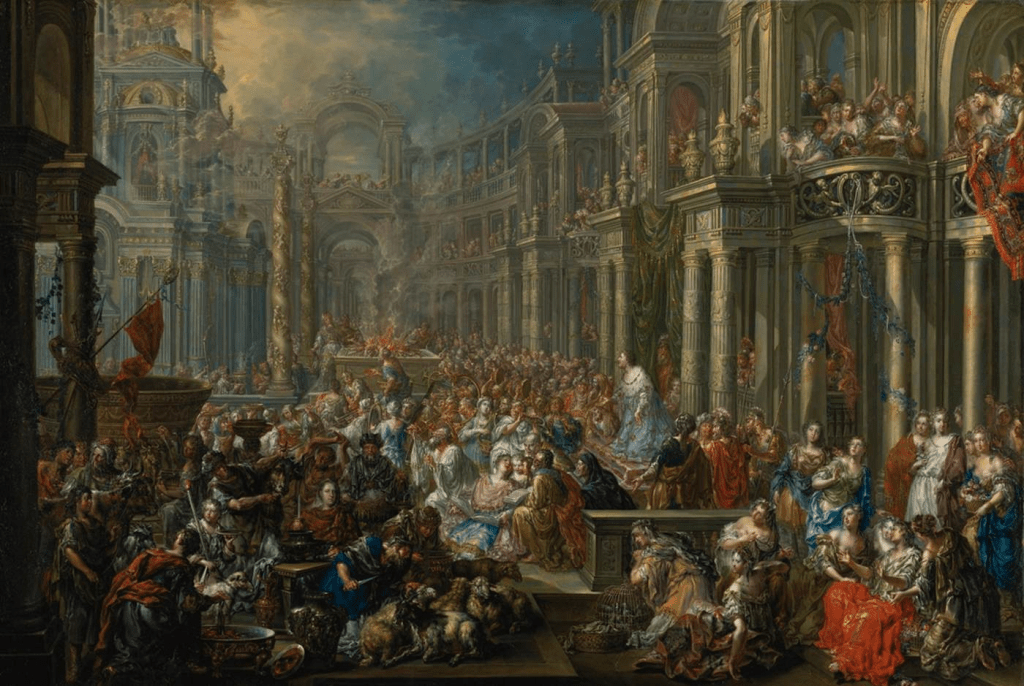
Dedication of Solomon’s Temple in Jerusalem, by Johann Georg Platzer (1704-1761)

I admit, at many times, that I am prone to melancholy. I tend to be quick at accepting blame, and rather slow at owning my good work. Another way of putting this is that it is easier to give than to receive.

Those who have endured a lot of hard circumstances, and persevered through many adversities, can sometimes be reticent to accept the good, the abundant, and the beautiful, whenever it comes to us in this life.

Waiting for the other shoe to drop, far too many people hold back themselves from receiving and enjoying the really good things in life. They worry that the goodness will disappear, or be taken away; and so, they withhold gratitude and blessing, whenever they are in the presence of great abundance.

Just so you know, in case there are those of you who need to hear it spelled out plainly: That’s messed up.

People are meant to be abundantly generous, as well as wildly receptive. It’s likely why there are so many spiritually unhealthy persons in the world.

Bless their hearts, they give a lot, without receiving much, and then their spiritual diarrhea makes it so they can’t give anymore. And they oftentimes give to those who are in such a habit of receiving (and not giving) that the receiver’s spiritual constipation becomes a terrible problem.

Let’s avoid both extremes by letting ourselves both give and receive with equal abandon. No one can be spiritually growing, healthy, and mature without the dynamic of giving and receiving.

Solomon knew how to do both. King Solomon was the king of abundance. He accepted and received big; and he gave and blessed big. Nobody before him or after him received and gave more.

The Temple, in all of its glory and grandeur, with the Ark of the Covenant encrusted with gold as the central object in the building, was all for a God who doesn’t live in houses, a God who is invisible.

In Solomon’s dedication of the Temple, he made it clear that the God of Israel is not, and cannot, be restricted to, or located within, a single place. Thus, the Lord is limitless, and not subject to any human manipulation.

God is free to give with great abandon. And God is also free to take away. Blessed be the name of the Lord God. If we continually try and anticipate or predict what God will do, we will likely be a nervous ball of anxiety all of the time, wondering when the unexpected and/or unwanted will visit us.

It is much better to receive the good things the Lord gives us, and enjoy them while we have them.

“I came that they may have life and have it abundantly.”

Jesus (John 10:10)

Nothing is permanent, with the exception of relationships and love. So, if we can connect the temporal material things of this life in service to the immaterial realities of this universe, then we are in a position to experience peace, joy, and satisfaction.

If and when the material disappears, or is taken away, then it shall neither defeat us, nor destroy us. For our relational connections with God and others exist, and are free flowing, with the energy of gracious receiving and giving as the conduit of abundant life.

Melancholy is important and has its place for us in this present life; yet, so do things like celebration, dedication, joy, exuberance, emotional commitment, and open love. Indeed, to have these in abundance is a reflection of the God of abundance, in whose name we are bold to pray:

God of abundance, you have fed us with the bread of life and cup of salvation; you have united us with Christ and one another; and you have made us one with all your people in heaven and on earth. Now send us forth in the power of your Spirit, that we may proclaim your redeeming love to the world and continue forever in the risen life of Christ our Savior. Amen.

The Parable of the Sower (Mark 4:1-20)

The Sower, by Mike Moyers

Again Jesus began to teach by the lake. The crowd that gathered around him was so large that he got into a boat and sat in it out on the lake, while all the people were along the shore at the water’s edge. He taught them many things by parables, and in his teaching said:

“Listen! A farmer went out to sow his seed. As he was scattering the seed, some fell along the path, and the birds came and ate it up. Some fell on rocky places, where it did not have much soil. It sprang up quickly because the soil was shallow. But when the sun came up, the plants were scorched, and they withered because they had no root. Other seed fell among thorns, which grew up and choked the plants, so that they did not bear grain. Still other seed fell on good soil. It came up, grew and produced a crop, some multiplying thirty, some sixty, some a hundred times.”

Then Jesus said, “Whoever has ears to hear, let them hear.”

When he was alone, the Twelve and the others around him asked him about the parables. He told them, “The secret of the kingdom of God has been given to you. But to those on the outside everything is said in parables so that,

“‘they may be ever seeing but never perceiving,
    and ever hearing but never understanding;
otherwise they might turn and be forgiven!’”

Then Jesus said to them, “Don’t you understand this parable? How then will you understand any parable? The farmer sows the word. Some people are like seeds along the path, where the word is sown. As soon as they hear it, Satan comes and takes away the word that was sown in them. Others, like seed sown on rocky places, hear the word and at once receive it with joy. But since they have no root, they last only a short time. When trouble or persecution comes because of the word, they quickly fall away. Still others, like seed sown among thorns, hear the word; but the worries of this life, the deceitfulness of wealth and the desires for other things come in and choke the word, making it unfruitful. Others, like seed sown on good soil, hear the word, accept it, and produce a crop—some thirty, some sixty, some a hundred times what was sown.” (New International Version)

The Sower, by Johne Richardson

All four of the New Testament Gospels have their own particular angle and focus upon the life of Jesus Christ. For Mark, he wrote to demonstrate and prove the established authority of Christ over everything.

God’s power is expressed in and through Christ. So, when Mark tells a story, he is concerned to communicate that God’s kingdom – God’s rule and reign on this earth – comes through Jesus as the Sovereign over this realm of the universe and our world.

By means of a parable – a farmer going out and scattering seeds – Jesus was making some points about the kingdom of God: it will be successful; it is thoroughly under divine control; and it’s inclusive.

God’s Reign Will Succeed

History is inexorably moving toward a climax. God’s sovereign rule has broken into human history. Christ’s authoritative rule is taking root, growing, and shall eventually envelope all the world.

It may not presently seem as if that’s going to happen. But appearances can be deceiving. Although much, if not most, of the good gospel seeds spread about this earth never produce a harvest of righteousness, there is enough good soil for those seeds to succeed.

Even though there is a lot of unproductive and ineffective soil in this world, good seeds in good soil will germinate and take root. They will grow, develop, mature, and ripen. An abundant yield of crops will more than satisfy the needs of the earth. And it will blow the imagination of even the wisest and best farmer.

One person, having realized the incredible fruit of the Spirit, makes a broad, deep, and expansive impact on dozens, hundreds, thousands, tens of thousands, and even millions of people. It certainly doesn’t happen overnight; but goodness, truth, beauty, and righteousness are making their way slowly – and will overtake and overwhelm all evil.

If you make disciples who make more disciples, that is multiplication. Jesus made disciples, and called his followers to do the same. He spent three years training twelve men; and then commissioned them to go out and reproduce the process with others. (Matthew 28:18-20)

Beginning in Jerusalem, the earliest disciples of Jesus began making more disciples, following Christ’s ascension, and that movement has never stopped. Jesus started a movement of a few seeds multiplying into many seeds, so that the Church would grow exponentially. Not even the gates of hell can stop the process from happening. (Acts 1:1-8; Matthew 16:17-19)

God’s Reign Is Ruled by God

That may seem like a ridiculously obvious statement, yet it still needs to be said. God is authoritatively in control, not only of God’s own kingdom, but of all things. This means that God’s rule and reign is the result of God’s action, not ours. The only thing we need to do is scatter the seed and be a simple farmer. Everything else is up to God.

Our ability to do anything is animated by God’s gracious work in our lives. The power to effect making disciples comes from the Lord. Since we are dependent upon God for our next breath, we are also completely under the authority and sustaining presence of God for everything in life.

Both the subject and object of every biblical story is God. In this unfolding drama of redemptive history that we are experiencing, God is the writer, producer, director, and lead actor; we only have some bit parts in the whole thing. It’s our job to respond – and not to try and take over the show.

God’s Reign Is Inclusive

When gospel seeds are established in good soil, eventually producing an abundant harvest, it will feed the entire world. It will include all kinds of people. The produce which is available is not limited to a particular group of people. God’s grace and goodness are shown to people without prejudice or favoritism.

The best things in life begin as small as a mustard seed. That’s because every good thing we have is a result of humility. And from that place – the hummus of the earth – God creates life, gives new life, and does the improbable and the impossible of transforming a tiny little seed into a tall expansive plant which blesses many.

Conclusion

As simple humble farmers of faith, we need to pay attention to what we have, so that we don’t become complacent. The forces of evil – the spiritual tornados and tsunamis – are still very much active on this earth. Those powers temporarily oppose the good power and authority of Christ.

The good word spread to us can be snatched and taken away by the ravens of Satan. Although other good words make some effective headway, all the weeds around them can choke the plants until they wither and die. All sorts of existential conditions surrounding the plants can cause a failure to thrive.

Whenever Christians face opposition – or when they observe young believers lost to those surrounding forces – they need not become discouraged. Why? Because this is all a part of the ministry to which every follower of Jesus is called. Our part is to keep sowing and planting. The rest is up to God.

Sovereign and almighty God:
Give me strength to live faithfully this day;
Let me not turn coward because of difficulties, or become irresponsible to my duties;
Let me not lose faith in other people;
Keep me sweet and sound of heart, in spite of ingratitude, treachery or meanness;
Preserve me from minding little stings or giving them;
Help me to keep my heart clean and to live so honestly and fearlessly that no outward failure can dishearten me or take away the joy of conscious integrity;
Open wide the eyes of my soul that I may see good in all things;
Grant me this day some new vision of your truth;
Inspire me with the spirit of joy and gladness, and make me the fertilizer to suffering souls; in the name of the strong Deliverer, our only Lord and Savior, Jesus Christ. Amen.

The Blessing of Unity (Psalm 133)

How very good and pleasant it is
    when kindred live together in unity!
It is like the precious oil on the head,
    running down upon the beard,
on the beard of Aaron,
    running down over the collar of his robes.
It is like the dew of Hermon,
    which falls on the mountains of Zion.
For there the Lord ordained his blessing,
    life forevermore. (New Revised Standard Version)

In the ancient world, the temple in Jerusalem sat at the highest point of the city. In fact, Jerusalem itself sits relatively high in its geographic region – about 2,500 feet above sea level. A person walking literally goes up to Jerusalem, and up even higher to the temple mount. It was here, at the highest point, that the worship of God happened.

And as the worshipers made their pilgrimage to Jerusalem, and then to the temple, they sang the psalms, including today’s psalm, where they anticipated meeting with God. The Psalms of Ascent (Psalms 120-134) all express a joy of coming together in faith to worship Yahweh.

To meet with God is to experience an abundant life and joyous unity. It is to be blessed, having a settled peace in being with God and God’s people.

From the vantage of Christianity, the great high place for Christians is the Easter celebration of Christ’s resurrection. Since Jesus rose from death, he raises us up from unbelief to faith, and from death to eternal life.

Everything for the believer in Jesus flows from this infinite and powerful fount of resurrection grace. And everything unites and galvanizes around the center of the person and work of Christ. Because of the resurrection, believers are united into one spiritual family; we are all brothers and sisters.

It is a very good thing that Christ has united us, and it is a very pleasant thing when we consider one another as kindred and maintain the unity that we have been given. And not only are we joined by the gracious action of God, but today’s psalm calls all people to worship God and be united together.

The abundant blessing of unity with each other is maintained by allowing it to flow. The psalm lets us know that the two liquid elements of oil and dew help us to keep things moving and flowing in the right direction for our sense of family and working together. And when those elements flow from the top of Mount Calvary, the result is a world of blessing.

Oil provides the lubrication for our unity here on this earth. This sort of oil was used to consecrate a priest for service.

Moses poured some of the anointing oil on Aaron’s head and anointed him, to consecrate him. (Leviticus 8:12, NRSV)

The consecrated oil was special, to be used for the purpose of anointing the priests. It was both expensive and precious, yet God encouraged liberality with it in the consecration ritual. The oil is poured out so lavishly on the priest’s head that it ran down over the beard and onto the collar of the robe.

This was, indeed, symbolic that God is not stingy, but generous; and that unity with both God and others is pleasant, and not an onerous chore. For the Christian, this recalls the Gospel story of Mary liberally pouring out an entire bottle of perfume on Jesus:

Then turning toward the woman, Jesus said to Simon, “Do you see this woman? I entered your house; you gave me no water for my feet, but she has bathed my feet with her tears and dried them with her hair. You gave me no kiss, but from the time I came in she has not stopped kissing my feet. You did not anoint my head with oil, but she has anointed my feet with ointment.” (Luke 7:44-46, NRSV) 

The Lord has always been a generous God. And because of Christ’s resurrection, a new life of abundance and generosity is possible. It’s like the dew of Mount Hermon.

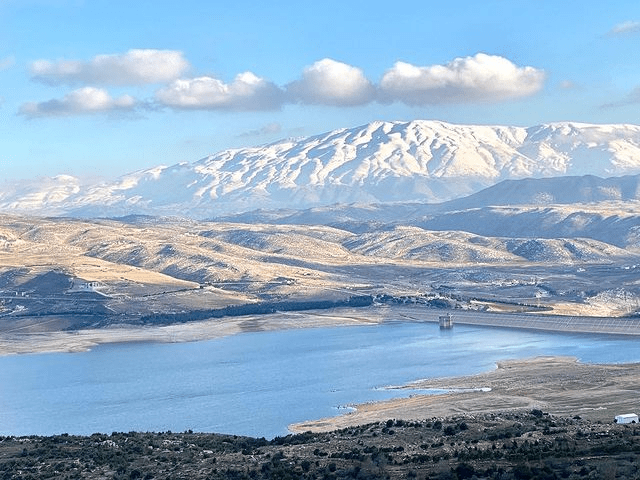
Mount Hermon is on the border between Lebanon and Syria

Mount Hermon is well north of the temple mount in Jerusalem. It too, is high up. Mount Hermon  rises to 9,232 feet and is the highest point on the east coast of the Mediterranean Sea. When the snow-capped ridge of the mountain melts, it liberally flows down and feeds the Jordan River, providing life for the valley.

Without Mount Hermon, there would be nothing and no one in the valley, which is why this water source is so important. Just like the oil flowing down Aaron’s beard, so the dew of Mount Hermon flows well beyond the mountain’s peak to provide abundant life. It enables us to come together united as one family in one place together.

Life and unity are not scarce. The resurrection of Christ opened the floodgates of heaven with life-giving grace, instead of death-dealing judgment, as in Noah’s day. Jesus is the wellspring of life who makes us one big family of faith by providing people with living water.

“Those who drink of the water that I will give them will never be thirsty. The water that I will give will become in them a spring of water gushing up to eternal life.” (John 4:14, NRSV)

No longer does life need to be quantified and measured in terms of years of time. Yes, we are mortal. But this will give way to immortality because a resurrected life is an everlasting life – made possible by Jesus.

My prayer and my hope is that our psalm for today will be like a glass of cold water on hot day when you are feeling parched. And this water will keep coming, as much of it as you need. The oil will keep flowing, with as much love and grace as you need for today. And there will be plenty more when tomorrow comes. It never runs out.

Perhaps you are encouraged with your own faith walk, but are awfully discouraged with the lack of unity in your family, neighborhood, church, workplace, nation, and world. Unity is not a piece of pie in which some get only a sliver, if any at all. In reality, there is plenty to go around. The power of the resurrection has made it possible.

In this present evil age, there are times of angry conflict and emotional distress, along with periods of great separation and sorrow. People everywhere who are divided and estranged from one another can hear God’s call to live together in unity. It is a call of love which beckons us to participate in the generous overflowing love of the Savior who has paved the way for an abundant life by bringing people together in faith.

Jesus prayed, “Holy Father, protect them in your name that you have given me, so that they may be one, as we are one.” (John 17:11)

Listen To Lady Wisdom (Proverbs 3:13-18)

Tree of Life, by Margarita Kriebitzsch, 2013

You’re blessed when you meet Lady Wisdom,
    when you make friends with Madame Insight.
She’s worth far more than money in the bank;
    her friendship is better than a big salary.
Her value exceeds all the trappings of wealth;
    nothing you could wish for holds a candle to her.
With one hand she gives long life,
    with the other she confers recognition.
Her manner is beautiful,
    her life wonderfully complete.
She’s the very Tree of Life to those who embrace her.
    Hold her tight—and be blessed! (The Message)

I like it that the author chose to personify wisdom as a woman. Maybe that’s because I have a wife and three daughters. Perhaps it has something to do with the fact that they, along with most of the women in my life, seem to have an almost mysterious quality of insight and understanding which transcends my very cerebral and logical approaches to life.

What I’m trying to say is that wisdom isn’t measured with a one-dimensional test of a person’s mental reasoning powers, but also requires emotional intelligence, social intelligence, interpersonal and relational intelligence, and spiritual intelligence, just to name a few.

And Lady Wisdom has it all. She’s the perfect combination of all the intelligent factors which make for a complete, fulfilling, and good life.

Everyone desires a good life. Nobody wakes up in the morning, sits on the edge of the bed, and thinks to themselves, “I really hope to have a bad day today!” A person might get up on the wrong side of the bed and grump their way through the first hours of the day, but no one makes a conscious decision to deliberately have a disappointing life. 

Indeed, we all want a good life. Students go to school hoping to have a good experience. Marriages begin with the hope of having a good life together. New employees start with the wish that there will be satisfaction in doing a job well done. Parents dream of their kids growing up to have a good life. 

We want the kind of life that brings contentment, joy, and happiness. So, how does it come?

A good life comes through embracing Lady Wisdom. And she has always been there, as the very Tree of Life:

“I was there when God set the heavens in place,
    when he marked out the horizon on the face of the deep,
when he established the clouds above
    and fixed securely the fountains of the deep,
when he gave the sea its boundary
    so the waters would not overstep his command,
and when he marked out the foundations of the earth.
    Then I was constantly at his side.” (Proverbs 8:27-30, NIV)

A good life has a basic respect and honor for God at the heart of it. Lady Wisdom understands this, first hand. She knows we are prone to being afraid. So, she assures us that the pursuit of true wisdom is worth it. With Lady Wisdom at our side, we have calm and confidence; we know when to take risks and when to be patient.

Most of all, our insecurities and anxieties begin to melt away as we connect with the image of God within us. Trust bubbles up from the depths of our soul, and we are no longer afraid of the unknown and what may happen to us.

The fear of the Lord is the beginning of wisdom, and knowledge of the Holy One is understanding.

Proverbs 9:10, NIV

The fear of the Lord means to honor and obey God, to be loyal and submissive. We know there is a good God from which our own good lives derive.

In a state of trust, of calm and confidence, we are able to listen and hear Lady Wisdom’s sage instruction. So, if you want to live a good life – and not just survive but thrive – then we must adopt a posture of listening.

The prerequisite to any semblance of a good life is to have a teachable spirit, to give focused attention to Wisdom. A fool is a fool, first and foremost, because he does not listen. Instead, he is negative, complains, and spews advice based in partial information.

But the person who hugs Lady Wisdom and does not let go, has learned to be attentive to the voice of God.

Continual fear of people is a death-dealing practice. But the person who fears God by listening to wise counsel discovers a life-giving practice that will serve them well for a lifetime. 

The teachable spirit bends the ear to hear good advice. Such a wise spirit inclines toward acquiring knowledge and learning the skillset needed to live a spiritually abundant life.

For the Christian, therefore, we cannot learn if do not read. The Bible is a book. If the Bible was a car, I would tell us all to learn to be mechanics; if it were a fish or a deer, I would tell us all to learn the best ways to hunt and fish; or if it was a store, I would encourage us to learn about being good shoppers and consumers. 

Yet, the Bible is a book. So, we must read it, memorize it, meditate on it, and learn from it. Becoming familiar with the contents of Holy Scripture, and immersing ourselves in it’s wisdom, will mold us in the ways of humility and form us spiritually for a lifetime of peace, love, and joy. 

Maybe you aren’t a tree hugger. But I encourage you to become one. Embracing Lady Wisdom is the surest way to avoiding unnecessary problems and finding purpose in life. Indeed, because she is good, we become good.

Today, God of Wisdom, let me experience your good and gracious heart. Draw me into your very being, into the core of your love for me, others, and the world. Give me a glimpse of others from your good, right, and just perspective, in loving them, forgiving them, and delighting in the way they give glory to God through their very existence. Help me to discern out of that place of deep affection for humanity, that I, too, might be a useful conduit of your love in the world. Amen.