Indeed, what do you long for? Before anything ever came into being, it was dreamed for. Everything that exists, had a beginning in the possibility of longing for it. I think it is inappropriate for me to ask you such a question, without first telling you what it is I long for. And there are so many things that I long for! Yet, I offer just a few of them…
I am a hospital chaplain. I dream of a healthcare system that values its caregivers so much that it does away with hierarchical organization. I imagine and visualize such a system taking psychological safety as seriously as physical safety. I long for healthcare administrations to establish the individual employee’s care – not in cheap talk of self-care – but in actual establishing of policy and procedure to ensure that care is realized.
For only in the consummate care of the caregiver, can care seekers receive what they truly need.
Such caregiver care toward the care seeker will translate into taking all the time needed to listen to the patient, practicing patience themselves in seeking to truly understand. With the caring caregiver full of attentive love, they can and will step back in thoughtful reflection for a gracious and effective care plan for the patient.
And, what’s more, they will follow up with equal motivation and attention in order to provide skillful love, precisely where it is needed and wanted. For all caregivers shall know that a “bedside manner” is not optional, but is as important to healing as the actual care plan which is on paper.
I am a church pastor. I dream of good and effective change and reformation for the Body of Christ, as well as all faith communities everywhere. I imagine churches and church leaders who bathe all things in prayerful conversation with God and others. I long for a church that truly cares for those struggling to make sense of faith, and gives ample and adequate space for faith seekers to express their doubts, feelings, and questions in a safe and supportive environment.
Such pastors, elders, deacons, and denominational leaders will give scant attention to the more secular matters of building needs, budget finances, and butts in the pew (which, of course, often emit the most foul odor, because they originate in the person who is a tedious fart). They will have the sweet smelling incense of mentoring others in the faith, attending to the needs of the community at large, and lifting up emotional and mental needs with equal passion alongside the physical and spiritual needs of people.
For only in the consummate care of the pastors and leaders, attending to their foundational needs of bodily care and exercise, mental and emotional health, and spiritual disciplines, can parishioners receive the holistic care they truly need in order to grow and mature in faith.
Oh, how I dream, imagine, and long for a world that exalts the holistic person – body, mind, feelings, and soul – so that everyone in everyplace on the earth realizes their God-given potential as people gifted to serve the holistic well-being of others.
All of us are but temporary sojourners on this earth. And this world which we inhabit is fundamentally broken. Let us long for better days, imagine those days in our mind’s eye, and dream into existence that which originally had its origin in the heart of God.
Longing is only realized through belonging. If we remain emotionally lonely, bodily disconnected, mentally rootless, and spiritually adrift, we’ll never know the confident hope of belonging to God and community. Until we participate with ancient and universal rhythms of being in this world together, we will continue to experience the things which are nightmares to us.
So, what do you long for? It really is neither an esoteric nor impractical question. It is the vital question of our time.
Give thanks to the Lord, for he is good; his love endures forever.
Let Israel say: “His love endures forever….”
The Lord is my strength and my defense; he has become my salvation.
Shouts of joy and victory resound in the tents of the righteous: “The Lord’s right hand has done mighty things! The Lord’s right hand is lifted high; the Lord’s right hand has done mighty things!” I will not die but live, and will proclaim what the Lord has done. The Lord has chastened me severely, but he has not given me over to death. Open for me the gates of the righteous; I will enter and give thanks to the Lord. This is the gate of the Lord through which the righteous may enter. I will give you thanks, for you answered me; you have become my salvation.
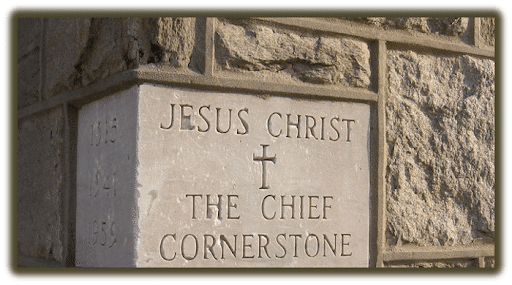
The stone the builders rejected has become the cornerstone; the Lord has done this, and it is marvelous in our eyes. The Lord has done it this very day; let us rejoice today and be glad. (New International Version)
Jesus The Cornerstone, by Gloria Ssali, 2016
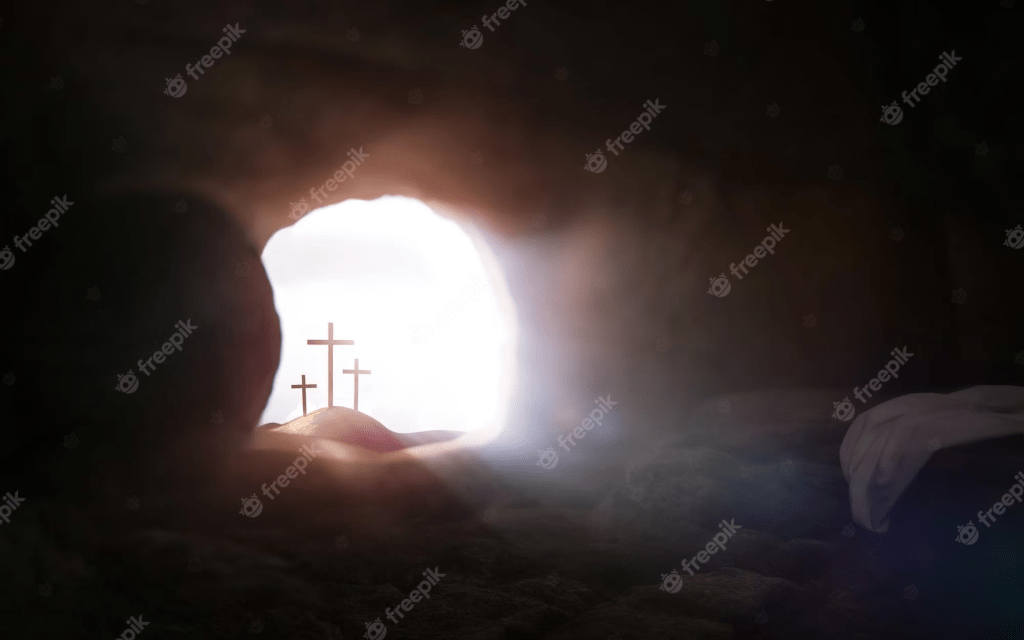
Indeed, today we rejoice with gladness and celebrate that Christ is risen! Christians have a firm foundation of faith that gives us strength and stability.
Everyone’s life is constructed on some sort of foundational support. If we consider a building, it’s foundation has four cornerstones. For us as people, those stones consist of the body, the mind, the emotions, and the spirit. Each of these stones is holding up the one building of our life, and so therefore, they each need our attention in order to be well maintained.
Physical
Jesus is the
Mental Spiritual
Cornerstone
Emotional
We can neither treat them as if they are different sizes (which then would never hold up the building of our life) nor as of different importance.
For example, if we get a crack in the physical stone of our life, it is insufficient to examine the mental stone and try to repair the crack through positive thinking or mindfulness. Or, if our emotional stone is damaged, it won’t get fixed by focusing on the spirit stone by only praying.
These days, a lot of people have had bad, even traumatic, religious experiences, and so they’ve jettisoned the spirit cornerstone altogether. And as their building begins to collapse, they wonder why this is all happening.
The spirit cornerstone is Jesus. We need him. We need his whole entire life – not just parts of it. Christ is not a tool that we can use and then store in the garage for next time; he’s the whole garage, and the entire hardware store. We can no more set him aside than we can set aside our lungs or our heart.
So, why do so many resist facing the cracked and damaged stones? Why resist, or even reject, Jesus? Why do so many Christians want the victory of this Resurrection Day without the hard suffering of Good Friday?
Because we are still coming to grips with what it takes to live into the victory of the Cross – yes, the Cross. There’s no new life without a death. If we want a miracle, we need to die – die to our expectations, dreams, desires, and anything we believe we need, other than Jesus.
The builders rejected the stone because it was too hard. But the reality is that you cannot build on a foundation of marshmallows. Love isn’t actually soft, but hard; it’s permanent, like solid marble; it’s not going anywhere. We need that firm base of love to construct a soul that’s worth living.
Christ’s earthly life had incredible times of miraculous healings, provisions of food and necessities, and relational connections. But that’s only part of it. There was also hardship, adversity, rejection, mockery, torture, abuse, and death. When the Apostle Paul considered it all, he said:
But whatever were gains to me I now consider loss for the sake of Christ.
What is more, I consider everything a loss because of the surpassing worth of knowing Christ Jesus my Lord, for whose sake I have lost all things.
I consider them garbage, that I may gain Christ and be found in him, not having a righteousness of my own that comes from the law, but that which is through faith in Christ—the righteousness that comes from God on the basis of faith.
I want to know Christ—yes, to know the power of his resurrection and participation in his sufferings, becoming like him in his death, and so, somehow, attaining to the resurrection from the dead. (Philippians 3:7-11, NIV)
Both suffering and resurrection go together for a spiritually sound life, free of cracks and damage. A new life is fresh, hopeful, and full of promise – and it’s downright hard; there is nothing easy about it. We don’t get to pick and choose which parts of Jesus we want – we must take him wholesale just as he is, the entire thing.
It’s from the person and work of Jesus Christ as our cornerstone – both his cross and resurrection – that a new building is being built into a spiritual house which is the place of hospitality for the entire world.
As you come to him, the living Stone—rejected by humans but chosen by God and precious to him—you also, like living stones, are being built into a spiritual house to be a holy priesthood, offering spiritual sacrifices acceptable to God through Jesus Christ. For in Scripture it says:
“See, I lay a stone in Zion, a chosen and precious cornerstone, and the one who trusts in him will never be put to shame.”
Now to you who believe, this stone is precious. But to those who do not believe,
“The stone the builders rejected has become the cornerstone,”
and,
“A stone that causes people to stumble and a rock that makes them fall.”
They stumble because they disobey the message—which is also what they were destined for.
But you are a chosen people, a royal priesthood, a holy nation, God’s special possession, that you may declare the praises of him who called you out of darkness into his wonderful light. Once you were not a people, but now you are the people of God; once you had not received mercy, but now you have received mercy. (1 Peter 2:4-10, NIV)
Jesus is our cornerstone, the center of life and worship. Our priority as believers, is allowing God to build us into a community of faith that worships Jesus with lives dedicated to knowing him and making him known.
Christian worship is the expression of a relationship in which God the Father reveals himself and his love in Christ, and by his Holy Spirit gives grace, to which we respond in faith, gratitude, obedience, and love to one another and the world.
People, at their core, exist for worship. Firmly built on Christ the cornerstone, worship becomes less about gaining truth, and more about letting truth gain us and capture us. The more we pay attention to the presence of Jesus Christ through song, prayer, Scripture, and sacrament, the more we will experience the centrality and power of God. Jesus becomes very precious to us when we align ourselves to him as the cornerstone of our faith and worship.
I urge you, brothers and sisters, in view of God’s mercy, to offer your bodies as a living sacrifice, holy and pleasing to God—this is your true and proper worship (Romans 12:1, NIV)
Jesus, as the cornerstone upon which all is supported, means that acceptable worship can happen anywhere. Everywhere can become a sanctuary and a sacred space – home, neighborhood, and marketplace – as well as church. In all these locations, Christian discipleship will prove itself.
Several years ago, a man named Matt had an aunt who had struggled for years to make ends meet. When her health started to decline, she was forced to sell her fifty acres of property to pay for health care. As an act of kindness, Matt traveled to Massachusetts and bought the land from his aunt for the appraised value of $50,000. While exploring the land to see about building a house, he discovered outcroppings of stone ledges.
Matt contracted a geologist, who surveyed the land and informed him the stone was actually Goshen stone, a type of mica used for sidewalks, patios, and landscapes. At the time, it sold for $100 a ton – and Matt had about 24 million tons on the land. The appraised value on the surface was $50,000, but experts estimated that the land was worth up to $2 billion.
Jesus is the precious cornerstone. He is much too valuable to be left in on a piece of property undiscovered. And he’s also much too needed to merely remain in a church building. He’s the cornerstone who has the resurrection power to be the foundation for all the world. So, let’s let him.
Almighty God, who through your only Son Jesus Christ overcame death and opened to us the gate of everlasting life: Grant that we, who celebrate with joy the day of the Lord’s resurrection, may be raised from the death of sin by your life-giving Spirit; through Jesus Christ our Lord, who lives and reigns with you and the Holy Spirit, one God, now and forever. Amen.
Tell me, you who want to be under the law, are you not aware of what the law says? For it is written that Abraham had two sons, one by the slave woman and the other by the free woman. His son by the slave woman was born according to the flesh, but his son by the free woman was born as the result of a divine promise.
These things are being taken figuratively: The women represent two covenants. One covenant is from Mount Sinai and bears children who are to be slaves: This is Hagar. Now Hagar stands for Mount Sinai in Arabia and corresponds to the present city of Jerusalem, because she is in slavery with her children. But the Jerusalem that is above is free, and she is our mother. For it is written:
“Be glad, barren woman, you who never bore a child; shout for joy and cry aloud, you who were never in labor; because more are the children of the desolate woman than of her who has a husband.”
Now you, brothers and sisters, like Isaac, are children of promise. At that time the son born according to the flesh persecuted the son born by the power of the Spirit. It is the same now. But what does Scripture say? “Get rid of the slave woman and her son, for the slave woman’s son will never share in the inheritance with the free woman’s son.” Therefore, brothers and sisters, we are not children of the slave woman, but of the free woman.
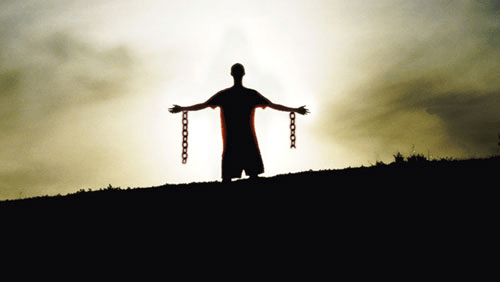
It is for freedom that Christ has set us free. Stand firm, then, and do not let yourselves be burdened again by a yoke of slavery. (New International Version)
Get your hermeneutics together, man
First of all, I want to say that I have little tolerance for Bible readers who insist on an exclusive literal interpretation of Scripture – because it’s downright nonsensical.
Today’s New Testament lesson is one of many biblical passages which really ought to put a wooden stake to the heart of such a misguided hermeneutic. The Apostle Paul himself uses an allegorical or figurative approach to interpreting an Old Testament story.
Holy Scripture interprets itself in many ways. It is, at the least, hubris to believe one has the corner on biblical interpretation through a single mode of literal Bible interpretation; and it is, at the worst, damaging to other’s souls to restrict them in their reading and reflection – not to mention destructive whenever a literalist (who is typically also a legalist) brings their judgmentalism forward to condemn the other approaches.
Okay, I feel better now, getting that off my chest. But, unfortunately, we’ve still got to deal with legalism – which is what Paul set out to do with his writing to the churches in the region of Galatia.
Let go of the legalism
There can be something oddly comforting about law. Having clear black-and-white no-nonsense rules can give a sense of security. You always know where you stand. You’re either in or you’re out, either pure or sinful.
Yet, here’s the score on the law: it is meant for the immature and is designed as a guide to lead us to maturity.
If we live by law, we are bound by law. Law can only take us so far in our walk with God. A slavish commitment to rules must, at some point, give way to the greater virtues of grace and love.
The Galatian churches wanted a religion they could see and hold in their hands. But Paul would have none of it; he was dogged about the devotion to a life of grace. Since Christ has set us free, we are truly and really free. So now, we are to embrace the freedom and never go back to being slaves to the law again – which is closely akin to relapsing into spiritual immaturity.
We (hopefully) expect a kid to be a kid. When the kid grows up and is an adult with adult responsibilities, we expect him to speak and act like an adult, not a kid.
What’s more, we ought also to expect the adults in the room to treat one another like adults. Layering a bunch of rules and regulations on grown-up people is nothing more than handling them like they’re kids. It’s a nonsensical approach to dealing with each other.
Embrace your freedom
Freedom means that we have no obstacles in expressing grace, love, and hope to others. We are free to bask in the forgiveness we possess in Christ.
If our Christianity is reduced to a point system or following a list of juvenile rules, then we have missed what the law was all about in the first place. The law is meant to lead us to Christ, and it must, at some point, give way to the larger law of love.
The law has its place. Yet, if we are perpetual slaves to it and never outgrow it’s intended purpose for us, then we need to move onto maturity and embrace the freedom we have in Christ.
To live in freedom doesn’t mean we can simply do whatever we want, as if there’s no consequences to our words and actions. It’s not “anything goes.” Rather, Christian freedom is a life attuned to the Spirit; an awareness of living for Jesus through the fruit of the Spirit. It doesn’t break laws; it fulfills them.
All Christians must grow up and become spiritual adults. That means leaving childish ways of the law behind and embracing the freedom of the Spirit.
So, where are you in your Christian life? Are you a slave to Law or a free person to Love?
Hospitals and health clinics are probably not on your A-list of fun places to hang out. But you go. Maybe begrudgingly, and perhaps because your spouse or significant other insisted or even made threats. You and I go because we recognize the need. When there is a change in our health, or an emergency arises, or even because we understand its good to get an annual physical, we take the time out of our lives to go. What’s more, we in the U.S. are blessed with some of the best healthcare in the world. You know the importance and the need for competent physicians who have a good bedside manner.
All of that is for our bodies. Yet, we are not one-dimensional blobs of protoplasm who walk around needing our cells fixed once-in-awhile. We are living breathing human beings with as much need for doctors of the soul as we need doctors for the body. To ignore that we need competent “metaphysicians” [more than just the physical] with a good bedside manner is to not recognize the high value of the unseen inner person.
In some ways I feel like the old country doctor you see in Westerns – patching up people who got shot in the street in a gunfight – and getting paid with a bushel of apples or a basket of eggs. I admit I would much rather operate (pun intended) more like the modern-day family physician who insists on annual physicals, med checks, and makes good referrals to other competent professionals.
Imagine with me if you saw as much importance to go to your local pastor to get an adjustment for your soul as you did going to your local chiropractor for a back adjustment; if you believed there was value in scheduling an annual “metaphysical” on your calendar; and, if you were faithful to take some needed biblical medicine every day and come in every so often to your soul doctor for a check to see how it was all going.
I can hear some of your objections. Yes, I know that there are a great many metaphysical quack pastors out there who only give unhelpful panaceas and have questionable educational credentials. But that doesn’t take away from your need to find a good metaphysician and stick with him/her. They are out there, and there are a lot of good ones.
Jesus said, “Do not fear those who kill the body but cannot kill the soul. Rather fear him who can destroy both soul and body…” (Matthew 10:28). It’s important and necessary to care for your body; to address disease; to do the things necessary to restore your health through medication, surgery, and/or therapy. It is equally important to care for your soul; to address the sickness of your heart; and to do the things necessary to restore your spiritual health through metaphysical therapy.
You need to schedule an appointment – maybe with your physician – but also, and just as necessary with your metaphysician. Even if you’re feeling fine. Get that annual metaphysical and catch any warning signs of danger in the future of your spiritual health and well-being…. What are you waiting for?











 Rev. Tim Ehrhardt