Reverence, Humility, and Contentment (Ecclesiastes 5:1-20)

Guard your steps when you go to the house of God; to draw near to listen is better than the sacrifice offered by fools, for they do not know how to keep from doing evil. Never be rash with your mouth nor let your heart be quick to utter a word before God, for God is in heaven and you upon earth; therefore let your words be few.

For dreams come with many cares, and a fool’s voice with many words.

When you make a vow to God, do not delay fulfilling it, for he has no pleasure in fools. Fulfill what you vow.It is better that you should not vow than that you should vow and not fulfill it. Do not let your mouth lead you into sin, and do not say before the messenger that it was a mistake; why should God be angry at your words and destroy the work of your hands?

With many dreams come vanities and a multitude of words, but fear God.

If you see in a province the oppression of the poor and the violation of justice and right, do not be amazed at the matter, for the high official is watched by a higher, and there are yet higher ones over them. But all things considered, this is an advantage for a land: a king for a plowed field.

The lover of money will not be satisfied with money, nor the lover of wealth with gain. This also is vanity.

When goods increase, those who eat them increase, and what gain has their owner but to see them with his eyes?

Sweet is the sleep of laborers, whether they eat little or much, but the abundance of the rich will not let them sleep.

There is a grievous ill that I have seen under the sun: riches were kept by their owners to their hurt, and those riches were lost in a bad venture; though they are parents of children, they have nothing in their hands. As they came from their mother’s womb, so they shall go again, naked as they came; they shall take nothing for their toil that they may carry away with their hands. This also is a grievous ill: just as they came, so shall they go, and what gain do they have from toiling for the wind? Besides, all their days they eat in darkness, in much anger and sickness and resentment.

This is what I have seen to be good: it is fitting to eat and drink and find enjoyment in all the toil with which one toils under the sun the few days of the life God gives us, for this is our lot. Likewise, all to whom God gives wealth and possessions and whom he enables to enjoy them and to accept their lot and find enjoyment in their toil—this is the gift of God. For they will scarcely brood over the days of their lives because God keeps them occupied with the joy of their hearts. (New Revised Standard Version)

Life can be paradoxically both meaningful and meaningless. Yet, if we can live consistent with who we are and how we were created to be, then it is likely we shall find a semblance of meaning, purpose, and even joy in this present life.

Reverence

Too much talk leads to sin. Be sensible and keep your mouth shut. (Proverbs 10:19, NLT)

We are to be cautious in our speech, especially in addressing God. We must choose our words carefully and deliberately, in prayer, as well as with others.

God is God, and we are not. Therefore, since God is far above us, the high and holy One, it is wise to minimize our talking. There’s no need for lengthy and showy prayers. It is the mark of a fool that talks too much, just as much as it is the mark of a fool to let daydreams occupy too much of their thoughts.

Even fools who keep silent are considered wise; when they close their lips, they are deemed intelligent. (Proverbs 17:28, NRSV)

To be reverent and respectful before God involves not only the volume of words, but also the sanctity of words.

Whenever a person makes a vow or a promise to God, they need to be diligent about fulfilling that vow. The Lord takes our words seriously, and is not pleased with flippant promises that we have little intention of keeping.

On the flipside, good intentions are just that – they do not constitute a promise to do anything. We make vows so that we will be accountable to ourselves and others, and then follow through with the promise, no matter what.

Reneging on any promise, whether the vow is to another or God, is a foolish act with real consequences. Therefore, we should consider our promises well before making them, and avoid being rash.

Humility

All of us have both observed and experienced oppression and injustice of another or a group of people. In our anger, we may want to play both judge and jury. Humility teaches us that this is not our role, and to accept that a right and just God will deal with injustice.

The Lord sneers at those
    who sneer at him,
but he is kind to everyone
    who is humble. (Proverbs 3:34, CEV)

The injustice of this world does not necessarily need to create a deep theological conflict within us. We rarely, if ever, have the big picture on the circumstances and complexities of what is going on. But God does.

The Lord is watching. God neither slumbers nor sleeps. There is never a Divine nap time. So, God knows all, and will handle arrogant people according to their deeds and motives.

People who are proud will soon be disgraced. It is wiser to be modest. (Proverbs 11:2, GNT)

Contentment

It is the proud and arrogant person who never seems content. They continually want more – likely because they have the wrongheaded notion that they deserve more, even if it comes by taking resources from others.

Yet, the reality is that both kings and commoners rely upon the produce which comes from the soil. And regardless of whether a person has lots of money, or not, wealth isn’t the thing which makes for a truly happy life.

So, it is pointless and foolish to hoard food, money, stuff, resources, and even intangible things such as love and encouragement. Having a liberal outlook of sharing and giving creates joy. Misers, however, are typically curmudgeons who rarely smile and enjoy what they have.

The more stuff and wealth a person has, the less it is of benefit to humanity, whenever it is stockpiled and/or selfishly used and spent. Besides, when somebody has a lot, they have a lot to worry about. But workers living a simple life sleep just fine.

It is foolish to work so hard for something, only to end up with nothing you can take with you into eternity; or to have it taken by someone with an evil scheme to get it. On top of it, leaving this life with no humility and charity means that such a person really does leave with absolutely nothing to show for their life.

There’s no need to waste your life by filling it with nothing but aggravation and worry. Life has purpose and joy when there are liberal amounts of gratitude, encouragement, and friendship.

Let’s live today according to what is most important in life. Instead of chasing wealth, power, and control, we have the opportunity – no matter who we or our station in life – to live honestly and reverently, humbly and gently, with satisfaction and contentment.

What will you choose this day?

Almighty God of mercy, thank You for extending grace to me as I humble myself before You. Help me to be careful with my words, and to approach You with reverence and respect. Enable me to listen more and speak less, and to fulfill my vows to You. Guide me in being content with what You have given me and not to be consumed by the pursuit of wealth. I pray for wisdom and discernment in all my dealings and decision-making. Amen.

The Heart of Words (Matthew 12:33-37)

A good tree produces good fruit, and a bad tree produces bad fruit. You can tell what a tree is like by the fruit it produces. You are a bunch of evil snakes, so how can you say anything good? Your words show what is in your hearts. Good people bring good things out of their hearts, but evil people bring evil things out of their hearts. I promise you on the day of judgment, everyone will have to account for every careless word they have spoken. On that day they will be told they are either innocent or guilty because of the things they have said. (Contemporary English Version)

Words are important. They have meaning and power.

Our speech is the outward demonstration of what is really within the heart. There really isn’t any room to believe that a constant stream of gossip, backbiting, slander, and negative comments is anything but coming from a heart of evil. The person who speaks such words is not a loving, gracious, merciful person. Conversely, the person who continually encourages, uplifts, and seeks to be positive, reflects a deep heart of love for others.

Therefore, simply altering our speech when we’re around particular people is not the point; and it does no good. That kind of talking only breeds hypocrisy and is two-faced. Instead, the place to aim is the heart because that’s where the words come from. And the way to truly renovate a heart is to sub-contract the project to Jesus.

The people we typically hang-out with the most are the people that most influence our attitudes and our speech. 

So, if we spend copious amounts of time with Jesus, it’s inevitable that our hearts will become more like his heart, and thus, our words will be in alignment with the words and ways of Christ. Be rooted in Christ and the fruit of the tree will demonstrate it.

I always find public confessions on TV to be a rather disingenuous affair. Typically, celebrity apologies only take shape when one has been caught saying something and are called on the carpet. Then, when the apology comes, it’s predictably odd and incongruent, with the person saying something to the tune of, “I’m sorry if I hurt anybody by what I said. Saying that really wasn’t me. I’m not really like that.”

Well, apparently you are. It came out of your mouth. Jesus said that out of the overflow of the heart the mouth speaks. The words we say out loud betray what is truly inside us.

Jesus used the metaphor of a tree to illustrate his point. If the roots, the trunk, and the branches are good and healthy, then you can be sure the tree will produce good healthy fruit. However, if the tree is diseased, or infested with insects and rotting from the inside out, then no one can expect anything other than bad fruit, not fit to consume.

If the fruit is bad, the tree is bad. If the words are hateful, sarcastic, passive-aggressive, manipulative, conniving, racist, hurtful, ignorant, mean, unjust, foolish, and either subtly or overtly abusive, then the person has a dark heart and is need of redemption, not excuses.

Conversely, if the words are affirming, encouraging, loving, compassionate, gentle, caring, direct, helpful, peaceful, kind, giving hope and life, then there is a good heart behind it.

Yes, bad hearts can parrot good words. However, those words are not genuine but mere rote recitations to achieve some sort of personal agenda. And, of course, good people will occasionally say dumb or hurtful words. In such times, let it be a reminder that we all have some shadowy places within our hearts – and that we must depend on God’s grace to enlighten those dark spaces.

Let’s observe patterns, rather than focusing on isolated events where either good or bad words were said. A consistent pattern of invalidating another’s experiences or feelings; intimidating or threatening others; dismissing or discounting someone’s input; or being unnecessarily blunt, are all major red flags pointing to a severe heart issue.

Evil exists in the world. And if we are not vigilant to the power of language, wickedness can easily smack us upside the head when we aren’t looking.

The heart cannot be concealed forever. Eventually, the virtuous person will be shown as such by the stream of gracious speech which pours forth from the heart, as if it were living water for others to drink and enjoy. Their words reflect their good character.

The wicked person, however, cannot keep the bad words down. Those vile words sit in the soul, poisoning and making the person ill. Then, all of a sudden, the evil words come up and out with a great vomitous heave and spew impurity and unholiness all over the innocent. Their words betray their foolish and poor character.

Every tree that does not bear good fruit will be cut down and thrown into the fire. The wicked heart will not be able to speak ill of others with impunity forever. They will be called to account for their abusive words, whether overtly violent, or subtly undermining.

The righteous heart, however, shall experience divine pleasure and reward, as if the careful construction of helpful and building up words wins first-prize at the great heavenly fair.

The good person loves and does not hate. They are so far from harming anyone that they even pray and wish well for their enemies. They pray for blessings on those who curse them. There is an honest striving to speak good words to everyone, regardless of who they are.

The upright heart thinks the best of everyone and holds nothing over someone else’s head. Such a good heart condemns no one, leaving all judgment to God alone. It is patient with the most exasperating of people, praying they might come to their senses and become spiritually healthy.

The righteous are able to use their speech to admonish their neighbor with care and affection. They freely forgive, happily give, liberally encourage, and use their tongue to speak words of life. Indeed, their speech is wise, humble, full of grace, and above all, loving.

Almighty God, to you all hearts are open, all desires known, and from you no secrets are hid: Cleanse the thoughts of our hearts by the inspiration of your Holy Spirit so that we may perfectly love you, and worthily magnify your holy Name; through Christ our Lord. Amen.

James 3:1-12 – Taming the Tongue

Not many of you should become teachers, my fellow believers, because you know that we who teach will be judged more strictly. We all stumble in many ways. Anyone who is never at fault in what they say is perfect, able to keep their whole body in check.

When we put bits into the mouths of horses to make them obey us, we can turn the whole animal. Or take ships as an example. Although they are so large and are driven by strong winds, they are steered by a very small rudder wherever the pilot wants to go. Likewise, the tongue is a small part of the body, but it makes great boasts. Consider what a great forest is set on fire by a small spark. The tongue also is a fire, a world of evil among the parts of the body. It corrupts the whole body, sets the whole course of one’s life on fire, and is itself set on fire by hell.

All kinds of animals, birds, reptiles and sea creatures are being tamed and have been tamed by mankind, but no human being can tame the tongue. It is a restless evil, full of deadly poison.

With the tongue we praise our Lord and Father, and with it we curse human beings, who have been made in God’s likeness. Out of the same mouth come praise and cursing. My brothers and sisters, this should not be. Can both fresh water and saltwater flow from the same spring? My brothers and sisters, can a fig tree bear olives, or a grapevine bear figs? Neither can a salt spring produce fresh water. (New International Version)

Words and speech are the most powerful tools we have in the Christian life. And the tongue is the means of forming the words and using the speech God gives us.

The problem is, we may too often underestimate the importance and the great power of the tongue to effect both good and evil. We might not believe that our particular words carry much weight.

Yet, in reality, our words are very powerful.  In fact, what we say with our tongues is either the vehicle of praise to God, or the ruin of another person. We must measure our words because the tongue is a beast to control and tame. 

The tongue is so powerful that it determines the direction of a person’s life.

The horse is a strong animal, and the strength of a horse must be respected at all times. Yet, a small woman, even a young girl who knows what she is doing with a bridle and a bit, can make a horse do whatever she wants. Ships can be massive and carry thousands of people and huge amounts of cargo. Yet, it is controlled and directed by the rudder – a very small piece of the ship.  In our own day, we know the devastating power of a very small handgun trigger which can literally snuff out a life in an instant.

Likewise, the tongue is quite small among the parts of the body. Yet, it sets the course of a person’s life and has the power to determine its destiny.  A rider who does not know how to handle a horse is in trouble.  An undisciplined pilot of a ship is in danger of shipwreck.  A gun owner loose with gun safety is a danger to others. And the loose, unbridled, untrained and undisciplined tongue is on a one way course to destruction.

The tongue is so powerful that it can destroy another person.

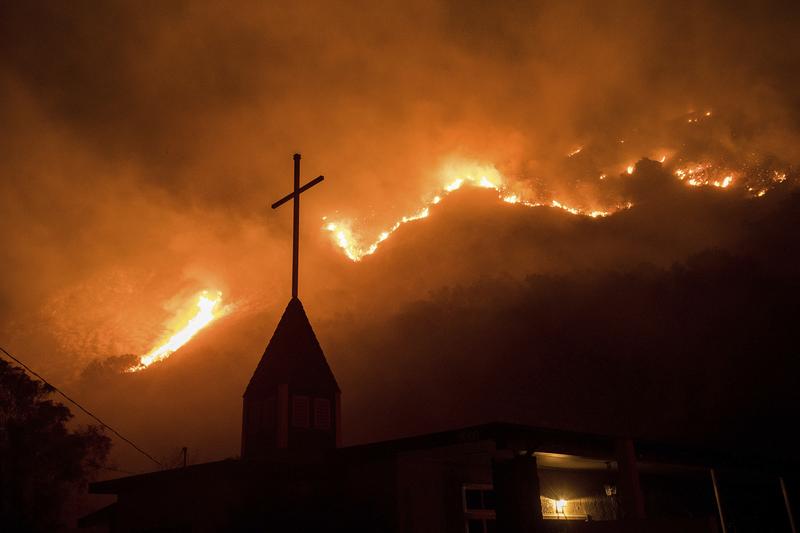
Like fire, the tongue has an awesome potential for harm. The great Chicago fire of 1871, one of the costliest disasters of the nineteenth-century, killed three hundred people and destroyed seventeen-thousand buildings.  All the destruction was started by Mrs. O’Leary’s cow kicking over a lantern in a barn. 

The Yellowstone National Park fire of 1988 burned for several months and completely destroyed nearly 800,000 acres of the park.  At the peak of the fire there were 9,000 firefighters battling the blaze. All the devastation was caused by one quick flash of lightning.

The largest fire in American history occurred in 1871 and began in northern Wisconsin. The fire created its own wind system and turned into a tornado, moving into the Upper Peninsula of Michigan. By the time it was over, 3.7 million acres were scorched with 2,500 people left dead. All the destruction was likely caused by a small meteorite.

Whenever we underestimate the power of our speech and allow a stray word to fly off the tongue, the spark has the potential to start a huge conflagration of evil. A firestorm of destruction can be set off with just a few uncontrolled words. 

Through gossip (saying something behind somebody’s back that you would not say to their face), flattery (saying something to someone’s face that you would not say behind their back), negative criticism, sarcastic humor, boasting, and a host of evil words, the tongue has the immense power to destroy life.  It is speech fueled and spread by Hell itself.

The tongue is so powerful that it cannot be tamed.

Animals can be tamed, even crocodiles.  I once took my oldest daughter to the circus, when she was a small girl, and watched as a guy had a trained crocodile open its mouth and stuck his head inside the crazy reptile! 

Yet, no one can tame the tongue. It is like a tarantula, biting its victim with paralyzing venom so that the arachnid can eat its prey alive. The untamed and uncontrolled tongue is like a poisonous spider which spreads its verbal venom, paralyzing other people and sucking the life out of them.

The Apostle James paints a hopeless picture because he wants to drive us to the grace of God for help. We cannot tame the tongue – but God can. When we begin to see the true nature of our speech, it reveals something of ourselves.

The tongue is so powerful that it exposes the duplicity of the heart.

Whatever comes out of our mouths reveals what is on the inside of our lives. If we can grasp the truth of this, I believe it could transform the way people talk to one another. Even more metaphors to communicate the point….

Salt water and fresh water cannot both come from the same spring. A fig tree cannot bear olives, and a grapevine is not going to produce figs. And whatever comes out of the mouth reveals the source. Evil words come from an evil source; good words come from a good source. 

A pattern of negative condescending speech is drawing from a well, pumping up words from the depths of Hell. Conversely, a continuous stream of helpful words that encourage and build up others, draws its nourishment from God’s Word.

Conclusion

The following are four ways to help bring the tongue under control:

  • Train your tongue for good. Speech is a skill to be developed. When starting an exercise regimen, we are deliberately training our bodies for health. When dieting, we are saying “yes” to certain foods, and “no” to others. The tongue needs to be trained to express gratitude, good news, and grace. And one of the best ways to do it is through speaking Scripture out loud in a daily regular regimen. Consider going on a fast from talking and seek only to be silent and listen for a specified amount of time.

Do not waste time arguing over godless ideas and old wives’ tales. Instead, train yourself to be godly. “Physical training is good, but training for godliness is much better, promising benefits in this life and in the life to come.” (1 Timothy 4:7-8, NLT)

Solid food is for the mature, for those whose faculties have been trained by practice to distinguish good from evil. (Hebrews 5:14, NRSV)

  • Read a chapter of Proverbs each day for a month. There are thirty one chapters in Proverbs, one for each day of the month. Pay attention to the power of words. Notice the difference between the speech of a wise person and the words of a fool – and take to heart the consequences of both approaches. 

You will say the wrong thing
    if you talk too much—
    so be sensible and watch
    what you say. (Proverbs 10:19, CEV)

Careless words stab like a sword,
    but wise words bring healing. (Proverbs 12:18, NCV)

  • Build friendships with people who are positive and encouraging. If a negative person keeps being negative, even after you have warned them more than once about it, you likely need a new relationship. 

Warn a quarrelsome person once or twice, but then be done with him. It’s obvious that such a person is out of line, rebellious against God. By persisting in divisiveness, he cuts himself off.  (Titus 3:10-11, MSG)

  • Listen and learn before speaking. A judgmental spirit often comes from misinterpreting another person’s words and/or actions. We can too often jump to conclusions about something or someone with only partial information and without the whole story.

Love never gives up.
Love cares more for others than for self.
Love doesn’t want what it doesn’t have.
Love doesn’t strut,
Doesn’t have a swelled head,
Doesn’t force itself on others,
Isn’t always “me first,”
Doesn’t fly off the handle,
Doesn’t keep score of the sins of others,
Doesn’t revel when others grovel,
Takes pleasure in the flowering of truth,
Puts up with anything,
Trusts God always,
Always looks for the best,
Never looks back,
But keeps going to the end. (1 Corinthians 13:4-7, MSG)

Right and Just God, teach us to speak wisely. Let us avoid useless thoughts and useless conversations. Help us to speak often of you. Grant that our words may never hurt others but always bring comfort to those in sorrow, and guidance to those in need. Take our tongues and make them yours. Take our minds and make them instruments of your goodness and a channel of truth. May you help us to use both words and silence in redemptive ways, through Jesus Christ our Redeemer. Amen.

Psalm 29 – The Voice of the Lord and the Power of Words

Welcome, friends! Click the video below and hear a message from God’s Word…

Psalm 29

The words of Psalm 29 spoken by children…

A song inspired by the words of Psalm 29…

May God’s peace, which goes beyond anything we can imagine, guard your thoughts and emotions through Christ Jesus. Amen.