‘Tis the Season For Praise (Psalm 148)

By Stushie Art

Praise the Lord!
Praise the Lord from the heavens;
    praise him in the heights!
Praise him, all his angels;
    praise him, all his host!

Praise him, sun and moon;
    praise him, all you shining stars!
Praise him, you highest heavens
    and you waters above the heavens!

Let them praise the name of the Lord,
    for he commanded and they were created.
He established them forever and ever;
    he fixed their bounds, which cannot be passed.

Praise the Lord from the earth,
    you sea monsters and all deeps,
fire and hail, snow and frost,
    stormy wind fulfilling his command!

Mountains and all hills,
    fruit trees and all cedars!
Wild animals and all cattle,
    creeping things and flying birds!

Kings of the earth and all peoples,
    princes and all rulers of the earth!
Young men and women alike,
    old and young together!

Let them praise the name of the Lord,
    for his name alone is exalted;
    his glory is above earth and heaven.
He has raised up a horn for his people,
    praise for all his faithful,
    for the people of Israel who are close to him.
Praise the Lord! (New Revised Standard Version)

By Bible Art

God is sovereign – which means that the Lord has complete power, dominion, and authority over everything that exists. God has supremacy because the Lord is the Creator God, the One who brought all things into existence.

Ideally, God and all creation exist harmoniously together. People coexist with God and recognize the Lord’s sovereignty through offering praise, adoration, and thanksgiving to the Lord.

That is what today’s psalm calls us to do, especially in this season of Christmastide. Christians are to offer their praise to God, despite whatever circumstances may be happening in their lives, and around them.

The psalmist was not telling people to simply forget their sorrows. He was exhorting everyone, including all creation, to praise the Lord in the middle of their distress.

When Christ was born, circumstances were not good for the Jews in Judea. Roman occupation had a firm authoritative hold upon them. Throughout their history, Jews have been often marginalized and oppressed. They know what suffering is.

Even though Christianity is a sizable world religion, Christians in many parts of the world today experience ostracization and discrimination. Christians everywhere are not immune to world events with situations like dictators, disasters, and diseases.

Yet, there is always an opportunity for praise to God. And the psalmist summons the faithful to do so. Praise and adoration of God shape us and form us spiritually, so that, even if we do not feel like doing it, the very act of offering the praise trains our spirits to bend in a good direction.

We could simply give-in to the status quo of things through constant complaining; or keep offering our woes. But that doesn’t negate the importance of praise.

Today we have the opportunity (and responsibility) to praise God for the incarnation of Christ. To remember that God loved us enough to become one of us. To adore the Christ child, and choose to give thanks, even though there might be oppression all around us.

We can celebrate, along with all creation, the nature of God and the Lord’s good purposes for humanity and all the earth. Adverse situations may stop us from many things we want to do, yet no circumstance can ever prevent us from praising God for divine attributes and divine sovereignty.

All of creation praises God by being exactly what God created it to be. A tree doesn’t try and be a star in the sky. It simply takes root and grows, branching out and becoming a haven for many creatures. Squirrels do what squirrels do, just like flowers, rocks, wind and weather do what they do.

It’s us people who tend to go rogue and try to be something or someone we’re not.

We can best praise God by living as God created us to live. We were designed to live in a divine/human cooperation of caring for all creation. We best exist alongside God by being good stewards of all that God has given to us – including the earth, our families and neighborhoods, and especially ourselves.

Praise is the job description of everything which exists. We will do that well as we honor our mandate to care, and not to harm; to serve others, and not be self-serving.

All things are connected on this planet. The ecosystems of the earth, and the economies of people, are all meant to live in harmony with each other, so that all of creation is blessed.

You and I have a sacred trust of relating well with each other, and everything around us.

The human condition is one of ongoing ups and downs. We experience a full range of tragedy, division, and hardship; along with joy, wonder, and happiness. In all things, no matter what, we are called to praise the Lord.

Each of us needs to find that place and that way of orienting and reorienting ourselves to what is important and why we are here.

For me, that happens whenever I hug my dear wife. Sometimes, I even go out in my backyard and hug my oak tree. The very act of hugging helps ground me to what is here and real, what is important and necessary.

If we can but touch one another, not just literally, but with well-placed words and helpful actions, then we can recall why harmony with all things is so important.

I’m in no way saying this is easy. It isn’t. There are many days when either the world seems as if it is a big collective ball of grumpy; or you yourself can hardly do the barest of responsibilities.

Yet, we can still find a way to praise, to be grateful, to offer what little care there may be to give.

Because it’s not so much about the amount of what we do, but rather how we are able to do it. A smidge of something done with love is infinitely better than lots of accomplishment without any care behind it.

The holidays are some of the hardest days for some folks. Christmas and the New Year are associated with grief for various reasons. It can bring isolation, not connection. The last thing such a person may want to do is praise the Lord, especially with a community of folks. And yet, that may just be the best activity.

There is no one-dimensional way of praising God; our offerings to the Lord can be multi-faceted. It can be achieved according to what we have to offer, and why we are offering it. It will not look the same for everyone.

Whatever you really need to do for an offering of praise this year, then do it. It’s okay if it’s a bit avant-garde, or off the beaten path. You are, after all, talking to a guy who hugs trees, for God’s sake.

Maybe this is the time to re-establish an old tradition that has fallen by the wayside. It could be the right opportunity to pick up that old musical instrument or to stretch your voice in singing again.

The exhortation we have from the psalmist is to praise. How you go about it, is up to you, my friend.

May almighty God, who sent his Son to take our nature upon him, encourage you in this holy season, scatter the darkness of sin, and brighten your heart with the light of his holiness. And may the blessing of God – Father, Son, and Spirit – be upon you and remain with you forever. Amen.


Everything Belongs to God (Psalm 24)

By Stushie Art

The earth is the Lord’s and all that is in it,
    the world, and those who live in it,
for he has founded it on the seas
    and established it on the rivers.

Who shall ascend the hill of the Lord?
    And who shall stand in his holy place?
Those who have clean hands and pure hearts,
    who do not lift up their souls to what is false
    and do not swear deceitfully.
They will receive blessing from the Lord
    and vindication from the God of their salvation.
Such is the company of those who seek him,
    who seek the face of the God of Jacob.

Lift up your heads, O gate
    and be lifted up, O ancient doors,
    that the King of glory may come in!
Who is the King of glory?
    The Lord, strong and mighty,
    the Lord, mighty in battle.
Lift up your heads, O gates!
    and be lifted up, O ancient doors,
    that the King of glory may come in!
Who is this King of glory?
    The Lord of hosts,
    he is the King of glory. (New Revised Standard Version)

The world belongs to God; and so do we. People have a simple, yet profound, task in this life: To confess the Lord’s great and sovereign ownership of everything, including themselves; and to therefore live a good and holy life because of that theological understanding.

“There is not a square inch in the whole domain of our human existence over which Christ, who is Sovereign over all, does not cry, Mine!”

Abraham Kuyper

Abraham Kuyper (1837-1920) was born in the Netherlands. He was a church minister, university professor, and politician – having established a Christian university, as well as served in the Dutch parliament and as Prime Minister of the Netherlands.

Kuyper labored throughout his life to flesh-out the theological implications of a sovereign God. He consistently insisted that all we do as humans is to be integrated and brought under the lordship of Jesus Christ.

He firmly believed that all things belong to God in Christ; thus, all the fragments of our lives are to be oriented and integrated around our Creator’s great claim upon us as creatures. Whether a pastor, teacher, or politician – every vocation, each activity, and all thoughts and intents rightly belong to God.

By Stushie Art

This means that religion and spirituality cannot be kept within superimposed limits. There is no separation of any one domain of human thought from the rest, no isolation of any one domain of human life from another or from Christ.

The spiritual life is not limited to merely the ethereal. It is both celestial and terrestrial – heavenly and earthly – concerned for the immaterial and the material. God cares about it all, because it all belongs to God.

God owns the world. So, the implications of this for us is huge. It means we don’t really own anything. We are simply stewarding all that God has given us – including our very lives.

The chaos of this world, from a biblical perspective, comes from creatures attempting to assert their own sovereignty and to control things. Since we were not created to be little gods roaming about doing our own thing, the inevitable result is a topsy-turvy messed-up world.

God’s divine claim and ownership of the world means that absolute authority does not rest with nations, states, or leaders. Everything we see, as well as what we don’t see, belongs to the Lord.

A significant task of believers is to confess and bear witness to God’s rightful and benevolent rule in this world. In fact, Christians everywhere pray toward this end every week:

“Your kingdom come, your will be done, on earth, as it is in heaven.” (Matthew 6:10)

The circle of life, within Holy Scripture, is the Creator God bestowing life and relationship to created humans, who then respond by practicing just and righteous living – thereby receiving renewal from the Lord and life anew. Theoretically, this movement can go unbroken. It can be a regular celebration in consistent rhythms of worship and adoration of God.

When we are able to get into the intended divine groove of faith, life, and worship, we will discover our meaning and purpose in the world.

By rightly ordering our lives, centering and grounding them in the gracious and loving relationship of Creator and creature, then we find true blessing – because it enjoys an intuited stamp of approval by the God who makes life possible.

In the Christian tradition, Jesus is the Victor, the King of Glory. All the promises and hopes of people are found and focused, in Christ. We enter through Jesus, the door of life, into deliverance from death and everything which separates us from God, others, and self.

Jesus comes to bring blessing, justice, righteousness, mercy, purity, and peace. For this is how the world was meant to operate from the beginning. We are to open the ancient door of faith, especially when the Lord comes knocking:

Listen! I am standing and knocking at your door. If you hear my voice and open the door, I will come in and we will eat together. Everyone who wins the victory will sit with me on my throne, just as I won the victory and sat with my Father on his throne. If you have ears, listen to what the Spirit says to the churches. (Revelation 3:20-22, CEV)

Old Abraham Kuyper is long dead, and yet he got it right, if we are able to hear him:

“Whatever people may do, to whatever they may apply their hands – in agriculture, in commerce, and in industry, or in mind, in the world of art, and science – they are, in whatsoever it may be, constantly standing before the face of God. They are employed in the service of God. They have strictly to obey God. And above all, they must aim at the glory of God.”

Blessed Lord, Creator of heaven and earth, though I am quite capable of fretting, complaining, and lamenting about how out of control things seem, the truth is that nothing is outside your grip. I may not always see your hand, discern your heart, or like your ways, but you are God and there is no other. 

So, continue to renew my thinking, gentle my heart, and deepen my worship. I humbly and gladly affirm that you are God, and I am not, through Jesus Christ, my Lord, who with you and the Holy Spirit reign sovereign as one God, now and forever. Amen.

What Can I Do in an Impossible Situation? (Daniel 2:1-23)

Daniel Interprets King Nebuchadnezzar’s Dream, by Mattia Preti (1613-1699)

In the second year of Nebuchadnezzar’s rule, he had many dreams. The dreams made him anxious, but he kept sleeping. The king summoned the dream interpreters, enchanters, diviners, and Chaldeans to explain his dreams to him. They came and stood before the king.

Then the king said to them: “I had a dream, and I’m anxious to know its meaning.”

The Chaldeans answered the king in Aramaic: “Long live the king! Tell your servants the dream, and we will explain its meaning.”

The king answered the Chaldeans: “My decision is final: If you can’t tell me the dream and its meaning, you will be torn limb from limb, and your houses will be turned into trash dumps. But if you do explain the dream and its meaning, you’ll receive generous gifts and glorious honor from me. So explain to me the dream as well as its meaning.”

They answered him again: “The king must tell his servants the dream. We will then explain the meaning.”

The king replied: “Now I definitely know you are stalling for time, because you see that my decision is final and that if you can’t tell me the dream, your fate is certain. You’ve conspired to make false and lying speeches before me until the situation changes. Tell me the dream now! Then I’ll know you can explain its meaning to me.”

The Chaldeans answered the king: “No one on earth can do what the king is asking! No king or ruler, no matter how great, has ever asked such a thing of any dream interpreter, enchanter, or Chaldean. What the king is asking is impossible! No one could declare the dream to the king but the gods, who don’t live among mere humans.”

At this, the king exploded in a furious rage and ordered that all Babylon’s sages be wiped out. So the command went out: The sages were to be killed. Daniel and his friends too were hunted down; they were to be killed as well.

Then Daniel, with wisdom and sound judgment, responded to Arioch the king’s chief executioner, who had gone out to kill Babylon’s sages. He said to Arioch the king’s royal officer, “Why is the king’s command so unreasonable?” After Arioch explained the situation to Daniel, Daniel went and asked the king to give him some time so he could explain the dream’s meaning to him. Then Daniel went to his house and explained the situation to his friends Hananiah, Mishael, and Azariah so that they would ask the God of heaven for help about this mystery, in hopes that Daniel and his friends wouldn’t die with the rest of Babylon’s sages. Then, in a vision by night, the mystery was revealed to Daniel! Daniel praised the God of heaven:

God’s name be praised
    from age to eternal age!
        Wisdom and might are his!
God is the one who changes times and eras,
    who dethrones one king, only to establish another,
        who grants wisdom to the wise and knowledge to those with insight.
God is the one who uncovers what lies deeply hidden;
    he knows what hides in darkness;
I acknowledge and praise you, my fathers’ God!
    You’ve given me wisdom and might,
        and now you’ve made known to me what we asked of you:
            you’ve made known to us the king’s demand. (Common English Bible)

Daniel Interprets Nebuchadnezzar’s Dream, 1917

The King’s Trouble

Nebuchadnezzar was quite the guy – a stereotypical ancient king, in many ways. In our story for today, he certainly comes across as a demanding sovereign, expecting his wishes and commands to be done, no matter how difficult or unreasonable they seem to others.

The king was bothered by a troubling dream. So, in expected kingly fashion, Nebuchadnezzar called for his court appointed sages to explain it to him. And in an over-the-top expectation, even for an arrogant king, Nebuchadnezzar had no intention of telling them what it is he had dreamt.

The sages, of course, had no idea what to do with this exaggerated command. The king’s wise men replied that no one – except the gods – can reveal such secrets as what was dreamt. But in King Nebuchadnezzar’s line of thinking, since the gods of the sages cannot reveal the dream – and thus an interpretation of the dream – then those gods must be weak, ineffective, and useless.

The King’s Anger

In reading and listening to the story, we can feel the response of Nebuchadnezzar coming, and know that it isn’t going to be good. Indeed, the king flew into a rage. The wise men’s failure to provide the contents of the dream, and so, a solid interpretation for the dream, led King Nebuchadnezzar to order them all killed. In issuing such a command, this meant that Daniel and his wise friends were to be killed, as well.

Daniel was a Jewish exile, brought to Babylon after Nebuchadnezzar’s conquest of Jerusalem. He was wise, godly, and even-keeled. Daniel calmly intervened and offered to do exactly what the king requested in the first place. All he asked was for some time. Then, Daniel immediately went to his godly and wise friends, and together they looked to the Lord in prayer.

Sure enough, just as God had come to Nebuchadnezzar in a dream, so God came to Daniel and revealed the mystery to him. Daniel’s prayer of thanksgiving makes it clear that the source of the wisdom is the God of heaven, and not Daniel himself. Thus, we are meant to make the connection that Daniel’s God is vastly superior than the gods of the court sages.

The King’s Limits

King Nebuchadnezzar’s sovereignty and control was not universal. It is God who grants wisdom. Yes, we do our part in gaining knowledge and understanding as best we can. We look into Holy Scripture for guidance and seek to obey biblical commands and live into divine promises. Yet, there is also an aspect of wisdom that is given by God.

Ultimate insight comes as a result of both human observation and learning, and divine revelation and response to prayer. Throughout the book of Daniel, a prominent theme is the importance of prayer as the prerequisite to receiving wisdom. Daniel and his three friends joined in prayer together, immediately after hearing of the king’s situation and command.

An even greater theme in the book of Daniel is that God can give wisdom because there is nothing hidden from the Lord; God understands everything. And it is this theological conviction which underlies prayer. Daniel and his companions were supported and emboldened by their knowledge of God.

Believers in every historical age have the privilege of beseeching God for wisdom when circumstances are rough and dire. As the Apostle James says in the New Testament:

My friends, be glad, even if you have a lot of trouble. You know you learn to endure by having your faith tested. But you must learn to endure everything, so you will be completely mature and not lacking in anything. If any of you need wisdom, you should ask God, and it will be given to you. God is generous and won’t correct you for asking. (James 1:2-5, CEV)

Whenever facing opposition and suffering, it is important to know that God is in control, and that divine enablement and insight is only a prayer away.

Blessed God, Light of the world, shine upon us and disperse the clouds of our selfishness and stubbornness, so that we may reflect the power of the resurrection in our life together. Amen.

A Divine Appointment (2 Kings 8:1-6)

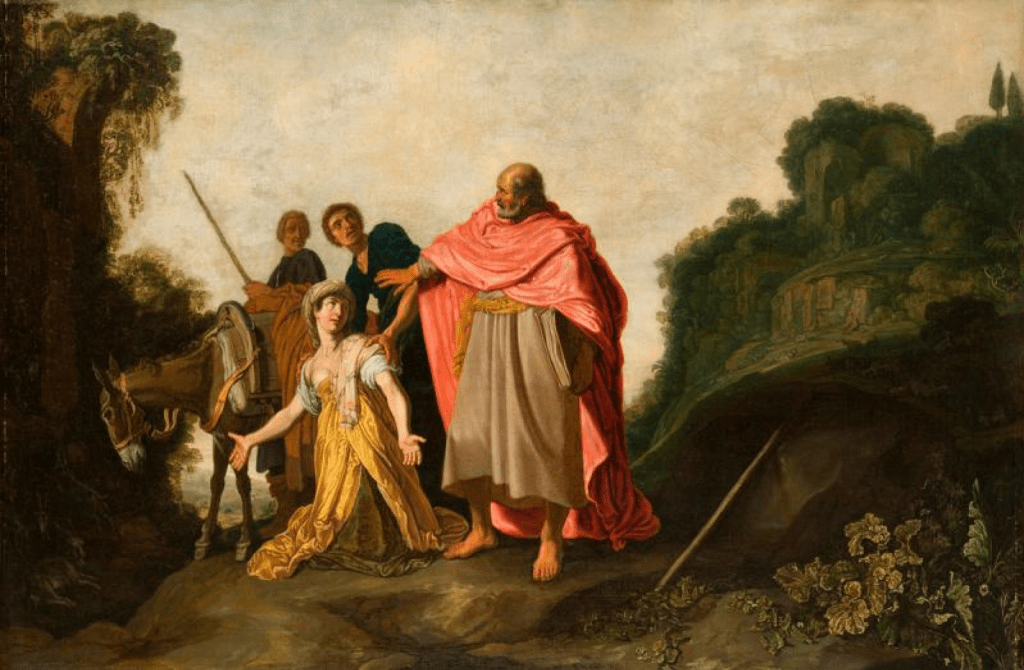
The prophet Elisha and the Shunammite woman, by Pieter Lastman, 1620

Elisha spoke to the woman whose son he had brought back to life: “You and your household must go away and live wherever you can, because the Lord has called for a famine. It is coming to the land and will last seven years.”

So the woman went and did what the man of God asked. She and her household moved away, living in Philistia seven years. When seven years had passed, the woman returned from Philistia. She went to appeal to the king for her house and her farmland. The king was speaking to Gehazi, the man of God’s servant, asking him, “Tell me about all the great things Elisha has done.” So Gehazi was telling the king how Elisha had brought the dead to life. At that very moment, the woman whose son he had brought back to life began to appeal to the king for her house and her farmland.

Gehazi said, “Your Majesty, this is the woman herself! And this is her son, the one Elisha brought to life!”

The king questioned the woman, and she told him her story. Then the king appointed an official to help her, saying, “Return everything that belongs to her, as well as everything that the farmland has produced, starting from the day she left the country until right now.” (Common English Bible)

People of faith typically don’t see divine appointments coming at all; they often show up in the middle of hard mundane days.

The prophecies and actions of the prophet Elisha are covered in the book of 2 Kings with a series of ten incredible narratives (chapters 2-9). Each of them are designed to demonstrate the power of God over (and sometimes against) the power of the king.

This was important because the royal decisions and actions of most of the Israelite kings were quite disconnected from God’s law and justice. Most kings did whatever they wanted, sometimes to the point of completely leading the people away from the worship of Yahweh and toward the worship of other gods.

Today’s Old Testament lesson concerns the ninth story in this series of narratives. A widow, whose son Elisha had restored to life in the second narrative (2 Kings 4:8-37) left for the land of the Philistines when there was a severe famine. Although the woman was simply listening to the prophet and doing what he said, squatters took advantage of the situation and took over her house and property while she was away.

In a clear demonstration of what a “divine appointment” looks like in Holy Scripture, Elisha’s servant and the king were talking together about this very woman and the miracle that took place with her son. The prophet had essentially raised her dead child to life. Then, lo and behold, the woman walked into the conversation to appeal the injustice that had happened to her and her family.

Even the worst of kings would discern the right thing to do in such a situation. After questioning the woman, the king ensured that she would get everything restored to her. Through it all, we are meant to see the power and sovereignty of God over the human authority of political kings.

I hope that you, at some point in your life, have experienced a meeting with another person that you can see was unmistakably arranged by God. And a great need you had was met because of this encounter. The Lord blessed you through it in a way that you didn’t see coming at all.

The fact of the matter is that God is sovereign, all-knowing, and all-powerful, along with being infinitely gracious, good, just, right, and loving. Therefore, God sets about to bless both us and other people. And when God determines to do something, nothing and no one in heaven or on earth can stop it.

Wherever you presently are, and whatever it is you are doing now in your life, is really no accident. And if your life situation is awful and far from any sort of idyllic scene of blessing, then please know that this is a circumstance that is ripe for a divine appointment.

For how could we ever know God as the Great Deliverer unless we were between a rock and a hard place with nowhere to turn? How could we ever experience God as the Divine Healer unless we were broken and/or brokenhearted?

How could we ever realize God as Provider unless we were out of resources and down to our last penny? Or God as Helper unless we were desperate and unable to move? Or God as the One who restores unless we had lost everything?

Just as there cannot be resurrection and new life without a crucifixion and an old life, so our lives will inevitably take a trajectory of suffering and hardship before glory and blessing. In order to allow the good to completely fill us, we must be totally emptied of everything else.

Maybe you will never experience something quite as dramatic as the woman did with gaining her son back to life, and her property restored after a terrible famine, but know this: The great Lord and God of all, the Sovereign of the universe, has your back through all that you’re going through on this earth.

I often get asked by patients and parishioners alike, “Where is God?” It feels to them that God is absent, silent, and far from understanding what they’re going through in the midst of their very challenging adversity.

Really, however, it’s actually an easy question for me to answer: Jesus is our Immanuel, God with us. The Spirit of God is right beside you, walking with you, even holding you up at times, through all the crud and crap of this old fallen sinful world of ours. Seeing only one set of footsteps in the sand, it turns out God is the One that carries the weak and weary in their trouble. The Lord is anything but absent.

If God has authority over earthly rulers, then the Lord most certainly has power to handle your life.

O God, why have you abandoned me? Though you have hidden your face from me, still from this dread and empty place, I cry to you, who have promised me that underneath are your everlasting arms. God, you are my help and comfort; you shelter and surround me in love so tender that I may know your presence with me, now and always. Amen.