
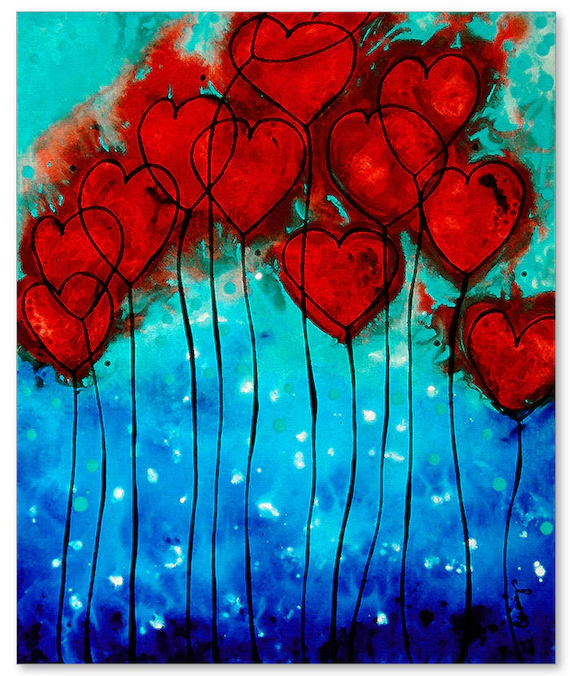
It’s All About Love (Song of Songs 2:1-7)

I am a rose of Sharon,
a lily growing
in the valleys.

[ GROOM ]

Like a lily among thorns,
so is my true love among the young women.

[ BRIDE ]

Like an apple tree among the trees in the forest,
so is my beloved among the young men.
I want to sit in his shadow.
His fruit tastes sweet to me.
He leads me into a banquet room
and looks at me with love.
Strengthen me with raisins
and refresh me with apples
because I am weak from love.
His left hand is under my head.
His right hand caresses me.

Young women of Jerusalem, swear to me
by the gazelles
or by the does in the field
that you will not awaken love
or arouse love before its proper time. (God’s Word Translation)

Notice how the flowers grow in the field. They never work or spin yarn for clothes. But I say that not even Solomon in all his majesty was dressed like one of these flowers. (Matthew 6:28-29)

Love the Lord your God with all your heart, with all your soul, and with all your strength. (Deuteronomy 6:5)

As long as I have you, I don’t need anyone else in heaven or on earth.

Psalm 73:25

There is nothing quite like a field of flowers. Along the coastal plain of the Mediterranean Sea, south of Mount Carmel, is Sharon. In the ancient world, there was found crocuses, tulips, and hibiscus.

These days, in the Spring of the year, one can see bindweed and pimpernel, sage and iris, as well as orchids and poppies. In addition, lilies bloom throughout the valleys of the Middle East. In the Spring, flowers are commonplace in the valleys and countryside.

In today’s Old Testament lesson, the bride in this poetic ode to love and beauty, is saying there is nothing special about her. There are many women, and she in no way stands amongst them all.

Love says otherwise. Love picks out the individual. In the Song, the groom views the bride as if a flower among thorns. There is a beauty that attracts him to her. She may be a commoner, yet her beautiful qualities stand out and are attractive. All others pale in comparison to her.

Likewise, the bride basks in the security of the groom, finding all others tasteless compared to him. He is like an apple tree that provides shade, and whose fruit is delicious.

There is a mutual attraction that is life-giving and beautiful. It is more than a fleeting infatuation. They see within each other the qualities which will bind and sustain them when there are rough times and hard roads.

Beauty is much more than outward appearance. It is the endearing inner qualities of a good and right spirit, which is outwardly seen in a visage of compassion and caring, gentleness and humility, purity and peace.

Such beauty, in and out, causes one to swoon with love – hence, making one love-sick. Love is powerful. It is not to be corrupted by the lust which only views another as an object to be gained.

We are to let the beauty and power of love develop, grow, and mature. The flowers of the field may seem to spring up overnight. However, the seeds and the bulbs have been awaiting the right time to take root, break the ground, grow up, and flower.

Love is both endearing and enduring. Love is to be nurtured and cultivated. It cannot be hurried. Love is an attention to the whole person, and seeks to endure for the long haul. It maintains a beautiful commitment into the growing coldness of autumn, and holds vigil through the season of winter. Love isn’t going anywhere.

But I am talking about Christ the groom, and Church the bride. Spiritual commitment is not really measured in doctrinal statements and dogmatic theology. It is shown and known by embracing Love with a capital “L.”

God is Love. Yes, God does loving deeds and actions. Yet, we are told that the very nature and character of God is Love. Jesus is Love incarnate, the embodiment of what Love sees and does in this world.

I am, of course, taking a decidedly Christian approach to the Song, and an allegorical view of it. This is why, if we delight in knowing and enjoying the Song, we discover the way to genuine spirituality, and the key which unlocks the whole of Holy Scripture.

Not everyone, of course, will agree with me or choose to go down this allegorical path. Perhaps this is why we have so much religion nowadays which is devoid of love, and chooses to focus on sterile doctrinal checklists to which we must ascribe.

Please don’t hear what I am not saying. Doctrine is important. Theology is a must. But if our doctrine and theology has no beauty, and has no thoughts of love, and is not basically oriented in the direction of love, then I strongly argue that it isn’t doctrine or theology at all!

“And what is proper love? One should love the Lord with an exceeding great and very strong love so that the soul be tied to the love of the Lord, finding itself totally absorbed in it, as if he were suffering of lovesickness, when his mind is never free because of love for that woman, and he is obsessed with her, whether sitting down, or standing up, even when he is eating and drinking. More than this should the love for the Lord be in the heart of those who love him, meditating on it constantly, even as God has commanded us: ‘With all your heart and with all your soul.’” – Maimonides, Jewish Rabbi and philosopher (1138-1204, C.E.)

We were created by God for love. God longs to love us; and we are to love God with our entire self – heart, soul, mind, and strength. What’s more, our own love for one another is shaped by the love we receive from God.

Indeed, the biblical book, Song of Songs, is not only in the literal middle of the Old Testament; it is also in the very heart of it. It is all about Love.

Bless us with Love, O Merciful God;
That we may Love as you Love!
That we may show patience, tolerance,
Kindness, caring and love to all!
O Compassionate One, grant compassion unto us;
That we may help all fellow souls in need!
Bless us with your Love, O God.
Bless us with your Love. Amen.

The Beauty of Love (Song of Songs 1:1-17)

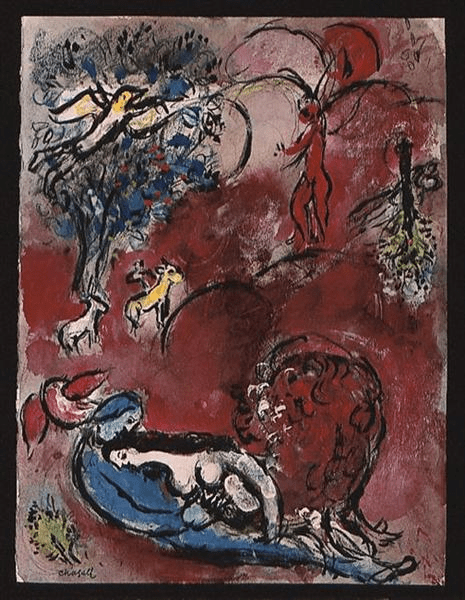
Song of Songs I, by Marc Chagall, 1960

The Song of Songs, which is for Solomon.

[Woman]

If only he would give me some of his kisses . . .

Oh, your loving is sweeter than wine!
Your fragrance is sweet;
        your very name is perfume.
        That’s why the young women love you.
Take me along with you; let’s run!

My king has brought me into his chambers, saying,
“Let’s exult and rejoice in you.
Let’s savor your loving more than wine.
        No wonder they all love you!”

Dark am I, and lovely, daughters of Jerusalem—
        like the black tents of the Kedar nomads,
        like the curtains of Solomon’s palace.
Don’t stare at me because I’m darkened
        by the sun’s gaze.
My own brothers were angry with me.
        They made me a caretaker of the vineyards—
        but I couldn’t care for my own vineyard.

Tell me, you whom I love with all my heart—
        where do you pasture your flock,
        where do you rest them at noon?—
            so I don’t wander around with the flocks of your companions.

[Man]

If you don’t know your way,
    most beautiful of women,
        then follow the tracks of the herds
            and graze your little goats
            by the tents of the shepherds.

I picture you, my dearest,
        as a mare among Pharaoh’s chariots!
Lovely are your cheeks, adorned with ear hoops;
        your neck, with beads.
Let’s make hoops of gold beaded with silver for you!

[Woman]

With my king close by,
        my perfume filled the air.
A sachet of myrrh is my love to me,
        lying all night between my breasts.
A cluster of henna flowers is my love to me
        in the desert gardens of En-gedi.

[Man]

Look at you—so beautiful, my dearest!
        Look at you—so beautiful! Your eyes are doves!

[Woman]

Look at you—so beautiful, my love!
        Yes, delightful! Yes, our bed is lush and green!
The ceilings of our chambers are cedars;
        our rafters, cypresses. (Common English Bible)

The Song of Songs is an unabashedly sensuous biblical book. It is, throughout its contents, an erotic paean to love. In eight chapters, a man and a woman pursue each other through verdant fields and lush valleys. The excitement they have, being together, is palpable.

For most of church history, the Song of Songs has been viewed as an allegory, a love poem between Christ and the Church. And in the case of Hebrew Scripture, the covenant love which exists between God and Israel, has been the predominant interpretive lens.

Seen from this perspective, the Song of Songs reflects that we ought to love the Lord with overpowering commitment, as if we were love-sick for our Beloved. Our thoughts are constantly on the object of our love – how we can please our beloved one.

And yet, there still seems to be room to read the Song in the very down-to-earth realness of physical love between two lovers. Since we are embodied people, such love ought to be celebrated, and is anything but base or to be refused. Sex is a gift from the Creator, and encouraged by God.

I think that the Song of Songs is not an either/or; it is a both/and; it’s both literal and allegorical. That’s not a weird thing. On the allegorical level, the Song is a beautiful poem describing the Divine Eros for God’s people, and the faithful’s heartfelt love for the God whose very name is Love.

Concerning a literal view, the Song celebrates the sanctity of human love, seeing within it the symbol of God’s love for us. Our very real bodies are themselves sacred, just as much as our souls.

Yet, however one chooses to look at the Song of Songs, it remains a statement of mutual admiration, of committed love and affection. It is indeed a poetic lifting of love above all else.

Indeed, if love isn’t the answer, we are not asking the right question.

Believe it or not, the Song of Songs was once viewed as an important key, capable of unlocking the entirety of Holy Scripture.

In fact, C.H. Spurgeon, the Prince of Preachers, in the nineteenth century, preached 59 sermons from this book; in Victorian England, no less. Spurgeon discerned the Song as central to the whole of the Bible. Reflecting on Song of Songs 1:7, he said:

“These words express the desire of the believer after Christ, and his longing for present communion with Him…. Tell me where Thou feeds, for wherever Thou stands as the Shepherd, there will I lie down as a sheep; for none but Thyself can supply my need. I cannot be satisfied to be apart from Thee. My soul hungers and thirsts for the refreshment of Thy presence….

“Satan tells me I am unworthy; but I always was unworthy, and yet Thou hast long loved me; and wherefore my unworthiness cannot be a bar to my having fellowship with Thee now. It is true I am weak in faith, and prone to fall, but my very feebleness is the reason why I should always be where Thou feeds Thy flock, that I may be strengthened, and preserved in safety beside the still waters.

“Why should I turn aside? There is no reason why I should, but there are a thousand reasons why I should not, for Jesus beckons me to come. If He withdraw Himself a little, it is but to make me prize His presence more. Now that I am grieved and distressed at being away from Him, He will lead me yet again to that sheltered nook where the lambs of His fold are sheltered from the burning sun.” Charles Haddon Spurgeon

The Song, in history past, once functioned as a beautiful path to deep intimacy with God. Methinks it behooves us to recover this.

The two lovers in the Song see beauty everywhere. They see it in each other, in the fields where the sheep are pastured, in the orchards where love is consummated, in the seasons, in the animals, trees, and hills. Beauty is all around them, and it is they themselves.

All things which God has created are lovely. Nothing is too small or too insignificant when the eyes of love look upon them. Beauty is designed to be noticed, celebrated, and praised. Love is meant to be expressed out loud, with flavor.

Each time love is stated, every exhalation of adoration, and all of the instances when beauty is acknowledged and affirmed, the ones who speak bind themselves more deeply to God and God’s big world. Together, they call all of it good.

Today’s Old Testament lesson is a wondrous reminder that beauty and love will have its way. Regardless of class, race, family, or societal norms, lovers will continue to seek and find one another and claim their relationship.

While the daughters may stare, and the brothers may be angry, the lovers will yet affirm the beauty of their love. And they will find contentment with each other.

You and I are no accident on this earth; we were created by a loving Creator who has an eye for beauty. And no matter how separated we may get from our divine source, God will seek us out; and if we seek the Lord, he will be found.

O God, you have prepared for those who love you such good things as surpass our understanding: Pour into our hearts such love towards you, so that we, loving you in all things and above all things, may obtain your promises, which exceed all that we can desire. Amen.

The Way of Love (Song of Songs 3:1-11)

Song of Songs III, by Marc Chagall, 1960

Night after night on my bed
I looked for the one I love.
I looked for him but did not find him.
I will get up now and roam around the city,
in the streets, and in the squares.
I will look for the one I love.
I looked for him but did not find him.
The watchmen making their rounds in the city found me.
I asked,
“Have you seen the one I love?”
I had just left them when I found the one I love.
I held on to him and would not let him go
until I had brought him into my mother’s house,
into the bedroom of the one who conceived me.

Young women of Jerusalem, swear to me
by the gazelles
or by the does in the field,
that you will not awaken love
or arouse love before its proper time.

Who is this young woman coming up from the wilderness
like clouds of smoke?
She is perfumed with myrrh and incense
made from the merchants’ scented powders.
Look! Solomon’s sedan chair!
Sixty soldiers from the army of Israel surround it.
All of them are skilled in using swords,
experienced in combat.
Each one has his sword at his side
and guards against the terrors of the night.
King Solomon had a carriage made for himself
from the wood of Lebanon.
He had its posts made out of silver,
its top out of gold,
its seat out of purple fabric.
Its inside—with inlaid scenes of love—
was made by the young women of Jerusalem.
Young women of Zion, come out and look at King Solomon!
Look at his crown,
the crown his mother placed on him on his wedding day,
his day of joyful delight. (God’s Word Translation)

Song of Songs III, by Marc Chagall, 1960

Eastertide is a celebration of new life through exploring the implications of living a resurrected life. A significant dimension to that life is a new awakening and awareness of love. Being raised to a new life of love means that we can dispense with old ways of looking at love that were unhealthy for us.

King Solomon’s Song of Songs has been viewed throughout the history of biblical interpretation in various ways. It’s been seen as a celebration of sexual love between a man and a woman. Others view the Song as a description of the mutual love between God and Israel or Christ and the Church.

With whatever approach we examine this unique book of Holy Scripture, I believe it’s helpful for us to avoid looking at it too literally, as if it were a sex manual for spiritually minded newlyweds.

For most of church history, the book has been viewed allegorically and metaphorically, not literally. So, it seems to me, this warrants the interpreter to walk mindfully and wisely through its wonderful prose, and not like some arrogant and supposed Romeo who believes they are God’s gift to scripture interpretation.

The Song of Songs, at its heart, is really an ode to Love itself. Love is the force that binds us together as humans, and comes from the One who is pure Love. As such, Love is perhaps the most potent strength in the universe. Thus, Love needs to be respected. Love must be handled with care, because its power can harm us if we are careless with it.

Longing for love is a universally understood feeling. The need for love is so great that the woman in today’s Old Testament lesson will put herself at considerable risk in order to seek and find her beloved in the middle of the night on the city streets.

“You have to keep breaking your heart until it opens.”

Rumi, 13th century Persian poet

Love, however, is not to be awakened before its proper time. Certainly, to love is to risk, for we choose to put ourselves out there for the sake of giving and receiving love. Yet, there are to be limits on that pursuit. Seeking love can put one in a hazardous situation. It’s best, therefore, to allow some patience with love, to not rouse love with blind desire.

Love will have its way; we need not force it before its true readiness.

The woman longs for her beloved. The pain of separation is almost too much for her to bear. Love hurts. There is, however, good pain and bad pain. The pain of waiting and wondering has a purpose which we need to submit to, and follow. It is an opportunity for careful reflection, mindful contemplation, and healthy introspection.

Without these spiritual disciplines, the problem of fear arises – not love – and begins to gnaw at us, that perhaps we are unloved. Thoughts and feelings of insecurity can creep in and dog us with incessant and obnoxious barking.

But we must trust in Love. Love cannot be domesticated, nor fully defined, and that is a good thing – because Love is much bigger than any of us. And it’s also good that we cannot precisely interpret nor explain all of the contents within the Song of Songs. The book is a good reminder that Holy Scripture stands above us, and not the other way around.

God is Love. And Love is God. True human love serves as a symbol of divine love. We not so much come to understand the ways of God and Love, as we discover it, describe it, and then determine to live it.

People never fully connect to God, at least this side of heaven, in much the same way as the desired rendezvous of the lovers in the Song never explicitly occurs. The God we seek is the God who corresponds to our needs and desires, our loves and our fears.

And yet, God is also wholly other than us; God is revealed to humanity by means of Scripture. God issues decrees and commands that may not seem as if they sync with our perceived needs. From this perspective, people must obey, regardless of any feeling.

God is, therefore, both approachable to us and completely apart from us, at the same time, all the time. God engages with us in intimate personal spiritual experiences; and God also reaches out through Scripture in human/divine encounters. Both ways are approaches of love, initiated by the One who loves us.

No matter what the question is, Love is always the answer. This is the way.

Creator God, by the mercies of your son, our Lord, Jesus, compel us to turn our hearts to the way of Love, so that we may follow Christ as your faithful people. Guide us, we pray, to Love. Amen.

The Love of God for You (Song of Songs 8:6-7)

God Is Love, by Voss Creative

Place me like a seal over your heart,
    like a seal on your arm;
for love is as strong as death,
    its jealousy unyielding as the grave.
It burns like blazing fire,
    like a mighty flame.
Many waters cannot quench love;
    rivers cannot sweep it away.
If one were to give
    all the wealth of one’s house for love,
    it would be utterly scorned. (New International Version)

Throughout most of church history, the Old Testament poem of Solomon’s Song of Songs has been interpreted allegorically as the love between God and God’s people.

A more literal hermeneutic views the Song as an actual relationship between a man and woman – which has it’s merits in that it acknowledges and affirms our bodily nature.

Yet, no matter what interpretive grid one uses for the Song, this wondrous and unique biblical book is an Ode to Love, lifting the centrality and power of Love as the greatest force in the world.

As for me, I believe it’s likely that the Song purposely has both the literal and allegorical in view. There are many places throughout Holy Scripture which have intended double and even triple meanings to the text. However one chooses to see the Song, love begins with God, and gives shape to our own human love for God, one another, and one’s lover.

“God carries your picture in his wallet.”

Tony Campolo

We learn a great deal of love from God. The Lord is a jealous God. That doesn’t mean the Lord is some weird stalker deity with insecurities about losing the devotion of worshipers. No, instead, divine jealousy is the positive quality of showing steadfast love and commitment, being completely devoted to following through with divine promises and presence.

The Song is far from the only place in Scripture which likens the relationship between God and God’s people as a marriage of lovers. In fact, God’s covenant relationship with people is at the heart of understanding the whole of Scripture.

In the prophecy of Hosea, God expressed a longing for Israel to remain faithful, because the Lord loves her. Hosea had an unfaithful wife, and throughout the book of Hosea the relationship between him and his wife Gomer mirrored the relationship between God and Israel. Just as Hosea kept showing faithful love to Gomer, even though she was brazenly unfaithful, so too, God looked at Israel with affection and steadfast love, not bearing to give her up.

“If you have never known the power of God’s love, then maybe it is because you have never asked to know it – I mean really asked, expecting an answer.”

Frederick Buechner, The Magnificent Defeat

The love of God shall always win the day, despite our own human love, which can wax and wane according to mood or circumstance. Grace, mercy, and love are deep in the nature of God; Love is who God is, not just what God does.

The one marrying you is the one who made you—
    the Lord of heavenly forces is his name.
The one redeeming you is the holy one of Israel,
    the one called the God of all the earth.
As an abandoned and dejected woman the Lord has summoned you;
    as a young wife when she is rejected,
        says your God.
For a brief moment I abandoned you,
    but with great mercy I will bring you back.
    In an outburst of rage,
    I hid my face from you for a moment,
    but with everlasting love I have consoled you,
    says your redeemer, the Lord.

These are like the days of Noah for me,
    when I promised that Noah’s waters would never again cover the earth.
    Likewise I promise not to rage against you or rebuke you.
The mountains may shift,
    and the hills may be shaken,
    but my faithful love won’t shift from you,
    and my covenant of peace won’t be shaken,
    says the Lord, the one who pities you. (Isaiah 54:5-10, CEB)

As the Old Testament draws toward the end, God’s love remains constant, desiring the people to hold fast to their Lord:

This is what the Lord All-Powerful says: “I have a very strong love for Jerusalem. My strong love for her is like a fire burning in me.” (Zechariah 8:2, NCV) 

Into the New Testament, the love of God continues to burn for God’s people. In the Gospels, Jesus showed committed love to all sorts of people, going so far as to be the ultimate martyr, giving himself as sacrifice of atonement on behalf of a world who mostly rejected him.

“Do you see this woman? I came into your house. You did not give me any water for my feet, but she wet my feet with her tears and wiped them with her hair. You did not give me a kiss, but this woman, from the time I entered, has not stopped kissing my feet. You did not put oil on my head, but she poured perfume on my feet. Therefore, I tell you, her many sins have been forgiven—as her great love has shown. But whoever has been forgiven little loves little.” (Luke 7:44-47, NIV)

One of Christ’s disciples, the Apostle John, learned to channel his passionate anger into passionate love. John knew that people’s needs are supremely and fully met through the Lord who loves them – and not through alternate avenues of love:

Do not love this world nor the things it offers you, for when you love the world, you do not have the love of the Father in you. For the world offers only a craving for physical pleasure, a craving for everything we see, and pride in our achievements and possessions. These are not from the Father, but are from this world. And this world is fading away, along with everything that people crave. But anyone who does what pleases God will live forever. (1 John 2:15-17, NLT)

God knows that going elsewhere to satisfy our needs, ultimately gets us nowhere, especially our need for love. God yearns, passionately, for us to find our pleasure and enjoyment in him. God waits with loving patience to show grace and compassion.

“The Love of God” by Frederick M. Lehman, 1917

The love of God is greater far
than tongue or pen can ever tell;
it goes beyond the highest star,
and reaches to the lowest hell.
The wand’ring child is reconciled
by God’s beloved Son.
The aching soul again made whole,
and priceless pardon won.


O love of God, how rich and pure!
How measureless and strong!
It shall forevermore endure—
the saints’ and angels’ song.