Changing the System (Philemon 1-25)

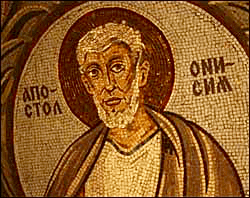
A mosaic of Philemon’s slave, Onesimus

Paul, a prisoner of Christ Jesus, and Timothy our brother,

To Philemon our dear friend and fellow worker—also to Apphia our sister and Archippus our fellow soldier—and to the church that meets in your home:

Grace and peace to you from God our Father and the Lord Jesus Christ.

I always thank my God as I remember you in my prayers, because I hear about your love for all his holy people and your faith in the Lord Jesus. I pray that your partnership with us in the faith may be effective in deepening your understanding of every good thing we share for the sake of Christ. Your love has given me great joy and encouragement, because you, brother, have refreshed the hearts of the Lord’s people.

Therefore, although in Christ I could be bold and order you to do what you ought to do, yet I prefer to appeal to you on the basis of love. It is as none other than Paul—an old man and now also a prisoner of Christ Jesus—that I appeal to you for my son Onesimus, who became my son while I was in chains. Formerly he was useless to you, but now he has become useful both to you and to me.

I am sending him—who is my very heart—back to you. I would have liked to keep him with me so that he could take your place in helping me while I am in chains for the gospel. But I did not want to do anything without your consent, so that any favor you do would not seem forced but would be voluntary. Perhaps the reason he was separated from you for a little while was that you might have him back forever—no longer as a slave, but better than a slave, as a dear brother. He is very dear to me but even dearer to you, both as a fellow man and as a brother in the Lord.

So if you consider me a partner, welcome him as you would welcome me. If he has done you any wrong or owes you anything, charge it to me. I, Paul, am writing this with my own hand. I will pay it back—not to mention that you owe me your very self. I do wish, brother, that I may have some benefit from you in the Lord; refresh my heart in Christ. Confident of your obedience, I write to you, knowing that you will do even more than I ask.

And one thing more: Prepare a guest room for me, because I hope to be restored to you in answer to your prayers.

Epaphras, my fellow prisoner in Christ Jesus, sends you greetings. And so do Mark, Aristarchus, Demas and Luke, my fellow workers.

The grace of the Lord Jesus Christ be with your spirit. (New International Version)
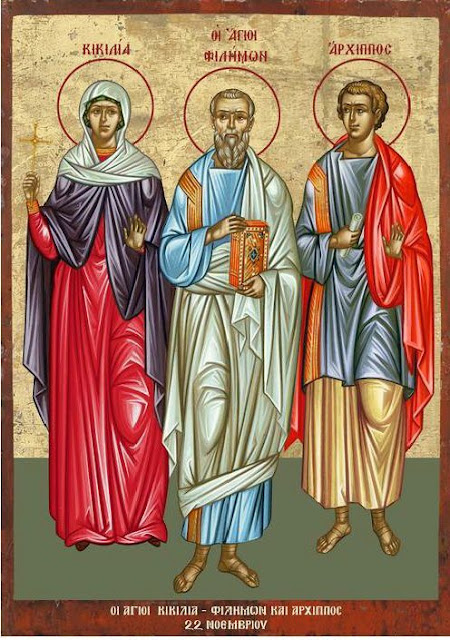
Orthodox depiction of Saints Apphia, Philemon, and Archippus

Tucked away near the end of the 66 books of the Holy Bible is the little letter of Philemon. Many Christians have neither heard a sermon preached on it, nor ever discussed it. Yet, there it is, contained as part of the New Testament canon. So, it could use some attention from us.

The letter is an appeal to Philemon concerning his slave Onesimus – who fled from his master and subsequently ended up converting to Christianity through the Apostle Paul’s influence.

At the time, Paul was imprisoned and Onesimus attended to his needs. Although Paul desired to keep Onesimus with him, he sent the slave back to Philemon. The Apostle was wanting the master to receive the slave as a beloved brother in the Lord, and not just as a servant. Then, Paul hoped Philemon would send Onesimus back to him, thus smoothing out the master/slave relationship and having his own needs met, as well.

The bottom line of the letter is that Paul very much desired that Onesimus be freed from his servitude by Philemon. He didn’t want to pull rank and twist Philemon’s arm to do it. Even though we don’t precisely know what happened in response to Paul’s letter, it’s likely that Onesimus was freed, since the appeal was included in the New Testament.

Christianity, ideally, is meant to transform lives, to change social relationships, to establish a truly egalitarian society in which the status of humans owning other humans would be done away with. Men ought to become brothers with one another and not highly stratified and separated with gross power inequities between them.

Now, in Christ, it doesn’t matter if you are a Jew or a Greek, a slave or free, male or female. You are all the same in Christ Jesus.

Galatians 3:28, ERV

Sitting where we are now, a few millennia later, we might find it curious that Paul and other biblical writers didn’t simply call for the outright abolition of slavery altogether. And yet, slavery was such an ensconced part of the ancient world (some places in the Roman Empire had up to 70% of the population as slaves) that to do so immediately would have likely brought such shock to the system that more harm than good may result.

In Paul’s experience, he continually went about the business of agitating for change by proclaiming a gospel of grace for all people. And the places where he did so saw great societal transformation – which is why Paul got so much pushback from so many authorities who benefited from keeping others under their feet.

In the household of faith, all persons are sisters and brothers and useful servants of one another and of the Lord.

The healings by Jesus in the Gospels not only restored one’s physical health but also restored the individual back to the community. The leper’s social stigma was lifted; the woman’s isolation due to bleeding was done away with; and stereotypes of those born with disabilities were overturned.

No one is inferior in the kingdom of God. Everyone is inherently worthy and has a vital purpose in God’s new society. Since the cross of Christ has erased all barriers, Christian community is to be realized through respectful equality, mutual love, and caring fellowship.

That’s how the system is changed.

Almighty God, by your Holy Spirit you have made us one with your saints in heaven and on earth. May our earthly pilgrimage be always supported by this fellowship of love and prayer, and know ourselves surrounded by their witness to your power and mercy; through Jesus Christ our Lord. Amen.

The Parable of the Weeds

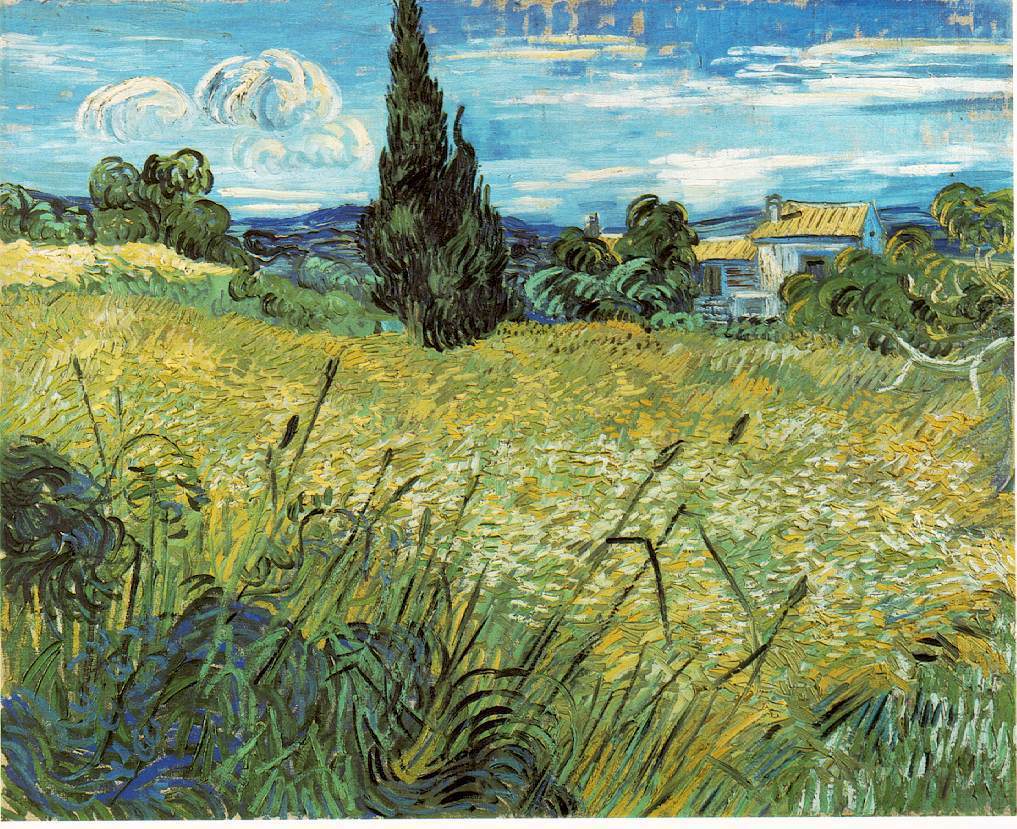
Van Gogh Wheat Field
Wheat Field and Cypress by Vincent Van Gogh, 1890

Jesus told them another parable: “The kingdom of heaven is like a man who sowed good seed in his field. But while everyone was sleeping, his enemy came and sowed weeds among the wheat, and went away. When the wheat sprouted and formed heads, then the weeds also appeared.

“The owner’s servants came to him and said, ‘Sir, didn’t you sow good seed in your field? Where then did the weeds come from?’

“‘An enemy did this,’ he replied.

“The servants asked him, ‘Do you want us to go and pull them up?’

“‘No,’ he answered, ‘because while you are pulling the weeds, you may uproot the wheat with them. Let both grow together until the harvest. At that time, I will tell the harvesters: First collect the weeds and tie them in bundles to be burned; then gather the wheat and bring it into my barn.’”

Then he left the crowd and went into the house. His disciples came to him and said, “Explain to us the parable of the weeds in the field.”

He answered, “The one who sowed the good seed is the Son of Man. The field is the world, and the good seed stands for the people of the kingdom. The weeds are the people of the evil one, and the enemy who sows them is the devil. The harvest is the end of the age, and the harvesters are angels.

“As the weeds are pulled up and burned in the fire, so it will be at the end of the age. The Son of Man will send out his angels, and they will weed out of his kingdom everything that causes sin and all who do evil. They will throw them into the blazing furnace, where there will be weeping and gnashing of teeth. Then the righteous will shine like the sun in the kingdom of their Father. Whoever has ears, let them hear. (Matthew 13:24-30, 36-43, NIV)

We live in an increasingly polarized world. We see it, feel it, and experience it daily in our politics and economy, and even in our families, churches, and faith communities. How are we going to deal with our differences? What kind of path might we chart forward? Where might we turn for help?

Let us acknowledge from the outset that within our world there are vast differences in religion and belief structures, as well as deep differences on issues surrounding human sexuality, immigration, race, and COVID-19, just to name a few. And let us also acknowledge that when we read Christ’s parable of the weeds (or the parable of the wheat and the tares) there is strong tendency to view ourselves and our beliefs as the good seed, which leaves anyone who does not agree with us as the weeds.

It is fruitless for us to debate who is the genuine crop and who is the weeds. We will likely just go around and around with airing our own opinions as gospel truth and expecting others to simply accept our arguments. That approach is neither wise nor even possible. I highly suspect that Christ’s disciples had such a mindset. I see them as the servants who eagerly ask the owner, “Do you want us to pull up the weeds?” In other words, whenever we see weedy people, we want to yank them out and get them out of our lives.

Oh, wouldn’t it be nice if it were that easy? If we could only purge all those problem people with their goofy thinking and crazy politics from among us, then all would be okay. Right? Wrong. It would not be okay. For those who are followers of Jesus, we take our cues from him. So, what Jesus says takes precedence over our personal approaches of how to handle those who express evil.

And what Jesus gave was a clear and unequivocal answer to the issue of weeds: “No, do not pull them up!” I can imagine the disciples (and us for that matter) retorting with: “Well, for heaven’s sake, why not, Jesus? Don’t you see what is happening to our world? Are you going to let this evil keep happening? I thought you cared about us!”

“I’ll tell you, why not,” said our Lord, “Because doing violence to the weeds will end up doing violence to the crop as well.” Christ’s response to our questions about the problem of evil in the world is to let God take care of it. That means, in the meantime, we are supposed to co-exist with each other. Yes, you heard that right. No holy crusades to stamp out problem people. No inquisitions or purges or forced takeovers to uproot whom we consider to be wicked people.

There has always been a temptation for people throughout history to exterminate evil people and force others into right doctrine and theology. That, however, is not our mandate as Christians. God, the owner of the world’s field, will send his own harvesting angels to do the work. They will separate the crop from the weeds. That is not our job.

So, what are we supposed to do with evil – just let it go?  Am I to let that evil person just be evil?  Shouldn’t I give them what they deserve?  Shouldn’t I at least tell them that they are no good rotten sinners and that they are going to hell because they are wicked?

Earlier in the Gospel of Matthew, Jesus had already dealt with how to handle so-called problem people saying,

Love your enemies and pray for those who persecute you,” (Matthew 5:44). 

Jesus will decisively solve the problem of evil, and not us!  It is not our place, and if we make it our place, we will end up hurting and destroying our fellow brothers and sisters in the church and the world.  We are to love and pray people into God’s benevolent rule and reign of the earth, not give them the message that they must either turn or burn.

The sobering reality taught by Jesus in this parable is that it is not a simple matter that we, the crop, are here; and they, the weeds, are over there.  It is more sinister than that: The enemy is within, not out there.  We have no further to look than in our own hearts, which is why we desperately need the lordship of Christ to completely overtake us.

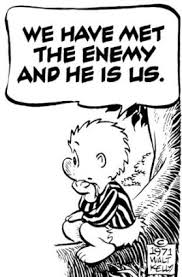
Evil is present alongside the good.  Evil exists in the here and now where there is a desire to trip others up, to discourage people in their respective faith commitments, to offend and hurt others who believe differently, to overlook the weak, and to speak ill of others.  Evil is in our backyards where there is an impatient eagerness to step on others to get our way.  Evil is at its height where there is ignorance of Christ’s teaching, for no one can truly follow Jesus if they do not know what that way is. “We have met the enemy, and he is us,” said Walt Kelly in his mid-twentieth century newspaper comic strip, Pogo.

Walt Kelly - Pogo 

The eventual end of evil, when Christ returns, is that wickedness will be handled once and for all. There will be no more tormenting of others; no more oppression; no more inattention to those who are in need; no more disparaging of the weak; no more misguided or petty wars waged on the innocent; no more injustice; no more pain; no more bondage to sin. The tormentors, apart from repentance, will become the tormented. As they have gone about their lives in anger fomenting division and destruction in this life, so the tables will turn in the next life. Therefore, the Holy Scripture is adamant that Today is the day of repentance and salvation because tomorrow is judgment day. As the writer of Hebrews said:

Today, if you hear his voice, do not harden your hearts… See to it, brothers, and sisters, that none of you has a sinful, unbelieving heart that turns away from the living God. But encourage one another daily, as long as it is called “Today,” so that none of you may be hardened by sin’s deceitfulness. We have come to share in Christ, if indeed we hold our original conviction firmly to the very end. As has just been said:

“Today, if you hear his voice,
    do not harden your hearts
    as you did in the rebellion.”

Who were they who heard and rebelled? Were they not all those Moses led out of Egypt? And with whom was he angry for forty years? Was it not with those who sinned, whose bodies perished in the wilderness? And to whom did God swear that they would never enter his rest if not to those who disobeyed? (Hebrews 3:7, 12-18, NIV)

Grace awaits us, my friends, ever-present and poised to wash over us with baptismal power and spiritual rest. We may expect God to do things in a hurry.  However, the kingdom of God does not work that way.  The kingdom of God comes gently, like a seed planted in the ground; and, it takes time for it to grow.  Meanwhile, evil exists, and we think it ought to be sucked-up in God’s divine vacuum cleaner like clods of dog and cat hair.  We expect not to be left waiting, and for God to act drastically when we are wronged or are uncomfortable in any way.  We might confuse God’s slowness as being uncaring, when it really means that God is patient, and desires people to come to repentance.  God awaits us, always ready to hear the prayer of the penitent person.

O Lord God Almighty, Creator of heaven and earth, we are complacent people.  While you desire us to be a beacon of light to a world in need, we have become preoccupied with all the weeds in the field.  We are sorry for the madness unleashed through our own sinful desires.  We invite you now to plant a seed of love in our hearts for all people, not just our friends.  We commit ourselves to watering that seed and nurturing it with your Word.  We choose to trust you and live by your words, Lord Jesus.  Amen.