A Lot of Hurting, Touching, and Healing (Luke 6:12-19)

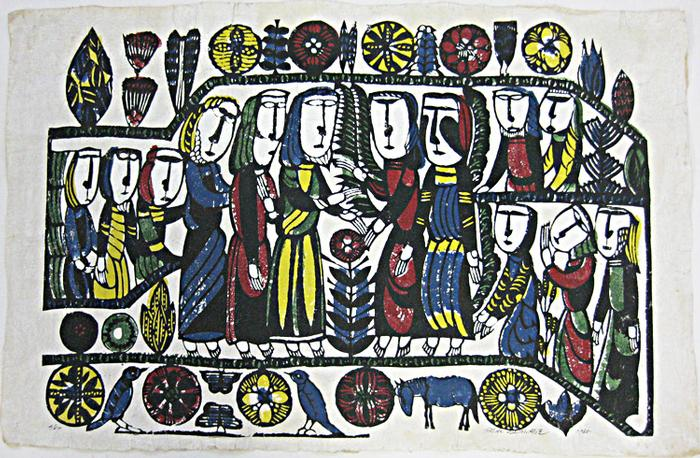
Jesus calls his twelve disciples, by Sadao Watanabe

One of those days Jesus went out to a mountainside to pray, and spent the night praying to God. When morning came, he called his disciples to him and chose twelve of them, whom he also designated apostles: Simon (whom he named Peter), his brother Andrew, James, John, Philip, Bartholomew, Matthew, Thomas, James son of Alphaeus, Simon who was called the Zealot, Judas son of James, and Judas Iscariot, who became a traitor.

He went down with them and stood on a level place. A large crowd of his disciples was there and a great number of people from all over Judea, from Jerusalem, and from the coastal region around Tyre and Sidon, who had come to hear him and to be healed of their diseases. Those troubled by impure spirits were cured, and the people all tried to touch him, because power was coming from him and healing them all. (New International Version)

Pain is a lot

Touch is important. Humanity needs touch. It’s also one of those things that we likely take for granted. 

Philip Yancey and Dr. Paul Brand co-authored a book, originally published in 1982, entitled “Pain: The Gift Nobody Wants.” It’s largely a biography of Dr. Brand, who pioneered both the diagnosis and prognosis of leprosy. 

He discovered that leprosy occurs because of a lack of feeling – an inability to sense touch. The delicate nerve endings we all have in our fingers and toes are numb to the leper. The lack of sensing pain in the extremities leads to small cuts or injuries, which would be immediately treated by someone who feels pain, becoming gangrene with the losing of fingers and toes.

The ability to feel, to reach out and touch another person, is vitally important to our spiritual and emotional lives. Without touch, the calloused heart and unfeeling soul does not realize the damage that is being done to it.           

One of the gifts we have as people is the ability to feel guilt, sorrow, disappointment, and pain – to be touched mentally, emotionally, and spiritually – as well as physically. And in our ability to feel pain, it brings about attention to prayer and addressing the situation.

Many people are troubled in either mind or spirit, or experience chronic ailments of the body, day in and day out. They just want relief, to be at peace in both body and soul.

Jesus prays… a lot

In today’s Gospel lesson, Luke puts together two stories: one of Jesus choosing and calling his twelve disciples; and then one of Jesus being among the people and healing them of their diseases and their troubles. Let’s observe the relationship between them.

Jesus often withdrew to lonely, isolated places in order to pray (Luke 5:16). On this particular occasion, he went out and spent the entire night in prayer to God. When morning came, we discover the reason for the all-night prayer meeting: Christ chose the people who would be closest to him in his earthly ministry. He called the twelve to follow him and be his disciples.

I find it highly instructive that Jesus spent so much time in prayer before making such big decisions about his ministry. If anyone could size up somebody as a potential follower, it seems to me it would be Jesus. And yet, there was a lot of deliberation and interaction with the Father. Since the Lord Jesus found it necessary to pray with an extending time, and consult with the heavenly Father, I would say that our own prayer life and reaching out to consult and collaborate could probably use an upgrade.

Jesus heals… a lot of people

Then, Jesus and his disciples, together enter the fray of the crowd. And the disciples get their first lesson in following Jesus: Christ-centered ministry is about healing – it’s about restoring people to physical, mental, emotional, and spiritual health.

Healing is at the heart of all real Christian ministry. And healing is really what everyone is to be about, whether they identify as Christian, or not. To be healed is to experience a holistic restoration of body, mind, emotions, and spirit.

Touch is a big part of healing. Physical touch is important, and it’s powerful. Sometimes, bodily healing is needed because a person has been physically abused, or experienced some sort of physical trauma. And it can be very difficult to have others touch them, after such experiences. Yet, part of the healing will be in experiencing redemptive touch – either by surgeons, family, friends, or trusted others. The answer to bad touch and bad pain is to experience good touch and the good pain of healing.

Non-physical touch is no less important. And, I believe, Jesus understood this perhaps more than most. He routinely “touched” people in ways that changed their lives. Christ sought to not only bring physical healing, but also to heal the mental, emotional, and spiritual wounds.

Jesus touches… a lot of lives

Jesus touched a lot of lives through his healing ministry:

  • In healing lepers of their disease, Christ made sure that they were no longer ostracized from the community but were restored to full function in society.
  • In curing persons demonized and tormented by evil spirits, Jesus was concerned to restore them to their right mind and ensure they were included as members of society, as well as restored to their families.
  • In bringing salvation from guilt and shame, Jesus brought reconciliation and restoration between God and sinners.
  • In all his relational interactions, Jesus was intentional about making connections to the lonely and the lost, to those who were emotionally cut off from the mass of society.

So, whenever we feel pain – whether in body, mind, emotion, or spirit – this experience lets us know that we need to pay attention to something. As we do that, it can drive us to the source of healing, wholeness, and restoration. We go to prayer – not out of duty – but because we are convinced that there are divine resources only God can provide.

And we can come, again and again, finding the grace to help us in our time of need. For God’s mercy is inexhaustible; the grace of God will never run out or run dry.

Therefore, let followers of Jesus everywhere be aqueducts of grace, angels of mercy, and agents of healing in a world which so desperately needs the love, care, and attention we can give them.

May God the Father bless you; God the Son heal you; and God the Holy Spirit give you strength. May God the holy and undivided Trinity guard your body, save your soul, protect your mind, and bring you safely to his heavenly country; where he lives and reigns for ever and ever. Amen.

Trinity Sunday – The God of Wholeness

oak tree 2

We live in a fundamentally broken world. Systemic racism, political gridlock, social stratification, hate crimes, alcohol and domestic abuse, ageism, disease, malpractice, terrorism, and xenophobia barely scratch the surface of sad societal ills and we face living in this old fallen world. Indeed, it is all quite distressing. To realize wholeness and integrity will require operating the mechanism of blessing.

“May the grace of the Lord Jesus Christ, the love of God, and the fellowship of the Holy Spirit be with you all.” (2 Corinthians 13:14)

This is the blessing I leave with my congregation each Sunday. A divine blessing involves the wholeness and integrity of the triune God given to us through grace, love, and fellowship. Holding each facet of that blessing together can sometimes be a challenge.

There was a time in my life when I golfed every day. Even though I played a lot of golf, it was rare for me to have an entire round where my driving, approach shots, chipping, and putting all worked nicely together. My typical experience was that when my driving was superb, my chipping and putting was awful; or, that when my putting was amazing, my approach shots were atrocious. Rarely did I have the whole package of a solid golf game put together in one seamless round. Instead, my game, along with most amateur golfers, is typically disjointed with a combination of brilliant shots and ugly shanks.

The Christian life can seem the same way – with the ability to show love and grace, be open and caring on some days, and not so much on other days. We need God – the triune God. Within God there is complete wholeness, a total well-rounded divine Being.  As we connect with this Being, then we can experience God’s wholeness and integrity, which leads to our own consistent daily wholeness, with no divided herky-jerky self.

The Trinity – Father, Son, and Spirit – provides us with a model of wholeness and displays how it all comes together in a solid consistent life of blessing. There is a beautiful connection between the Trinity and our lives.  It is a path to wholeness that involves healing, hope, and spiritual health based in the triune God.

Healing

The grace of Jesus enables us to pull ourselves together. Jesus is the one who has brought reconciliation and restoration – he has made the bridge and connection to God. In response to this grace we aim for perfection (not perfectionism) pull ourselves together” and restore and heal ourselves. Since Jesus is the Reconciler, the one who restores and heals, we are to allow that grace to wash over us and seep deep into our souls so that we experience reconciliation, restoration, and healing.  When we are broken and disjointed, the grace of Jesus sets us back in place again.

Tim Hansel

The late Tim Hansel was a teacher and mountain climber. He wrote a book many years ago entitled, You Gotta Keep Dancin’: In the Midst of Life’s Hurts, You Can Choose Joy! Hansel lived with chronic debilitating pain for thirty-five years after a climbing accident where he literally fell off a mountain and shattered most of the vertebrae in his back. In his long journey of coming to grips with his painful existence, Tim Hansel discovered that wholeness can certainly come through brokenness. Healing can happen with pain still present. Maturity can occur through painful growth of the human spirit. He constantly said to people, “Pain is inevitable; but misery is optional.” He explained to others, “Character is developed through adversity and pain. That adversity can either destroy us or build us up, but it will not leave us the same, depending upon our chosen response to it.  Pain can either make us better or bitter.”

Even if you do not experience the kind of healing and restoration of body or soul you are looking for, maybe, like Tim Hansel, you will receive grace and freedom that the loving triune God gives. God himself lives with observing the terrible pain of humanity’s hurts every day. The more we participate in the life of God, the greater is our ability to deal with pain – our own as well as the pain of others.

Hope

The fellowship of the Holy Spirit enables us to receive comfort. The Spirit is the Paraclete, the one who encourages by coming alongside and helping. The Spirit works with us, intimately participating in our lived everyday experiences. The Spirit is God’s means of experiencing wholeness. The Holy Spirit lovingly appeals to us in ways we can understand and act – speaking words of comfort and exhortation with the commitment to a faithful presence. Since the Spirit is committed to helping us, thus, we are to help others through living in fellowship with them.

John-Wesley

When John Wesley was a young Christian, a seasoned saint advised him, “Do you wish to serve God and go to heaven? Remember you cannot serve him alone. You must therefore find companions or make them. The Bible knows nothing of solitary religion.” Wesley took that advice to heart. Convinced that the pursuit of personal holiness was impossible apart from Christian community, he carefully organized the Methodist movement (a reaction against solitary religion) into societies (congregations), classes (small groups of eight to twelve), and bands (accountability groups of three to five).

We are meant to receive the encouragement of the Spirit. The Holy Spirit does not hold back in providing us with the help we need to live the Christian life in the form of other believers. We are all important. If we are not healed, we hurt and then hurt others. However, with healing comes hope, and hope encourages us that it will not always be this way – there are better days ahead.

Hope helps us to see beyond the immediate pain, hard circumstance, or adversity to what God can do through the help and power of the Holy Spirit. Just as there is complete and whole fellowship within the triune God, so there can be wholeness of fellowship with us. Christianity is not a solitary religion; it involves companions and fellow disciples for the journey.

Health

The love of God the Father is our peace. God’s unconditional love brings spiritual health to the Body of Christ and to the world. Within God there is complete and total love – a wholeness in which everything God does expresses loving-kindness.

Unity and peace happen when there is health in the church and the world. It is the fruit of love. Love for one another brings unity of prayer and purpose. It is love that brings about peace and harmony. It is love which solidifies compassion in circumstances of adversity.

We are meant to receive the Father’s love. Love brings people together and enables them to become conduits of the loving nature of God to others. There is no other path to spiritual health and sanity than the journey of love.  And love most often gets messy because we get into the muck of people’s lives with all their needs and hurts. Sometimes it takes a tragedy before some folks show love. So, live each day with no regrets as if it were your last and Jesus was coming today.

The Trinity

God the Son, Jesus Christ, brings healing because of his grace.

God the Holy Spirit brings hope because of his encouragement.

God the Father brings health because of his love.

Because of the Trinity, our work is clear:

The Body of Christ brings healing to the world because it bestows grace.

The Body of Christ brings hope to the world because of its encouragement.

The Body of Christ brings health to the world because of its love.

May the grace of the Lord Jesus Christ, and the love of God, and the fellowship of the Holy Spirit be with you all, now and forever. Amen.