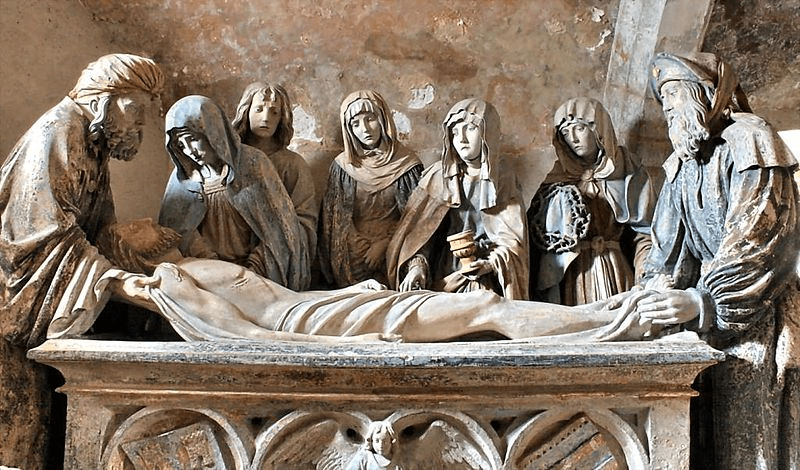
Holy Saturday (John 19:38-42)

The Entombment, by the French sculptor Maître de Chaource, 16th century

After these things, Joseph of Arimathea, who was a disciple of Jesus, though a secret one because of his fear of the Jews, asked Pilate to let him take away the body of Jesus. Pilate gave him permission, so he came and removed his body. Nicodemus, who had at first come to Jesus by night, also came, bringing a mixture of myrrh and aloes, weighing about a hundred pounds. 

They took the body of Jesus and wrapped it with the spices in linen cloths, according to the burial custom of the Jews. Now there was a garden in the place where he was crucified, and in the garden there was a new tomb in which no one had ever been laid. And so, because it was the Jewish day of Preparation and the tomb was nearby, they laid Jesus there. (New Revised Standard Version)

Today is Holy Saturday – a quiet place sandwiched between the ignominy of the cross and the celebration of resurrection – a day of solitude, silence, and stillness. 

This isn’t a particularly popular day. People don’t rave about Holy Saturday, in fact, many Christians haven’t had a thought that this day could have any significance. Yet, this very day has its place in the scheme of the Christian life.

There cannot be resurrection and new life without a death and dying to self. There must be suffering before there can be glory. Whenever Christians quickly jump to triumphal language about victory and speak little-to-nothing about suffering, then we are left with a cheap grace which has been purchased with the counterfeit currency of velocity. 

This day is meant for us to get out of our heads and wrap our hearts around the important reality that Jesus Christ was truly in the grave – very much dead. 

It was real suffering on Good Friday, and it is a real death in the grave on Holy Saturday. There is no movement.  All is silent and still. Jesus is in the solitude of a dark tomb. 

My friends, there is absolutely no getting around the fact that if we want a Resurrection Day with all its celebration and glory, then we cannot and must not circumvent Holy Saturday. 

On Holy Saturday, Christ’s disciples were experiencing an awful and real grief. Jesus suffered. He was tortured and humiliated. Jesus died. It was surreal for the disciples. They could barely believe there could ever be a day like today. Their Lord was dead and buried in a tomb.

Holy Saturday sits us down and asks some hard questions:

  • Are you ready to follow Jesus and suffer as he did? 
  • Are you willing to stop your striving, manifested through constant movement, and embrace solitude, silence, stillness with its contemplation and embrace of suffering?
  • Will you have sense enough to pray? 
  • Will you practice a Christian counter-cultural shift and face the ridicule of friends so that you might take some much-needed time to be with Jesus in the tomb?
  • Are you so antsy and anxious that you just want to leap into Easter with no solidarity with your Lord who is in the grave?

You may think that I’m being a bit too hard, or harsh, or cold…. That’s because Jesus is cold. He has a bonified cold dead body. It’s no fake death. There’s no “swoon theory” here, as if Christ only passed-out and did a weird divine fainting spell. No, he is dead. And if you and I want to live with Jesus, we must die with Jesus. 

Anyone who tries to promise a new life apart from journeying with Jesus into the grave is a spiritual charlatan. 

Only through death can there be life. 

On this Holy Saturday, let us intentionally slow down, do less, give ourselves a large chunk of unstructured time, and put aside routine things for a while. In its place, fill the time with unfettered access to God in Christ.

O God, Creator of heaven and earth: Grant that, as the crucified body of your dear Son was laid in the tomb and rested on this holy Sabbath, so may we await with him the coming of the third day, and rise with him to newness of life; who now lives and reigns with you and the Holy Spirit, one God, for ever and ever. Amen.

Wait for the Lord (Isaiah 64:1-9)

O that you would tear open the heavens and come down,
    so that the mountains would quake at your presence—

as when fire kindles brushwood
    and the fire causes water to boil—
to make your name known to your adversaries,
    so that the nations might tremble at your presence!
When you did awesome deeds that we did not expect,
    you came down; the mountains quaked at your presence.
From ages past no one has heard,
    no ear has perceived,
no eye has seen any God besides you,
    who works for those who wait for him.
You meet those who gladly do right,
    those who remember you in your ways.
But you were angry, and we sinned;
    because you hid yourself we transgressed.
We have all become like one who is unclean,
    and all our righteous deeds are like a filthy cloth.
We all fade like a leaf,
    and our iniquities, like the wind, take us away.
There is no one who calls on your name
    or attempts to take hold of you,
for you have hidden your face from us
    and have delivered us into the hand of our iniquity.
Yet, O Lord, you are our Father;
    we are the clay, and you are our potter;
    we are all the work of your hand.
Do not be exceedingly angry, O Lord,
    and do not remember iniquity forever.
    Now consider, we are all your people. (New Revised Standard Version)

Sometimes it feels like the whole world is messed up, with no resolution in sight. Everything is sideways.

In those moments, when I wonder if there will ever be glory after all the hardship and suffering, I come back to what I firmly believe and bank my life upon: God sees. God cares. God is still actively working behind the scenes in ways I don’t presently see. Truly, the invisible hand of God is looking after my life.

The ancient Israelites, in Isaiah 64, cried out for help because, although they could not see God, they trusted that somehow, someway, they were being seen. The prophet wanted God’s presence manifested in such a way that it would be recognized by both God’s people and God’s enemies.

The people cried out for mountains to quake, brushwood to burn, and water to boil. In other words, the people wanted the Lord to show up in a dramatic way. That’s neither a weird desire nor an offbeat prayer from God’s people. After all, the Lord has showed up and showed off with wondrous and awesome deeds for a long time in their history:

  • Divine plagues on Egypt forced Pharaoh to release Israel from bondage and go their own way
  • Divine deliverance brought them miraculously through the Red Sea
  • Divine judgment caused the waters to overwhelm the Egyptian army
  • Divine provision gave manna out in the desert
  • Divine presence was with the people as they entered the Promised Land
  • The Divine Warrior flattened the walls of Jericho and went before the people in fighting their battles

Indeed, God intervened with consistency. In today’s Old Testament lesson, there’s a qualification, a sort of prerequisite, which is given in order to realize God’s involvement: If the people want to see God move on their behalf, they will have to be patient and wait on the Lord.

Waiting. It seems to be the bane of many a person’s existence. Many people would rather do just about anything but wait. And yet, throughout the Bible’s Old Testament, people are exhorted to do just that: wait…

Wait for the Lord;
    be strong, and let your heart take courage;
    wait for the Lord!

Psalm 27:14, NRSV

Commit your way to the Lord;
    trust in him, and he will act.
He will make your vindication shine like the light
    and the justice of your cause like the noonday.

Be still before the Lord, and wait patiently for him;
    do not fret over those who prosper in their way,
    over those who carry out evil devices.

Refrain from anger and forsake wrath.
    Do not fret—it leads only to evil.
For the wicked shall be cut off,
    but those who wait for the Lord shall inherit the land. (Psalm 37:5-9, NRSV)

I waited patiently for the Lord to help me,
    and he turned to me and heard my cry.
He lifted me out of the pit of despair,
    out of the mud and the mire.
He set my feet on solid ground
    and steadied me as I walked along. (Psalm 40:1-2, NLT)

The psalmist, along with the faithful throughout the ages, can testify that patience with God is worth the wait. There is no answer to our dilemmas quite like that of God’s. And it’s really no use trying to cajole or manipulate God into acting sooner or quicker.

Although we are subject to time, God is above time, and is not subject to anyone’s clock. God will act when God will act, even if it seems painstakingly slow to us. Let’s not try to figure out God’s timetable. If Jesus wasn’t privy to the entire divine schedule, then what makes us think we’ll get a look at it?

“One of the greatest strains in life is the strain of waiting for God.” Oswald Chambers

Perhaps we ought to look more at ourselves and consider our own thoughts and actions. Are we really ready to receive what God wants to give us? Why do we want what we want? Is it for God’s glory, and the common good of all persons, or simply for our own narrow purposes?

It would be better if we consider that God’s word and promises are more powerful than any struggle we go through along the way. If we know the promise is truly coming, and it’s based in divine words, we can wait for it patiently.

For the ancient people, God promised to be the God of Israel; the people needed to be reminded that God’s apparent “slowness” doesn’t translate to a “no” in prayer. God created the elephant who never forgets, as well as the goldfish who never remembers. Take a guess which one is God and which one is us.

Even though God can be disappointed with our sinful behavior, and may allow us to die like a withered leaf in autumn, the Lord’s purpose isn’t for our destruction nor our destitution. God’s anger only lasts a moment, but the Lord’s favor endures for a lifetime.

Almighty and gracious God, help me to become patient, as Christ was patient. Through your guidance, may I become more accepting of my circumstances, and others around me. Assist me to welcome difficult times with a patient heart, through Jesus my Lord, in the strength of the Holy Spirit. Amen.

Embrace the Change, Slowly (Exodus 24:12-18)

Moses receives the law from God on Mount Sinai, by Unknown artist, 1877

The Lord said to Moses, “Come up to me on the mountain and wait there; I will give you the tablets of stone, with the law and the commandment, which I have written for their instruction.” So Moses set out with his assistant Joshua, and Moses went up onto the mountain of God. To the elders he had said, “Wait here for us, until we come back to you. Look, Aaron and Hur are with you; whoever has a dispute may go to them.”

Then Moses went up on the mountain, and the cloud covered the mountain. The glory of the Lord settled on Mount Sinai, and the cloud covered it for six days; on the seventh day he called to Moses out of the cloud. Now the appearance of the glory of the Lord was like a devouring fire on the top of the mountain in the sight of the Israelites. Moses entered the cloud and went up on the mountain. Moses was on the mountain for forty days and forty nights. (New Revised Standard Version)

The Lord graciously entered into a covenant with the ancient Israelites. Following this, Moses was summoned to come up the mountain into God’s presence. There he would receive the tablets of stone with the law and the commandment on it. Yahweh was providing the people with instruction on how to live in the covenant relationship.

The scene was set for the Lord to give an extended revelation to Moses. Moses ascended the mountain, into the cloud, so that the people did not see him. For the next forty days and nights, God’s law and commandments were relayed and taught to Moses.

What did not happen is God tossing some stone tablets containing the law to Moses and then going on God’s merry way. The whole encounter unfolds over an extended period of time. That’s because we are people; we need time to wrap our heads and hearts around new realities. Humans require the gift of slowness to learn and absorb.

Western society, however, does not operate that way. More, faster, and better seems to be our cultural creed. And it’s found everywhere around us. Speed reading. More money. Bigger stuff.

Hogs and chickens are raised on factory farms in large confinement buildings. They never see the light of day. Instead, they are given steroids and growth hormones to grow faster and bigger, so that they can get to the market more quickly and get a better price.

Churches and faith communities in financial trouble look for quick solutions and fast turnarounds by expecting pastors to work more, faster, and better. Sports teams hire and fire coaches with dizzying frequency, believing that if the athletes aren’t faster and better with more wins, then there’s something wrong with them, the coach, or both.

But we have no further than the end of our nose to look for change.

People are in control of very little in this world, and so, a great deal of life is the ability to respond in changing circumstances – both wanted and unwanted. Resilience and flexibility are needed.

Moses receives the Ten Commandments, by Julius Schnorr von Carolsfeld, 1860

The Lord brought about the end of Egyptian slavery for the Israelites through a series of plagues against Egypt. God miraculously delivered the people from the Egyptian army by parting the Red Sea. And Yahweh graciously entered into covenant with them at the mountain. All of this was a major change of life.

It was the people’s responsibility to respond in faith and obedience to the actions and words of God. The Lord was allowing them the space and the time to come to grips with their new reality – which is one reason why Moses met with God for forty days and nights on the mountain.

The Israelites needed to spend their time adjusting to their new life, and contemplating the giving of the law, which was about to happen. Since we are privy to the end of the story, we know that the people did not do this. They became impatient, and experienced a failure of faith and obedience.

Aaron and Hur were the leaders who needed to step up and guide the people in the special opportunity of preparation for receiving the law. Whatever it is they did, it wasn’t that.

Murmuring, complaining, and arguing are the initial signs of impatience and wanting things to happen faster, even immediately. But faith is not forged this way. Faith is developed through dealing with adversity by looking to God, listening, and obeying. Faith knows that all things can be faced with joy.

My brothers and sisters, whenever you face various trials, consider it all joy, because you know that the testing of your faith produces endurance. And let endurance complete its work, so that you may be complete and whole, lacking in nothing. (James 1:2-4, NRSV)

Waiting, patience, and the stretching of faith is not typically what people sign up for. Whenever there are circumstances which warrant endurance and perseverance, it’s far too easy to become antsy and begin grumbling about the situation.

That’s what happened to the ancient Israelites. They had a stiff price to pay for their impatience and impertinence. Don’t be like them. Instead, decide now for encouragement, in and through, all circumstances.

Watch out, brothers and sisters, so that none of you have an evil, unfaithful heart that abandons the living God. Instead, encourage each other every day, as long as it’s called “today,” so that none of you become insensitive to God because of sin’s deception. We are partners with Christ, but only if we hold on to the confidence we had in the beginning until the end. (Hebrews 3:12-13, CEB)

May almighty God give you grace to persevere with joy, so that the Spirit may complete the work begun in you, through Jesus Christ our Lord. Amen.

The Parable of the Mustard Seed (Mark 4:30-34)

Again he [Jesus] said, “What shall we say the kingdom of God is like, or what parable shall we use to describe it?It is like a mustard seed, which is the smallest of all seeds on earth. Yet when planted, it grows and becomes the largest of all garden plants, with such big branches that the birds can perch in its shade.”

With many similar parables Jesus spoke the word to them, as much as they could understand. He did not say anything to them without using a parable. But when he was alone with his own disciples, he explained everything. (New International Version)

Working with Seeds

I grew up on a rural Mid-West America farm. Working with seeds was our livelihood. Even though my farming father worried incessantly about the weather, there was one thing he was never anxious about: seeds.

My dad knew that when we planted seeds in the Spring, there would be a harvest in the Fall. That’s because he knew the seed already has within itself everything it needs to germinate, take root, grow, and produce a harvest. His role was simply to tend to it all by keeping the fields free of weeds, worms, and critters.

Since I was the youngest, I typically got the grunt work of our massive family garden. I was always excited when we planted things because I knew what was coming in a few months: some delicious veggies on my dinner plate which were fresh from the garden that I myself tended. I never wondered whether there would be food on the table, or not.

Seeds are, of course, small. If you think about it, they appear quite unimpressive. Yet, we know better. We understand that when planted, watered, and cultivated, those seeds turn into amazing plants. 

But it takes time. Even as dumb little kid, I clearly knew that my planting seeds would not result in seeing anything above ground the next day. I understood it would take a few weeks before new growth would break the ground.

Seeds and the Kingdom of God

The kingdom of God, Jesus told us, is like a mustard seed – a very small seed which can grow into a tree big enough for birds to nest. Unlike the mighty Roman Empire, or contemporary powerful national governments, the kingdom of God had humble beginnings. It grows, over a long period of time, to become a force greater than anything the world can produce.

While our world races forcefully on with the speed of the hare, Jesus is carefully and patiently building his Church at the pace of a tortoise. In the end, the kingdom of God will rule over all creation, while the kingdoms of this world shall no longer exist. 

Even though many of us now live in a society where quicker, faster, better, and stronger dominate everything, still the best things in life come as a result of tedious perseverance over an extended period of time. 

We are in such a hurry to accomplish our goals, make as much money as we can, and keep constant vigilance over our work. And for what purpose?

When we forget to slow down, or worse yet, believe slowness to be laziness and/or stupidity, there is a price to pay.

Lessons of the Seed

In graduate school, I typically read an average of 200 books per semester. Yes, you read that right. I had to keep up. I was on the clock with deadlines for papers and projects. In the factory, where I did a stent as a worker, I did piece work at the rate of 100 per hour for 8-10 hours. I had to go fast to survive and keep my job, let alone thrive. All of this, of course, impacted my mind, body, and emotions – in very uncaring ways. It was all done at the cost of my physical and mental health.

Indeed, our modern capitalist societies generate an unparalleled level of wealth and standard of living. But this has been achieved at the cost of devouring our planet faster than she can replenish herself. The stress we have put on mother earth we would never think of putting on our own mothers.

Even our attempts at leisure and self-care are anything but. We often end up racing to have as much fun and relaxation as we can cram into a few days or weeks of our “time off.” A return to the normal rat race has us telling each other, “I need a vacation from my vacation.”

There is such a thing as death by overwork. So, we desperately need to come back to the words and ways of Christ – to embrace the slow developing rhythms of grace. We need to age like a fine wine or an expensive bourbon, getting wiser as we get older.

Time is a precious gift given to us by a good and wise God. And that gift must be stewarded well. All the things that bind people together and make our lives worth living – family, faith, friendship, and community – all thrive on having copious amounts of time with each other (and God) in relational connection.

We are, I believe, in a pandemic of having no one to listen, of profound loneliness, and of incredible lostness of soul. The only real prescription for these debilitating maladies is slowing down and taking the time to be, and to be with each other.

Seeds are Slow

Instant gratification will not do the trick. We need to plant small seeds, and then take the time to nurture them and watch over them. While the rest of the world rages and roars on with their disease of speed, believers must carefully cultivate spiritual practices which foster healthy growth and development.

Whether we like it, or not, we serve a slow God. And what’s more, because slowness is built into the very nature of the world, decelerating our lives actually works. Life eventually becomes better, not worse.

You and I have the God-given right to determine our own pace and tempo – without anxious systems of power squeezing every ounce of speed and activity out of us, sucking our souls to serve a worthless idol.

I, for one, would not be opposed to creating a society known as “The Royal Order of Sloths,” or joining a group of slow walkers who label themselves as “Sauntering for Sanity,” or simply be straightforward with an organization known as “The Society for the Propagation of Slowness.”

That’s because the best things in life take time; and those things need us to slow ourselves enough to notice and enjoy them. Eventually, we shall find that the world is blessed because of our commitment to embracing the small and the slow.

Let us pray for all the world, and also for ourselves, knowing that what we ask in the name of the Lord, will be heard according to God’s mercy and patience.

Almighty God, we pray for faith, even as small as a mustard-seed, and for the love to nourish and nurture it, so that it may grow and flourish. We pray for the church throughout the world – that people of faith may work together in unity and in prayer to overcome evil and to promote true love among all people.

O Lord, you are the beginning of all our good, the wellspring of all our love and the source of all our freedom. Let your grace continue to work in us, that your will may be done through us, and that we may always rejoice in your presence. Lord, in your mercy, hear our prayer. Amen.