Build Spiritual Wealth (1 Timothy 6:11-21)

But you, man of God, flee from all this [love of money] and pursue righteousness, godliness, faith, love, endurance and gentleness. Fight the good fight of the faith. Take hold of the eternal life to which you were called when you made your good confession in the presence of many witnesses. 

In the sight of God, who gives life to everything, and of Christ Jesus, who while testifying before Pontius Pilate made the good confession, I charge you to keep this command without spot or blame until the appearing of our Lord Jesus Christ, which God will bring about in his own time—God, the blessed and only Ruler, the King of kings and Lord of lords, who alone is immortal and who lives in unapproachable light, whom no one has seen or can see. To him be honor and might forever. Amen.

Command those who are rich in this present world not to be arrogant nor to put their hope in wealth, which is so uncertain, but to put their hope in God, who richly provides us with everything for our enjoyment. 

Command them to do good, to be rich in good deeds, and to be generous and willing to share. In this way they will lay up treasure for themselves as a firm foundation for the coming age, so that they may take hold of the life that is truly life.

Timothy, guard what has been entrusted to your care. Turn away from godless chatter and the opposing ideas of what is falsely called knowledge, which some have professed and in so doing have departed from the faith.

Grace be with you all. (New International Version)

Whether we like it, or not, every one of us is a slave. I don’t mean slavery in the sense of nineteenth century antebellum black chattel slavery; but a slave in the vein of being a bondservant – one who is bound to a particular master by choice, and not by coercion.

Jesus put the matter this way:

“No one can serve two masters. Either you will hate the one and love the other, or you will be devoted to the one and despise the other. You cannot serve both God and money.” (Matthew 6:24, NIV)

Both Jesus and Paul had the assumption that we are all in service to something or someone, without exception. So, the question then becomes, “Who is your master?”

Becoming a bondservant to Master Mammon will cause a person to place their ultimate hopes and dreams in wealth and possessing financial resources. However, money will possess them, and not the other way around. Their relationships will suffer, wither, and become disconnected.

Conversely, being a bondservant to the Lord Jesus will lead a person to place their ultimate hope in God. Possessing a godly life, faith, love, endurance, and gentleness will be their way of life. They will give themselves to a spirit of generosity and the pursuit of good deeds. These servants of God will take hold of eternal life, and find themselves possessed by it.

The Apostle Paul, in writing one of his final letters on this earth, reminded his young protégé Timothy to teach his congregation the importance of being bonded in service to the right master, to build spiritual wealth in heaven, and not just financial wealth here on this earth.

The letter of Paul to Timothy is given as a relational gift, reminding the young pastor of the many things taught to him in the apprenticed relationship they enjoyed together. In this sense, it was a personal letter, designed to recall the importance of keeping tethered to Christ their Lord.

Through written language, Paul came alongside Timothy and spoke to him, saying to never become intimidated by riches or rich persons. Financial wealth is merely superficial, and holds no credit or influence in the kingdom of God.

God is far richer, and infinitely more powerful than anyone or anything in this world, Paul insisted. So, keep serving God alone; continue being bonded and united to Christ, which Paul knew was not an easy thing to do.

In a world of looking out for number one, survival of the fittest, and hyper-capitalistic economies, many succumb to the allure of trusting in Master Mammon. Instead, stay focused on the Lord Jesus, his words and his ways, and on living an exemplary life.

What is more, Paul exhorted Timothy to command those who are rich in this world to become rich in good deeds. It is possible to be wealthy and be a bondservant of Christ; yet, it is not at all easy to do so.

Which is why the rich person needs continual encouragement, exhortation, and accountability, in order to remain bound to what is most important. Such persons need the command to put their hope continually in God, and not in money or bit-coins; in Christ, and not in building a strong financial portfolio that will keep one swimming in plenty of financial resources.

Again, none of this teaching of the Apostle means that having an array of financial capital is somehow wrong or ungodly. Rather, it means that we must be quite intentional and careful to build our equity in the kingdom of God, and use our worldly wealth for good and just purposes that reflect a righteous life—a life of wonder, faith, love, steadiness, and kindness.

Guard the precious treasure given to you, that is, the great spiritual riches entrusted to you. Allow the overwhelming grace of God in Jesus Christ to keep you faithful and loving in this greedy and feckless world.

The Lord Jesus taught us in his Sermon on the Mount:

“Don’t hoard treasure down here where it gets eaten by moths and corroded by rust or—worse!—stolen by burglars. Stockpile treasure in heaven, where it’s safe from moth and rust and burglars. It’s obvious, isn’t it? The place where your treasure is, is the place you will most want to be, and end up being.” (Matthew 6:19-21, MSG)

Lord of our lives, teach us how to use our money and our possessions. Deliver us from stinginess and wasteful extravagance; inspire our giving with the spirit of true generosity. Help us always to remember your generous love for us, that we may be wise and faithful stewards of the good gifts you have given us. Amen.

Changing the System (Philemon 1-25)

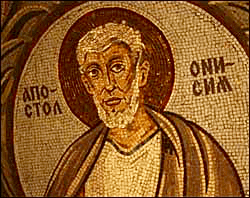
A mosaic of Philemon’s slave, Onesimus

Paul, a prisoner of Christ Jesus, and Timothy our brother,

To Philemon our dear friend and fellow worker—also to Apphia our sister and Archippus our fellow soldier—and to the church that meets in your home:

Grace and peace to you from God our Father and the Lord Jesus Christ.

I always thank my God as I remember you in my prayers, because I hear about your love for all his holy people and your faith in the Lord Jesus. I pray that your partnership with us in the faith may be effective in deepening your understanding of every good thing we share for the sake of Christ. Your love has given me great joy and encouragement, because you, brother, have refreshed the hearts of the Lord’s people.

Therefore, although in Christ I could be bold and order you to do what you ought to do, yet I prefer to appeal to you on the basis of love. It is as none other than Paul—an old man and now also a prisoner of Christ Jesus—that I appeal to you for my son Onesimus, who became my son while I was in chains. Formerly he was useless to you, but now he has become useful both to you and to me.

I am sending him—who is my very heart—back to you. I would have liked to keep him with me so that he could take your place in helping me while I am in chains for the gospel. But I did not want to do anything without your consent, so that any favor you do would not seem forced but would be voluntary. Perhaps the reason he was separated from you for a little while was that you might have him back forever—no longer as a slave, but better than a slave, as a dear brother. He is very dear to me but even dearer to you, both as a fellow man and as a brother in the Lord.

So if you consider me a partner, welcome him as you would welcome me. If he has done you any wrong or owes you anything, charge it to me. I, Paul, am writing this with my own hand. I will pay it back—not to mention that you owe me your very self. I do wish, brother, that I may have some benefit from you in the Lord; refresh my heart in Christ. Confident of your obedience, I write to you, knowing that you will do even more than I ask.

And one thing more: Prepare a guest room for me, because I hope to be restored to you in answer to your prayers.

Epaphras, my fellow prisoner in Christ Jesus, sends you greetings. And so do Mark, Aristarchus, Demas and Luke, my fellow workers.

The grace of the Lord Jesus Christ be with your spirit. (New International Version)

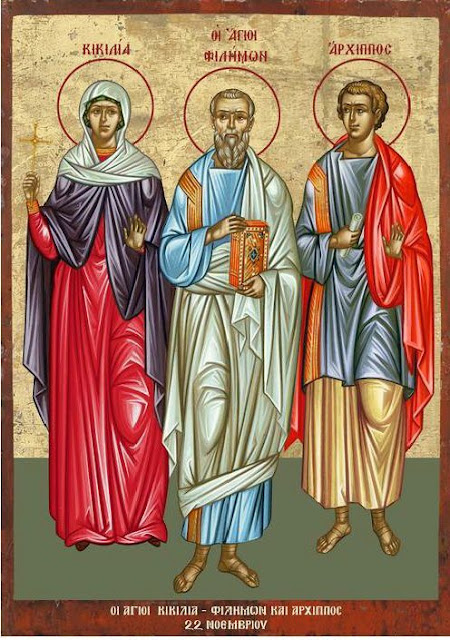
Orthodox depiction of Saints Apphia, Philemon, and Archippus

Tucked away near the end of the 66 books of the Holy Bible is the little letter of Philemon. Many Christians have neither heard a sermon preached on it, nor ever discussed it. Yet, there it is, contained as part of the New Testament canon. So, it could use some attention from us.

The letter is an appeal to Philemon concerning his slave Onesimus – who fled from his master and subsequently ended up converting to Christianity through the Apostle Paul’s influence.

At the time, Paul was imprisoned and Onesimus attended to his needs. Although Paul desired to keep Onesimus with him, he sent the slave back to Philemon. The Apostle was wanting the master to receive the slave as a beloved brother in the Lord, and not just as a servant. Then, Paul hoped Philemon would send Onesimus back to him, thus smoothing out the master/slave relationship and having his own needs met, as well.

The bottom line of the letter is that Paul very much desired that Onesimus be freed from his servitude by Philemon. He didn’t want to pull rank and twist Philemon’s arm to do it. Even though we don’t precisely know what happened in response to Paul’s letter, it’s likely that Onesimus was freed, since the appeal was included in the New Testament.

Christianity, ideally, is meant to transform lives, to change social relationships, to establish a truly egalitarian society in which the status of humans owning other humans would be done away with. Men ought to become brothers with one another and not highly stratified and separated with gross power inequities between them.

Now, in Christ, it doesn’t matter if you are a Jew or a Greek, a slave or free, male or female. You are all the same in Christ Jesus.

Galatians 3:28, ERV

Sitting where we are now, a few millennia later, we might find it curious that Paul and other biblical writers didn’t simply call for the outright abolition of slavery altogether. And yet, slavery was such an ensconced part of the ancient world (some places in the Roman Empire had up to 70% of the population as slaves) that to do so immediately would have likely brought such shock to the system that more harm than good may result.

In Paul’s experience, he continually went about the business of agitating for change by proclaiming a gospel of grace for all people. And the places where he did so saw great societal transformation – which is why Paul got so much pushback from so many authorities who benefited from keeping others under their feet.

In the household of faith, all persons are sisters and brothers and useful servants of one another and of the Lord.

The healings by Jesus in the Gospels not only restored one’s physical health but also restored the individual back to the community. The leper’s social stigma was lifted; the woman’s isolation due to bleeding was done away with; and stereotypes of those born with disabilities were overturned.

No one is inferior in the kingdom of God. Everyone is inherently worthy and has a vital purpose in God’s new society. Since the cross of Christ has erased all barriers, Christian community is to be realized through respectful equality, mutual love, and caring fellowship.

That’s how the system is changed.

Almighty God, by your Holy Spirit you have made us one with your saints in heaven and on earth. May our earthly pilgrimage be always supported by this fellowship of love and prayer, and know ourselves surrounded by their witness to your power and mercy; through Jesus Christ our Lord. Amen.