Saints, Sinners, and Sacrifice (Mark 8:31-38)

Then he began to teach them that the Son of Man must undergo great suffering and be rejected by the elders, the chief priests, and the scribes and be killed and after three days rise again. He said all this quite openly. And Peter took him aside and began to rebuke him. But turning and looking at his disciples, he rebuked Peter and said, “Get behind me, Satan! For you are setting your mind not on divine things but on human things.”

He called the crowd with his disciples and said to them, “If any wish to come after me, let them deny themselves and take up their cross and follow me. For those who want to save their life will lose it, and those who lose their life for my sake, and for the sake of the gospel, will save it. For what will it profit them to gain the whole world and forfeit their life? Indeed, what can they give in return for their life? Those who are ashamed of me and of my words in this adulterous and sinful generation, of them the Son of Man will also be ashamed when he comes in the glory of his Father with the holy angels.” (New Revised Standard Version)

Saintly Sinners and Sinning Saints

People cannot be separated easily into the categories of saints or sinners. We are much more like saintly sinners or sinning saints. 

If we look closely, everyone is, at the same time, both beautiful and hideous; holy and depraved; full of faith and full of fear. And when it comes to the church, it is both the place of spiritual sensitivity toward others, as well as a den of decadent self-interested individuals. 

So, anyone searching for a church or a community that is a nice clean upward path of success with everything done to perfection with no one ever being hurt or unhappy, will be sorely disappointed. Such an organization or institution does not exist; and, it never did.

Yet, with that reality in mind, Jesus stands right alongside imperfect people, despite all their flaws, shallowness, and self-interest. Jesus is very well acquainted with people’s damaged emotions and open putrid spiritual abscesses. Yet, Christ treats everyone with mercy; Jesus never tires of rehabilitating and reforming.

Christ’s disciple, Peter, is the poster child for humanity’s mix of faith and failure. He stepped out of a boat in great faith and walked on the water, only to begin sinking because of his great fear. (Matthew 14:22-33)

It was Peter who made a bold and right confession of faith, and then turned around and bought into a satanic agenda. Yet, Jesus was right there, next to Peter all the way. Christ both rebukes and loves, all the while never abandoning us, but always working in and through us to accomplish good and right purposes.

The bald fact of the matter is that following Jesus involves pain and sacrifice. That’s the reality of living in a broken mixed-up world. What’s more, Christ’s Church is still imperfect and in the process of becoming holy. So, if we will admit it, we are all like Peter – a little devil who needs to get in line behind Jesus.

Everyone gets frustrated or disgusted with church, or really any consistent gathering of people. It’s easy to complain and even avoid others. It’s much harder to take up our cross and lose our life for the sake of Christ and others. We truly can choose to put love where love is not, even when we do not feel loved.

Imagine that your family has gathered for a holiday. Everyone is together. But you are struggling with tiredness and anger. Your spouse is sulking. Your teenage kids don’t want to be there. You worry about your aging parent. And you’re anxious about whether your crazy uncle is going to be nice or go on some weird political rant.

You want to be present, to celebrate the holiday. Your family is anything but a Hallmark card. Everyone’s hurts and hang-ups are not far from the surface. But you are together for a reason, to celebrate and experience joy. It may be a twisted human version of togetherness and spirituality, but it’s still a foretaste of the heavenly banquet that is to come. So, you deal with it all, and find some peace and satisfaction, transcending the carnal and experiencing the sacred.

In much the same way, the church gathers together in an imperfect way, a crazy mix of sinner and saint. But we gather in and around Jesus – and that makes all the difference. There’s a reason for doing this that is bigger than all our dysfunctional ways and dyspeptic attitudes. 

Jesus Christ is building his church, and he will keep it going until the end of the age. Fellow saints and sinners, Jesus isn’t finished with us yet!

The Sacrifice of Jesus Is Needed

Jesus openly stated openly that it is necessary for him to suffer deeply and die a cruel death. It’s God’s plan. But Peter didn’t like that plan, at all. So, he took Jesus aside and rebuked him, believing Jesus to be off his rocker for even suggesting such a terrible scenario. Jesus, however, turned the tables on Peter and rebuked him right back because being Christ-centered without being cross-centered is satanic.

Peter presumed to know what was best for Jesus. He believed the suffering of the cross would never happen. Peter’s perceptions were dim and limited. He did not the reality of how the world truly is; and that Jesus needed to offer himself as a sacrifice for the sins of the entire planet. 

Sometimes, like Peter, we may believe that the way I see and the way I perceive is the way things really are; or, at least, how I think they should be. 

Peter had been walking with Jesus for a few years, watching and enjoying him. It was all good. So, in his mind, it should never change; why try and fix something that isn’t broken? Oh my, but broken the world is!

Just because it was good for Peter did not mean it was good for everybody or should always be this way. If Peter had his way, we would likely be in hell. We, like Peter, are finite humans with limited understanding and perceptions.

One can easily slip into a satanic mode of believing that because something is going fine for me that everyone else is doing okay, too. I like it, I want it, so what’s the problem? 

The problem is that we too easily view life through selfish lenses. In such a state, we fail to:

  • see other people’s needs
  • perceive a lost world with any sense of reality
  • understand that Jesus has an agenda different from our own

Our limited perceptions come out in saying things such as:

  • “Oh, she’s just depressed because she is avoiding responsibility.” 
  • “People on government welfare are lazy.” 
  • “He’s addicted because he doesn’t want to help himself.” 
  • “They’re picketing because they’re a bunch of malcontents.”

Statements like those are legion, and betray a satanic worldview devoid of grace. It’s a compulsive need to find blame. It’s a belief that if there’s personal suffering, there must be personal sin. 

We belong to one human family, and therefore, we are all in this life together. One person’s joys are our joys; one person’s struggles are our struggles. The detachment we can have toward other humans is completely foreign to the words of Jesus. 

The Christian life always involves suffering, and Jesus invites us to follow him in his way of sacrifice.

The Sacrifice of Christ’s Followers Is Needed

There is a way to reverse a satanic agenda and demonic thinking: self-denial. Jesus issued an invitation to fall in line behind him and walk with him in his suffering. 

Self-denial is not so much doing something like giving up chocolate for Lent; rather, it’s giving up on ourselves as our own masters. It’s a decision to make the words and ways of Jesus the guiding direction for life. It’s the choice to quit holding onto the way I believe things ought to be, and take the time to listen to Jesus.

The logic of Jesus is relentless. Life comes through death. We give up our lives to find life. It’s unhelpful to adulterate our lives by serving the gods of success and perfectionism. Jesus invites us to quit our moonlighting job with the world, and go all in with him. In this way, we find abundant life. 

Jesus was encouraging not only submission to suffering, but also an embrace of suffering. In doing so, we find reward and joy. For those familiar with this path, suffering is a blessing. In walking this road, they find the true purpose and meaning of life. 
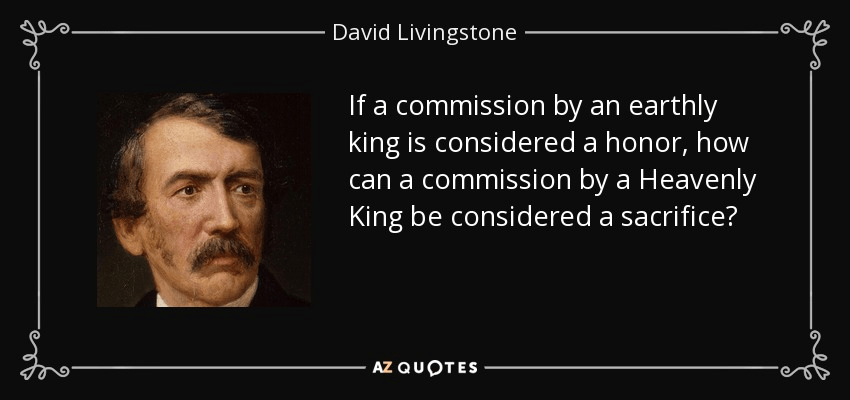
Few people suffered as much as the nineteenth-century missionary medical doctor to Africa, David Livingstone.  He was a pioneer explorer who opened up the interior of Africa to the outside world. He had two reasons for doing so: To take the good news of Christ’s suffering to the African people; and, to open Africa to legitimate trade, so that the illicit slave trade would end. 

Dr. Livingstone’s hand was bitten and maimed by a lion. His wife died while on the mission field. The one house he built was destroyed in a fire. He was often wracked with dysentery and fever, or some other illness in the jungle. 

Someone once commented to him that he had sacrificed a lot for following Jesus. His response: “Sacrifice? The only sacrifice is to live outside the will of God.” When asked what helped him get through the hardship, he said,  “The words of Jesus to take up my cross are always ringing in my ears.”

We may mistakenly believe that we must watch out for ourselves; push for our personal preferences; that if I accept the invitation to follow Jesus in the way of self-denial, I will be miserable and people will walk all over me. Those thoughts are merely demonic whispers in the ear.

There are two differing ways of thinking and acting: 

  1. The way of success, perfection, and a pain-free life as the evidence of God’s working. 
  2. The way of suffering as right and necessary in order to connect with God and be in solidarity with those who suffer. 

Suffering, rejection, and execution did not fit into Peter’s church growth plan. But according to Jesus, we do not exist only for ourselves, to be in some sort of spiritual country club. We exist to follow Jesus in his path of sacrifice and suffering for a world of people who desperately need to know the grace of forgiveness, and the mercy of Christ.

Since Jesus died, we are to die to ourselves. Since Christ lives, we are to live a new life. In God’s upside-down kingdom, joy comes through suffering. We follow Jesus as the mix of sinner and saint that we are. Amen.

Care For the Flock (Ezekiel 34:1-16)

The Lord God said:

Ezekiel, son of man, Israel’s leaders are like shepherds taking care of my sheep, the people of Israel. But I want you to condemn these leaders and tell them:

I, the Lord God, say you shepherds of Israel are doomed! You take care of yourselves while ignoring my sheep. You drink their milk and use their wool to make your clothes. Then you butcher the best ones for food. But you don’t take care of the flock! You have never protected the weak ones or healed the sick ones or bandaged those that get hurt. You let them wander off and never look for those that get lost. You are cruel and mean to my sheep. They strayed in every direction, and because there was no shepherd to watch them, they were attacked and eaten by wild animals. So my sheep were scattered across the earth. They roamed on hills and mountains, without anyone even bothering to look for them.

Now listen to what I, the living Lord God, am saying to you shepherds. My sheep have been attacked and eaten by wild animals because you refused to watch them. You never went looking for the lost ones, and you fed yourselves without feeding my sheep. So I, the Lord, will punish you! I will rescue my sheep from you and never let you be their shepherd again or butcher them for food. I, the Lord, have spoken.

The Lord God then said:

I will look for my sheep and take care of them myself, just as a shepherd looks for lost sheep. My sheep have been lost since that dark and miserable day when they were scattered throughout the nations. But I will rescue them and bring them back from the foreign nations where they now live. I will be their shepherd and will let them graze on Israel’s mountains and in the valleys and fertile fields. They will be safe as they feed on grassy meadows and green hills. I promise to take care of them and keep them safe, to look for those that are lost and bring back the ones that wander off, to bandage those that are hurt and protect the ones that are weak. I will also slaughter those that are fat and strong because I always do right. (Contemporary English Version)

We have a pastoral duty to care for one another. Individuals need not have the title of “Pastor” in order to function as pastoral people who seek the welfare of the flock. A part of our responsibility (and privilege) is to know the flock well enough in discerning when there are some lost ones out there. Whenever that happens, we care about them enough to go after them.

If we either ignore the flock, fail to care for it, or seek to fleece them for our own benefit, we will have to contend with a God who has no tolerance for unnecessarily putting the sheep at risk. And we are to be attentive to the ones who have strayed and are lost.

Caring about the lost, enough to go after them, has always been, unfortunately, a scandalous activity for Christians who do it. In the Gospels, the religious leaders had a big problem with how Jesus was spending his time (Luke 15:1-3). From their perspective, Christ was guilty by association. Many of the people Jesus pursued and hung-out with were unsavory characters; there was really no doubt about their bad character. 

But we must come back to why Christ made the decisions he did: Jesus did not come to earth to make already righteous people feel good about being around him; he came to rescue sinners and restore them to God. 

Jesus never wavered from this fundamental mission. With everything he said and did, Jesus, the Good Shepherd, communicated that lost people matter to God – and that practice eventually got him killed.

Early in my Christian life, I adopted a practice, on most Friday nights, of going to a certain bar known for its less than virtuous clientele. I typically ordered a bowl of chili gumbo, and simply sat and talked with fellow students. I learned a lot about people – their hopes, fears, and spiritual inclinations. 

I learned even more about God. I saw the terrible brokenness of many people’s hearts, and saw that the heart of God was pained in longing to restore such persons to a place of spiritual abundance, peace, and joy.

One Friday night, in the middle of winter, as I was walking back from the bar with a friend at about midnight, we encountered a guy so drunk that he could not walk straight. He wasn’t wearing any pants, nor did he have a coat. In below freezing temperatures, he was in only a shirt and underwear. 

All the people who passed by him laughed and kept walking. But we stopped. It took several minutes to get some semblance of a story out of him about what happened, where he came from, and where he lived. The poor guy couldn’t remember losing his pants, which had his wallet and keys. 

He lived far enough away that there was no way he would have ever made it home. It’s quite probable that without someone helping him he would have passed out somewhere and died. We got him home, found a way to get into his place, and tucked him in his bed.

The next day I went and checked on him. Even though he had a bad hangover, we still had a good conversation about what happened and why I helped him. We ended up meeting several times together and talked a great deal about God, guilt, grace, Jesus, and salvation. 

Meanwhile, however, not everyone was happy about my practice. Some of the people in my church were not pleased with me spending time in a bar with “sinners.” They told me things like, “Bad company corrupts good character” and “it doesn’t look good.” I merely matter-of-factly responded, “I like the way I’m reaching out to lost people better than the way you’re not.”

We are in danger of becoming encrusted with so much insulation from lost people, and their very real hurts, that we do not know God’s heart for them. 

Jesus, better than any of us could ever imagine, knows how awful and horrific sin really is. That’s because he suffered by taking on the shameful baggage of every person who ever lived. Since Jesus understands how awful guilt and shame is, it’s God who goes uncorked with joy and celebration when just one lost sheep is restored to the flock.

Grace lies at the center of God’s heart – a scandalous grace that defies all earthly sense. God’s deepest desire, greatest yearning, and most passionate dream is that lost people return home. (Luke 15:11-32) 

In light of the reality that God’s heart burns for lost people, we as churches, faith communities, Christian ministries, and believers everywhere really need to: 

  • Put away all petty concerns and realize there are lost people, far from the flock, at risk and dying apart from God
  • Put all worries about the future in biblical perspective – because there are people with no hope and no God all around us
  • Put aside all pre-occupations with optics and marketing, numbers and money; and instead have a holy obsession with people knowing Jesus Christ, and him crucified, risen, and coming again 

We are to make it our aim in this life to pray for, long for, look for, run after, and pursue lost people and restore them to life.

For what does it profit a person to gain the world but lose their life because they was too pre-occupied with everything but caring for the flock? And what does it profit a church to have buildings, budgets, and butts in the pew, but never see a lost soul come to Jesus?

A Reality Check (Hebrews 10:1-4)

The law is only a shadow of the good things that are coming—not the realities themselves. For this reason it can never, by the same sacrifices repeated endlessly year after year, make perfect those who draw near to worship. Otherwise, would they not have stopped being offered? For the worshipers would have been cleansed once for all and would no longer have felt guilty for their sins. But those sacrifices are an annual reminder of sins. It is impossible for the blood of bulls and goats to take away sins. (New International Version)

Sometimes, we silly people confuse the sign for the real deal. It’s important to distinguish between the two. We discern the difference all the time when it comes to more mundane affairs.

People generally know that looking at a movie poster is not watching the actual film; that wearing a string of cheap pearls is only mimicking the real and expensive ones; or that sitting in a doctor’s waiting room isn’t the same thing as being in the appointment.

However, when it comes to our religion, we seem to blur the lines between sign and substance. Praying a “sinners prayer” or making a profession of faith isn’t the same as growing, maturing, following, and living a committed Christianity.

Knowing some Christian lingo and/or going with the flow of cultural Christianity doesn’t necessarily mean that Christ’s words and ways are being followed.

And today’s New Testament lesson is a reminder, and not a guilt trip, that the law points to the actual substance of religious life – and is not life itself.

The laws surrounding the old system of animal sacrifice were never meant to be an end in itself. It pointed forward to the real deal and was, therefore, completely inadequate to bring deliverance from sin, death, and hell to anyone.

The very fact that sacrifices needed to be repeated year and after year demonstrated that they were ineffectual in saving a person. Rather, those sacrifices were designed to cause the worshiper to long for a sacrifice to end all sacrifices – to anticipate that the sin issue would be settled once and for all.

The only thing the sacrifices did was remind people they were sinners in need of a savior. Just as a slap on the hand is grossly inadequate for handling a murderer, so offering an animal was never going to do the trick in taking care of divine justice.

And besides, God has never been pleased with a bunch of sacrifices anyway. So, what is God really pleased with? The Lord is pleased with a heart devoted to obedience and fealty to Jesus Christ; God cares about inner attitudes and dispositions of the spirit which are inclined toward righteousness, holiness, mercy, humility, and justice for all.

Sacrifices, in and of themselves, have no power; they are like a toothless lion who couldn’t bite into you if he tried. The way to set things right is through the once for all mighty sacrifice of the Son – an offering to end all offerings.

God doesn’t want a checklist of daily sacrifices, any more than a spouse only wants supper on the table at night, or a paycheck every month. It’s nice but falls short of the full scope of marital interactions and relations. A marriage built on law won’t stand. It needs real flesh and blood relationship, complete with a devoted heart, sincere attitudes, and loving words and actions.

Since Christ has ably and permanently taken care of the sin issue, what sort of impact ought that to have on the Christian’s life? What kind of people are we to be?

To begin listing things to do is to go back to law and fail to grasp the gospel. And that’s where many churches and believers get tripped up and miss the grace of God altogether. Observing rules of cultural Christian activities or holding to some accepted Christian norms isn’t going to cut it.

Christ’s Sermon on the Mount by Jorge Cocco Santángelo

Jesus described the sort of people who go beyond ritual regulations and rules to embrace the true spirit and end of the law:

“You’re blessed when you’re at the end of your rope. With less of you there is more of God and his rule.

“You’re blessed when you feel you’ve lost what is most dear to you. Only then can you be embraced by the One most dear to you.

“You’re blessed when you’re content with just who you are—no more, no less. That’s the moment you find yourselves proud owners of everything that can’t be bought.

“You’re blessed when you’ve worked up a good appetite for God. He’s food and drink in the best meal you’ll ever eat.

“You’re blessed when you care. At the moment of being ‘care-full,’ you find yourselves cared for.

“You’re blessed when you get your inside world—your mind and heart—put right. Then you can see God in the outside world.

“You’re blessed when you can show people how to cooperate instead of competing or fight. That’s when you discover who you really are, and your place in God’s family.

“You’re blessed when your commitment to God provokes persecution. The persecution drives you even deeper into God’s kingdom. (Matthew 5:3-10, MSG)

That describes folk who have embraced faith as the fulfillment of law. It’s a summary of the law’s intended purpose and end.

So, let’s worship Christ; and not some caricature of him. Maybe carefully reading through the entire book of Hebrews in one sitting will help.

Blessed God, purify your people by your abiding presence. Enlighten the minds of your people with the light of your good news. Bring wandering souls to an awareness and knowledge of Jesus Christ; and those who are walking in the way of life, keep them steadfast to the end. Guard those who are strong and prosperous from forgetting you. Increase in us your many gifts of grace and make us all fruitful in good works for the sake of Christ in the power of the Holy Spirit. Amen.

Remember Your Baptism (Matthew 3:13-17)

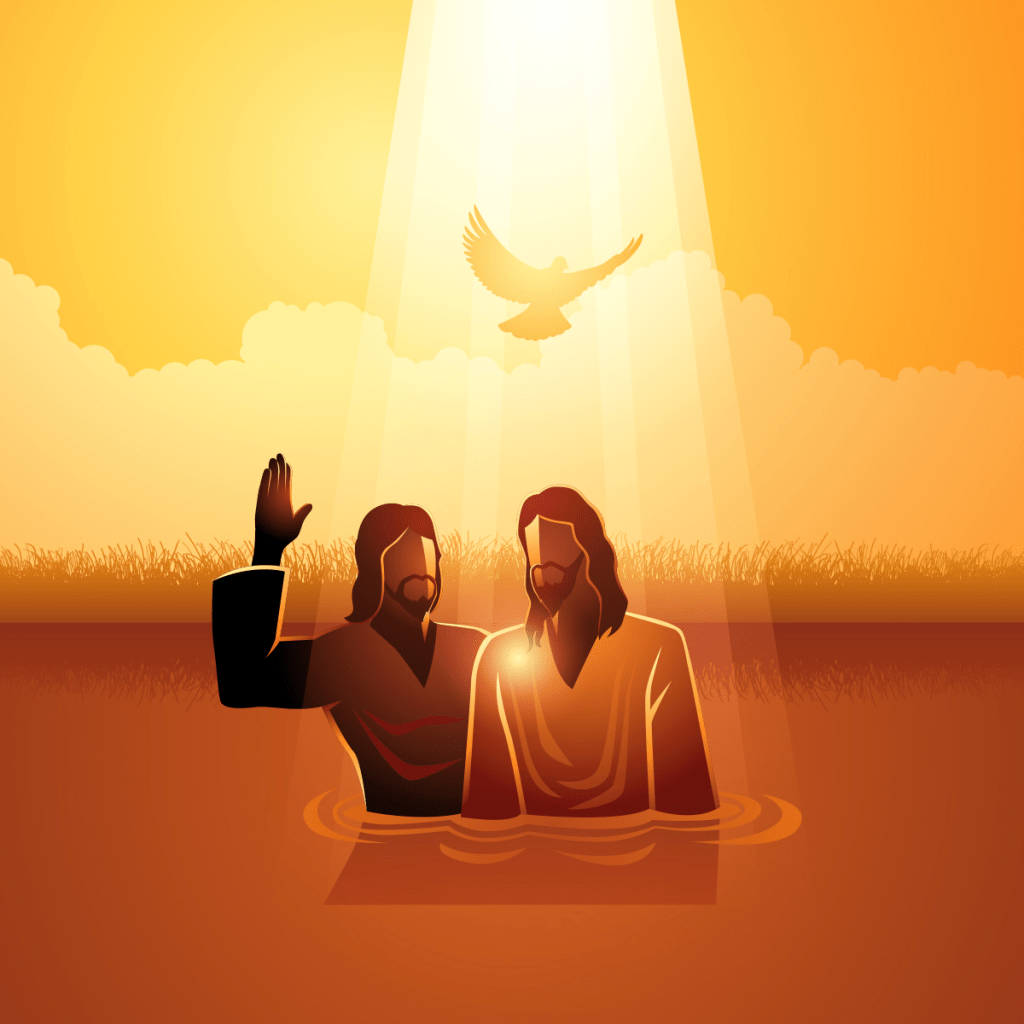
John baptizing Jesus with the Holy Spirit’s affirmation

Then Jesus came from Galilee to the Jordan to be baptized by John. But John tried to deter him, saying, “I need to be baptized by you, and do you come to me?”

Jesus replied, “Let it be so now; it is proper for us to do this to fulfill all righteousness.” Then John consented.

As soon as Jesus was baptized, he went up out of the water. At that moment heaven was opened, and he saw the Spirit of God descending like a dove and alighting on him. And a voice from heaven said, “This is my Son, whom I love; with him I am well pleased.” (New International Version)

Baptism is important. Remembering is important. Put together, remembering our baptism is highly important. Here’s why….

Baptism is important to Jesus

Baptism is the distinguishing mark or symbol of being a Christian. 

The New Testament actually knows nothing of an unbaptized Christian. That’s because the practice is tied to our identity as believers. Our baptisms are based in the baptism of the Lord who, in his Great Commission, told us to baptize in the name of the Father, Son, and Spirit (who were all present at Christ’s baptism). 

The absence of baptism is like a bride without a wedding ring; a football player not wearing a uniform; a motorcycle gang without tattoos; or like an Iowa farmer without a Pioneer seed corn hat!

Baptism is the outward sign that we belong to God. It is the distinguishing symbol that we have been adopted by God and will receive all the promises of salvation in Christ.

Christ’s baptism fulfilled all righteousness through identification with repentant people

John the Baptist was understandably hesitant to baptize Jesus; he knew Jesus had no need of repentance. Although Jesus had no sin to confess, his baptism is a powerful symbol of his humility. It anticipates his ministry to people who recognize their need for God. 

It was necessary for Jesus to be baptized in order to communicate solidarity with people who are coming to God. “Righteousness” means having a right relationship with both God and other people. By being baptized, Jesus is proclaiming that a renewed and right relationship with God will become a reality through himself. Baptism is the sign that we belong to God and that our righteousness is tied to our union with Jesus.

It was important for Jesus to identify with sinners; it is important for us, as well. We remember our baptism – that we belong to God – by identifying with “sinners.” Here are 7 ways of doing it:

  1. Practicing hospitality (love of strangers)
  2. Using our spiritual gifts of speaking and serving on their behalf
  3. Getting to know people very different from ourselves
  4. Meeting people on their turf (not just ours)
  5. Showing respect and upholding dignity
  6. Asking thoughtful and caring questions
  7. Listening with focused attention

It isn’t what we “do” for people that’s as important as affirming our shared humanity with them; thus leading folks to the ultimate person who can address the needs of their heart:  Jesus.

Christ’s baptism fulfilled all righteousness through the affirmation of witnesses

Before Jesus began his ministry, it was necessary to receive validation of what he was about to teach and do. In ancient Judaism, one of the protections guaranteeing that Scripture would be taught according to the way of God, was through an ordination, of sorts. In order for a new rabbi to become a new rabbi, he needed the laying on of hands from two other rabbis who had authority to do so. 

That’s why Christ’s baptism is important. John the Baptist was a powerful teacher and prophet who was recognized by the people as such. John publicly said he wasn’t worthy to carry Jesus’s sandals, that Jesus is the Lamb of God that takes away the sin of the world. So, a baptism by John validated Jesus and inaugurated his ministry. 

Baptism of Christ by Dave Zelenka

A second voice – another witness from heaven – affirmed Jesus: “This is my Son, the one I love. I am very pleased with him.” And then, the Holy Spirit, in the form of a dove, came upon Jesus. This further affirmed that Jesus would save people, not through arm-twisting and great shows of power, but through humility and gentleness.

Baptism was Christ’s first recorded act as an adult. In some ways, it was his first miracle – the miracle of humility in identifying with sinners.

Remember your baptism

Baptism is a sign and seal of God’s grace. Just as Christ’s baptism focused all the promises of God in salvation as being fulfilled in one person, so in our baptism we claim all the promises of God as found in Jesus. Water symbolizes new life, God identifying with us – Immanuel, God with us.

In baptism, God promises and seals to us our union with Jesus so that identity is not found in my past and my profession of faith, but in Christ’s past of bringing redemption to us.  Baptism does not so much express faith as call one to a life of faith and sets us apart as belonging to God.

Baptism is a visible declaration of an invisible reality: union with Christ. Just as circumcision was the outward visible sign of the old covenant, so baptism is the sign of the new covenant in Christ – available to both male and female – thus opening the way for women to participate fully in the ministry of the gospel.

In particular, infant baptism confirms that salvation is not initiated by us, but by God. It affirms that one is betrothed to God. As a child, then an adult, grows into the faith, it is our task to remember our baptism, to be reminded that God’s mark is upon us, that we belong to the Lord. 

God has set us apart to be a holy people, given to Jesus to live as he did. We must never forget that baptism is God’s identifying mark upon us; that our union and solidarity with Jesus is affirmed through this practice.

We are not solitary Christians; we belong Christ and to one another. Baptism is the initiation rite that takes a lifetime to complete. Therefore, we must struggle together in working out our salvation.

Because of our union with Jesus Christ, we must remember:

  • I do not belong to the world. So, I will not live selfishly, only seeking my own comfort agenda. Instead, I will give and serve others from a pure and humble heart.
  • I do not belong to sin. So, I will not give myself over to shameful words or actions, to bullying or manipulating people, to throwing fits and pity parties to get my way, nor using my tongue to speak gossip, slander, or suck-up to others. Instead, I will use my speech wisely, building up others through thoughtful and heartfelt encouragement.
  • I do not belong to the devil. So, I will not seek his agenda of lying, cheating, stealing, and being bitter. 

I belong to Jesus, so therefore:

  • I will uphold biblical justice by championing the cause of the fatherless and the widow, the poor and the needy, the least and the lost among us.
  • I will love others with all the grace God gives me.
  • I will forgive others because Christ has forgiven me.
  • I will consider others better than myself by embracing the humility of Christ.
  • I will hunger and thirst for righteousness.
  • I will seek peace and pursue it.
  • I will, give myself to my Lord and Savior Jesus Christ my Savior and Lord – completely and thoroughly, unabashedly and unreservedly.
  • I will live into my baptism and remember it always because I belong to Jesus!