Sing a New Song (Psalm 98:1-5)

Oh, sing to the Lord a new song!
For He has done marvelous things;
His right hand and His holy arm have gained Him the victory.
The Lord has made known His salvation;
His righteousness He has revealed in the sight of the nations.
He has remembered His mercy and His faithfulness to the house of Israel;
All the ends of the earth have seen the salvation of our God.

Shout joyfully to the Lord, all the earth;
Break forth in song, rejoice, and sing praises.
Sing to the Lord with the harp,
With the harp and the sound of a psalm, (New King James Version)

I still remember, years ago when I was in college, a guy with a pony tail and wearing flip-flops, walking up with a guitar on his back in front of a gathering of fellow students who were Christians.

Yet, most evident, was his broad smile which seemed to engulf his entire face. He talked about his life before Christ – which was all of his life up until the week before – and what Jesus had done for him.

Then, he took his guitar and announced that he wrote a song to this very text, the first few verses of Psalm 98. I wish I had a recording of it, especially because of how he sang it with such volume and exuberance, as if the words had just been crafted yesterday.

Even though the psalm is ancient, the psalmist himself was inviting people to sing a song infused with a new perception of life on this earth.

There is always plenty of room to reflect on what God has done, and is doing, in this very big world. Not only can we consider the immensity and intricacy of the created order, but we can also declare all the things we cannot detect with our five senses.

And perhaps those are the things which impact us the most, when we sense and feel the reality of God’s work in the world, and in our lives. At least that’s what my pony-tailed smiling friend was so excited about.

The things which exist beyond our normal human experience are no less real than our daily mundane activities. This is the realm where the Lord makes the greatest impact of all. God hasn’t only done great things, but has done great things for me.

We have to use metaphors and personifications in order to even begin understanding the wonder and awe of God’s saving power in our very real here-and-now lives. God’s mighty right hand and holy arm of power speak to the incredible strength and authority which can reach into the thickest and nastiest of garbage dumpsters to pull out the pearl of great price, that is, you and me.

Consider God, the One who puts all things right, and is just and good in all things – paying attention to the least of us, and lifting up with divine deliverance from the most dire and awful of circumstances.

Indeed, the Lord has made God’s salvation known, and revealed God’s righteousness to the nations.

Sometimes it takes someone with a fresh new song to wake us up to the reality that we can discern the activity of God every day, in all the ordinary and myriad ways of our lives. Along with all of creation, and pony-tail guy, we join the chorus of those who are already singing with the unique voice God provided for us.

And those many songs all include, at their center, the reality that before I chose God, God chose me; that when I forget, God remembers; that with my waxing and waning of love, God is consistently steadfast and faithful with love; and that God provides salvation, and judges the people with equity, even when I show favoritism.

With each new testimony of God’s saving work, it becomes harder and harder for others to insist that God is absent, hidden, or negligent. God is there. God is here. God is everywhere.

We can get so wrapped up in our own small worlds, and our own little safe places, where everyone looks like me, acts like me, and thinks like me. But the world is much bigger than our contrived spaces in which we can set ourselves up as master and commander.

The Lord mercifully breaks through all of our puny posturing and petulance, and saves us from ourselves. God pushes and cajoles us to see beyond the end of our noses. We are moved to see a new perspective we haven’t noticed before.

And once we make out what God is doing, and does for me, then bursting into song with shouting and volume is the organic response to our experience. If you think about it, there is really no other way to respond, once you have gotten a glimpse of God’s activity, and discerned something that was previously undiscernible.

Even the rocks will cry out in the face of such love and grace.

It’s okay to open your mouth, once your eyes have been opened, and let a new song come tumbling out. Because joy is the response of being delivered from what once bound us.

Gracious and Loving God, you have filled the world with beauty: Open our eyes to behold your gracious hand in all these works; that, rejoicing in your whole creation, we may learn to serve you with gladness; for the sake of him through whom all things were made, your Son Jesus Christ our Lord.

Who Is In Control? (Psalm 47)

Ascension, by Angela Taylor Perry

Clap your hands, all you peoples;
    shout to God with loud songs of joy.
For the Lord, the Most High, is awesome,
    a great king over all the earth.
He subdued peoples under us
    and nations under our feet.
He chose our heritage for us,
    the pride of Jacob whom he loves.

God has gone up with a shout,
    the Lord with the sound of a trumpet.
Sing praises to God, sing praises;
    sing praises to our King, sing praises.
For God is the king of all the earth;
    sing praises with a psalm.

God is king over the nations;
    God sits on his holy throne.
The princes of the peoples gather
    as the people of the God of Abraham.
For the shields of the earth belong to God;
    he is highly exalted. (New Revised Standard Version)

Who is in control? This is really a big question. We humans seem almost obsessed with the issue of control.

Some people want to be in charge of regulating everything. Others want to exert force over nothing at all. And there are those who continually want to know the clear lines of authority and who is in control, at all times.

Control, in and of itself, is not a bad thing. In fact, it’s a good thing. Taking charge of a situation – and especially of oneself – is often needed. Leadership that is informed, decisive, humble, true, and right, is a must.

The problem comes whenever we try to exert domination over another person, or attempt to command an organization when it isn’t our responsibility to do so.

Ultimate control of all things belongs to God, and not to you or me. The psalmist is insistent that God is the Ruler of the universe; and that all things belong to the Lord. God’s commands are good.

The Lord’s dominion is known as the kingdom of God. Whenever people are in sync with this reality, then they are able to be joyful and celebrate the good, right, and just Being who is in control.

Yet, if people have problems trusting another; desire to always call the shots on everything; and command everyone; there you will find a host of miserable people – with the one trying to exert control as the most miserable of all.

People, instead, are called to self-control. We are to have charge over our own thoughts and actions. It’s important to have sobriety in our lives in which we can use proper restraint, as well as needed initiative.

Be alert and be of sober mind. Your enemy the devil prowls around like a roaring lion looking for someone to devour. (1 Peter 5:8, NIV)

In order to get our lines of authority in the proper places, and to participate in the established rhythms of control in the universe, we are commanded to clap, shout, and sing. Because God has ultimate control, divine initiatives are grounded in goodness, justice, righteousness, and deliverance from evil. The Lord has mercifully acted on behalf of people.

The Lord only asks of us to do things that he himself has done. The psalm states that “God has gone up with a shout.” We shout because God shouts. God rules over the nations, and was not simply some local deity that the ancient Israelites served and worshiped. The divine presence is with those who acknowledge God; they will hear the Lord’s shout.

“No misfortune is seen in Jacob,
    no misery observed in Israel.
The Lord their God is with them;
    the shout of the King is among them.
God brought them out of Egypt;
    they have the strength of a wild ox.” (Numbers 23:20-22, NIV)

We are also told to sing. The reason we do so is because the Lord is high above all people, and is king over the nations. This is something we need to say out loud and to sing, and to not only read silently in our heads. Our ears need to listen to the psalm, to hear the praises of God reverberating on our ear drums.

My people, hear my teaching;
    listen to the words of my mouth. (Psalm 78:1, NIV)

It is perfectly appropriate for Christians to use today’s psalm in reflection upon Ascension Day. Jesus has been lifted up into the sky; God has gone up with a shout. The Lord has equipped us for citizenship in the kingdom of God. We have solid grounds for celebration, shouting, and singing. Jesus is our King.

God put this power to work in Christ when he raised him from the dead and seated him at his right hand in the heavenly places, far above all rule and authority and power and dominion and above every name that is named, not only in this age but also in the age to come. And he has put all things under his feet and has made him the head over all things for the church. (Ephesians 1:20-22, NRSV)

Because of Christ’s ascension, believers in Jesus have the memory of the past, the experience of the present, and a hope for the future. With Jesus in control, there is no need for fear, or for trying to gain control for oneself.

Grant, we pray, Almighty God, that as we believe your only-begotten Son our Lord Jesus Christ to have ascended into heaven, so we may also in heart and mind there ascend, and with him continually dwell; who lives and reigns with you and the Holy Spirit, one God, for ever and ever. Amen.

Ephesians 5:15-20 – Speak to One Another with Psalms, Hymns, and Spiritual Songs

Be very careful, then, how you live—not as unwise but as wise, making the most of every opportunity, because the days are evil. Therefore, do not be foolish, but understand what the Lord’s will is. Do not get drunk on wine, which leads to debauchery. Instead, be filled with the Spirit, speaking to one another with psalms, hymns, and songs from the Spirit. Sing and make music from your heart to the Lord, always giving thanks to God the Father for everything, in the name of our Lord Jesus Christ. (New International Version)

As you likely well know, an inebriated person tends to say and do things that they do not typically say or do when they’re sober. The Apostle Paul’s point about being filled with the Spirit is that, instead of doing and saying stupid things, we are so filled with God that we do things and say things that we would not typically do and say if we were not filled with God – that is, good things. 

Apart from being full of God’s Spirit, we tend toward mumbling, not singing; worry, not making music in our hearts; and complaining and arguing, not giving thanks. Half-filled Christians practice a half-hearted Christianity. They’re only half-baked in their service and devotion to Christ.

Why sing? 

Because singing is part of being filled with the Spirit of God. Singing happens when we experience God’s overflowing grace in our lives through the blessings of being chosen, adopted, and redeemed into God’s new community. (Ephesians 1:3-11)

Music is powerful. It’s not only a means of expressing praise and commitment to Christ and each other, it is also a powerful means of being impressed. For example, when we first teach kids the alphabet, we teach it in a song. Trying to teach letters in a rote fashion typically doesn’t work well for pre-school kids. Words set to music is why we still remember words from old TV shows, because those words were set to a catchy tune.  Music is why an Alzheimer’s patient cannot remember her daughter’s name but can flawlessly sing all four verses of Amazing Grace.

Singing is an offering and a sacrifice of praise to God (Hebrews 13:15). And singing is also a vehicle whereby we are taught, encouraged, and built up in the community of believers. We sing to God, one another, and even ourselves.

Church music, then, is to be both a means of praising God and a practice of encouraging each other. We do it through psalms, hymns, and spiritual songs.

Psalms

The word “psalm” helps us rightly think of the biblical book of Psalms. Singing the psalms is an ancient practice, going all the way back to the Israelites singing psalms in the temple and synagogue. The early church maintained this practice, especially as a means of being faithful to praying without ceasing. 

However, over time, medieval congregations began neglecting the practice. In fact, the congregations eventually gave up most singing altogether. Almost all the singing was done by church choirs and professional musicians employed by the state (no separation of church and state) to write, compose, and perform in worship services. 

Five-hundred years ago, with the Reformation, Martin Luther reinstituted congregational singing. He gave music back to the people. One of the results of this change was putting the book of psalms to song – the Psalter.  For many Protestant denominations, the Psalter became the primary means of singing. The Psalter chiefly set prayers to song. It was both a means of expressing prayer to God and learning Scripture.


Hymns

There have always been hymns in the church. Yet, it was not until the Reformation that hymns began to be written and sung by congregations. For the Reformers, hymns were used to teach sound doctrine and theology, as well as a means of confessing the faith together

Spiritual Songs

Spiritual songs are the present day equivalent of praise and worship choruses, or what some refer to as contemporary songs. These are songs purposefully designed to be emotional expressions of praise to God and to give powerful testimony for what God has done or is doing.

So, what?

Quick review:

  • Psalms are used to pray and learn Scripture.
  • Hymns are used to teach us sound doctrine and confess the faith together.  
  • Spiritual songs are an important way of expressing praise to God and being encouraged in the faith. 

Therefore, church music is to serve as both a revelation from God, and as a response from God’s people.

There are two important deductions from this verse:

  1. A variety of songs is inferred and expected.
  2. Paul commanded their use.

The reason worship style is such a hot topic in a lot of churches is because we all have our personal preferences.  And yet, if we are to be faithful to today’s New Testament lesson, we will not just lock in on what I want. 

Truth be told, we are selfish people when it comes to music. We want what we want, and we don’t care what somebody else wants. And we will persist in that self-absorbed spirit until somebody calls us on it. That somebody is the Apostle Paul. The Word of God calls us to encompass psalms, hymns, and spiritual songs – all three of them – in our worship.

I have a good friend who is an accomplished church musician and worship pastor. I once asked him how I can lead a worship service among such a variety of preferences concerning music. He answered my question with a question: “How highly do people, including and especially your musicians, value the unity of the church?  Do they love each other so much that they can allow for a wider range of style, and do so without vocally complaining about it?”

My friend went on to say, “When I arrived at one church as their pastor, some people were in a rather bad habit of saying very openly, ‘Oh I hate that song,’ or, ‘If I hear this song one more time I’m walking out.’ What I tried to do was teach people that this is not the most loving or mature approach and does little to build up the rest of the Body of Christ.”

If a group of people are being faithful to Scripture, and doing their best musically, then – if the music seems lifeless, dull, or strange to us – the real issue isn’t style but our hearts.       

Is that heart filled with the Spirit of God? If it is, then we will speak to one another using the Psalter, using time-honored hymns, and utilizing fresh contemporary praise songs. And the result will be the Body of Christ, the Church, built up in the faith.

Gracious God, give us grace to take to heart the great dangers we are in by our unhappy divisions about music.  Take away all hatred and prejudice, and whatever else may hinder us from godly union and concord; that, as there is but one body and one Spirit, one hope of our calling, one Lord, one faith, one baptism, one God and Father of us all, so we may from this time forward be all of one heart and of one soul, united in one holy bond of peace, and may with one mind and one mouth glorify you, through Jesus Christ our Lord. Amen.

Psalm 98 – Sing a New Song

Sing to the Lord a new song
    because he has done wonderful things!
His own strong hand and his own holy arm
    have won the victory!
The Lord has made his salvation widely known;
    he has revealed his righteousness
    in the eyes of all the nations.
God has remembered his loyal love
    and faithfulness to the house of Israel;
    every corner of the earth has seen our God’s salvation.

Shout triumphantly to the Lord, all the earth!
    Be happy!
    Rejoice out loud!
    Sing your praises!
Sing your praises to the Lord with the lyre—
    with the lyre and the sound of music.
With trumpets and a horn blast,
    shout triumphantly before the Lord, the king!
Let the sea and everything in it roar;
    the world and all its inhabitants too.
Let all the rivers clap their hands;
    let the mountains rejoice out loud altogether before the Lord
    because he is coming to establish justice on the earth!
He will establish justice in the world rightly;
    he will establish justice among all people fairly. (Common English Bible)

Please notice the point of today’s psalm: Sing to the Lord a new song. Yes, a “new” song. This means we have an obligation to bring fresh music to our worship of God. This is a summons to get an original voice. Rather than going down the same ruts in our speaking and living, we are to exercise some creativity.

It seems as if those who want to stick with the “tried and true hymns” of the church have forgotten those hymns are only a few hundred years old in a church which is two-thousand years old. Back in the nineteenth century, a bitter worship battle ensued between those who wanted to sing the new hymns and those who had been singing the psalter for the past few hundred years.

The reason we sing new songs is because God is continually performing wonderful deeds in every generation. God has not only worked in the past; the Lord is doing the miraculous in the present, as well. The psalmist is thinking in cosmic, not provincial, terms. Included in the praising of new songs are a variety of creatures, along with all of creation.

Rivers Will Clap and Mountains Shout by Itamar Raz

We sing because of what God has done in the past, is doing in the present, and will do for the future. Creative and fresh praise that remembers previous divine works, experiences the now of the Spirit, and anticipates the coming of the Lord is the sort of praise called for in the psalm.

Being attentive to God’s mighty deeds helps us breakout into new vistas of living. Considering God’s works through new songs can become so invigorating that everyone and everything on earth is encouraged to join into the imaginative expression of praise.

We are to praise the Lord in this present time because of what God has done in the past, with a continual eye to the future when Christ will come again. If we don’t make the effort to offer praise that is fresh, creative, and thoughtful for our present time, then we ought not be surprised when a watching world gives a shoulder-shrugging “meh” to our tepid singing. And if such vibrant praise seems foreign, then the time is past due for a renewed focus on the works of God because the Lord really has done miraculous things for us.

Let’s jump start your creativity a bit:

  • Do some prayer walking through your neighborhood. See the community through another’s eyes.
  • Write in a journal or collect photos of significant experiences. No one needs to read or see it unless you want them to. Although, it’s a good idea to share with others.
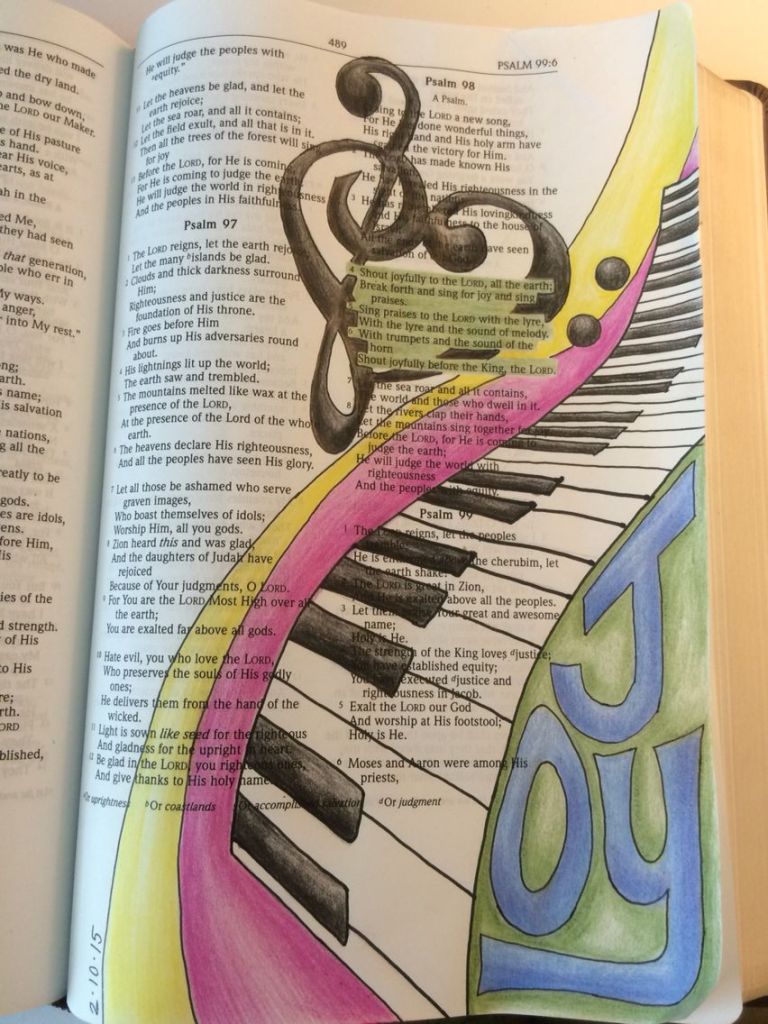
  • Sketch, paint, or sculpt. Make a visual depiction of your joy or experience. It doesn’t matter if it looks like a second grade art project. It’s the process of creating that matters.
  • Participate in a new activity, like taking an online class or developing a different routine.
  • Don’t just do what somebody else did. Reflect on what is important to you. Then, make something to remind you of its value.

You are already a creative artist. You just might not know it, yet. Since you carry within yourself the DNA of a creative God, the Lord’s image and likeness within wants a creative outlet. Open yourself to the possibility of smelling colors, talking to trees, and listening to what animals have to say to you. In doing so, you just might discover that the miraculous has been under your nose all along.

Mighty God, your holy arm of power has done incredible works in history. What’s more, you have done influential works in my life, especially through deliverance from evil and transformation of heart.  For this, and for all your miraculously good work, I praise the gracious and wonderful name of Jesus Christ, my Savior and Lord. Amen.