2 Samuel 6:1-11 – Unacceptable Worship

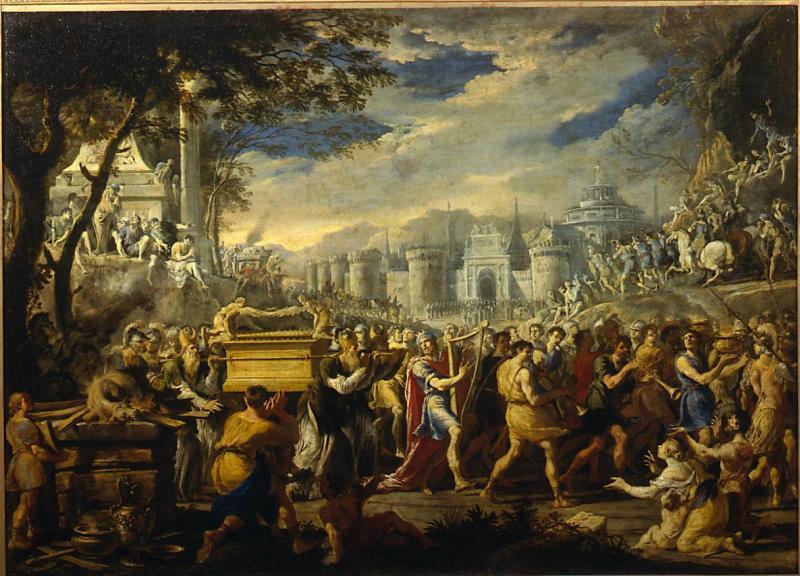
Transferring the ark of the Lord to Jerusalem by Domenico Gorgiolo (1609-1675)

David again brought together all the able young men of Israel—thirty thousand. He and all his men went to Baalah in Judah to bring up from there the ark of God, which is called by the Name, the name of the Lord Almighty, who is enthroned between the cherubim on the ark. They set the ark of God on a new cart and brought it from the house of Abinadab, which was on the hill. Uzzah and Ahio, sons of Abinadab, were guiding the new cart with the ark of God on it, and Ahio was walking in front of it. David and all Israel were celebrating with all their might before the Lord, with castanets, harps, lyres, timbrels, sistrums and cymbals.

When they came to the threshing floor of Nakon, Uzzah reached out and took hold of the ark of God, because the oxen stumbled. The Lord’s anger burned against Uzzah because of his irreverent act; therefore, God struck him down, and he died there beside the ark of God.

Then David was angry because the Lord’s wrath had broken out against Uzzah, and to this day that place is called Perez Uzzah.

David was afraid of the Lord that day and said, “How can the ark of the Lord ever come to me?” He was not willing to take the ark of the Lord to be with him in the City of David. Instead, he took it to the house of Obed-Edom the Gittite. The ark of the Lord remained in the house of Obed-Edom the Gittite for three months, and the Lord blessed him and his entire household. (NIV)

The narrator who originally compiled, told, and wrote this story wanted to communicate something significant about God and how to relate to the Lord.  God put the big kibosh on David’s hoedown. At that time in the history of Israel, the ark was the foremost symbol God was present with the people. Within the ark contained the tablets of the Ten Commandments (the symbol of God’s Word); the staff of the first priest, Aaron, (the symbol of God’s choice); and, a pot of manna (the symbol of God’s provision). 

The ark was a holy object, pointing to a holy God.

The ark of the Lord was built during the time of Moses, when the ritual laws were established concerning offerings and how to approach God in worship. There were detailed prescriptions for how to construct all the sacred articles for worship. (Exodus 35:30-40:33) 

The ark was at the center of worship, representing the presence of God among the people. For nearly five-hundred years before David, the ark had become a familiar object in the life of Israel, always there, continually being the symbol of God to the people.

We have all likely had the experience of something becoming so familiar to us that we begin to lose sight of how important and valuable it really is. Not until we lose it, or something traumatic happens, do we wake up and take stock of its true significance. 

The Israelites had become lethargic and apathetic toward the worship of God, and it led to some disheartening and tragic circumstances. The people of God throughout the ages have always needed to be vigilant against the opiate of familiarity, dulling the senses to the importance of worship.

Moving the ark of the Lord to Jerusalem was one of the first acts David did as the king of Israel and Judah.  God was with David and brought him success against his enemies. David enjoyed a close relationship with God.  Yet even though David’s heart was in the right place, he made a huge miscalculation which ended up offending God. 

David had the best of intentions in bringing the ark to Jerusalem and giving it a prominent place in the center of Jewish life. This was an exceptionally good plan. The problem, however, came in the manner the ark was carried from one place to another. 
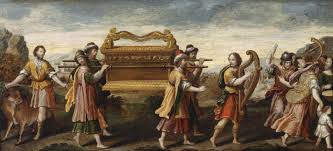
King David bringing the ark to Jerusalem by Unknown Italian artist, c.1500

God’s law laid out in careful detail how the ark was to be transported. Uzzah and Ahio were Levites charged with the ark’s care. Only the Levites could handle the ark and the holy objects of worship that went along with it. Since it was the job of the Levites for hundreds of years, they knew better than to carry the ark of the Lord on a cart. God clearly told Moses that the ark was to have two long poles of acacia wood overlaid with gold inserted into four gold rings of the ark.

The ark was to always be carried on the shoulders of the Levites with the two poles.

We are not told why Uzzah and Ahio were pulling the ark on a cart with oxen instead of carrying it in the prescribed way. Perhaps it was because the ark was incredibly heavy and no easy task to carry.  Maybe they decided it would be easier and more expedient to have the much stronger oxen pull the ark on a nice new cart; it would save a lot of energy transporting it over a long distance. 

As pragmatic people, Uzzah and Ahio’s approach makes a lot of sense. However, God was not okay with this arrangement.  When the oxen stumbled and the ark was in danger of falling off the cart, Uzzah reflexively reached out to steady it.  That was the last act Uzzah ever did on this earth. God immediately put him down for his “irreverent act.”

So, here is the not so good idea: Evaluating the worship of God by common sense pragmatism, what we think will work best, and how we feel it ought to be done.  Everything about worship is to pay attention to the holiness of God through our obedience.  Whenever we avoid the prescriptions of Holy Scripture, however best the intentions might be, is not a good thing and people will get hurt.  One can never justify an action that goes against God’s Word because people are praising God. 

Just because the heart is in the right place does not mean what is being done is okay.

David’s first response was anger, then fear.  He gave his best effort, and it resulted in God’s disfavor. Perhaps David realized that maybe he took for granted that the ark could be moved any old way he wanted to move it. 

Trouble with God happens whenever we value efficiency and expediency over obedience and submission.

The great error of Uzzah which resulted in his death was trying to manage God. We do not take care of God; God takes care of us. God does not bow to us and allow himself to be managed by creatures. The Lord wants pure unadulterated obedient worship from people in the way God wants it to be done, period. It is not up for negotiation.

So, David took some time to re-evaluate the whole approach to worship he was doing and left the ark with a Philistine. Then, he went back and did it right….

Holy God, we confess that we have too often forgotten we are yours. Sometimes we carry on our lives as if there was no God and we fall short of being a credible witness to you. For these things we ask your forgiveness and for your strength. Give us clear minds and open hearts so we may bear witness to you in our world. Remind us to be who you would have us to be regardless of what we are doing or who we are with. Hold us close and build our relationship with you and with those you have given us on earth, through Jesus Christ our Lord. Amen.

Acts 2:36-42 – From Sorrow to Salvation

Baptism by American artist Ivey Hayes (1948-2012)

“Therefore, let all Israel be assured of this: God has made this Jesus, whom you crucified, both Lord and Messiah.”

When the people heard this, they were cut to the heart and said to Peter and the other apostles, “Brothers, what shall we do?”

Peter replied, “Repent and be baptized, every one of you, in the name of Jesus Christ for the forgiveness of your sins. And you will receive the gift of the Holy Spirit. The promise is for you and your children and for all who are far off—for all whom the Lord our God will call.”

With many other words he warned them; and he pleaded with them, “Save yourselves from this corrupt generation.” Those who accepted his message were baptized, and about three thousand were added to their number that day.

They devoted themselves to the apostles’ teaching and to fellowship, to the breaking of bread and to prayer. (NIV)

Imagine we are all standing around in a huge modern-day lobby, ready to listen to Peter. We understand big events like this must be well-organized, so everyone is getting a name tag.  But the name tags are given to us with not only our first names; they also include our hidden guilt and shame.  People walk up to the registration table. “Name?” “Bob.”  “What are you ashamed of, Bob?”  “I stole some money from my boss once, and he never found out.” The person takes a marker and writes, Bill: Embezzler. 

Next person: “Name?” “Jill.” “Jill, what are you guilty of?” “I deliberately slandered a group of people. I said things that were not true about them because I did not like them.” So, the person writes on Jill’s nametag, Jill: Slanderer. “Name?” “George.” “What kind of guilt and shame are you carrying?” “I’ve been coveting my neighbor’s Corvette… and his wife.” George: Coveter. Person after person comes. 

Then, up to the table comes Jesus. “What is your shame, Jesus?” Well, in truth, none. So, Jesus starts walking down the line. He comes to Bob and says, “Bob, give me your name tag,” and puts it on himself. “Jill, give me your name tag.” He puts it on himself. “George, give me your name tag.” It goes on himself.

Soon Jesus is covered with name tags and a bunch of icky shame and awful guilt. Apart from Jesus, we cannot take the name tags off because we cannot shed the labels of who we really are. Christ bore the cross covered with all our guilt and shame attached to him. It was all crucified with him.

When the people of the Apostle Peter’s day understood who Jesus was and what he had done for them, they were deeply troubled in their spirits and their souls were horribly upset. They were cut to the heart with the things they had done which sent Christ to the cross. The crowd’s remorse was so deep and profound that they were beside themselves with spiritual pain and asked Peter,

“What shall we do!?”

Peter called them to “repent and be baptized.” To repent is to have a complete change of mind and heart; it is to express a courageous naming of shame, guilt, and sin. Repentance, then, leads to a 180 degree turn of direction to our lives. Repentance is realizing what we have become, and seeing it is not a good place to be.

Sometimes we lack awareness of how serious our situation really is and how at risk we really are. It may be hard to imagine our offense is bad enough to crucify Jesus. Perhaps we have self-justified our morsels of gossip or our lack of attention to the poor, only choosing to see our hard work and sincere efforts to do good.

For others, the problem with repentance runs deeper, having been raised in a legalistic environment. These folks lug around a guilt-laden backpack that would bend the knees of a mule. And most of the guilt, they realize, is neurotic—not based on any real transgression.  Every bad thought and each failure of faith is obsessed over to the point that they cannot shake the pangs of constant shame.

The good news is that the kingdom of God is near. In the name of Jesus Christ there is forgiveness, healing, and new life. If today there is a realization of being in a bad place in your life, whatever that place is, the cross of Christ addresses the deepest needs of your life. What shall we do?  Repent and be baptized.

Repentance, baptism, forgiveness of sins, and receiving the Spirit are all linked together in today’s New Testament lesson. Baptism is the sign and seal of God’s promise of forgiveness in Jesus; it visually shows us that God washes away our guilt and shame in the name of Jesus.

Baptism is a different kind of nametag, identifying that we belong to God. One who repents and embraces new life in Jesus Christ de-thrones all other competing lords and identifies as a beloved child of God.

The result of that ancient mass repentance and baptism was that three-thousand people were added to a small church of one-hundred-twenty persons! Since repentance leads to action, the new believers went to work devoting themselves to the apostles’ teaching and orienting their lives completely around Jesus through their constant fellowship together.

Allow me to be a bit more specific about what repentance looks like and does not look like. The prayers of the mildly repentant sound something like this:

“Easy-going God: We have occasionally had some minor errors of judgment, but they’re not really our fault. Due to forces beyond our control, we have sometimes failed to act in accordance with our own best interests. Under the circumstances, we did the best we could. We are glad to say that we’re doing okay, perhaps even slightly above average. Be your own sweet Self with those who know they are not perfect. Grant us that we may continue to live a harmless and happy life and keep our self-respect. And we ask all these things according to the unlimited tolerances which we have a right to expect from you. Amen.”

I like eggs.  I eat them nearly every day.  Fresh eggs are the best.  Sometimes I make an omelet, with, of course, bacon, green pepper, and cheese.  When I am making my omelet, if I crack open a rotten egg, I do not go ahead and mix it in with the others in the hope that the other good eggs will overwhelm the rotten one.

Grace can only be grace when we have a true realization of our guilt and shame. Grace is radical. It throws out the rotten omelet altogether and makes a new one so incredibly delicious that we never want to go back to the old way of making them. And it is for everyone who calls on the name of the Lord.

Godly sorrow, like the kind in today’s story, leads to repentance. In the Apostle Paul’s first letter to the Corinthian church, he called them out and insisted they turn from their old way of life.  In his second letter, he followed up with this: 

I know I distressed you greatly with my letter. Although I felt awful at the time, I don’t feel at all bad now that I see how it turned out. The letter upset you, but only for a while. Now I’m glad—not that you were upset, but that you were jarred into turning things around. You let the distress bring you to God, not drive you from him. The result was all gain, no loss.

Distress that drives us to God does that. It turns us around. It gets us back in the way of salvation. We never regret that kind of pain. But those who let distress drive them away from God are full of regrets, end up on a deathbed of regrets.

And now, isn’t it wonderful all the ways in which this distress has goaded you closer to God? You’re more alive, more concerned, more sensitive, more reverent, more human, more passionate, more responsible. Looked at from any angle, you’ve come out of this with purity of heart. And that is what I was hoping for in the first place when I wrote the letter. (2 Corinthians 7:8-11, MSG)

There are (many) times we need to feel awful before we feel wonderful – awful concerning how much we have hidden our shame and never let it see the purifying light of the gospel – but wonderful of how over-the-top good grace really is, once we have exposed the guilt and let Jesus replace it with God’s mercy.

O merciful God, we bring long-held grudges and recent grievances, and we chew them over, even at the foot of your cross. We tiptoe around chasms of misunderstanding, we pick our way anxiously among stumbling-blocks of language and culture, and blame each other for every misstep, even while singing of your Spirit. We tremble to name the troubles we see in the Church and the world, for fear of our own sins finding us out, for fear that we will become easy targets for everyone’s hostility. Have pity on us, for our hands are not strong enough and our hearts are not big enough to hold all together in love. We beg you to come to us, foolish as we are, downcast and despairing. We beg you to send us a breath of your Spirit with the perfume of resurrection and hope, through Jesus Christ, the Light of the world. Amen.

Matthew 14:1-12 – Speaking Truth to Power

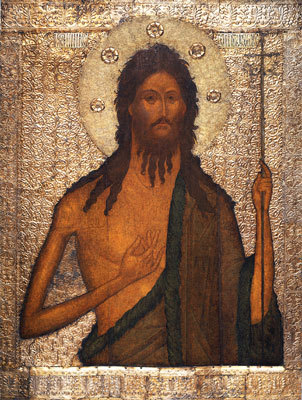
16th century Russian Orthodox icon of John the Baptist

At that time Herod the tetrarch heard the reports about Jesus, and he said to his attendants, “This is John the Baptist; he has risen from the dead! That is why miraculous powers are at work in him.”

Now Herod had arrested John and bound him and put him in prison because of Herodias, his brother Philip’s wife, for John had been saying to him: “It is not lawful for you to have her.” Herod wanted to kill John, but he was afraid of the people, because they considered John a prophet.

On Herod’s birthday the daughter of Herodias danced for the guests and pleased Herod so much that he promised with an oath to give her whatever she asked. Prompted by her mother, she said, “Give me here on a platter the head of John the Baptist.” The king was distressed, but because of his oaths and his dinner guests, he ordered that her request be granted and had John beheaded in the prison. His head was brought in on a platter and given to the girl, who carried it to her mother. John’s disciples came and took his body and buried it. Then they went and told Jesus. (NIV)

John’s murder is a story about our world – a world of power, sex, and intrigue. Times may change, but people across the ages do not change. Humanity is fundamentally the same in every century. And the world is still the world, no matter the historical time. 

The contrast between Herod and John supply us with two types of people who exist throughout every age of humankind, offering us the choice of which way we will go with our lives. The story illustrates for us the reality of living in a fallen world as a devout person.

The Herod in today’s Gospel lesson was a son of Herod the Great, the one who killed all the male babies when Jesus was born in order to try and get rid of any rival king (Matthew 2:1-18). King Herod is displayed in the narrative as a tragic and pathetic figure who is ruled by his own lusts. He seems too proud and wimpy to admit he made a rash promise and killed a man just to save face with his guests at a party.

Talk about a Jerry Springer worthy family drama, here it is: The Herod family was rich, proud, and downright violent. They tended to marry within their own clan to hold their power and possessions for themselves. Herodias married her uncle Herod Philip; Salome was their daughter. Later, Salome married Philip the tetrarch, half-brother to Herod Philip. Through marriage, Salome became both aunt and sister-in-law to her mother. Then the Herod in our story married Herodias, who had been married to Herod’s half-brother, Herod Philip. Having fallen in love with Herod Antipas, Herodias divorced Herod Philip to marry Herod Antipas. Sheesh, nothing like complicated family drama.

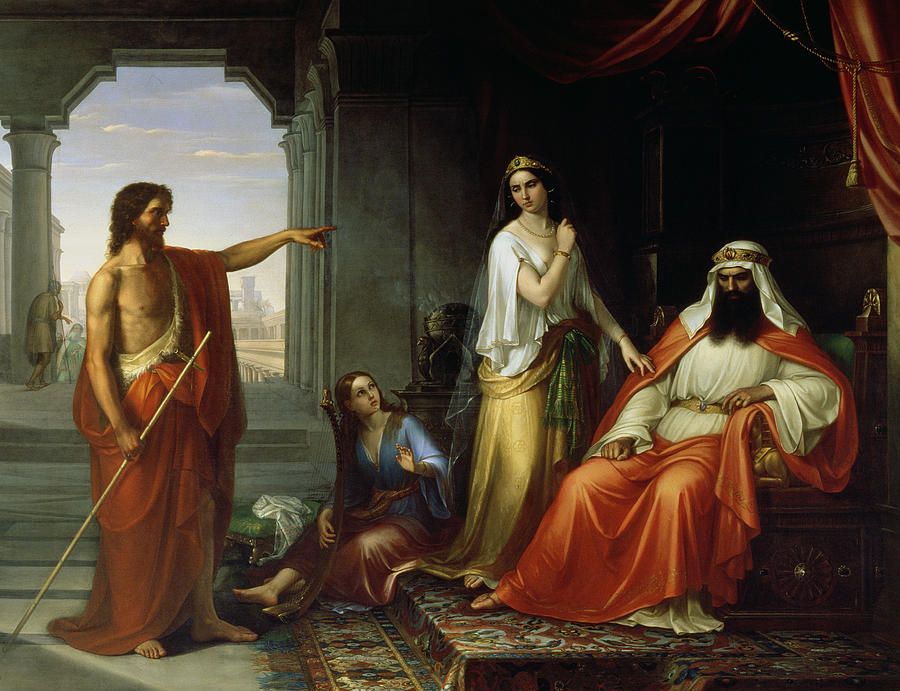
St. John the Baptist Rebuking Herod by Italian artist Giovanni Fattori (1825-1908)

Into this violation of Old Testament marriage laws (the Herod’s were Jewish) came John who made no bones about the fact this was not right (Leviticus 18:16, 20:21). Herodias nursed a grudge against John for speaking out against her and Herod’s choices. Hell, hath no fury like a woman’s scorn, and when Herodias found an opportunity to get rid of John, she coached her daughter into asking for John the Baptist’s head on a platter. Herod, too insecure to take back his ridiculous promise and look like a fool, consented to the execution of John.

In contrast to all this tragic theater is John the Baptist. John was a messenger of God and a preacher of repentance. As one who was preparing the way for Jesus, his message was simple and to the point: Repent, for the kingdom of God is near. John got into trouble and lost his life because he spoke truth to power by meddling in the life of King Herod and his family. The Herod’s were the political establishment of the day, and John did not temper his words when dealing with them.

There is a refreshing integrity about John. He was always the same no matter where he was, and no matter who the people were around him. In contrast to Herod, John was bold, courageous, confident, unafraid, and secure enough in his relationship with God to engage in ministry without thought to the consequences.  He was unconcerned for what others might think of him if he proclaimed truth in the public square, and it did end up costing him his life.

The story of John the Baptist’s death speaks about the hostility of this world. And it prefigured and foreshadowed the death of Jesus. Like John, Jesus was executed by the civil authorities. Herod, like Pilate after him, hesitated to execute and was swayed by the crowd. Herodias, like the chief priests toward Jesus, finally got her way through scheming and manipulation. John’s disciples came and took his body and buried it, just like Joseph of Arimathea and Nicodemus did for Jesus.

These stories, on the surface of things, appear to be only gloom and doom. Yet, there is a message of hope and joy. The absurd is working out itself in deliverance from sin, death, and hell. Through death, Jesus conquered death. We now have no fear of death; its sting has been taken away. Without fear of death, we have no reason to fear life with its troubles and tribulations.

The fork in the road is between the way of John or Herod. It is a values-based decision. If worth is derived from what we do, what we have, and/or other’s opinion of us, we will likely identify more with Herod and his choices. If there is a preoccupation with hoarding power and control, this is the path of Herod. 

Conversely, if the ultimate value is in knowing Christ crucified and the power of his resurrection, then we identify with John as our spiritual ancestor. If security and worth is derived from being in Christ, then there is boldness to speak truth to power and give grace to the powerless.

Herod saw no further than his immediate needs and safety; he failed to discern his own heart. Because of his spiritual blindness, Herod did not look away from himself and look to God. Faith in Jesus comes when persons look away from themselves and look to Christ who holds the power to free all from spiritual bondage.

Let us look to the example of John the Baptist who consistently sought to do the will of God as best as he understood it. Together with all God’s people past and present, we declare that God is with us, the kingdom of God is near, and the love of Christ brings faith and hope.

Almighty God, through your providence John the Baptist was wonderfully born and was sent to prepare the way of your Son, our Savior by the preaching of repentance. Lead us to repent according to his preaching and, after his example, constantly to speak the truth, boldly to rebuke vice, and patiently to suffer for truth’s sake; through Jesus Christ your Son, our Lord, who is alive and reigns with you, in the unity of the Holy Spirit, one God, now and forever. Amen.

Exodus 15:22-27 – On Grumbling

Then Moses led Israel from the Red Sea and they went into the Desert of Shur. For three days they traveled in the desert without finding water. When they came to Marah, they could not drink its water because it was bitter. (That is why the place is called Marah.) So, the people grumbled against Moses, saying, “What are we to drink?”

Then Moses cried out to the Lord, and the Lord showed him a piece of wood. He threw it into the water, and the water became fit to drink.

There the Lord issued a ruling and instruction for them and put them to the test. He said, “If you listen carefully to the Lord your God and do what is right in his eyes, if you pay attention to his commands and keep all his decrees, I will not bring on you any of the diseases I brought on the Egyptians, for I am the Lord, who heals you.”

Then they came to Elim, where there were twelve springs and seventy palm trees, and they camped there near the water. (NIV)

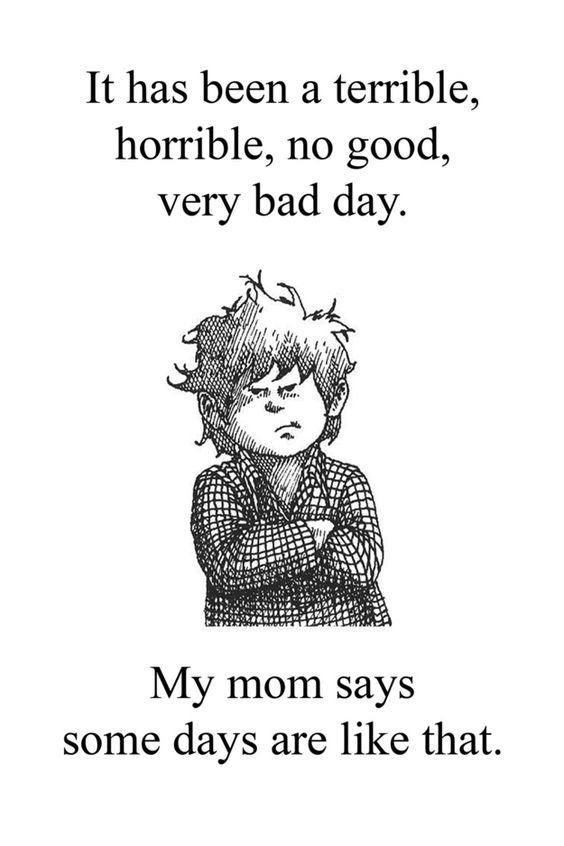
I like children’s books. I suppose its because I’m still a kid at heart. It’s fun to read to my grandchildren. One of the books I read to them is “Alexander and the Terrible, Horrible, No Good, Very Bad Day.” The book begins with Alexander recounting when he awoke one morning:

“I went to sleep with gum in my mouth and now there’s gum in my hair and when I got out of bed this morning, I tripped on the skateboard and by mistake I dropped my sweater in the sink while the water was running and I could tell it was going to be a terrible, horrible, no good, very bad day…. I think I’ll move to Australia.”

For the remainder of the story, Alexander’s day was a mishap of messes. Nothing seemed to go his way, and no one appeared to notice or even to care.

One of the reasons the book has been read so many times by so many children (and obviously adults, like me) is because we can all relate to the feelings of having a day where nothing seems to go right. In the middle of it we just feel like being somewhere else, like Australia.

In such times, when life is topsy-turvy and upside-down, it is so amazingly easy to grumble and complain. The ancient Israelites were having an Alexander-like day. Unlike having gum in your hair, not having water to drink is a big deal, a vital problem. So, we might understand why there was so much grumbling going on among the people. I am sure they were anxious, nervous, and scared.

Yet, complaining, unlike our emotions, is a volitional response. We choose to grumble. The problem with gripes and complaints is that it sets a person down a dark path. Oh, the criticisms and grievances begin easily and are seemingly harmless, at first. They are, however, anything but innocuous.

A mere grumble under the breath did not stop with finally getting water to drink. If we look ahead in the story of God’s people in the exodus event, the moaning and complaining quickly returned the minute something did not go their way. Then, the people became so disillusioned with their circumstances that they began longing for the “good old days” back in Egypt when they had plenty to eat and drink, forgetting about their cruel bondage in slavery. (Exodus 16:1-3)

The psychological progression continued with beginning to blame their situation on God, as if he were some mean malevolent deity. From that point, it was inevitable that the people would disobey God and eventually succumb to the idolatry of the golden calf. (Exodus 32:1-8)

Despite the grand celebration of leaving Egypt and experiencing a miraculous deliverance through the Red Sea, the people quickly forgot because of their present circumstance of lacking water. It is only logical and makes sense that the mighty God who saved them with incredible acts of power would care for the people in a desert. Yet, for many, there was no faith to be found in a new situation they had not faced before.

Failure of faith begins neither with ignorance nor an egregious sin. It begins with grumbling and complaining. And if allowed to run amok, complaints will bear the fruit of discouragement, disobedience, and eventually a disavowal of God.

The author of the New Testament letter to the Hebrews reflected on the grumbling of their forebears and had this to say in response:

See to it, brothers and sisters, that none of you has a sinful, unbelieving heart that turns away from the living God. But encourage one another daily, as long as it is called “Today,” so that none of you may be hardened by sin’s deceitfulness. We have come to share in Christ, if indeed we hold our original conviction firmly to the very end. As has just been said:

“Today, if you hear his voice,
    do not harden your hearts
    as you did in the rebellion.” (Hebrews 3:12-15, NIV)

Encouragement is the insecticide which eliminates the worm of complaints. If left alone, we stew in our own bitterness over missed expectations. Grumbling bores its way into our soul and eats away at our faith. We need the continual encouragement of one another to remember our collective deliverance and express gratitude for our salvation.

May it be so to the glory of God.

We give you thanks, Lord God, because you give food and drink to all, heal all, create wonders in this world, forge wisdom within us, and give refuge beneath the shadow of your wings. From your wisdom grant us wisdom, from your love grant us love, from your understanding grant us understanding. Feed us when we are hungry, give us strength when we are weak, raise us up when we are bent over, set us free when we are enslaved. Just as our spiritual ancestors were blessed – may you grant us the blessing of peace, strength, and gratitude. Amen.