Isaiah 5:1-7 – A Parable of the Vineyard

I will sing for the one I love
    a song about his vineyard:
My loved one had a vineyard
    on a fertile hillside.
He dug it up and cleared it of stones
    and planted it with the choicest vines.
He built a watchtower in it
    and cut out a winepress as well.
Then he looked for a crop of good grapes,
    but it yielded only bad fruit.

“Now you dwellers in Jerusalem and people of Judah,
    judge between me and my vineyard.
What more could have been done for my vineyard
    than I have done for it?
When I looked for good grapes,
    why did it yield only bad?

Now I will tell you
    what I am going to do to my vineyard:
I will take away its hedge,
    and it will be destroyed;
I will break down its wall,
    and it will be trampled.

 I will make it a wasteland,
    neither pruned nor cultivated,
    and briers and thorns will grow there.
I will command the clouds
    not to rain on it.”

The vineyard of the Lord Almighty
    is the nation of Israel,
and the people of Judah
    are the vines he delighted in.
And he looked for justice, but saw bloodshed;
    for righteousness, but heard cries of distress. (New International Version)

God is the owner of the vineyard. Israel and Judah are the beloved. The Lord graciously chose them, gave them divine promises, and set his steadfast love upon them. God sang over them with affection and took care of them.

The Lord God put time, effort, and love into the relationship. God anticipated good things, looked forward to a bright future, and expected a flowering of justice and righteousness from the people.

It didn’t happen. The relationship went sour. Nothing but rotten grapes.

God builds. God gives. God sustains…. And God destructs. God takes away. God ends what he begins.

The Lord didn’t put all that work into the people to have them perpetuate injustice toward the poor and disadvantaged. God didn’t choose Israel so that they would then neglect God’s law by mistreating others and ignoring the right.

The bloodshed of the people was that they squeezed and bled the poor to death. The cries and anguished responses of the needy were ignored. There was no mercy. So, God was not about to idly stand by and let such rotten grapes abuse and ruin the good, the just, and the right.

The relationship between and God and God’s people was an ancient love song that went off key and struck a minor chord. The Lord has extreme love and patience… until he doesn’t. There’s no way the just and right God is going to put up with abusive, ignorant, and bad folks forever.

Jesus had this allegorical image of Isaiah in mind when he spoke in parables about the impossibility of good fruit coming from bad vines and trees, and the necessity of removing dead branches. (Luke 6:43-45; John 15:1-17)

If the grapes are bad, the vine is bad. If the words are hateful, sarcastic, passive-aggressive, manipulative, conniving, racist, hurtful, mean, foolish, and either subtly or overtly abusive, then the person has a dark heart and is need of redemption, not excuses.

Every tree that does not bear good fruit will be cut down and thrown into the fire. The wicked heart will not be able to speak ill of others and act hatefully with impunity forever. They will be called to account for their abusive words and actions, whether overtly violent, or subtly undermining.

The righteous heart, however, shall experience divine pleasure and reward, as if the careful construction of helpful and building up words with loving deeds wins first-prize at the great heavenly fair.

The good person loves and does not hate. They are so far from harming anyone that they even pray and wish well for their enemies. They pray for blessings on those who curse them. There is an honest striving to speak good words to everyone, regardless of who they are.

The upright heart thinks the best of everyone and holds nothing over someone else’s head. Such a good heart condemns no one, leaving all judgment to God alone. It is patient with the most exasperating of people, praying they might come to their senses and become spiritually healthy.

The righteous are able to use their speech to admonish their neighbor with care and affection. They freely forgive, happily give, liberally encourage, and use their tongue to speak words of life. Indeed, their speech is wise, humble, full of grace, and above all, loving.

The just and right person uses their hands and feet to build good things for others, especially the most vulnerable and needy among us. They willingly meet needs without bitterness or with a begrudging heart.

If there is a problem with words, it will not do to simply change the speech. That’s because it is a heart issue. And the heart must be willing to change and be transformed by sheer mercy.

If there is an issue with actions, it will not do to merely enforce a change in behavior. That’s because it’s a heart problem. And the heart desperately needs to acknowledge sin and repent from evil.

Fortunately, God is the expert on renovating dilapidated hearts and performing effective heart transplants.

Oftentimes something needs to be destroyed for a building to be erected. There always needs to be a death before there can be a resurrection. New life cannot occur without forsaking an old life.

Believers in Jesus are mindful that our life of faith, hope, and love comes from a death. So, we journey with Jesus along the road of suffering, up Calvary, and are crucified with him so that we might rise with him.

This is the way.

It is the way of repentance, of genuine change, of new habits, of Christianity. So now, let’s go to him outside the camp, bearing his shame. We don’t have a permanent city here, but rather we are looking for the city that is still to come. (Hebrews 13:13-14)

May justice, righteousness, and peace be yours in abundance through him who gave himself for us and for our salvation.

Merciful Father, we pray that violence will be overcome by the power of love; that opposition and division give way to reconciliation; and that the desire for power and control be transformed into the desire for forgiveness, justice, and peace.

May peace be in our hearts so that they are open to the action of your divine grace.

May all humanity – especially the poor, the needy, the least among us, and the lost – feel the warmth of your steadfast love and the love of your people toward them.

May the fruit of love, joy, peace, patience, kindness, goodness, faithfulness, gentleness, and self-control be our breakfast, lunch, and dinner; and may your divine abundance of mercy and justice be scattered throughout our city, our nation, and our world, through Jesus Christ our Lord, in the strength of your Holy Spirit.

Amen.

Mark 10:17-22 – Jesus Intervenes

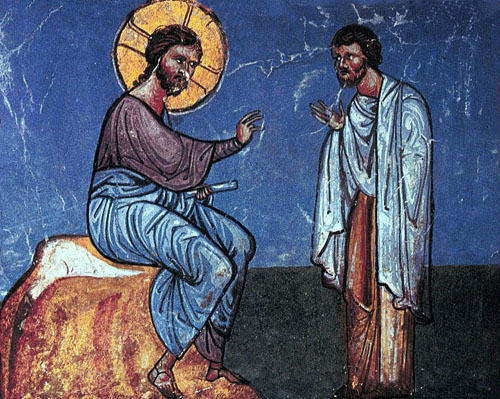
Eastern Orthodox mural of Jesus and the rich man

As Jesus started on his way, a man ran up to him and fell on his knees before him. “Good teacher,” he asked, “what must I do to inherit eternal life?”

“Why do you call me good?” Jesus answered. “No one is good—except God alone. You know the commandments: ‘You shall not murder, you shall not commit adultery, you shall not steal, you shall not give false testimony, you shall not defraud, honor your father and mother.’”

“Teacher,” he declared, “all these I have kept since I was a boy.”

Jesus looked at him and loved him. “One thing you lack,” he said. “Go, sell everything you have and give to the poor, and you will have treasure in heaven. Then come, follow me.”

At this the man’s face fell. He went away sad because he had great wealth. (New International Version)

We are all addicts. 

We all have our own sin addictions which keep us stuck in guilt and shame.

We may not all struggle with the same sin. Yet we all have some besetting sin(s) that we must be weaned off of. The most pervasive addiction found in Holy Scripture is neither substance abuse nor alcohol – it is the addiction to wealth and money.

Maybe your initial response was of someone else, besides yourself: “I don’t have as much money as____” or, “So-and-so has a real problem with that!” Those statements are what we call, in terms of addiction, denial. 

In truth, all of us are in some sort of denial about how much we really trust in paychecks, bank accounts, investments, and owning material stuff. I’m no exception. I own more books than I’ll be able to read in a lifetime, and yet, I tend to believe I don’t have enough of them.

Even the poor can have an addiction wealth and money by thinking about it and wishing for it to an unhealthy degree, as if wealth is the thing that will ultimately make them happy.

People in denial rarely have any idea how much they are hurting others, themselves, and God.  In fact, the consistent witness of the early church fathers is that the sheer accumulation of stuff is the same as stealing from the poor. 

Because of denial, people need an intervention. They need to be jolted back to their senses. Intervention is a gift. Someone cares enough about the person to intervene. Yet, interventions don’t always work. The person can choose to walk away and refuse to change.

Jesus did a gracious intervention with a rich young man. The man was addicted to wealth and money, but he didn’t see it. In fact, he thought he was quite godly and spiritual. It’s a sad story because the man walks away untransformed by his encounter with Jesus and did not accept the gracious invitation to follow the Lord. 

Chinese depiction of Jesus and the rich man, 1879

The man simply did not see himself as hopeless and desperately needing to change. He held to his denial.

The man approached Jesus with a question: “What must I do to inherit eternal life?” Whereas I would probably get all excited about being asked a question like this and launch into some long-winded gospel answer, Jesus immediately picked up on the attitude and the need behind the question. 

What must I do to get? It’s almost as if the man wants to acquire eternal life like he would acquire wealth. “I am a successful businessman with plenty of money, and a respected citizen with lots of wealth – now I want to be a success with God, as well.” 

The question may have been sincere, yet it was misguided. Eternal life is not spiritual real estate for an upwardly mobile person to acquire and possess. The man seems to believe he can purchase eternal life, as if everyone has their price, even God. “After all,” he may have been reasoning, “I have gotten everything else in life, so why not obtain eternal life?”

Jesus questioned the question. He went after the underlying assumption of doing something good to obtain eternal life. The fact of the matter is that the man cannot do anything. He can’t because only God is good. Jesus points him to God by changing the action from getting to entering. And he changed the language from a market acquisition to entering into a journey.

Jesus was inviting the man to walk with him.

Eternal life is a journey of faith in the God who is good, and not a transaction to get it. And, we too, must be careful not to treat eternal life as if it were a transaction, as if we must get a person to sign on the dotted line through a “sinner’s prayer” or some other formula that will seal the deal for eternal life. 

Instead, eternal life is a walk of obedience with God and his commands.

Jesus responded to the rich man with the Ten Commandments, specifically the ones which focus on human relationships. Jesus wanted him to realize that the path into the kingdom of God and eternal life goes through and not around how we treat our fellow human beings.

Christ and the Rich Young Ruler by Heinrich Hofmann, 1889

The Lord sought to expose the impossibility of continuing in life on the rich man’s terms. The guy just could not imagine what he might be lacking. So, Jesus helped him out. Christ gave him some major interventional language…. Sell. Give. Follow.

Sell everything. Give to the poor. Come, follow me.

One cannot simply add Jesus to their life, like adding a new car or a new fishing rod. Rather, one’s heart must change in order to accommodate real, genuine eternal life. 

Jesus offered the rich man someone to be, rather than something to get

It’s one thing to give from what you have; it’s another thing to surrender your life and all you have. 

In the New Testament Gospels, there are no easy conversations with Jesus. He gets personal in every encounter and gets under everybody’s skin. Christ doesn’t settle with superficial small talk when there are people whose hearts are little more than idol factories. 

Jesus never leaves us alone, because there is always the invitation to “Come, follow me.”

Christ exposed the wealthy man’s divided loyalties – he was trying to serve both God and money. But he would have to choose between the two. 

And that is our choice, as well. 

The question for us is not, “Am I completely devoted to money?” Instead, the question from our Gospel story today is, “Am I trying to serve God while maintaining a moonlighting job with the world?” 

God wants from us an undivided heart; the Lord desires absolute allegiance.

Jesus is looking for those who are poor in spirit, who recognize their great need for God – instead of believing that they are okay and just need to add a little Jesus to their lives. 

God is looking for spiritual beggars who understand their desperate situation and don’t practice denial by sugar-coating their actual spiritual state.

Like a drunkard who won’t give up his vodka; like a sex addict who won’t give up strip clubs or emotional affairs; or like a workaholic who just can’t come home; the rich man would not give up his disordered love for money and possessions. 

So, Jesus did an intervention. 

The Lord Jesus didn’t ask everybody to do exactly as he called the rich man to do. He didn’t ask the very wealthy Zacchaeus to do it, and he didn’t tell Peter to sell his fishing business. 

But Jesus does tell us to do something which seems impossible. Yet, where the impossible exists, so exists grace.

Blessed Lord, you have taught us that all our doings without loving generosity are worth nothing. Send your Holy Spirit and pour into our hearts your gift of love, the true bond of peace and of all virtues, without which whoever lives is counted dead before you. Grant this for the sake of your only Son Jesus Christ, who lives and reigns with you, in the unity of the Holy Spirit, one God, now and forever. Amen.

Amos 8:1-12 – A Prophet’s Perspective on Power and Poverty

Miners’ wives carrying sacks of coal by Vincent Van Gogh, 1881

This is what the Sovereign Lord showed me: a basket of ripe fruit. “What do you see, Amos?” he asked.

“A basket of ripe fruit,” I answered.

Then the Lord said to me, “The time is ripe for my people Israel; I will spare them no longer.

“In that day,” declares the Sovereign Lord, “the songs in the temple will turn to wailing. Many, many bodies—flung everywhere! Silence!”

Hear this, you who trample the needy
    and do away with the poor of the land,

saying,

“When will the New Moon be over
    that we may sell grain,
and the Sabbath be ended
    that we may market wheat?”—
skimping on the measure,
    boosting the price
    and cheating with dishonest scales,
buying the poor with silver
    and the needy for a pair of sandals,
    selling even the sweepings with the wheat.

The Lord has sworn by himself, the Pride of Jacob: “I will never forget anything they have done.

“Will not the land tremble for this,
    and all who live in it mourn?
The whole land will rise like the Nile;
    it will be stirred up and then sink
    like the river of Egypt.

“In that day,” declares the Sovereign Lord,

“I will make the sun go down at noon
    and darken the earth in broad daylight.
I will turn your religious festivals into mourning
    and all your singing into weeping.
I will make all of you wear sackcloth
    and shave your heads.
I will make that time like mourning for an only son
    and the end of it like a bitter day.

“The days are coming,” declares the Sovereign Lord,
    “when I will send a famine through the land—
not a famine of food or a thirst for water,
    but a famine of hearing the words of the Lord.
People will stagger from sea to sea
    and wander from north to east,
searching for the word of the Lord,
    but they will not find it. (New International Version)

I’ve been in the church most of my life. I have listened to thousands of sermons, as well as preaching thousands of them myself. I can count on both hands how many times I’ve heard a sermon from one of the twelve minor prophets in the Bible. Although I personally have preached on them more times than that, it still pales in comparison with how many sermons I’ve preached from the New Testament gospels or epistles.

This, I believe, is an indictment on us, especially those with privilege and power. If you add the major prophets, we have sixteen books contained in Holy Scripture calling out powerful and influential people’s oppression of others. To overlook such a girth of text is to stick our fingers in our ears and refuse to listen to God.

Those with power, position, and privilege must continually be vigilant to use such influence for the benefit of all persons – not just themselves or people just like them.

The books of the prophets make it very clear that God cares about justice. God will uphold the needy. The Lord will stand with the oppressed. If we fail to share a divine sense of justice and injustice, there will be hell to pay.

God is longsuffering. The Lord patiently awaits us to pay attention. Yet, eventually, that patience will run its course. A prophet will be sent to voice God’s concerns. Like a basket of ripe fruit now finally ready to be eaten, so God’s justice is ripe and ready for action.

The prophet Amos delivered a scathing message to the ancient Israelites about their total disregard for the poor and needy in the land. The people in positions of authority and power only looked on the less fortunate as commodities – as pawns to be taken advantage of for the rich merchants. 

Because the wealthy never took the time to listen to the poor, God would not listen to them. Judgment was coming, and it would not go so well for the power brokers of society who only thought of their business and squeezing others for more money.      

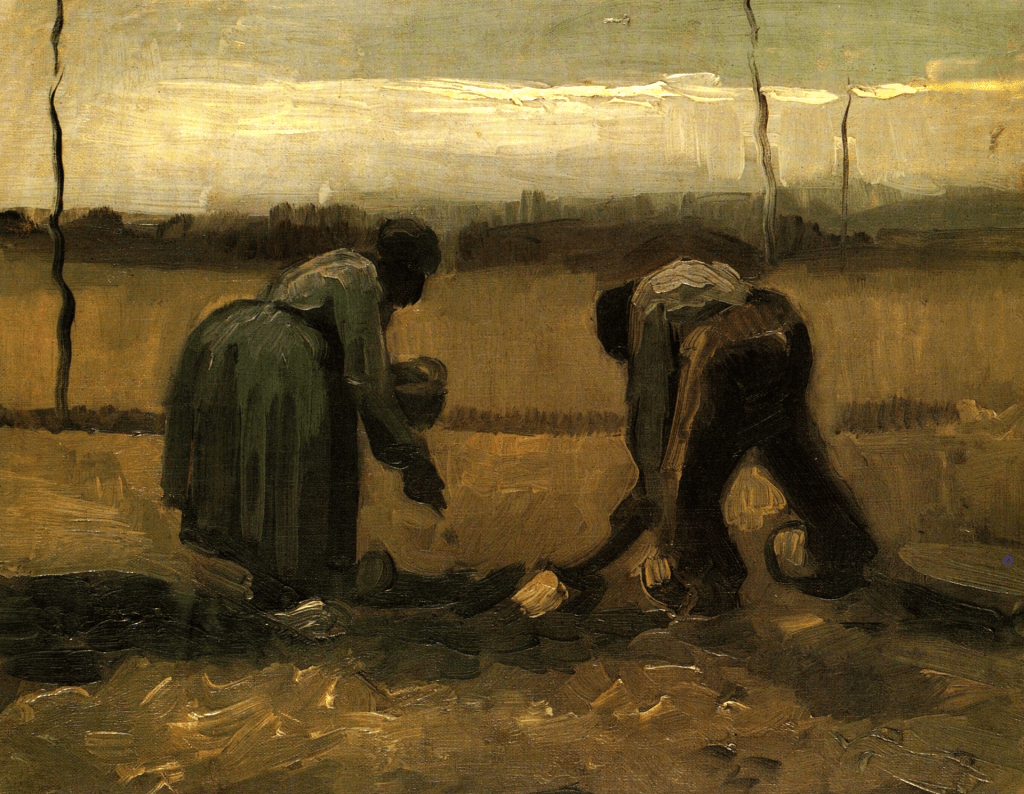
Peasants planting potatoes by Vincent Van Gogh, 1885

Few people rush to have poor folk as their friends. Those in poverty are often overlooked and disregarded. Either they are ignored altogether or are given hand-outs and services without ever having any significant human contact. Even when there is help, it comes from a distance.

In other words, those in authority rarely take the time to listen and get to know the real face of poverty. If there isn’t a photo opportunity, then encounters with the poor are not likely to happen with politicians, or anyone else. After all, so many are busy making money, checking stock portfolios, and considering how to get bigger market shares…. 

Perhaps we have an answer as to why there is no revival in the land. God shows such solidarity with the poor that to ignore them is to ignore him.  No matter our financial picture and outlook, every one of us can grace the poor with the gift of time and listening.  For in doing so we might just be listening to the voice of God.

Justice is the responsibility of everyone, not just a few.

God identifies closely with the poor, the distressed, the underprivileged, and the needy. The Lord listens to the lowly. So, we as God’s people, are to share this same concern. It is a theme throughout the entirety of Holy Scripture.

From the Old Testament:

God will rescue the needy person who cries for help
and the oppressed person who has no one’s help.
He will have pity on the poor and needy
and will save the lives of the needy. (Psalm 73:12-13, GW)

Those who mock the poor insult their Maker; those who rejoice at the misfortune of others will be punished. (Proverbs 17:5, NLT)

Those who are gracious to the poor lend to the Lord, and the Lord will fully repay them. (Proverbs 19:17, CEB)

If you close your ear to the cry of the poor, you will cry out and not be heard.

Proverbs 21:13, NRSV

Those who give to the poor will lack nothing, but those who turn a blind eye will be greatly cursed. (Proverbs 28:27, CEB)

Give your food to the hungry
    and care for the homeless.
Then your light will shine
    in the dark;
your darkest hour will be
    like the noonday sun. (Isaiah 58:10, CEV)

The Spirit of the Sovereign Lord is on me,
    because the Lord has anointed me
    to proclaim good news to the poor. (Isaiah 61:1, NIV)

From the New Testament:

“If you want to be complete, go, sell what you own, and give the money to the poor. Then you will have treasure in heaven.”

Jesus (Matthew 19:21, CEB)

Command those who are rich in this present world not to be arrogant nor to put their hope in wealth, which is so uncertain, but to put their hope in God, who richly provides us with everything for our enjoyment. Command them to do good, to be rich in good deeds, and to be generous and willing to share. (1 Timothy 6:17-18, NIV)

 If we are rich and see others in need, yet close our hearts against them, how can we claim that we love God? My children, our love should not be just words and talk; it must be true love, which shows itself in action. (1 John 3:17-18, GNT)

Poverty is not only an issue in some far away place; the poor are found everywhere, and they are always among us.

I believe an honest hearing of the prophet Amos would change the world. I’m not talking about angry ranting which works people into a frenzy of fear and suspicion. I am referring to giving Amos a serious hearing, just like we give the Apostle Paul our focused attention.

Just because poverty has always been with us, doesn’t mean we ought to only shrug our shoulders and say, “Meh, what’s a guy to do?” Instead, we can determine to address the issues which create a large class of poor people to begin with – including malevolence and materialism.

The moral compass of many of the earth’s nations is askew, even broken. It needs to be recalibrated to the true north of biblical justice. Back in the prophet’s day, bullying, bribery, and backstabbing were tools used for malevolent purposes. Those same implements are still being used by some today.

You must not pervert justice or show favor. Do not take a bribe, for bribes blind the eyes of the wise and distort the words of the righteous. (Deuteronomy 16:19, NET)

Those who plant injustice will harvest disaster,
    and their reign of terror will come to an end. (Proverbs 22:8, NLT)

But why would people be so unjust to other people? What would motivate someone to purposefully harm another in this way?… Materialism would.

Whenever people have an exorbitant amount of stuff, generosity is typically not their first impulse (Ecclesiastes 5:10). Rather, the extremely rich among us have an equally extreme temptation to hold on tight to their wealth – so much so that money and acquiring more stuff becomes their religion. That’s why Scripture is replete with warnings about money.

In short, poverty must be tackled, from a biblical perspective, on both the personal and systemic level. Individuals, families, churches, faith communities, organizations, corporations, and governments must all remove the obstacles which keep people in poverty. This is an appropriate use of power and authority.

What will you and I do?…

Gracious God, you are found everywhere – both the halls of power, and the back alleys of slums. As we seek you more and more, help us to see the face of Jesus in everyone we encounter, whether rich or poor, so that we might share the gift of life with them, through Jesus Christ our Lord, in the power of your Holy Spirit. Amen.

James 2:1-7 – Favoritism is Foolish

My dear friends, don’t let public opinion influence how you live out our glorious, Christ-originated faith. If a man enters your church wearing an expensive suit, and a street person wearing rags comes in right after him, and you say to the man in the suit, “Sit here, sir; this is the best seat in the house!” and either ignore the street person or say, “Better sit here in the back row,” haven’t you segregated God’s children and proved that you are judges who can’t be trusted?
 
Listen, dear friends. Isn’t it clear by now that God operates quite differently? He chose the world’s down-and-out as the kingdom’s first citizens, with full rights and privileges. This kingdom is promised to anyone who loves God. And here you are abusing these same citizens! Isn’t it the high and mighty who exploit you, who use the courts to rob you blind? Aren’t they the ones who scorn the new name—“Christian”—used in your baptisms? (The Message)
 
Have you ever felt like an outsider?  It is an awkward feeling, isn’t it? 
           
Imagine being a visitor to a church worship service. Picture that you are a just a normal person trying to make ends meet, without much money or resources, and only a few clothes with none of them being very dressy. You have never been to this church before. You pull up in a fifteen year old car that has a few rattles to it and park. 
 
What is going through your mind?… What are you observing?… “Wow, that is a big building! I don’t know anybody here.” You work-up the courage to get out of the car and walk into the building. Your inner dialogue may be, “Where do I go? Will anybody notice me? How am I supposed to act? Are my kids going to be okay?  Where do I sit?” All the things the regular attenders never think about and take for granted are at the forefront your mind. 
 
Not everyone thinks the same and has the same experiences – and that is the point the Apostle James was communicating to the insiders about the marginalized outsiders. 
 
If we are only attentive and aware and care about people who look just like us, think just like us, and act just like us, then we are playing favorites and have become judgmental persons who cannot be trusted with the things of God.
 
That’s a big reason why so many persons in the West today have no desire to be a regular church attender.
           
Showing favoritism is not a good thing. It’s foolish. The word “favoritism” comes from an idiom, “lifting up the face,” that is, taking something merely at face value. To make a biased judgment based only on surface impressions is contra God’s will.
 
Jesus freely associated with people of dubious morality. He went out of his way to hob-nob with hated tax collectors and came into close contact with ostracized lepers.
           
Discrimination of people based on our limited understanding of them is soundly condemned throughout Holy Scripture. 
 
You must neither show partiality to the poor nor honor the rich. You must judge your fellow citizen fairly. (Leviticus 19:15, NET)
 
Prejudice is wrong. (Proverbs 28:21, GNT)
 
I caused everyone to hate and despise you, because you disobeyed me and failed to treat all people alike. (Malachi 2:9, CEV)
 
Times change; God’s heart for the poor never changes. God cares for all kinds of people, not just “insiders.” 
 
The Apostle Peter had to get prejudice of Gentiles out of his heart. He had always assumed they were inferior and needed to be outsiders. It took a series of visions from God for Peter to become woke.
 
“I really am learning that God doesn’t show partiality to one group of people over another. Rather, in every nation, whoever worships him and does what is right is acceptable to him.” (Acts 10:34-35, CEB)
 
All people, without exception, are to be treated well and respected. 
 
Be fair with everyone, and don’t have any favorites. (1 Timothy 5:21, CEV)
 
God soundly condemns favoritism. Whenever we discriminate between people, we render opinions based on outward appearance. Then, there are only insidious motives toward outsiders to be used for one’s own advantage – which is at the heart of all discrimination and segregation.
           
The church James addressed had the mistaken notion that certain persons were better than others because of their ability to contribute to world missions and wield a big influence. 
 
The temptation was to suck-up to the rich. The church needed some stable donors, and not some poor people who were going to drain their already short resources. Showing preferential treatment to the wealthy only made sense to them.
           
But James would have none of it. For him, showing favoritism was sin and reflected a terrible malady of the heart: a divided loyalty between God and the world. 
 
When things got rocky they turned to the rich, instead of coming to the Lord who has unlimited resources. 
 
Wherever you find favoritism, there you will find a divided loyalty between the kingdom of God and the kingdom of Satan.
 
Inattention to the poor and needy might make good fiscal and business sense, but it will result in spiritual death when Jesus comes back to judge the living and the dead. 
 
Blaming poor people for being poor merely takes the attention off one’s own heart and need for repentance.
           
Showing favoritism ought to bring to the surface that we need to re-establish a true, genuine, authentic, and real relationship with Jesus who does not look at us for what we can do for him but loves us just because he wants to. 
 
People who show favoritism and give preferential treatment to certain persons only demonstrate that they are not gracious, merciful, and kind, like God is.
           
In the third century, Brother Lawrence was a deacon in the Church of Rome. According to tradition, Lawrence was in charge of the church’s treasury and its mercy (benevolence) fund. One day the Prefect of the city asked Lawrence to gather up and give him “the wealth of the church.”
 
Lawrence sent back a message: “I do not deny that our Church is rich … and that no one in the world is richer, not even the emperor …. I will bring forth all the precious things that belong to Christ, if only you will give me a little time to gather everything together.” The Prefect agreed, as he dreamed of what he could do with the money, gold, and silver.
 
For three days, Lawrence ran about the city of Rome, collecting the Church’s treasures. But they were not the sort of treasures the greedy Prefect was dreaming of. Instead, Lawrence walked through all the alleys and squares of the city and gathered the church’s real treasure—the poor, the disabled, the blind, the homeless, and the lepers.
 
The people Brother Lawrence gathered into the church included a man with two eyeless sockets, a disabled man with a broken knee, a one-legged man, a person with one leg shorter than the other, and others with grave infirmities. He wrote down their names and lined them up at the entrance to the church. Only then did he seek out the Prefect to bring him to the church.
 
“These are the treasures of the Church of Christ!” Lawrence declared as he presented the ragged crowd to the astonished Prefect. “Their bodies may not be beautiful, but within these vessels of clay they bear all the treasures of divine grace.”
 
The ground is level at the foot of the cross. Jesus was not an upwardly mobile and tech-savvy Jew; he was a king who chose to serve and get into the lives of the poor, the pitiful, the wretched and the marginal folks of society just as he did with the rich and influential. 
 
Getting rid of favoritism only happens whenever we adopt a ministry of mercy toward the poor.
 
Learn. Get to know a family in poverty. Listen to their story. Find out the roots of their situation. See how incredibly resourceful and resilient they are at getting by and how they are helping others.
 
Act. Volunteer at the local food pantry. Deliver meals at Christmas. Do some research on poverty in your area.  Find out what poverty level is and calculate if you could live on that amount. Take a helping vacation or mission trip. Send a needy student to college. Find out what organizations need to help those in poverty. Show respect to everyone who is need.
 
Connect. Do you have any ways of helping people out of poverty? Feel free to share what you have done.
 
Come, Holy Spirit, and open our hearts, minds, and souls to your presence. Grace us with the strength to follow the example of Jesus. May you provide us with a voice to cry out for justice for the poor. Remind us that what we do to the least of those among us, we do to you. Amen.