Luke 18:18-30 – A Rich Man’s Question

A certain ruler asked him, “Good teacher, what must I do to inherit eternal life?”

“Why do you call me good?” Jesus answered. “No one is good—except God alone. You know the commandments: ‘You shall not commit adultery, you shall not murder, you shall not steal, you shall not give false testimony, honor your father and mother.’”

“All these I have kept since I was a boy,” he said.

When Jesus heard this, he said to him, “You still lack one thing. Sell everything you have and give to the poor, and you will have treasure in heaven. Then come, follow me.”

When he heard this, he became very sad, because he was very wealthy. Jesus looked at him and said, “How hard it is for the rich to enter the kingdom of God! Indeed, it is easier for a camel to go through the eye of a needle than for someone who is rich to enter the kingdom of God.”

Those who heard this asked, “Who then can be saved?”

Jesus replied, “What is impossible with man is possible with God.”

Peter said to him, “We have left all we had to follow you!”

“Truly I tell you,” Jesus said to them, “no one who has left home or wife or brothers or sisters or parents or children for the sake of the kingdom of God will fail to receive many times as much in this age, and in the age to come eternal life.” (New International Version)

The sorts of questions we ask say a lot about us. We might classify all questions into genuine curiosity and self-justification. This includes the tone of voice and affect in which the question is asked.

The wealthy man in today’s Gospel lesson asked a question. Rather than his tone being one of truly seeking to know, and his affect reflecting an authentic desire to know, instead he had his nose held high with a sanctimonious sounding expression. The man was mostly after a divine sanction of his lifestyle and his spirituality.

It doesn’t take the Son of God to know that this guy was pompously trying to angle for some kudos from Jesus about his superior life. But Christ, rather than blowing off the rich man or just blasting him for being a peacock, answered his question and led the man to what is most important.

One way of looking at the interaction between the rich man and Jesus is that it was an intervention. The rich man was addicted to wealth and money, but he didn’t see it. And he wanted validation that his way of life was sanctioned by the Almighty. 

The rich man believed himself to be quite godly and spiritual – an upstanding citizen, a religious man, attentive to God’s law. It’s a sad story because he walked away un-transformed by his encounter with Jesus and refused to follow him. He didn’t see himself as hopeless and desperately needing to change. He held to his denial.

We are all addicted to sin.  If you want to push back on that statement and are thinking, “Well, I don’t have as much money as _____” or, “So-and-so really has a problem with this…” then you are practicing what we call, in terms of addiction, denial. 

Truth be told, all of us are in some sort of denial about how much we really trust in paychecks, bank accounts, investments, and a wealth of stuff. Even people who are truly in poverty can also be addicted to wealth by always thinking about money and wishing for it as the answer to their problems, as if wealth is the highest good to attain in life.

Jesus put the problem out there for us all to see by communicating to us that sin cannot be managed – rather, sin needs to die. 

The good news is that by honestly facing up to our own addiction to things we can find grace. Grace always has the last word. Grace trumps addiction to money, stuff, and anything else. 

God’s love and acceptance is not conditional. Both the wretched sinner and the pompous peacock will find Christ’s forgiveness through the cross. Jesus put sin to death. We are simply invited to bring it out in the open, confess it, and follow Jesus.

One question that delights the heart of God, and reflects a humble and penitent spirit from us is this: “Will you forgive me, Lord?”

Most merciful God, we confess that we have sinned against you in thought, word, and deed, by what we have done, and by what we have left undone. We have not loved you with our whole heart; we have not loved our neighbors as ourselves. We are truly sorry and we humbly repent. For the sake of your Son Jesus Christ, have mercy on us and forgive us; that we may delight in your will, and walk in your ways, to the glory of your Name. Amen.

Psalm 10 – Backstabbers

Why are you far away, Lord?
Why do you hide yourself
    when I am in trouble?
Proud and brutal people
    hunt down the poor.
But let them get caught
    by their own evil plans!

The wicked brag about
    their deepest desires.
Those greedy people hate
    and curse you, Lord.
The wicked are too proud
to turn to you
    or even think about you.
They are always successful,
though they can’t understand
    your teachings,
and they keep sneering
    at their enemies.

In their hearts they say,
    “Nothing can hurt us!
We’ll always be happy
    and free from trouble.”
They curse and tell lies,
and all they talk about
    is how to be cruel
    or how to do wrong.

They hide outside villages,
waiting to strike and murder
    some innocent victim.
They are hungry lions
    hiding in the bushes,
hoping to catch
    some helpless passerby.
They trap the poor in nets
    and drag them away.
They crouch down and wait
    to grab a victim.
They say, “God can’t see!
    He’s got on a blindfold.”

Do something, Lord God,
and use your powerful arm
    to help those in need.
The wicked don’t respect you.
In their hearts they say,
    “God won’t punish us!”

But you see the trouble
and the distress,
    and you will do something.
The poor can count on you,
    and so can orphans.
Now break the power
    of all merciless people.
Punish them for doing wrong
    and make them stop.

Our Lord, you will always rule,
but every godless nation
    will vanish from the earth.
You listen to the longings
    of those who suffer.
You offer them hope,
and you pay attention
    to their cries for help.
You defend orphans
    and everyone else in need,
so that no one on earth
    can terrify others again. (Contemporary English Version)

Nobody can go through life without having to deal with evil in the form of two-faced people. It’s just part of the human condition to experience it. 

The O’Jays sang about such persons in their 1972 song, Backstabbers: 

(What they do!)
(They smile in your face)
All the time they want to take your place
The back stabbers (back stabbers)
(They smile in your face)
All the time they want to take your place.

The psalmist knew first-hand about such people, all too well. He experienced their lies and their constant thoughts about cruelty to others and doing wrong. He watched their schadenfreude, that is, their delight in seeing others harmed and hurt. Outwardly, such devious people feign friendship; but meanwhile, they inwardly sneer and plot how to destroy. 

Schadenfreude: satisfaction or pleasure felt at someone else’s misfortune.

However, there is a God who sees all of it, both the outward calloused deeds, as well as the inward plotting of insidious works. And, what’s more, God will act.

The problem for most of us, the victims of the backstabber’s blade, is that the time between God seeing and God acting is sometimes far too long. We cry out for justice, and rightly so. God sees and hears. And God acts when it is time to act, without being on our schedule to do it.

Meanwhile, during this awkward in-between time, until God dispenses the divine will on both the evil and the good, the righteous person remains hopeful and confident that their cries are being heard and that divine protection will prevail. The psalmist assures us that the Lord listens to the longings of those who suffer. God offers them hope and pays attention to their cries for help.

Don’t let evil get the best of you; get the best of evil by doing good.

Romans 12:21, MSG

The way to face down the presence of hard-hearted people is to be both active and passive in the right ways: 

  • Actively cry out to God in prayer
  • Actively work for good
  • Take a pass on exacting revenge
  • Take a pass on nursing grudges and hate

If we can encourage one another to persevere in being consistently good, even while in the teeth of evil, it will go a long way toward spreading God’s benevolent and gracious kingdom and seeing God’s moral and ethical will done in our families, communities, and world.

Unfortunately, backstabbers will always be with us, no matter where we go, this side of heaven. Stay calm, don’t let the evil stick to your soul, and step back to see the big picture that vengeance belongs to the Lord… and maybe listen to some O’Jays while you’re at it.

God of justice and righteousness, you defend those who are vulnerable and in need. You will act so that no one on earth can terrify and harm others again. Shoo the bullying and belligerent ways of Satan away so that your heavenly kingdom may take root in the church and the world for the sake of Jesus our Savior. Amen

Jeremiah 7:1-15 – Holding People Accountable

The prophet Jeremiah, Basilica of St Vitalis, Ravenna, Italy—Photo by mountainpix

The word that came to Jeremiah from the Lord: Stand in the gate of the Lord’s house, and proclaim there this word, and say, Hear the word of the Lord, all you people of Judah, you who enter these gates to worship the Lord. Thus says the Lord of hosts, the God of Israel: Amend your ways and your doings and let me dwell with you in this place. Do not trust in these deceptive words: “This is the temple of the Lord, the temple of the Lord, the temple of the Lord.”

For if you truly amend your ways and your doings, if you truly act justly one with another, if you do not oppress the alien, the orphan, and the widow or shed innocent blood in this place, and if you do not go after other gods to your own hurt, then I will dwell with you in this place, in the land that I gave to your ancestors forever and ever.

Here you are, trusting in deceptive words to no avail. Will you steal, murder, commit adultery, swear falsely, make offerings to Baal, and go after other gods that you have not known and then come and stand before me in this house, which is called by my name, and say, “We are safe!”—only to go on doing all these abominations? Has this house, which is called by my name, become a den of robbers in your sight? I, too, am watching, says the Lord. Go now to my place that was in Shiloh, where I made my name dwell at first, and see what I did to it for the wickedness of my people Israel. 

And now, because you have done all these things, says the Lord, and when I spoke to you persistently, you did not listen, and when I called you, you did not answer, therefore I will do to the house that is called by my name, in which you trust, and to the place that I gave to you and to your ancestors just what I did to Shiloh. And I will cast you out of my sight, just as I cast out all your kinsfolk, all the offspring of Ephraim. (New Revised Standard Version)

One of the dangers of the religious life is slipping into the view that possessing a certain thing protects us from all harm – sort of like a talisman or rabbit’s foot.

Today’s Old Testament lesson is a classic example of succumbing to just such a danger. The ancient Jews in Jerusalem, in the days of the prophet Jeremiah, sincerely believed that because they had God’s temple in their city that this would protect them from any kind of attack from the outside. 

What is more, since they viewed the temple as an incredibly powerful good-luck-charm, the people thought that they could do whatever they wanted; they were covered and protected. So, they had no sense of accountability to the holy God whose temple overlooked Jerusalem and saw all of their unjust ways.

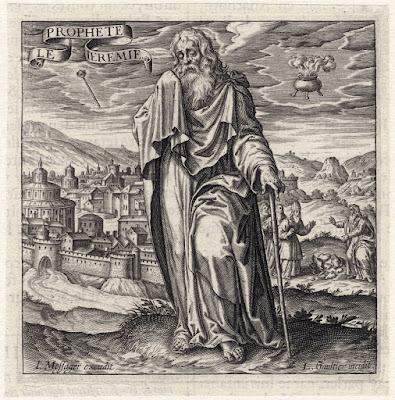
An engraving of the prophet Jeremiah by Léonard Gaultier (1561-1641)

Separated by a few millennia, we might see the folly with this magical type of thinking. Yet, it is just as easy for us to slip into the same mentality. 

Whenever we Americans think that our nation is so great that no one will ever take us over; or when we sincerely believe that because we are a missionary-sending nation that God will protect us; or when we buy into the notion that we can live however we want, but God would never judge us!; after all, we aren’t as bad as other nations!; well, then, we have come under the same condemnation as the Jews of old, we need to hear God’s Word for us today.

Jeremiah’s message was uncompromising. He clearly let the people know that while they have been living their hedonistic lives, God has been trying to talk them. But the people refused to listen. The prophet insisted that having the temple in the city is not some inoculation from keeping enemies at bay.

The prophet Jeremiah asserted that the people must change their ways, start living right, and be fair and honest with each other. They need to stop taking advantage of foreigners, orphans, and widows. They cannot kill innocent people and worship other gods, then turn around and invoke the temple as God’s presence and sanction on their security.

Justice is the responsibility of everyone; there are no favorites with God. The Lord does not favor particular people, ethnicities, or nations above others. Because one is an American, or not, makes no difference. Race and gender don’t come into view.

The sovereign God will hold all people culpable for their violent speech and behavior, no matter who they are or where they are from. Oppression, injustice, and spiritual gerrymandering will be dealt with by Judge Jesus, for both Jew and Gentile, man and woman, Westerner and Easterner, young and old.

For whom God has given much, much will be required. The Lord holds all people accountable for their actions.

Holy God, you still speak today through your Holy Word. Help me to listen well and pay attention to what you are saying so that I might honor you through humility and obedience for the sake of Jesus. Amen.

Acts 17:1-9 – Beware of Jealousy

When Paul and his companions had passed through Amphipolis and Apollonia, they came to Thessalonica, where there was a Jewish synagogue. As was his custom, Paul went into the synagogue, and on three Sabbath days he reasoned with them from the Scriptures, explaining and proving that the Messiah had to suffer and rise from the dead. “This Jesus I am proclaiming to you is the Messiah,” he said. Some of the Jews were persuaded and joined Paul and Silas, as did a large number of God-fearing Greeks and quite a few prominent women.

But other Jews were jealous; so, they rounded up some bad characters from the marketplace, formed a mob and started a riot in the city. They rushed to Jason’s house in search of Paul and Silas in order to bring them out to the crowd. But when they did not find them, they dragged Jason and some other believers before the city officials, shouting: “These men who have caused trouble all over the world have now come here, and Jason has welcomed them into his house. They are all defying Caesar’s decrees, saying that there is another king, one called Jesus.” When they heard this, the crowd and the city officials were thrown into turmoil. Then they made Jason and the others post bond and let them go. (New International Version)

Inevitably, whenever someone makes a splash and does something which receives a great deal of attention and/or kudos, there’s somebody else grumping in the background with jealousy.

A jealous person is a dangerous person. They seek to topple the object of their jealousy so that attention can be diverted on them.

It is an insidious game which the jealous play. Often, gaslighting is their major tool of choice – to spin circumstances in such a way that others will accept the jealous person’s view of events.

There is a difference between persuasion and gaslighting

Paul sought to persuade people that Jesus is the Messiah by understanding his audience, connecting their spiritual values with his, demonstrating competence and compassion, being clear and concise, and exemplifying a genuine spirit of integrity. Paul painted a compelling picture which was winsome and benefited the people.

Whereas his fellow Jews observed Paul’s success at persuasion and chose to gaslight the crowd by telling outright lies, playing on people’s fears, questioning motives, creating doubt, and withholding information. It is an emotionally abusive form of speaking which paints an awful picture of what will happen if the other person (Paul) has his way.

Paul had the people’s (and God’s) best interests at heart…

…the other Jews were looking out for themselves and had their own interests in mind.

Jealous persons often try to use gaslighting techniques to get their way. It’s what Satan tried to do with God, more than once.

We live in an age of envy

Jealousy is rife in our world, especially in the envy-laced West. Westerners have job-envy, food-envy, body-envy, house-envy, and a hundred other jealousies, mostly fueled by capitalist marketers who are, either knowingly or unknowingly, economic gaslighters – picturing for us a world of things we supposedly need.

And social media ups the ante by allowing millions of people to put forth a reality of themselves to others which isn’t real, at all – which ends up fomenting jealousy in others who believe they deserve this picture, as well.

If this all sounds weird and convoluted, well, it is. But that’s what jealousy does. It twists things to such a degree that we don’t even know what’s real anymore.

Jealousy survives and thrives through comparison – looking at another and deciding I need what they have. Then, unfortunately, the next logical step, for many, is to knock that other person down a few pegs so that I can get some of that attention and receive some of that stuff.

Jealousy and envy can take a very dark turn, at any time

Going beyond disparaging a person, there can be a malicious and underhanded bent to destroy what someone else has. Not just wanting it for yourself but wanting other people not to have it. This is a deep-seated resentment which breathes hatred and destruction. It’s the kind of jealousy the Jews had for Paul.

We all get jealous, at times; it’s part of the human condition. So, here’s a healthy way of dealing with it, instead of going dark and vengeful: Just as our hunger tells us we need to eat, the feeling of jealousy, if we will listen to it in the right way, can show us what is missing from our lives that really matters to us.

Acknowledging and naming the jealousy for what it is, then opens us to determine what my real need is, which perhaps, might not be getting met. We all have legitimate needs for love, belonging, and purpose. It’s just that we sometimes seek to meet those needs in illegitimate ways – like envy.

In a society where expressing needs may be looked upon as selfish or weak, many people opt to hustle for those needs through convincing a bunch of rabblerousers that another should get beat up and disparaged.

Let’s not do that… Let’s not start a riot.

It’s both okay and vital that we learn to ask for what we need and want – because the alternative isn’t going to end well.

Lord Jesus, fill us, your people, with charity, compassion, faith, gentleness, hope, humility, joy, kindness, light, love, mercy, modesty, patience, peace, purity, security, tranquility, trust, truth, understanding, and wisdom. Help us to walk in light and in truth, illuminated by the Holy Spirit so that together we may praise, honor, and glorify Our Father today and throughout all time. Amen.